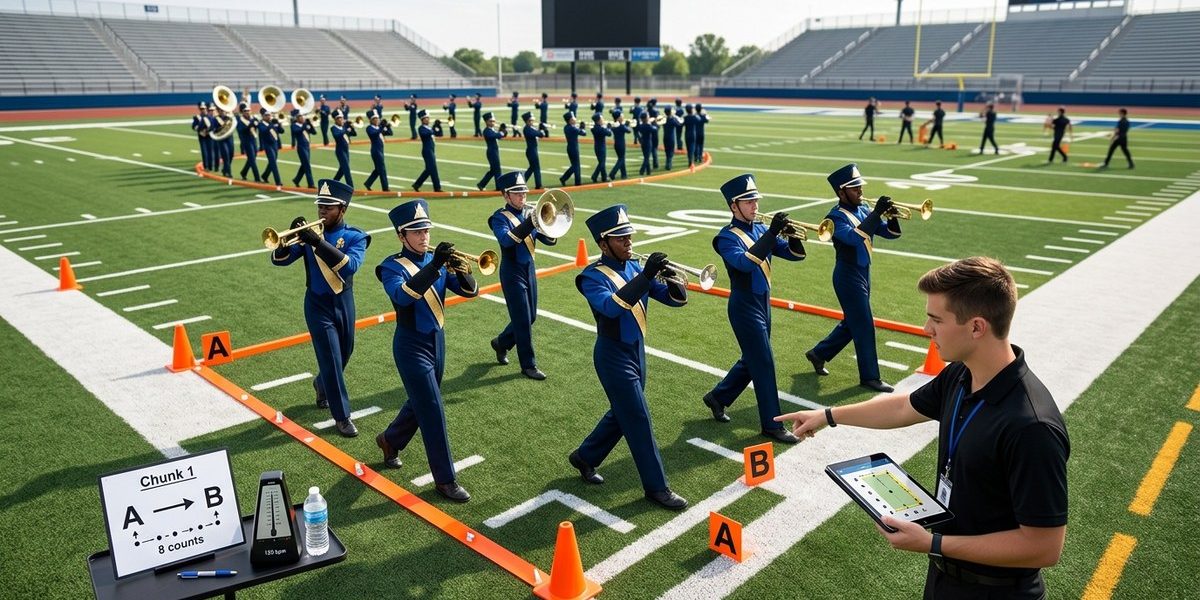
You are standing on a hot practice field, holding a folded sheet with 47 sets. Your brain feels full after the first ten. By set twenty you are guessing, not remembering. This is the moment most people hit a wall. But there is a smarter way. It is called the chunking method, and it uses the way your brain naturally organizes information. Instead of trying to hold every individual coordinate in your head, you group them into meaningful pieces. Think of it like learning a song: you do not memorize every single note; you learn phrases. The same principle works for drill sets, music runs, or even a tough coding sequence. In this guide we will show you exactly how chunking works and how to use it to cut your memorization time in half.
The chunking method works because our working memory can only hold about seven pieces of information at once. By grouping individual steps into larger, meaningful chunks, you reduce the load on your brain and speed up recall. For drum corps members, this means learning drill sets, music passages, and visual moves without burning out. Start by breaking your show into logical sections, name each chunk, practice them one at a time, then link them together. Within a few runs you will feel the difference.
What Is the Chunking Method?
The chunking method is a learning strategy where you take a long sequence of information and break it into smaller, more manageable units. Psychologists have known about it since the 1950s. A famous study showed that people could remember a string of 20 random letters if they grouped them into familiar chunks like FBI, CIA, and NBA. Without chunking, most people can only hold around seven items in short term memory.
In drum corps, a drill set might contain 80 or 100 individual step positions. If you try to memorize each coordinate as a separate fact, your brain will quickly overload. But if you group those positions into shapes, transitions, or phrases, everything becomes easier. The chunking method is not about skipping details. It is about organizing them so your brain can store and retrieve them faster.
Why Chunking Works So Well for Physical Movement
Your brain loves patterns. When you practice a chunk repeatedly, your neurons start firing together in a sequence. That creates a neural pathway that becomes more automatic with each repetition. This is why a trained marcher can run through a complex series of slides and pivots without thinking about each foot placement. The entire movement has become one chunk.
Another reason chunking works is that it reduces the number of decisions you have to make. Instead of deciding “left foot, right foot, turn, dip” you think “execute the slide chunk.” That frees up mental energy for listening to tempo, breathing, and blending with the ensemble. This is especially valuable during high stress moments like a final run at championships.
A 2026 study from the Journal of Cognitive Enhancement found that musicians who chunked their practice sessions improved retention by 43% compared to those who drilled linearly. The effect was even stronger for motor tasks like marching or playing an instrument.
How to Apply the Chunking Method to Your Drill Sets
Here is a step by step process you can start using today. It works whether you are learning a new show, cleaning a section, or teaching drill to a rookie.
-
Identify natural groupings. Look at your drill sheet or video. Find places where the movement flows together: a straight slide, a diagonal push, a circular rotation. Each of these is a chunk. Avoid making chunks too large; three to five steps per chunk is ideal.
-
Give each chunk a name. Naming helps your brain file the information. Use simple labels like “Slide to side,” “Tilt and hold,” or “Backward roll.” If you are working with a group, agree on the names so everyone is on the same page.
-
Practice one chunk at a time. Isolate that movement. Walk through it slowly without your instrument. Focus on the feel of the steps and the spacing. Repeat until you can do it without looking at the sheet. Aim for three smooth repetitions in a row.
-
Link chunks together. Once you have two chunks solid, connect them. Practice the transition between them. This is where many people trip up, so go slow. Use a metronome to keep your timing steady. You can find guidance on using a metronome to perfect brass timing in a separate article.
-
Add speed and context. After the sequence feels smooth at half tempo, gradually increase to performance tempo. Then run the linked chunks inside the full show context. This step builds automaticity.
You can apply the same method to music. Instead of memorizing every measure, chunk phrases by harmonic function or rhythmic pattern. For brass players, this pairs well with 5 daily warm-up exercises that transform brass tone quality.
Common Mistakes When Using the Chunking Method
Even good strategies can backfire if you use them incorrectly. The table below shows three frequent errors and how to fix them.
| Mistake | Why It Hurts | Fix |
|---|---|---|
| Making chunks too large | Your brain treats a huge chunk as many separate items, defeating the purpose. | Keep each chunk to 3-5 elements. If it feels too complex, split it again. |
| Skipping the naming step | Without a label, your brain has no file folder for the chunk and it stays disconnected. | Give each chunk a short, descriptive name. Say it out loud while practicing. |
| Rushing the linking phase | The transition between chunks is where mistakes happen; rushing builds bad habits. | Spend at least 30% of your practice time on linking two chunks together slowly. |
Advice from the Field
I spoke with a visual caption head who has taught drill to multiple finalist corps over the past decade. Here is what he told me:
“The biggest problem I see with new members is that they try to memorize every hash mark and yard line. That approach works for the first ten sets, then everything blurs. I tell them to treat each page of drill like a sentence. You would not try to say a sentence by sounding out each letter. You group the letters into words, then say the whole sentence. Chunking is exactly that. When you name a chunk, you are creating a word. When you link chunks, you are forming a sentence. Suddenly the whole show feels a lot smaller.”
That advice applies to any level. Whether you are a first year rookie or a seasoned vet, chunking helps you move from confusion to confidence.
A Practical Example: Learning a 16-Count Sequence
Imagine you have a 16 count drill sequence that moves from the left sideline to the middle of the field. Here is how chunking breaks it down:
- Chunk 1: Counts 1-4, slide to the right eight steps.
- Chunk 2: Counts 5-8, pivot and move diagonally forward.
- Chunk 3: Counts 9-12, mark time while facing the back hash.
- Chunk 4: Counts 13-16, slide left into final set.
Practice each chunk until it feels automatic. Then link chunk 1 to chunk 2, then chunks 1-2 to chunk 3, and finally all four. You will have the whole 16 count sequence down in a fraction of the time it would take to run the full set over and over.
This same logic works for any segment of your show. You can also apply it to visual technique. For example, if you are working on the complete guide to mastering 8-to-5 vs 6-to-5 marching styles, chunk each step size separately before blending them.
Building a Mental Practice Routine with Chunks
You do not need a field to practice your chunks. Mental rehearsal is a powerful tool that top performers use regularly. Close your eyes and walk through each chunk in your mind. See the yard lines, feel the weight shift, hear the music. Studies show that mental practice activates many of the same neural pathways as physical practice.
Try this: after you have learned a chunk physically, spend two minutes visualizing it. Repeat the visualization three times. You will notice the physical run feels smoother the next day. For more on this, check out the 10-minute mental practice routine that top corps members swear by.
How to Make Chunking a Habit
Like any skill, chunking gets better with use. Start small. Pick one section of your drill and apply the five step process today. Tomorrow, do the same for a music passage. Within a week you will automatically start chunking new material without thinking about it.
Remember that the goal is not to learn everything at once. It is to learn each chunk so well that it becomes one single unit in your brain. When you step onto the field, you will trust your body to execute the chunk without your conscious mind needing to supervise every step.
The chunking method is not a shortcut. It is a smarter way to use the memory capacity you already have. For musicians and athletes who need to perform under pressure, that is a game changer.
So the next time you open a drill packet, do not try to swallow it whole. Break it into pieces. Name them. Practice them. Link them. And watch your learning time drop.