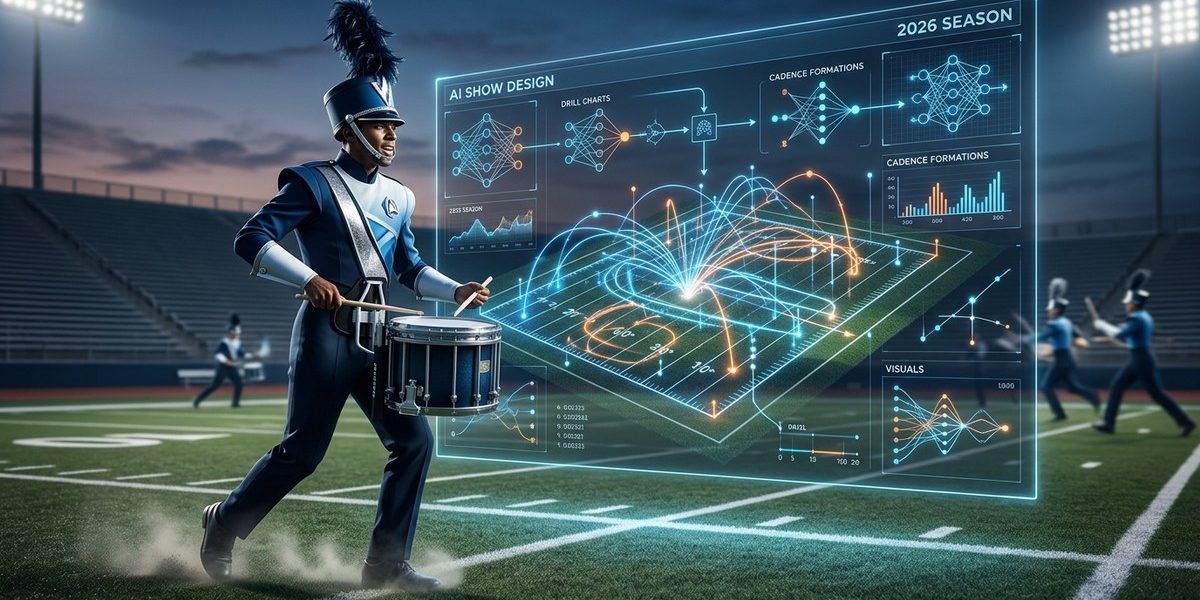
The first time a drum corps design team fed a raw musical sketch into an AI tool and watched it generate a full drill sequence, the room went silent. Not because the technology was scary. Because it worked. That moment is happening more and more often in 2026. Design teams across the activity are weaving artificial intelligence into their creative process, not to replace human artistry, but to speed up the tedious parts and unlock possibilities they never had time to explore before.
AI is not replacing show designers. It is handling time-consuming tasks like initial drill generation, audio analysis, and visual prototyping so humans can focus on nuance, emotion, and storytelling. The best 2026 shows will be co-created by people and machines working together, with the artistic vision always staying in human hands.
How AI Is Changing the Design Room
Drum corps show design used to mean months of manual work. Designers would sketch drill charts by hand, listen to audio mockups on loop, and spend entire weekends adjusting single transitions. That workflow is still valuable, but AI is now handling the heavy lifting for the early stages.
Here is how the process looks in 2026:
- Concept and audio input. The design team creates a musical sketch or picks a licensed arrangement. They upload the audio file into an AI tool that analyzes tempo, dynamics, key changes, and phrase structure. The tool then suggests orchestration layers and identifies moments that could use visual emphasis.
- Generative drill prototyping. Using the audio analysis as a guide, AI software generates several drill options. Each option maps performer movements to the music’s emotional arc. Designers can pick one, combine elements from multiple versions, or ask the AI to refine a specific section.
- Visual simulation and iteration. The chosen drill gets loaded into a 3D simulation environment. Designers can watch the show from any angle, adjust spacing, and test how the drill looks from the press box. They can also simulate different uniform colors and prop placements.
- Human polish and final decisions. The AI output serves as a starting point. Human designers then tweak every moment for artistic intent. They add subtle visual phrasing, adjust performer pathways for storytelling, and ensure the show feels alive rather than robotic.
What AI Does Best (And What It Should Not Touch)
Not every part of show design benefits from a machine’s touch. The smartest teams in 2026 are using AI for specific tasks while keeping the soul of the show firmly in human hands.
| Task | AI Strength | Human Role |
|---|---|---|
| Initial drill generation | Produces dozens of options in minutes | Selects, combines, and refines for narrative |
| Audio analysis | Maps tempo, dynamics, and phrasing | Interprets emotional intent and musical nuance |
| 3D visual simulation | Shows any angle, tests lighting, checks spacing | Evaluates artistic impact and audience experience |
| Prop and staging layout | Suggests efficient placements | Ensures props serve the story, not just the score |
| Uniform and color testing | Renders hundreds of color combinations | Chooses palettes that reinforce the show’s theme |
The table above shows a clear pattern. AI handles the math, the repetition, and the brute force exploration. Humans handle the feeling, the context, and the final call.
“We used to spend three weeks just getting a drill to a place where we could start making artistic decisions. Now we spend three days. That gives us weeks of extra time to focus on what actually matters: the emotional journey of the audience.” – Design consultant for a top-12 World Class corps
Common Mistakes Design Teams Make With AI
Jumping into AI without a clear plan can backfire. Here are the pitfalls that have already surfaced in the 2026 design season.
- Letting AI choose the music. AI can suggest arrangements based on trends, but it cannot feel why a particular piece of music connects with a specific audience. The repertoire decision must stay with humans.
- Using AI output without editing. A raw AI drill is functional but often lacks nuance. It may place performers in perfect geometric patterns that look sterile. Human designers need to add organic movement and personality.
- Skipping the audio analysis step. Some teams rush straight to visual generation without letting AI analyze the music first. That leads to drill that looks good in a vacuum but does not match the musical phrasing.
- Over-relying on simulation. A show can look perfect in a 3D render and fall apart on an actual football field. Designers must still run full ensemble rehearsals and adjust based on real-world conditions.
- Ignoring the performers. AI tools can suggest demanding drill moves that look spectacular but exhaust the performers before the ballad. Human designers must balance visual impact with physical sustainability.
The Three Steps to Start Using AI in Your Design Process
If you are a show designer or educator curious about bringing AI into your workflow, start small. You do not need a full tech stack to see benefits.
Step one: Use audio analysis tools. Upload a recording of your planned repertoire into an AI audio analyzer. Look at the waveform and dynamic map it produces. Notice where the loudest moments land and where the quietest breaths occur. Use that data to inform where your drill should open up and where it should compress.
Step two: Generate multiple drill options. Use a generative drill tool to create three or four versions of your first movement. Do not try to use any of them as a final product. Instead, look for one interesting transition or one unique form in each version. Steal those ideas and combine them into something new.
Step three: Simulate before you rehearse. Load your refined drill into a 3D viewer. Watch it from the press box angle. Check for collisions. Adjust spacing. Then take that simulation to your first rehearsal and see how it feels with real people moving at real tempos.
For more on building efficient practice habits that complement a modern design workflow, check out our guide on how to build a perfect 30-minute individual practice routine.
What the 2026 Season Will Look Like Because of AI
The shows hitting the field this summer will feel different. Not because they were designed by machines, but because the humans behind them had more time to think.
Designers are spending their extra weeks on subtle details. They are refining the emotional arc of the ballad. They are adding visual callbacks that reward repeat viewings. They are crafting transitions that feel seamless rather than functional. The AI handles the scaffolding. The humans hang the art.
You will also see more risk taking. When a design team knows they can generate and test a wild idea in an afternoon instead of a week, they are more likely to try it. That means more unexpected moments, more creative staging, and more shows that challenge what drum corps can be.
For a look at how the broader season is shaping up, read about how the 2026 season is reshaping drum corps repertoire choices.
Keeping the Human Element Front and Center
The most important thing to remember about AI in drum corps show design is that it is a tool, not a collaborator. It does not have taste. It does not understand why a crowd cheers when a brass line hits a perfectly voiced chord after a long silence. It cannot feel the weight of a show about loss or the joy of a show about celebration.
That is all you.
Use AI to do the work that slows you down. Use it to test ideas you would not have time to try otherwise. But never hand over the pencil completely. The best shows of 2026 will be the ones where the technology is invisible, where the audience feels the emotion without ever wondering how the drill got there.
If you are a performer wondering how these design changes affect your role on the field, consider reading about what judges actually look for during visual ensemble scoring. The criteria are evolving as the shows become more complex.
How You Can Apply This to Your Own Ensemble
You do not need to be a World Class design team to benefit from AI. High school bands, indoor percussion groups, and college marching bands can all use the same principles on a smaller scale.
Start with one movement of your show. Upload the audio to a free AI analysis tool. Look at where the energy peaks. Then sketch a drill that mirrors that energy. Even if you draw it by hand, the analysis will guide your decisions.
If you have access to a 3D simulation tool, use it to check your work before you teach it. You will catch spacing issues and collision problems before they waste rehearsal time.
And if you are a student who wants to get into show design someday, start learning these tools now. The designers who understand both the technology and the tradition will be the ones shaping the activity for the next decade.
For more on building your skills as a performer and future designer, read about effective practice routines to elevate your drum corps performance.
The New Design Room
The design room of 2026 looks different than it did even two years ago. There are still whiteboards covered in sketches, speakers playing reference tracks on loop, and designers arguing about whether a transition should happen on beat four or beat one. But now there is also a laptop running generative software, a 3D render spinning on a second monitor, and a shared folder full of AI-generated options waiting to be shaped into something beautiful.
That is the future of show design. More options. More time. More room for the human touch that makes drum corps special.
Go build something that moves people. The AI will handle the rest.