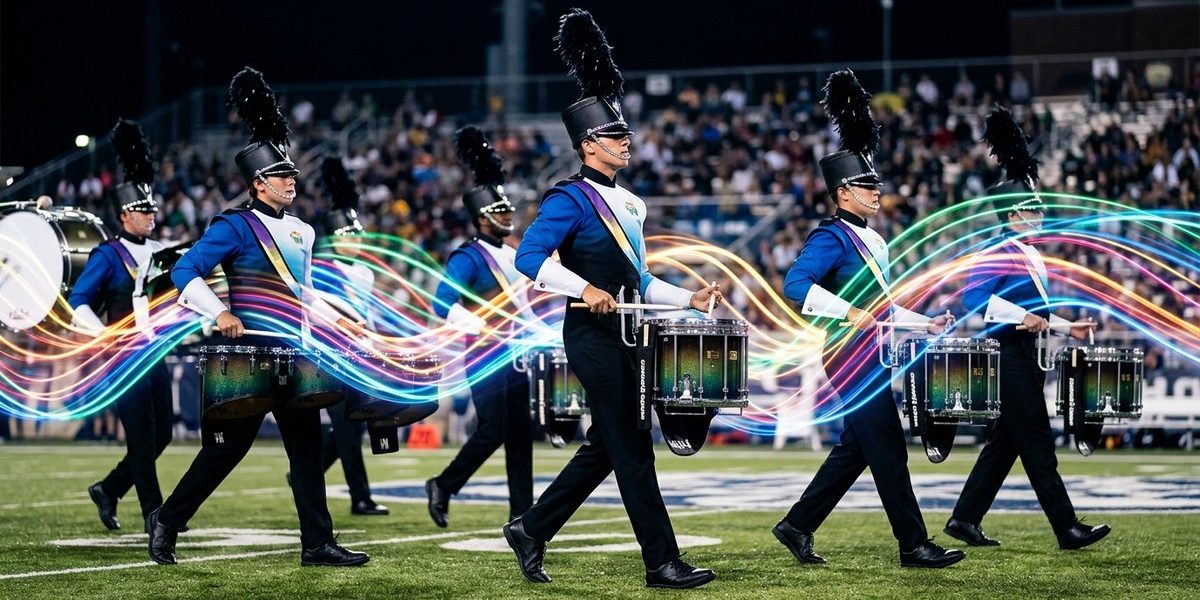
You watch the opening hit of Carolina Crown Wavelength 2026 and something clicks. The brass line isn’t just playing a chord. They are shaping light. The mellophones bend their sound into a curve that the guard catches with a silk toss. The drumline’s rim shots hit exactly when the color guard’s flags snap open. It feels like the music is painting the air in front of you. That is the magic of this show. Crown took their signature brass sound and found a way to make you see every note.
Carolina Crown Wavelength 2026 redefines how drum corps connects music and movement. By syncing pitch, dynamic, and articulation with specific visual cues, the corps creates a show where every sound has a visible counterpart. This article breaks down the design philosophy, the choreography techniques, and the rehearsal methods that make this production a masterclass in audio-visual storytelling.
The Core Idea Behind Wavelength
Crown’s design team started with a simple question. What if the audience could see the shape of a sound? In physics, wavelength describes the distance between peaks of a wave. In this show, it describes the distance between a musical phrase and its visual echo. The entire production is built on the idea that every musical gesture should have a matching visual gesture.
The show opens with a low, sustained tone from the contrabasses. As the pitch rises, the corps rises from the ground. The higher the note, the taller the performers stand. When the brass hits a sharp staccato accent, the guard snaps their heads to the side. The sound hits you, and the visual hits you at the same moment.
This is not just clever staging. It is a fundamental shift in how drum corps thinks about design. Instead of layering music and visuals separately, Crown wove them into a single thread. The result feels seamless. You do not watch the show and listen to the show. You experience the show as one thing.
How Sound Becomes Shape on the Field
The design team used three main techniques to turn sound into a visual spectacle. Each technique works differently, but they all serve the same goal.
1. Pitch Mapping
Every note in the brass book has a corresponding height or direction. Low notes send performers low to the ground or backward. High notes lift them up or push them forward. The mellophone solo in the ballad climbs a full octave, and the soloist rises from a kneel to a full stretch. The audience sees the melody climb as much as they hear it.
2. Dynamic Color Matching
Loud passages use wide, open body shapes and large flag movements. Soft passages use closed, tight shapes and small hand gestures. The percussion feature in the middle of the show starts with a whisper. The drumline plays with their sticks barely off the heads. The guard matches this with tiny, controlled rotations. When the volume explodes, the guard throws flags high and the corps opens their arms wide. The dynamic range of the music becomes the dynamic range of the movement.
3. Articulation Mirroring
Short, separated notes get short, separated movements. Long, connected phrases get flowing, sustained motion. The brass runs in the closer are fast and aggressive. The drill matches that speed with rapid direction changes. When the music holds a long note, the corps holds a pose. The articulation of the sound dictates the articulation of the body.
Here is a table that breaks down these techniques and common mistakes groups make when trying to copy them.
| Technique | How It Works | Common Mistake | Correct Approach |
|---|---|---|---|
| Pitch Mapping | Low notes = low body position, high notes = high body position | Moving too late after the pitch changes | Anticipate the pitch change by one beat so the visual lands with the sound |
| Dynamic Color Matching | Loud = wide and open, soft = tight and small | Overdoing the soft movements so they become invisible | Keep small movements precise and intentional, not lazy |
| Articulation Mirroring | Staccato = sharp, legato = smooth | Making all movements the same shape regardless of articulation | Practice each phrase with a metronome and mark every articulation change in your drill book |
“The best shows make you forget you are watching a marching band. You are watching a story told in sound and motion. Wavelength is the closest we have ever come to making the audience hear with their eyes.” — Crown design team member, spring training 2026.
Building the Visual Vocabulary
The guard and brass sections spent the first two weeks of spring training building a shared visual vocabulary. They did not touch their instruments or flags for the first three days. Instead, they moved together in silence. The goal was to create a common language of shapes and gestures that everyone in the corps could use.
They practiced five basic shapes. A circle meant sustain. A sharp angle meant accent. A wave meant crescendo. A drop meant decrescendo. A freeze meant cut off. Every performer learned these shapes until they were automatic. When the music was added later, the performers already knew what their bodies should do.
This approach saved hours of rehearsal time. Instead of teaching drill and music separately, the staff could focus on blending them. The performers did not have to think about what to do. Their bodies already knew. They just had to match the shape to the sound.
If you are a music educator or a marching arts enthusiast, this is a lesson you can use in your own group. Teach your students a visual vocabulary before you teach the show. It makes everything else easier.
A Practical Process for Your Own Group
You do not need a million-dollar budget to use these ideas. Here is a process you can adapt for your own ensemble.
- Choose one musical phrase from your show. Pick something short, maybe eight measures. It should have clear changes in pitch, dynamic, or articulation.
- Map the phrase. Write down every note and mark its pitch direction (up or down), its dynamic (loud or soft), and its articulation (short or long).
- Create three simple movements. One for pitch, one for dynamic, one for articulation. Keep them simple. A rise, a stretch, a snap. Do not overcomplicate it.
- Practice the movements without sound. Do this until every performer can do them in their sleep.
- Add the music. Play the phrase while performing the movements. Adjust timing until the sound and the visual hit at the same moment.
- Repeat with new phrases. Build your visual vocabulary one phrase at a time.
This method works for high school marching bands, college groups, and even indoor percussion ensembles. It is the same process Crown used, just scaled down.
What the Audience Sees and Hears
When you watch Wavelength live, the effect is almost hypnotic. The brass line plays a rising scale, and the entire corps rises with it. The sound swells, and the flags open wide. The percussion hits a rim shot, and the guard snaps their heads. You do not have to analyze it to feel it. Your brain automatically connects the sound to the movement.
The ballad is the best example. The soloist plays a long, floating melody. The corps moves in slow motion, almost like they are underwater. The guard uses silk flags that ripple like water. The sound is smooth, and the visual is smooth. Then the music turns aggressive. The tempo jumps. The drill breaks into sharp lines. The flags change to bright, cutting colors. The contrast is jarring in the best way.
This is what Crown does better than almost anyone. They understand that contrast makes moments memorable. If everything is loud and fast, nothing stands out. By saving the big visual moments for the big musical moments, they make every peak hit harder.
Why This Matters for the Future of Drum Corps
Crown Wavelength 2026 is not just a great show. It is a statement. It says that drum corps can be more than music and marching. It can be a complete sensory experience. Other corps will study this show for years. They will borrow the techniques and adapt them to their own styles.
For fans, this show is a reminder of why we love this activity. It pushes boundaries. It takes risks. It tries something new and makes it work. For educators, it is a blueprint. You can take these ideas back to your own program and use them tomorrow. You do not need a world-class design team. You just need a willingness to think differently.
If you want to understand how Crown built this show, start with the fundamentals. Work on your own 5 essential breathing exercises every brass player should master to build the control you need for long, sustained phrases. Then look at how to build a perfect 30-minute individual practice routine to integrate visual and musical practice into your daily work.
What Wavelength Teaches Us About Performance
The real lesson of Wavelength is simple. Sound and movement are not separate. They are two sides of the same thing. When you play a note, your body should show it. When you move, your sound should match. The best performers in the world do not think about this. They feel it.
Crown trained their performers to stop thinking and start feeling. They built a vocabulary so deep that the performers did not have to decide what to do. They just responded to the music. That is the goal for every performer, whether you are marching at Lucas Oil Stadium or practicing in your high school parking lot.
The next time you rehearse, try this. Pick one phrase and close your eyes. Listen to the shape of the music. Where does it rise? Where does it fall? Where does it hit hard? Then open your eyes and move with it. Do not plan the movement. Just let the sound guide you. That is what Wavelength is all about.
Taking the Field With a New Perspective
Carolina Crown Wavelength 2026 will be remembered as a turning point. It showed that drum corps can be a true fusion of sound and sight. It proved that the best design does not separate the two. It weaves them together until they become one thing.
Whether you are a fan watching from the stands, a student dreaming of marching, or a teacher planning next year’s show, take this with you. The sound you make has a shape. The movement you make has a sound. Trust that connection. Let it guide your performance. That is how you turn a good show into an unforgettable one.