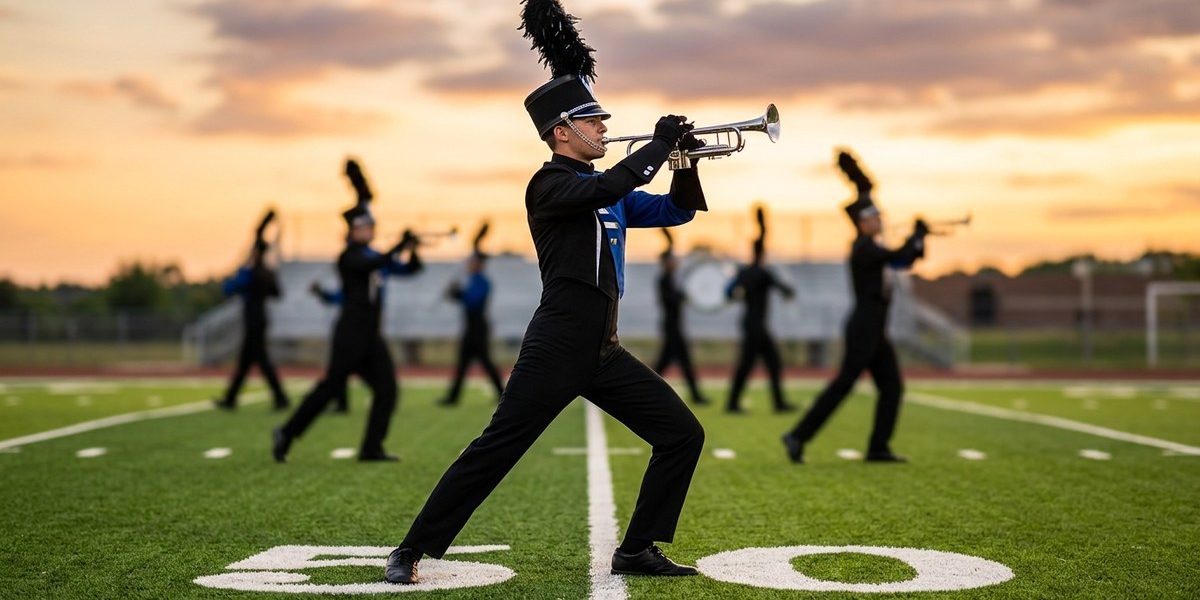
Every marching season, performers spend hours on foot technique and body posture. But one piece of the visual puzzle often gets less attention than it deserves: instrument profile. You can have the best slide step in the world, but if your horn or drum is tilted wrong, the entire visual line breaks. There is one marching band visual drill that fixes this faster than anything else. It is simple, repeatable, and used by top drum corps across the country. Here is exactly how it works and why it will change your marching.
The Static Profile Drill isolates your instrument carriage from your lower body movement. You hold a perfect playing position while marching forward, backward, and laterally. This builds muscle memory so your horn angle never wavers during a show. Used consistently, it eliminates the common “dropped bell” and “floating elbow” problems that judges notice immediately. In under two weeks of daily work, you will see a measurable improvement in your visual score and overall uniformity with your section.
Why This Drill Changes Everything about Your Visual Line
Most visual problems start with a simple disconnect. Your brain tells your feet to move, and your instrument follows along as an afterthought. The result is a bell that dips when you step, a horn that drifts left when you breathe, or a drum that tilts forward as you fatigue. Judges look for consistent instrument angles across the entire ensemble. A single person with a messy profile pulls the whole group down.
The Static Profile Drill forces you to maintain a fixed instrument position regardless of what your lower body is doing. It trains your core, shoulders, and arms to hold the perfect shape even during demanding movement. Once that shape becomes automatic, you can focus on musical expression without worrying about your carriage.
How to Execute the Static Profile Drill
Find a wall or a straight line on the practice field. You will also want a mirror or a partner for feedback. Follow these steps in order.
-
Set your instrument to its show position. Stand at attention. Bring the instrument up exactly as you would for playing: mouthpiece at the correct height, bell angle matching your section’s standard, elbows in a natural relaxed line. Do not adjust for comfort. Adjust for precision.
-
Freeze and check your profile. Turn your head (without moving your shoulders) to see your reflection or ask your partner to check. Your horn should be parallel to the ground or at the specific angle your caption head demands. Your shoulders should be square, not rolled forward. Your chin should be level.
-
March forward eight counts at a moderate tempo. Take eight steps forward using the marching style your band uses (8-to-5 or 6-to-5). Keep your upper body completely still. Do not let the instrument bounce, tilt, or shift. Focus on keeping the bell angle identical to your frozen check.
-
Stop and check again. After the eight counts, stop in a controlled position. Look at your reflection or get feedback. Note any change in angle. If the bell dropped half an inch, that is your target to fix.
-
Repeat in all directions. March backward eight counts. Then march sideways (crab step) eight counts in each direction. Then march a diagonal path. Each time, check your form after stopping.
-
Add music. Once you can hold the profile through movement, start playing a simple long tone while marching. Your instrument angle must stay steady through the breath support changes.
Common Mistakes and How to Fix Them
Even with the best intentions, certain errors creep in. The table below shows the most frequent problems and their corrections.
| Mistake | What It Looks Like | How to Correct It |
|---|---|---|
| Dropping the bell on the first step | The front of the horn dips as you lift your foot | Engage your core before moving; brace your abs as if preparing for a light punch |
| Elbow drift | One elbow moves away from your body during sideways movement | Tape a small foam block under your arm during practice to remind you to keep it close |
| Chin lift when breathing | Your head tilts up as you inhale, changing the horn angle | Practice breathing while looking straight ahead; use a metronome to time breaths |
| Shoulder roll forward after fatigue | Your shoulders slump forward, rotating the instrument down | Do 10 shoulder retractions before each drill repetition to reset your posture |
“The first time I ran the Static Profile Drill with my section, I saw three different horn angles in the first eight counts. Within a week of consistent practice, the entire line looked identical from the sideline. That is the power of isolating one variable at a time.” — Visual caption head for a top-12 DCI corps
Integrating the Drill into Your Practice Routine
You do not need a full field or a long rehearsal to make progress. Add the Static Profile Drill to your warmup or your individual practice time. Here are a few ways to get the most out of it.
- Start with 10 minutes per day. Focus only on forward and backward marching first. Add lateral and diagonal once you feel stable.
- Use a video recording. Film yourself from the front and the side. Watch the playback in slow motion to see tiny shifts you miss in real time.
- Pair up with a section mate. Check each other’s profile every four counts and call out corrections. This builds trust and sharpens your eye for detail.
- Combine with breath support exercises. If you are a brass player, try our 5 Essential Breathing Exercises Every Brass Player Should Master to keep your air steady while holding the profile.
- Set a weekly goal. For example, on Monday aim for no more than a half-inch drift in forward marching. By Friday, try zero drift.
When to Push Harder and When to Step Back
Progress is not always linear. Some days your profile will feel rock solid. Other days your body will be tired from rehearsal and the bell will wobble. That is normal. On high-fatigue days, drop the marching and do the drill standing still. Just set your instrument, hold it, and breathe. You are still building muscle memory.
If you find yourself struggling with a specific direction, like backward marching, spend extra time there. Many performers discover that their instrument angle changes drastically when they move in reverse because they cannot see where they are going. Use a landmark on the field to keep your path straight and your profile steady.
For a broader look at how to practice visuals when you do not have access to a full field, read our guide: The Complete Guide to Practicing Visuals Without a Field. It covers several other isolated drills that complement the Static Profile Drill.
Making the Profile Automatic
The entire goal of this marching band visual drill is to move the responsibility of instrument carriage from conscious thought to automatic habit. When you are in the middle of a demanding musical passage or a complex drill move, your brain should not have to remind your arms to keep the horn straight. That reminder should be hardwired into your muscle memory.
The only way to get there is repetition with feedback. Do the Static Profile Drill every day for two weeks. Record your progress. Watch the first day and the fourteenth day side by side. You will see a transformation that goes beyond your instrument profile. Your entire marching style will look more confident because your upper body is no longer fighting your lower body.
How This Drill Prepares You for Ensemble Success
When you bring your improved profile into a full ensemble setting, you will notice something immediate. The visual lines will snap into place faster. Your drill sets will look cleaner because everyone is holding the same angle. Your section’s uniformity score will reflect the hours you put into this single drill.
Instructors love seeing performers take ownership of their individual visual responsibility. It shows maturity and attention to detail. And it frees up the caption head to focus on bigger picture items like spacing and timing instead of fixing the same bell angle problem every block.
If you are an instructor, run this drill with your entire section once per rehearsal. A synchronized group that does the drill together builds ensemble awareness. Each person can see how their profile relates to the person next to them. That visual feedback is priceless.
One Habit That Keeps Your Progress Permanent
It is easy to nail the Static Profile Drill for a week and then forget about it when show season gets busy. To keep the improvement permanent, revisit the drill every time you pick up your instrument. Spend the first thirty seconds of every rehearsal checking your profile against a mirror or a wall. That tiny habit prevents your old slouches from creeping back.
You can also challenge yourself during water breaks. While you are standing around, set your instrument in playing position for five seconds and see if you can hold it perfectly without thinking. Make it a game. Over time, your body will default to the correct shape.
The One Visual Drill That Transforms Your Instrument Profile
The marching band visual drill you just learned is not complicated. That is exactly why it works. It strips away all the noise and focuses on the single most overlooked element of visual performance: keeping your instrument exactly where it belongs while you move. Top drum corps use it because they know that a clean profile separates a good performance from a championship one.
Start today. Grab your instrument, find a line on the floor, and march eight counts with your bell locked in place. Do it again tomorrow. And the day after that. Before your next competition, you will feel the difference in your marching control. More importantly, the judges will see it too.