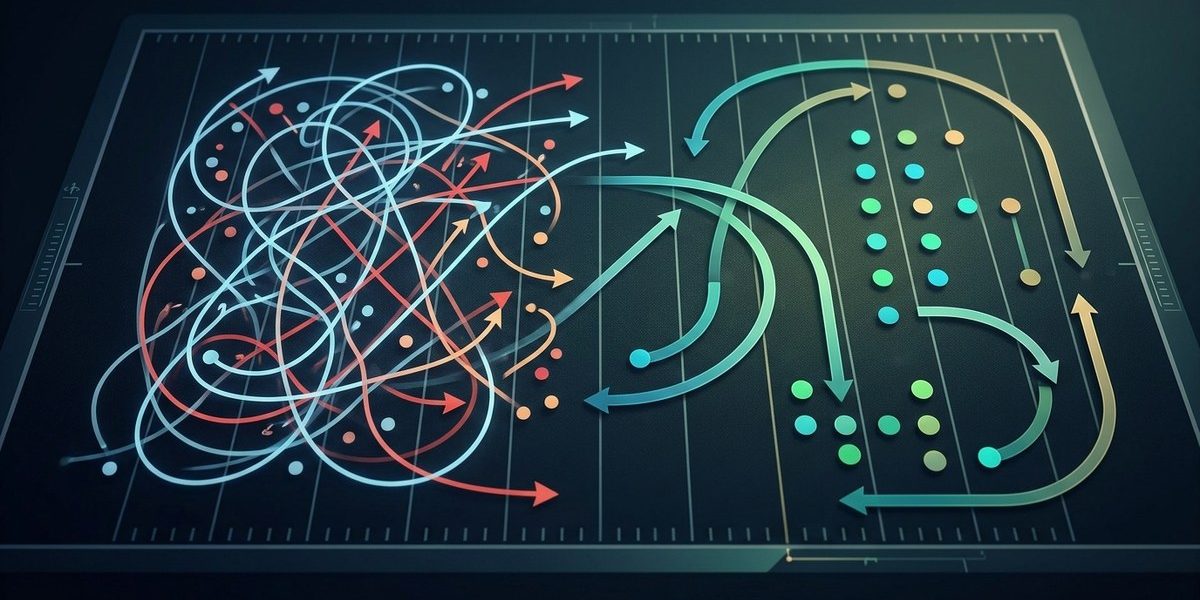
You stand on the sideline, staring at your drill chart. The page is covered in tiny numbers, arrows, and hash marks. Your set says you need to move from point A to point B, but by the time you factor in steps, tempo, and horn angles, your brain freezes. You are not alone. Most marchers hit this wall. The problem is not that you lack talent. The problem is that you are overthinking it. Let’s strip away the noise and give you a way to learn drill that actually works.
Learning drill does not require memorizing every coordinate at once. By breaking your path into small chunks, using visual landmarks, and counting steps in a steady rhythm, you can build muscle memory without the mental overload. This method helps you stay relaxed, hit your spots, and enjoy the process.
Why Your Brain Fights You During Drill
Drill design has grown more complex over the years. Modern drum corps shows layer curved forms, staggered diagonals, and rapid transitions. When you look at your set, your mind tries to process everything at once: the count, the step size, the direction, the instrument carriage, and the spacing relative to your neighbors. That is too many variables for your working memory.
Your brain prefers simple patterns. If you overload it, you freeze or make repeated mistakes. The solution is to reduce the number of things you think about at one time. Instead of trying to execute a perfect eight-to-five slide while worrying about your horn angle, focus on one element until it becomes automatic. Then layer in the next.
A good rule of thumb: if you can not describe your move in one short sentence, you are trying to hold too much in your head at once.
The Chunking Method: Three Steps to Any Set
Here is a numbered process that will help you learn any drill move faster, whether you are in the battery, the pit, or the brass line.
-
Identify your start and end point. Find two reference points on the field. For example, a yard line and a hash mark. Walk the path without thinking about counts. Just get a feel for the distance and direction. Do this three times.
-
Count your steps in a rhythm. Use a metronome at the show tempo. Walk the move while saying the counts out loud. If your move takes 16 counts from set one to set two, repeat that exact cadence until the number of steps feels locked in. Do not worry about spacing yet.
-
Add your spacing and visual responsibility. Once the step pattern is automatic, look for your nearest neighbor and adjust your interval. Practice the move with your instrument up, but keep your eyes on your reference point, not your feet. Trust the counts.
This approach works because it separates the spatial memory from the physical execution. You learn the map first, then the movement, then the polish.
Benefits of a Simplified Drill Approach
- Reduced anxiety during run-throughs
- Faster memorization of complex charts
- Fewer collisions and blown forms
- More mental energy for playing and showmanship
- Greater confidence in ensemble blocks
Common Mistakes and How to Fix Them
| Mistake | Why It Happens | The Fix |
|---|---|---|
| Watching your feet | You do not trust your spacing | Count steps out loud; look at a yard line 20 yards ahead |
| Overcorrecting mid-move | You panic if you drift a step | Commit to the path; adjust only at the arrival count |
| Forgetting counts when playing | Your brain prioritizes music over movement | Practice the move with a simple buzz or hum before adding full dynamics |
| Rushing tempo | You subconsciously speed up to reach the next set | Use a metronome; practice at 80% of show tempo first |
Listen to the Visual Techs
“The best marchers I have worked with are the ones who stop trying to think their way through the drill. They feel the counts, they see the space, and they trust their reps. If you are tensing up, you are probably overthinking. Let your body learn the shape.” — Mark Torres, visual caption head for a World Class corps
That advice holds true whether you are a rookie or a veteran. Overthinking creates tension in your shoulders, your grip, and your step. Tension kills timing and makes you look stiff. A relaxed body moves faster and more accurately.
Practice Without a Field
You do not need a full 80-yard grid to learn your drill. If you cannot get to a field, visualize the moves in your living room or parking lot. Mark the floor with tape for yard lines and hashes. Walk through the path at half tempo while repeating the counts. This builds the neural pathways without the pressure of a full rehearsal.
For more ideas on practicing away from the field, check out our guide on how to practice visuals without a field.
Mental Rehearsal Between Runs
Your brain learns almost as much from mental practice as from physical repetition. Between reps, close your eyes and walk through the set in your head. Picture the yard lines, feel the tempo, and hear the music. This strengthens the same motor circuits. Many top corps members use a short mental routine before each rep. You can read more in our article about the 10-minute mental practice routine that top corps members swear by.
Build a Stronger Foundation with Fundamentals
The simpler your approach to learning drill, the more you can focus on the fundamentals that matter most. Your posture, your foot technique, and your breathing all affect how clean your drill looks. If you are struggling with backward marching, for instance, that will throw off your entire feel for drill sets. Our guide on how to fix your backward marching can help you correct that weak spot.
Similarly, your upper body carriage plays a huge role in how judges see your drill. A locked shoulders or tilted horn can make a perfect move look messy. Spend a few minutes of each rehearsal on why your upper body carriage is sabotaging your visual score and how to correct it.
The Real Secret: Repetition Without Overanalysis
Some marchers think they need to understand every geometric detail of a form before they can execute it. That is backward. Your body learns through repetition, not analysis. Run the move ten times at a slow tempo. Then ten more at show tempo. Then add the music. Do not stop to fix every small deviation during the run. Just note it and adjust on the next rep.
If you find yourself making the same mistake over and over, pause and isolate that part. But do not fall into the trap of overcorrecting every step. Trust the process.
Stop Trying to Be Perfect on the First Run
Perfectionism is the enemy of progress. Your first few reps of a new drill set will be rough. That is normal. The goal is to build a rough shape, then refine it. If you demand perfection immediately, you will create tension and frustration. Give yourself permission to be messy for the first five runs. Then start cleaning.
Learn to Handle Tempo Changes
One of the biggest sources of overthinking is when the tempo changes mid-phrase. Your brain is already tracking counts, and suddenly the pulse shifts. The key is to separate the tempo change from the drill move. Practice the move at a steady tempo first, then add the change. For help with this, read how to stay in step when the tempo changes mid-phrase.
Trust Your Counts, Not Your Eyes
During a show, you cannot always see your dot. The lighting, the dust, or the angle of the sun may hide your reference points. That is why counting is your anchor. If you trust your steps, you will end up where you belong, even if your eyes tell you otherwise. This is especially true in diagonal moves and curved forms. Let your feet lead.
What to Do When You Plateau
Every marcher hits a point where drill feels stuck. You know the moves, but the execution feels sloppy. That plateau is often caused by a return to overthinking. You start analyzing your step size again, or you worry about your spacing mid-stride. The fix is to go back to the chunking method. Strip away everything except the counts and the destination. Run the move at half tempo with no horn. Let your body reset. Then gradually add the layers back.
A Final Word on Enjoying the Field
Drill is not a test of how much you can hold in your head. It is a dance. The best marchers look like they are flowing, not calculating. If you can let go of the need to control every micro-movement, you will find a new level of freedom. Your confidence will grow, your sound will open up, and you will actually have fun performing.
Keep Marching, Keep Learning
You have the tools now to stop overthinking your drill sets. The next time you step on the field, try the chunking method. Walk the path first. Count the steps. Add the spacing last. Before you know it, the forms will feel like home. If you want to build on this approach, check out our guide on how to build a perfect 30-minute individual practice routine that can complement your drill work. You have got this. Now go march.