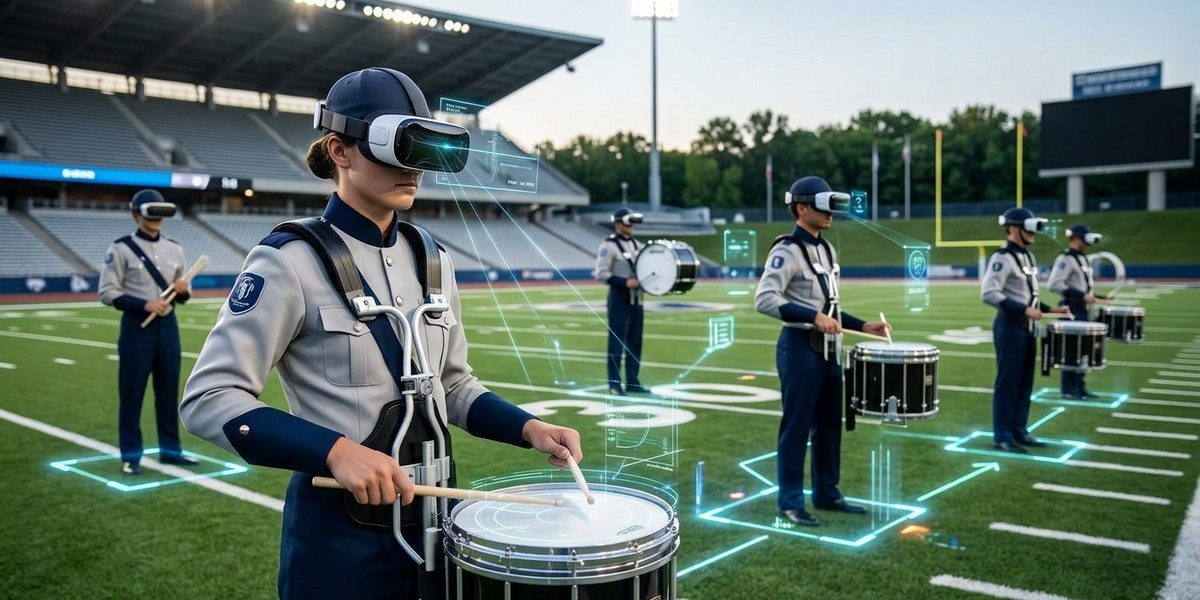
You used to have to wait for a parking lot, a rainy day, or a cramped gym to visualize your drill. You had to memorize coordinates from a sheet of paper and hope your muscle memory kicked in when the sun was blazing. In 2026, that is no longer the only way. Virtual reality has gone from a futuristic gimmick to a practical rehearsal tool for drum corps across the country. Members are now strapping on headsets to run drill in their dorm rooms. Caption heads are adjusting drill sets from a hotel lobby. And the whole activity is becoming more efficient, more accessible, and more fun.
Virtual reality is not replacing outdoor rehearsal. It is supplementing it. By putting members inside a 3D simulation of the field, drum corps can fix spacing issues, improve music memory, and reduce physical strain before they ever step onto the turf. In 2026, VR is becoming a standard part of the toolkit for top corps and individual players alike.
Why Traditional Rehearsal Needed an Upgrade
Think about the typical drum corps schedule. You wake up at 6:30 AM, eat breakfast, and head to the field for a block. The weather might cooperate. Or it might not. Rain, extreme heat, and lightning delays can eat into precious rehearsal time. Even when the weather is fine, there is the issue of space. Not every corps can afford a full-size artificial turf field. And during the winter months, indoor drill space is limited.
Even when you get on the field, the process of learning drill is repetitive. You look at a dot sheet. You walk to your coordinate. You look again. You adjust. The tech yells numbers. You write them in Sharpie on your hand. This method works, but it takes time. And it relies on the member’s ability to translate a 2D diagram into a 3D space.
Virtual reality solves many of these problems. It lets you walk through the drill in a realistic space without needing a field, good weather, or even a full ensemble. The technology has matured enough that the visuals are sharp, the tracking is accurate, and the latency is nearly zero.
How a VR Rehearsal Actually Works
If you have never tried a VR headset, the experience can feel surreal at first. But once you get used to it, the benefits become obvious. Here is a step-by-step look at what a typical VR rehearsal session looks like for a drum corps member in 2026.
-
Load the Drill Data. The corps’ drill designer exports the set coordinates from Pyware or a similar program. Those coordinates are imported into a VR application specifically built for marching arts. The software places virtual markers on the ground for each member.
-
Calibrate Your Position. You put on the headset and select your member number. The system places you at your starting dot. You can look around and see the entire field from your perspective. The yard lines, hash marks, and end zones are rendered accurately.
-
Run the Set. A metronome click starts. You march to your next position, following the path indicated by the virtual guide. The system tracks your movement and gives you feedback on your spacing and timing. You can see if you are ahead or behind the beat.
-
Add Music. The VR app can play the show audio synchronized to your movement. You hear the music through the headset or external speakers. This helps you connect the visual choreography to the musical phrasing without the distraction of actual instrument weight.
-
Review Playback. After you finish a segment, you can watch a replay of your run from any angle. You can see yourself from above, from the side, or from the judge’s perspective. This instant visual feedback is invaluable for fixing errors.
-
Repeat and Refine. You can loop a difficult transition as many times as you want. The system records your accuracy percentage, so you can see improvement over time.
Traditional Rehearsal vs. VR Rehearsal: A Side-by-Side Comparison
To understand where VR fits best, it helps to compare the two approaches directly. The table below breaks down key factors.
| Factor | Traditional Field Rehearsal | VR Rehearsal |
|---|---|---|
| Setup time | 15 to 30 minutes (marking field, setting up equipment) | 2 to 5 minutes (put on headset, load drill) |
| Weather dependency | High (rain, heat, lightning) | None (indoor use) |
| Space required | Full field or large gym | Small room (6×6 feet minimum) |
| Feedback speed | Delayed (tech watches, then tells you) | Immediate (real-time tracking and playback) |
| Music integration | Must play instrument while marching | Audio playback possible without horn/drum |
| Physical demand | High (full marching with instrument) | Lower (can focus on footwork alone) |
| Cost per session | Minimal after field/equipment cost | Headset cost ($300 to $1,000 per unit) |
The table shows that VR is not a replacement for full ensemble rehearsal. You still need to practice with your instrument and with the whole corps. But VR is a powerful tool for individual preparation, especially during the early learning phase of a show.
What Top Corps Are Doing Right Now in 2026
Several World Class corps have already adopted VR as part of their training regimen. Here are some examples of how they are using it.
-
Run-throughs before camp. Corps send headsets or loaner units to members before spring training. Members learn their drill sets at home, so when they arrive at camp, they already know the basics. This saves valuable on-field time for more advanced work.
-
Spacing and interval training. One major corps uses VR to teach members how to maintain consistent intervals during complex drill moves. The headset displays a ghost image of the ideal position, so the member can adjust in real time.
-
Sectional work without a field. Brass and percussion sections can run music and movement drills indoors without disturbing others. The visual feedback on timing helps clean up ensemble issues.
-
Injury recovery. Members who are injured or limited in physical activity can still practice drill mentally by walking through the moves at a reduced pace. This keeps them engaged and prevents them from falling behind.
-
Visual ensemble scoring practice. Some VR apps now include a virtual judge that scores your visual performance based on criteria similar to what judges use on the field. This helps members understand exactly what the adjudicators are seeing.
If you are looking for more structured ways to improve your individual skills, check out the guide on how to build a perfect 30-minute individual practice routine. VR can be a part of that routine.
Expert Advice: A Tech Caption Head’s Perspective
We spoke with a tech caption head for a top-twelve World Class corps who has been using VR since 2024. Here is what he told us.
“The biggest misconception is that VR is just a toy. It is not. It is a tool for learning. I have seen members go from struggling with basic drill to executing complex transitions in half the normal time. The key is to use VR for the early stage: learning the dots and the timing. Then you transfer that to the field. It saves us hours of frustration. The member steps onto the field already knowing where they are supposed to be. All we have to do is clean the execution.”
He also emphasized that VR does not replace the physical endurance you build from marching on turf. You still need to run the show at full speed with your instrument. But VR makes the mental part of the learning process much easier.
Common Mistakes When Using VR for Rehearsal
Like any technology, VR has a learning curve. Here are some pitfalls to watch out for if you are considering using it for your own practice.
-
Relying on VR for everything. Do not skip outdoor rehearsal because you practiced in VR. The feel of the ground, the wind, the weight of your instrument, and the presence of other members are all irreplaceable.
-
Ignoring the physical side. VR can lull you into thinking you have mastered a move when your body has not yet built the necessary stamina. Always follow up VR practice with physical repetition.
-
Using poor equipment. Cheap headsets with low resolution or high latency can cause motion sickness and inaccurate tracking. Invest in a reputable model or borrow one from your corps.
-
Forgetting to warm up. Even though you are not marching with a heavy instrument, VR still involves movement. Warm up your ankles, knees, and back before a session to avoid injury.
For more on how to practice your visual fundamentals without a field, read the complete guide to practicing visuals without a field. VR is one option, but there are other methods too.
How Individual Members Can Get Started
If your corps does not offer VR headsets, you can still try it on your own. Several affordable headsets work with general VR platforms. You can find free or low-cost drill apps that let you import your own show files. Many corps now provide their drill data in a format that works with these apps.
Start with one difficult transition. Load it into the app. Walk through it ten times. Watch the replay. Notice where you drift. Adjust your path. Repeat. After a few sessions, you will notice that your body remembers the correct path better than before.
Combine this with your usual practice routine. The article on should you practice with a metronome every day talks about the importance of timing, which VR can reinforce.
The Future of Rehearsal in Drum Corps
As VR technology continues to improve, we will likely see even more integration. Haptic gloves could simulate the feeling of holding a horn. Full-body tracking could provide feedback on posture and alignment. Some developers are already working on multiplayer VR where an entire corps can rehearse together from different locations.
Imagine a scenario where, in early January, every member of the corps can run the full show together in VR, even if they are scattered across the country. The drill designer can see the ensemble from above and make adjustments in real time. The caption heads can give verbal feedback. The members can practice together without anyone having to travel.
That future is not far away. In fact, some corps are already testing multiplayer VR sessions in 2026. It will not replace the magic of a live ensemble. But it will make the learning process smoother, smarter, and more inclusive.
Making VR Work for Your Corps
If you are a member or a staffer, start small. Try one set in VR. See if it helps you or your group. The key is to treat VR as a supplement, not a solution. Keep your outdoor rehearsals. Keep your instrument in your hands. But add VR to your toolkit.
The drum corps world has always been about finding an edge, whether through better technique, stronger endurance, or smarter planning. Virtual reality is just another way to get ahead. In 2026, it is becoming as common as dot books and metronomes. Give it a try. You might be surprised at how much faster you learn.
And if you want to keep improving your fundamentals beyond the virtual field, spend a few minutes reading about 5 essential breathing exercises every brass player should master. Good breath support translates to better control in any setting.
The field is waiting. Put on the headset, then take off the headset, and go march. Both worlds will make you better.