You are writing a cue for a car chase scene. The music is jagged, syncopated, full of sharp staccato hits. But when you watch the footage, the hero’s car glides in a long, sweeping arc. Something feels off. The audience won’t know why, but they will feel disconnected from the screen. That tension between what they hear and what they see is exactly why visual phrasing music matters so much.
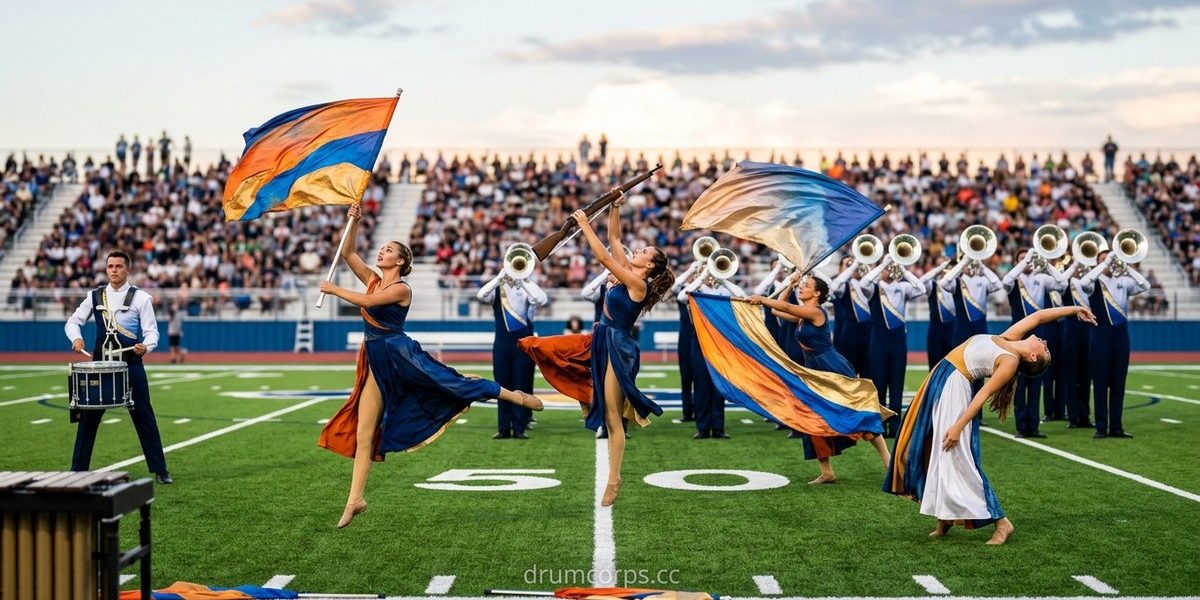
In the marching arts, performers do not just play notes. They move through space while playing. Their bodies become part of the phrase. A musical line that rises in pitch and volume should also rise in space through a lift, a change in direction, or an expanding formation. When the two match, the audience feels the phrase in their bones. When they do not match, the moment falls flat. This principle applies whether you are scoring a blockbuster film, composing for a video game, or designing a field show for a drum corps.
Visual phrasing is the practice of shaping movement to mirror the natural arc of a musical phrase. When composers and designers align physical motion with melody, rhythm, and dynamics, the audience experiences a unified emotional moment. Whether you work in film, video games, or drum corps, matching visual and musical phrasing transforms a good piece into an unforgettable one.
What Visual Phrasing Actually Means
Think of a musical phrase as a sentence. It has a beginning, a middle, and an end. It builds tension and releases it. In standard music theory, you shape that phrase with dynamics, tempo, and articulation. Visual phrasing does the same thing but with the body.
When a performer moves in a way that mirrors the musical arc, the phrase becomes physical. A crescendo might correspond with a forward step or a rising arm. A decrescendo might pull the body inward or lower the center of gravity. The audience processes both signals at once. That dual input creates a stronger emotional response than sound alone.
For composers working with visual media, this is the secret sauce. A video game composer writes a loop that must support both exploration and combat. The visual phrasing of the character’s movement, the camera angle, the lighting all of these shape how the music lands. If you write a sweeping legato line for a scene where the character is chopping wood in short, jerky motions, you create a mismatch. The player feels it even if they cannot name it.
The Shared Vocabulary Between Sound and Sight
Music and movement share a structural language. Here is how they map onto each other:
| Musical Element | Visual Equivalent | Example |
|---|---|---|
| Crescendo | Expanding space, rising gesture | A drum corps horn arc opens outward as the volume grows |
| Decrescendo | Contracting space, sinking posture | A soloist lowers their horn as they fade to piano |
| Staccato | Sharp, isolated movements | A snare line plays accented notes with crisp, high stick heights |
| Legato | Flowing, connected motion | A color guard rifle toss that arcs smoothly across the field |
| Accent | A sudden, strong movement or direction change | A downbeat hit that coincides with a dramatic step forward |
| Rubato | A held pause or slowing of motion | A ballad moment where the entire corps freezes mid-step |
This table is a starting point. The real artistry comes when you break these rules on purpose. If you want to create tension, you can deliberately mismatch the visual and musical phrasing. A loud, aggressive brass line paired with slow, drifting movement creates unease. That dissonance is a powerful tool. But you need to know the rules before you can break them.
Why Film and Game Composers Need This Skill
When you score a scene, you are not just writing music. You are writing an emotional guide for the audience. The visual phrasing of the actors, the camera movement, and the editing rhythm all tell you how to phrase your music.
Consider a cutscene in a role-playing game. The protagonist discovers a lost letter from a parent. The camera slowly zooms in. The character’s hand trembles. The music should breathe with that moment. A long, rising string phrase that peaks exactly when the character’s fingers touch the paper. That is visual phrasing in action. The music follows the shape of the emotion as expressed through movement.
In film, John Williams is a master of this. Think of the opening of Jurassic Park. The music swells as the characters look up at the dinosaurs for the first time. The camera tilts upward. The melody rises. The visual and musical phrasing are one motion.
For game composers, the challenge is interactivity. The player controls the timing. Your music must adapt to the visual phrasing of their choices. That is why layered stems and adaptive music systems are so important. You are not writing a fixed phrase. You are writing a set of musical building blocks that assemble in real time to match whatever the player does on screen.
A Practical Process for Aligning Visual and Musical Phrasing
If you want to start applying visual phrasing to your own work, follow these steps.
-
Map the emotional arc of the scene or moment. Write down where the tension peaks and where it releases. This is your phrase shape. Do this on paper before you write a single note.
-
Identify the dominant visual motion. What is moving? A character? The camera? The whole ensemble on a field? Describe that motion in simple terms. Is it smooth? Is it jagged? Does it accelerate or decelerate?
-
Match your musical phrasing to that motion. If the visual motion rises, let your melody or dynamics rise with it. If the motion is staccato, use shorter articulations and sharper rhythmic hits.
-
Test the alignment. Play your music against the visual element. Look for moments where the phrase peaks at different times. Adjust until the peak of the music and the peak of the movement land together.
-
Refine with intention. Once the alignment is solid, you can decide where to break it for effect. But break it deliberately, not by accident.
This process works for a drum corps show, a film scene, or a game level. The medium changes, but the principle stays the same.
Common Mistakes and How to Fix Them
Even experienced composers slip up here. Here are the most frequent errors and their solutions.
- Mismatched peaks. The music crescendos, but the character stays still. Fix it by moving the dynamic peak earlier or later to match the visual action.
- Ignoring the edit rhythm. In film, the cuts set the pace. If your musical phrasing ignores the editing rhythm, the scene will feel choppy. Map your phrase lengths to the shot lengths.
- Overwriting the moment. Sometimes a simple long tone supports the visual phrasing better than a busy melody. The movement is the star. Let your music breathe.
- Forgetting the release. A phrase needs a tail. After the peak, give the audience a moment to absorb it. Let the music fade or settle as the visual motion resolves.
Tools and Techniques for Better Alignment
Here are some practical ways to strengthen your visual phrasing skills:
- Watch scenes with the sound off first. Map the visual phrasing with your hand in the air. Rise and fall with the motion. Then score what your hand did.
- Study drum corps shows on YouTube. Pay attention to how the drill formations expand and contract with the music. A great example is the work of the Carolina Crown design team.
- Use a timeline view in your DAW. Draw the visual motion as an automation lane. Shape your dynamics, panning, and reverb to follow that curve.
- Practice with a partner. Have someone move while you play. Let their motion guide your phrasing in real time.
“The best moments in drum corps happen when the audience does not know whether they are being moved by the sound or the sight. They just know they felt something.” – A veteran drum corps designer reflecting on championship shows
How Drum Corps Trains You for This
Drum corps performers learn visual phrasing from day one. They do not just memorize drill coordinates. They learn to hear a phrase and feel where their body needs to be. A trumpet player holding a high G while stepping backward into a company front learns to match the intensity of the note with the precision of the step.
This training is directly transferable to composition. If you have ever marched, you already understand visual phrasing intuitively. If you have not, spend a season watching top corps. Notice how the breaking down the visual storytelling in Blue Devils 2017 ‘Metamorph’ works. Every movement serves the musical phrase.
For composers who want to build this skill, consider watching how Bluecoats 2014 ‘Tilt’ redefined modern drum corps design. That show is a masterclass in aligning visual and musical phrasing. The performers wear asymmetrical uniforms. The drill breaks traditional geometry. But every visual choice supports the musical narrative. The result is a show that still influences designers today.
You can also build your own visual vocabulary by practicing away from your instrument. The complete guide to practicing visuals without a field offers exercises that translate directly to understanding how movement and music connect.
A Table of Techniques and Missteps
| Technique | What It Looks Like | Common Mistake |
|---|---|---|
| Phrase matching | Rising melody with rising body position | Letting the visual stay flat during a crescendo |
| Dynamic mirroring | Forte with large, expansive gestures | Playing loud while moving small and contained |
| Rhythmic alignment | Staccato notes with sharp, isolated movements | Smooth legato motion during a syncopated rhythm |
| Spatial phrasing | Moving toward the audience during a climax | Moving away from the audience during the most intense moment |
| Breath points | Pausing movement at phrase endings | Rushing into the next phrase without a visual reset |
When to Break the Connection
Not every moment needs perfect alignment. Some of the most powerful artistic choices come from deliberate mismatch.
Imagine a quiet, fragile piano line under a scene of violent action. The contrast creates emotional distance. The audience watches the violence through a filter of sadness. That is a choice. It works because the composer understood the expected alignment and intentionally broke it.
In drum corps, you see this in the ballad. The music is tender and slow, but the drill might be chaotic and restless. That tension tells the story of inner conflict. The audience feels the character’s struggle because the visual and musical phrasing disagree.
The key is intentionality. If the mismatch is accidental, it feels like a mistake. If it is deliberate, it feels like art.
Bringing Visual Phrasing Into Your Daily Practice
You do not need a 150-member drum corps to practice this. Start small.
Write a 16-bar piano piece. Then design a simple movement sequence for yourself. It could be as basic as walking across your room. Shape the movement to match the music. Then record both. Watch the playback. Ask yourself where the alignment is strong and where it is weak.
Next, try the reverse. Find a video of someone moving. It could be a dancer, a athlete, or someone walking down the street. Write a short piece that follows their motion. Let their tempo and energy guide your musical phrasing.
Over time, this skill becomes instinctive. You will hear a phrase and see the movement. You will watch a scene and hear the shape of the music. That is the goal. When visual phrasing becomes second nature, your compositions will feel alive in a way that pure audio never can.
The best part? This skill translates across every medium. Whether you are writing for a stadium full of drum corps fans or a single player wearing headphones in their living room, the principle is the same. Movement and music are two sides of the same emotional language.
Start paying attention to how things move. Let that motion shape your next phrase. Your audience will thank you, even if they never know why.