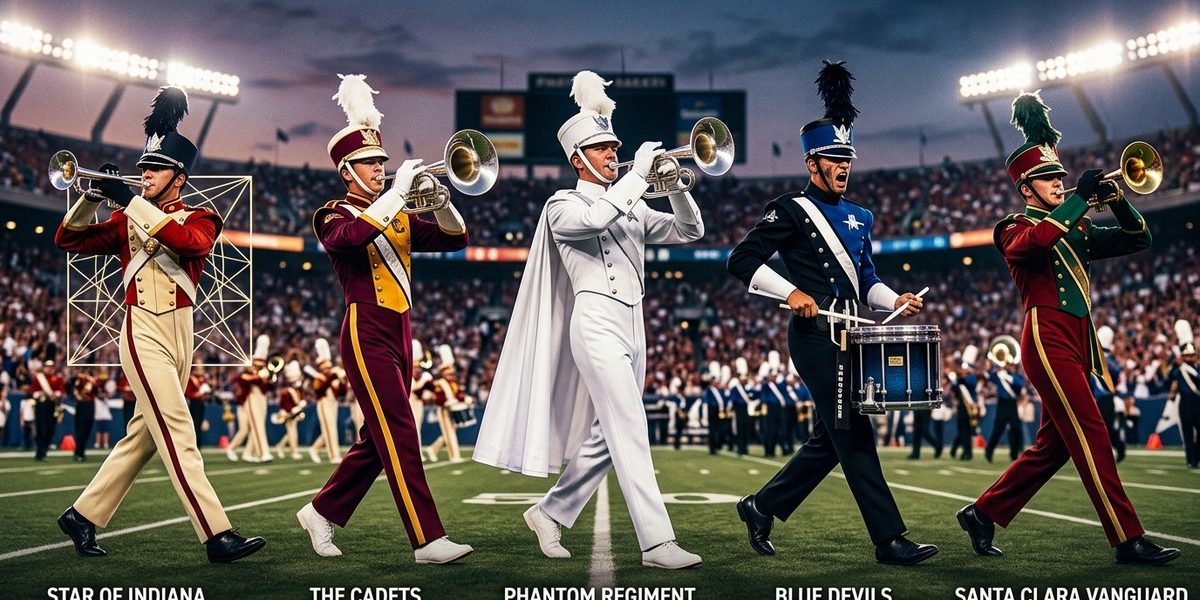
The 1990s were a decade of creative upheaval for Drum Corps International. The old guard of militaristic precision and G bugle dominance slowly gave way to something new. Designers started taking risks with concert hall repertoire, Broadway style vocals, and abstract visual concepts. It was a tense time for fans. Some loved the changes. Others felt the activity was losing its soul. In reality, the 1990s were the most creatively fertile period in DCI history. If you look at the activity today, you can trace almost every major innovation back to a handful of shows from this era. These are the performances that shook up the judging sheets and left audiences wondering what hit them.
The 1990s transformed drum corps from a strictly military art into a boundless theatrical medium. Shows like The Cadets’ 1992 “To Tame the Perilous Skies” and Star of Indiana’s 1993 “Barber and Bartok” broke every rule in the book. They introduced narration, abstract concert music, and fully realized visual themes. These five productions didn’t just win trophies. They rewrote the rules for future generations of designers and performers.
The Five Shows That Broke the Mold
What makes a show “redefine” an activity? It is not just about winning a championship. It is about changing what people think is possible on the field. It is about making the judges rewrite their own criteria. It is about inspiring every other designer to go back to the drawing board. These five shows did exactly that.
1. 1992 The Cadets “To Tame the Perilous Skies”
This show did not just win a championship. It changed the way designers thought about storytelling. The Cadets used voiceover recordings of WWII radio chatter and cockpit recordings to tell the story of the 8th Air Force. It was a huge gamble. Purists hated the narration. But the emotional payoff was undeniable. The show had a clear beginning, middle, and end. It taught the entire activity that music and marching could serve a narrative.
The opening hit remains one of the most iconic moments in DCI history. You hear the roar of B17 engines, then the voiceover: “This is it.” The brass line explodes. The drill forms the shape of a bomber. It gives you chills every single time. This approach to storytelling was a direct predecessor to how the Cadets pioneered visual storytelling in the years that followed.
2. 1993 Star of Indiana “The Music of Barber and Bartok”
Star of Indiana had money, talent, and a vision. They hired modern dance choreographers and dressed the corps in simple black unitards. The music was dense, complex, and difficult. There was almost no traditional drill. The movement was abstract and artistic. It felt like a performance at Lincoln Center, not a football game.
This show proved that drum corps could be high art. It directly influenced the design philosophy of later champion corps. You can hear echoes of Star’s approach in the evolution of Phantom Regiment’s classical repertoire. The “Adagio for Strings” segment is still talked about today. It was pure emotion. There were no gimmicks. Just incredible sound and movement.
3. 1995 The Cavaliers “The Planets”
Holst’s “The Planets” suite was the perfect vehicle for a drum corps show. Each movement offered a different mood and visual palette. The Cavaliers leaned into this completely. Their drill formed swirling galaxies and orbiting planets. The color guard used props that looked like celestial bodies. It was a total package. Every element of the show served the theme.
The Cavaliers are known for machine like precision. In 95, they married that precision with a softer, more artistic touch. The “Venus” movement was delicate and beautiful. “Mars” was aggressive and intense. The contrast made the show incredibly dynamic. It raised the bar for what judges actually look for during visual ensemble scoring.
4. 1997 Blue Devils “As Time Goes By”
The Blue Devils are famous for their jazz identity. In 1997, they fully embraced that identity. The show centered on a giant clock prop that moved and rotated across the