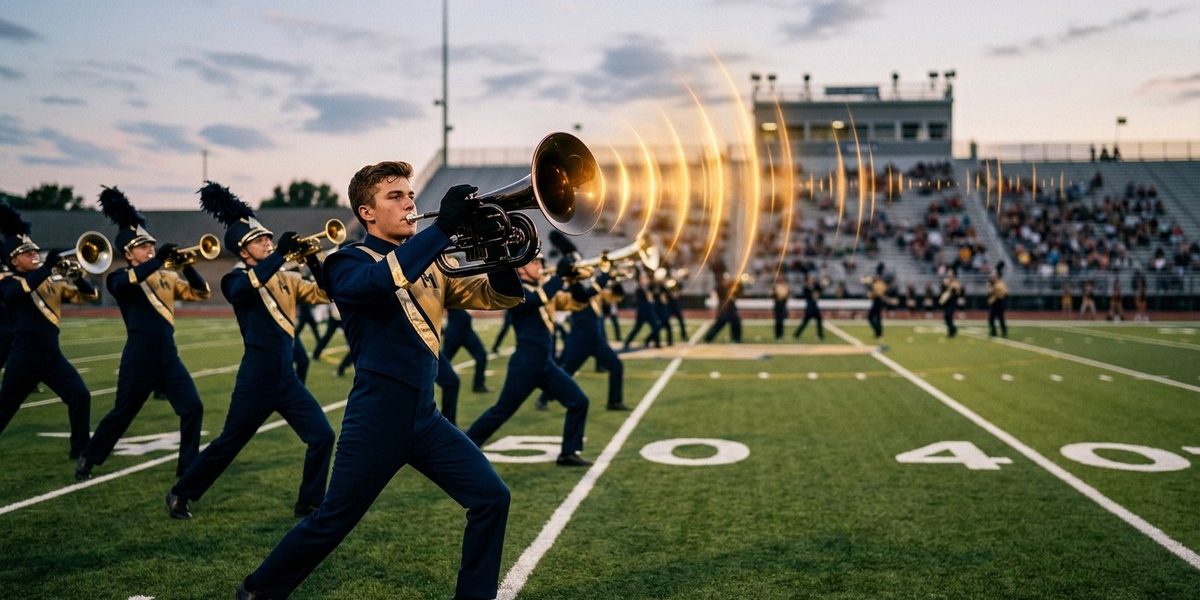
You are standing on the 50-yard line during a full ensemble run. The drum major gives the cue, you play your part with everything you have, and yet when you ask a friend in the stands how it sounded, they shrug. Your sound dies before it reaches the bleachers. You are not alone. Every marching brass player has felt this frustration. The good news is that the problem is rarely your instrument. It is almost always a combination of air support, embouchure efficiency, and horn angle. Let us break down exactly why your trumpet sounds weak at the back of the field and how to fix it today.
Weak projection on a marching field usually comes from three fixable issues: insufficient breath support from the diaphragm, a horn angle that points your sound into the ground, and an embouchure that is too tight or too loose for the outdoor environment. By adjusting your air speed, raising your bell, and relaxing your face, you can double your carry without changing a single note.
The Real Reason Your Sound Dies Outdoors
Indoor concert halls bounce sound off walls and ceilings. A marching field does not. When you play outside, your sound has to travel through open air with nothing to reflect it. That means every bit of energy you waste leaks into the sky instead of reaching the audience.
The biggest culprit is a shallow, chest-based breath. If you are breathing like you do at rest, your air column is too small to push your sound past the front sideline. You need to engage your diaphragm fully and use your core muscles to create a steady, fast stream of air. Without that, your tone thins out as soon as it leaves the bell.
Another common cause is a horn angle that points downward. When you march, especially during demanding drill, your trumpet naturally drops. That sends your sound into the turf instead of toward the box. Even a tilt of five degrees can cut your projection by half.
Three Mechanics That Kill Your Projection
Let us get specific about what is going wrong. Below is a table that compares common mistakes with their fixes. Read through each one and check which applies to you.
| Common Mistake | What It Does | The Fix |
|---|---|---|
| Shallow breathing from the chest | Creates a thin air stream that fades quickly | Breathe from the belly. Fill your lower lungs first. |
| Horn angle pointing below parallel | Sound hits the ground before reaching the stands | Raise your bell until it points directly at the audience. |
| Tight, pinched embouchure | Cuts off resonance and makes your tone shrill | Relax your corners. Let your lips vibrate freely. |
| Playing with too much mouthpiece pressure | Mutes your sound and causes early fatigue | Use air support to hold the note, not jaw pressure. |
| Not using enough core support | Air stream is weak and wobbly | Engage your abs. Push from the diaphragm. |
If you recognize any of these, do not worry. Each one is easy to correct with a few minutes of focused practice.
How to Build Real Breath Support for Marching Brass
Breath support is the foundation of projection. Without it, nothing else matters. Here is a numbered process you can use during your next warmup to build the kind of air power that carries to the back of the stadium.
- Stand with your feet shoulder-width apart and your shoulders relaxed. Place one hand on your stomach and one on your chest.
- Inhale through your mouth for four counts. Focus on expanding your stomach first. Your chest should barely move.
- Hold the breath for two counts. Feel the pressure in your lower torso.
- Exhale through your mouth on a hiss for eight counts. Keep the air steady. Do not let it burst out at the beginning.
- Repeat this cycle five times. Then try it with your trumpet. Play a long tone on a comfortable middle G and focus on keeping the air speed constant from start to finish.
A great drill is to practice long tones while walking. March in place at a comfortable tempo and play a sustained note. If your sound wavers, you are losing air support. Go back to step one and rebuild.
Expert advice: “Think of your air like a garden hose. If you kink the hose, the water dribbles out. If you open the nozzle all the way, the water shoots across the lawn. Your throat and embouchure are the kinks. Open them up and let the air fly.” — Mike S., brass caption head for a top-12 DCI corps
Horn Angle: The Five-Degree Fix
You have probably been told to keep your horn up. But what does that actually mean? It means the bell of your trumpet should point directly at the audience, not at the ground or the sky. When you are standing still, this is easy. When you are moving at 180 beats per minute in a backwards diagonal, it gets harder.
Here is a simple test. Have a friend stand thirty yards away and watch your bell while you march a basic eight-to-five pattern. If they see the bell drop below their eye level, your sound is dying. Fix it by mentally aiming your horn at the top of the stands. Overcorrect slightly. Most players underestimate how low their bell actually sits.
Try this drill during your next visual block. March a simple forward pattern while holding a long tone. Keep your eyes on a fixed point in the stands. Adjust your horn angle until you feel the air leaving the bell at a slight upward tilt. Hold that position for the entire set.
Relax Your Embouchure for More Carry
Many players think that playing louder means squeezing harder. The opposite is true. A tight embouchure restricts vibration and kills your tone. Your lips need to buzz freely to produce a full sound.
To check if you are too tight, play a middle G and slowly decrescendo to nothing. If your lips stop buzzing before the sound fades completely, you are clamping down. The fix is to back off the mouthpiece pressure and let your air do the work.
A helpful exercise is to practice buzzing on your mouthpiece alone. Buzz a comfortable pitch and then try to make it louder without pressing the mouthpiece harder into your lips. If you can do that, you have found the right balance. Take that feeling back to your trumpet.
Common Mistakes That Sabotage Your Sound
Here is a bulleted list of things to avoid during your next rehearsal:
- Breathing late and rushing the inhalation. You need a full breath before every phrase.
- Dropping your horn during rests. Keep the bell up even when you are not playing.
- Playing with a cold instrument. Warm up your trumpet before ensemble runs.
- Ignoring your core. Your abs are your air engine. Engage them.
- Using too much mouthpiece pressure. Let your air support the note, not your face.
- Forgetting to listen. Record yourself during practice. Compare your sound to a DCI recording.
A Simple Practice Routine to Fix Your Projection
You do not need hours of extra practice to fix this. Fifteen minutes a day dedicated to projection will transform your sound. Here is a routine you can start tomorrow.
| Exercise | Time | Focus |
|---|---|---|
| Breathing without the horn | 3 minutes | Belly breathing, steady exhalation |
| Mouthpiece buzzing | 3 minutes | Relaxed lips, consistent buzz |
| Long tones on middle G | 3 minutes | Constant air speed, relaxed embouchure |
| Long tones on high C | 3 minutes | Same air, less pressure |
| Marching long tones | 3 minutes | Horn angle, core support, steady sound |
| Free play | 3 minutes | Apply everything to a phrase from your show |
This routine works because it isolates each element. You cannot fix your sound if you are trying to fix everything at once. Break it down, fix one piece, and move on.
Why Your Warmup Might Be Working Against You
Many players start their warmup with loud, high notes. That builds bad habits. You should start with soft, relaxed long tones in your middle register. This sets your embouchure in a comfortable position before you ask it to work hard. If you want to learn more about building a better warmup, check out our guide on why your warmup might be holding you back (and how to fix it).
The Connection Between Core Strength and Brass Projection
Your core muscles are not just for marching. They are the engine of your air support. A weak core means a weak air stream. You do not need to be a gym rat, but adding a few planks and crunches to your routine will make a noticeable difference. The hidden connection between core strength and brass projection on the marching field is real. Spend five minutes a day on core work and your sound will thank you.
How to Practice When You Cannot Be on the Field
You do not always have access to a full field. That is fine. You can practice breath support and embouchure control anywhere. Work on mouthpiece buzzing while you watch TV. Practice your breathing exercises during a study break. The parking lot practice guide has more ideas for making the most of limited space.
Take Your Sound from Weak to Powerful
You asked why does my trumpet sound weak at the back of the field, and now you have the answers. It comes down to three things: breath support, horn angle, and embouchure relaxation. Pick one of these areas and work on it for the next week. Record yourself before and after. You will hear a difference.
Start with the breathing exercise today. Tomorrow, add the horn angle drill. By the end of the week, your sound will carry farther than it ever has. The audience will hear you, the drum major will hear you, and most importantly, you will hear yourself the way you always wanted to.