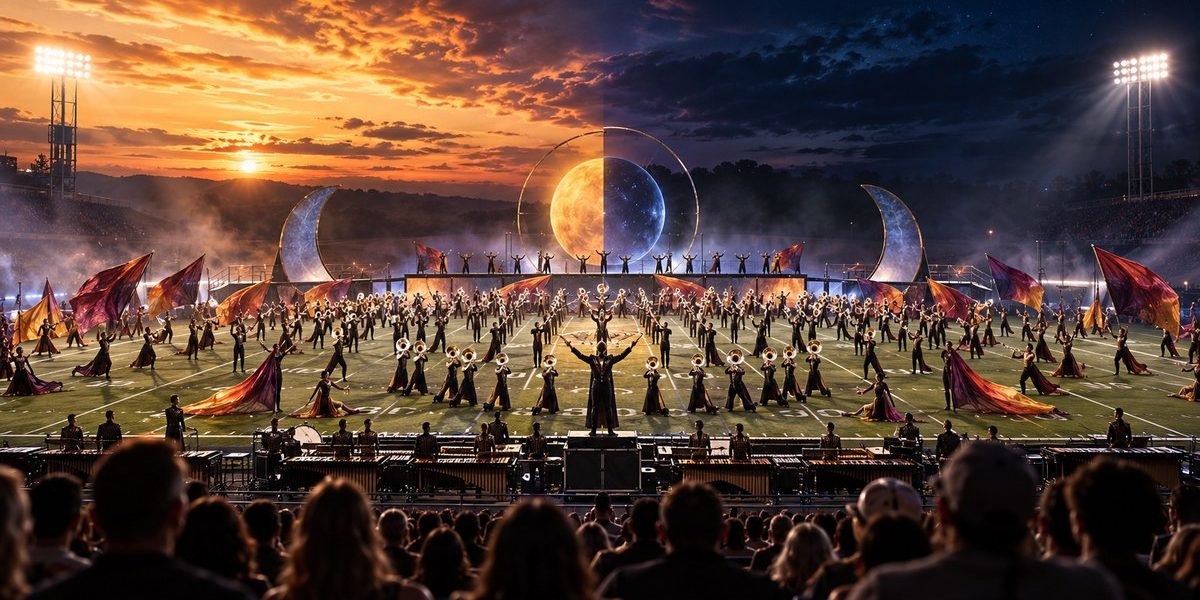
The Equinox Festival has always been a space where drum corps can take creative risks. But nobody was ready for what Pacific Crest delivered in their 2026 closer. As the final notes of their show hung in the cool evening air, the stadium fell into a silence that felt louder than any roar. It was the kind of silence that says, “We just witnessed something we don’t fully understand yet.” That moment, that collective holding of breath, is why we keep coming back to the marching arts. It is the reason this Pacific Crest Equinox closer review exists.
Pacific Crest’s 2026 Equinox closer was not just a loud finale; it was a masterclass in emotional architecture. By blending a slow, vulnerable brass chorale with sudden, explosive percussion hits and tightly synchronized drill, the corps created a narrative arc that felt more like a film scene than a drum corps finish. This review unpacks exactly how they did it.
The Moment the Energy Shifted
The show leading up to the closer was already strong. Pacific Crest had built a solid program around the theme of balance and transition, using the equinox as a metaphor for change. But the final two minutes of the performance were something else entirely.
Around the 9-minute mark, the battery dropped to a whisper. The front ensemble held a shimmering chord, and the brass line formed a single, curved line across the back sideline. That is when the soloist stepped forward. A single trumpet, exposed and raw, played a melody that felt like a question. It was not a showy lick. It was simple, patient, and aching.
Then the corps answered. The entire ensemble joined on a massive, suspended chord that seemed to come from everywhere at once. The air pressure in the stadium changed. That is the moment the crowd stopped clapping and started listening.
How They Built the Closer: A Step-by-Step Breakdown
Pacific Crest’s design team used a specific structure to create that speechless reaction. They did not rely on speed or volume alone. They used contrast, spacing, and restraint.
- The Vocal Point: The closer started with a single, unaccompanied voice from the brass section. This forced the audience to lean in.
- The Layered Response: Instead of a full fortissimo hit, the corps added voices one at a time. Mellophones entered first, then baritones, then the low brass. It felt like a sunrise.
- The Percussion Break: After the brass built to a peak, the drumline took over with a short, intricate passage that was more about texture than speed. They used cross-stick clicks and rim shots to create a rhythmic pulse.
- The Drill Collapse: As the music reached its final peak, the entire corps moved into a tight, compressed block at center field. The visual focus narrowed to a single point.
- The Final Release: The last chord was held for eight full counts. Then, the soloist played the same opening phrase one more time, but this time it resolved. The silence that followed was the real finale.
The Elements That Made It Unforgettable
There are a few specific techniques and choices that made this closer stand out from other strong finishes in 2026.
- Dynamic Restraint: The corps was willing to play softly when it mattered most. Many groups try to win the crowd by being the loudest. Pacific Crest won by being the most controlled.
- Visual Simplicity: The drill for the closer was not overly complex. Instead of running around the field, the performers moved with purpose. Every step had a reason.
- Emotional Timing: The design team knew when to pause. They let the silence do the work. That is a sign of mature show design.
- The Soloist’s Courage: The trumpet player who started the closer had to stand alone in front of thousands of people and play a quiet, exposed melody. That takes guts. And they nailed it.
Common Closer Mistakes vs. The Pacific Crest Approach
To understand why this closer worked so well, it helps to look at what often goes wrong in other finales. Here is a comparison of typical pitfalls and how Pacific Crest avoided them.
| Common Mistake | Why It Hurts the Show | How Pacific Crest Avoided It |
|---|---|---|
| Starting too loud | Leaves no room for growth. The climax feels flat. | They began with a single, quiet trumpet. |
| Overcrowding the drill | The audience cannot follow the story. | They used a simple, focused visual shape. |
| Rushing the tempo | The emotion feels frantic, not earned. | They held the final chord for eight counts. |
| Ignoring the battery | The percussion feels disconnected from the brass. | The drumline played a short, textural passage that bridged sections. |
| Ending abruptly | The audience does not have time to react. | They allowed silence to become part of the performance. |
Why Silence Was the Loudest Part
The most talked-about part of this closer happened after the music stopped. For about four seconds, the stadium was completely quiet. No clapping. No cheering. Just the sound of the night air.
“In drum corps, we are so focused on the next note that we forget the power of the space between them. Pacific Crest’s 2026 closer reminded us that silence is not empty. It is full of anticipation.” – A veteran DCI show designer who spoke with us after the festival.
That silence was not an accident. The design team built it into the show. After the soloist played the final resolving note, the corps held their final pose. Nobody moved. The audience had to decide when to break the spell. And for a few seconds, nobody wanted to.
What This Means for Show Design in 2026 and Beyond
This Pacific Crest Equinox closer review points to a larger trend in the activity. The most memorable moments are not always the loudest. They are the ones that create a shared emotional experience. As drum corps continues to evolve, we are seeing more designers trust their audiences to handle subtlety.
If you are a performer or a designer, there is a lesson here. You do not have to fill every second with sound. You do not have to march every step at full speed. Sometimes, the most powerful tool in your toolbox is the pause.
For those looking to bring this kind of control to their own playing, we recommend checking out our guide on 5 essential breathing exercises every brass player should master. That kind of breath control is what allows a soloist to stand alone and sound confident. And for the visual side, our article on the secret to smoother roll steps every visual caption head teaches can help you move with that same purposeful simplicity.
The Takeaway for Fans and Performers Alike
If you were in the stands at the Equinox Festival, you already know. If you were not, find the video. Watch it with good headphones. Pay attention to the spaces between the notes. Notice how the performers breathe together. Notice how the drill locks into a single, powerful image.
Pacific Crest’s 2026 closer was not just a good ending to a good show. It was a statement. It said that drum corps can be quiet and still be epic. It said that emotion does not need to be forced. It said that sometimes, the best way to leave the crowd speechless is to give them a moment worth staying silent for.
Next time you are at a show, or next time you are on the field, remember that moment. You do not have to win every second. You just have to win the right ones.