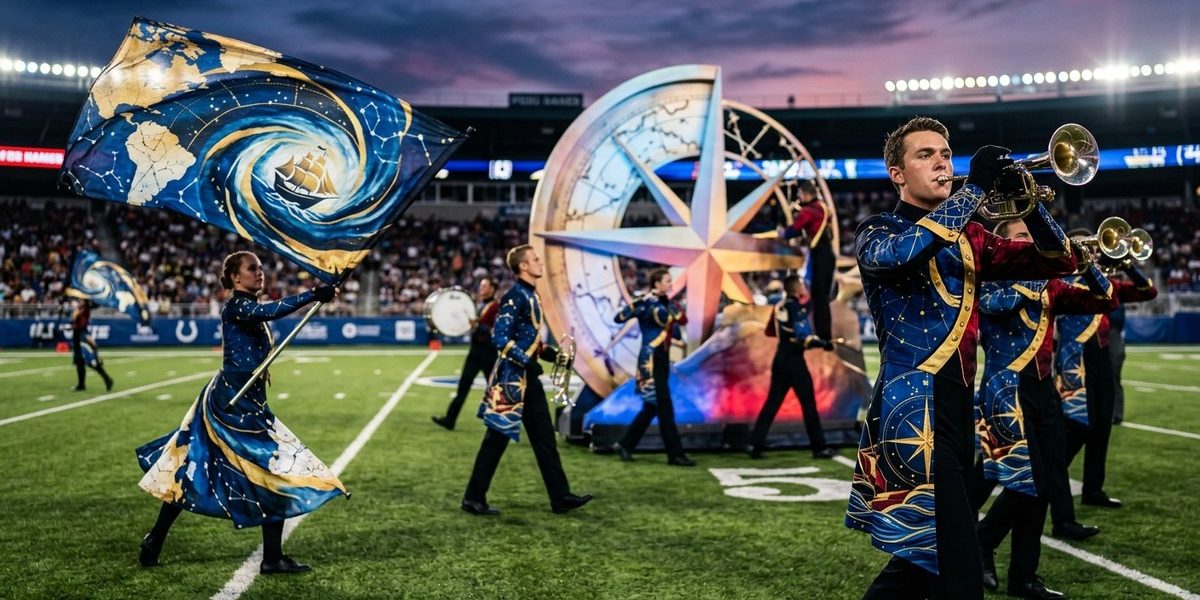
The 2026 drum corps season was packed with technical fireworks, massive drill sets, and powerhouse brass moments. Fans spent the summer buzzing about the usual front-runners, and rightfully so. But tucked away in the middle of the pack was a show that quietly delivered one of the most emotionally complete narratives of the year. The Colts of Dubuque, Iowa, presented “Voyage,” and if you blinked, you might have missed why it matters so much. This was not just a show about sailing or exploration. It was a masterclass in how to build a story arc using movement, music, and visual metaphor. For anyone who loves narrative design in live performance, this was the sleeper hit of 2026.
The 2026 Colts Voyage succeeded because it used a clear three-act structure to tell a story of departure, discovery, and return. It relied on emotional pacing rather than technical overload, making its narrative accessible to both seasoned drum corps fans and newcomers. This approach is a blueprint for underdog storytelling in the marching arts.
A Story Built on Departure and Return
The genius of the 2026 Colts Voyage was its simplicity. The show followed a protagonist leaving a familiar shore, facing the unknown, and returning forever changed. This is a classic hero’s journey, but the Colts executed it with a restraint that many top-tier corps overlook. They did not try to cram ten ideas into eleven minutes. Instead, they focused on three clear emotional beats.
The opening movement established a sense of home. The brass chorale was warm, almost nostalgic. The drill formed tight, grounded shapes. You felt the weight of the place being left behind. Then the music shifted. The percussion introduced a restless, churning rhythm that mimicked waves. The guard, dressed in deep blues and whites, began to move in sweeping, circular patterns. You could feel the departure happening in real time.
This is where the storytelling really shone. The show did not tell you they were leaving. It made you feel the leaving. The horn line dropped to a whisper, and then a single soprano voice cut through the silence. It was a moment of pure vulnerability. For a corps that often gets labeled as a “feeder” program for the top six, this was a statement. They were playing in the big leagues of emotional design.
How the Colts Used Music to Drive the Narrative
The musical selection for Voyage was not a medley of pop songs or film scores. It was an original composition tailored to the arc. The composer built a leitmotif, a short musical phrase that represented the idea of home. This theme returned at key moments, always slightly altered.
- In the first act, the leitmotif was full and major. It sounded safe.
- In the second act, during the storm sequence, the leitmotif was fragmented. It was played by a single trumpet, offstage, as if the memory of home was being distorted by the chaos of the journey.
- In the third act, the leitmotif returned in full force, but now it was layered with new harmonies. Home was not the same. The character had grown.
This kind of musical storytelling is rare in drum corps. Many shows rely on loud hits and fast tempos to generate excitement. The Colts understood that tension and release come from silence and space. The ballad in Voyage was not a power ballad. It was a quiet, introspective moment where the guard performed a solo dance with a single white flag. The flag represented the sail, but also the character’s hope. When the wind caught it, the entire corps breathed together. It was a moment of collective suspension.
The Visual Language of the Voyage
The drill design for Voyage was deceptively simple. On the surface, it looked like standard geometric transitions. But the visual team used a technique called “form dissolution.” Instead of moving from one block to another in straight lines, the corps would dissolve into a scatter, then reform into a new shape. This created the illusion of water, of shifting tides.
The color guard was the anchor of the narrative. They used equipment in a way that told the story without words.
| Narrative Beat | Guard Equipment | Visual Effect |
|---|---|---|
| Departure | Blue silks, held low | Created the feeling of a shoreline receding |
| Storm | White flags, tossed high | Represented crashing waves and disorientation |
| Discovery | Gold hoops, spun slowly | Symbolized a new horizon or a compass |
| Return | Blue silks, now paired with gold | Showed the character had integrated the journey |
This table shows how the Colts used a simple color and equipment palette to move the story forward. They did not need complex props or digital backdrops. The story was in the movement itself. The blue silks returned at the end, but they were now paired with gold. The character had not forgotten home. They had brought something back with them.
Why This Approach Matters for Storytelling
In the world of sports media and pop culture analysis, we often talk about “show, don’t tell.” The Colts Voyage embodied this principle perfectly. They did not project a title on the field that said “The Storm.” They showed the storm through the chaos of the drum line, the frantic drill, and the guard’s sharp, aggressive movements. The audience felt the danger before they intellectually understood it.
For NFL fans reading this, think of it like a great play call. A quarterback does not tell the defense what is coming. He shows them a look, then changes it at the snap. The Colts did the same thing. They set up a visual pattern, then broke it at the emotional peak. That moment of surprise is what makes a story stick.
Pop culture analysts will recognize the structure. It is the same arc used in films like “The Lion King” or “Moana.” A character leaves home, faces a trial, and returns transformed. The Colts did not reinvent the wheel. They just rolled it with more care than anyone else this season.
Three Lessons from the Colts Voyage for Any Creative
If you are a designer, writer, or performer, there is a lot to learn from this show. Here are three practical takeaways.
-
Limit your core ideas to three. The Colts had departure, storm, and return. That is it. They did not try to add a subplot about a sea monster or a love story. They stayed focused. This allowed every moment to build on the last.
-
Use a musical signature to track change. The leitmotif for home was the emotional anchor. Every time it returned, the audience knew where they were in the story. You can do this in any project. Pick a sound, a color, or a phrase, and bring it back at key moments.
-
Trust the silence. The most powerful moment in Voyage was not a loud chord. It was the pause before the final push. In a world where everyone is trying to be louder and faster, the Colts proved that restraint is a superpower. This is a lesson that applies to any creative work, from a drum corps show to a film edit to a marketing campaign.
Common Pitfalls in Storytelling Shows (And How the Colts Avoided Them)
Many drum corps shows fail because they try to do too much. They become a checklist of effects rather than a unified story. The Colts avoided these traps.
| Common Mistake | How the Colts Fixed It |
|---|---|
| Overloading the show with too many musical genres | They used a single original composition with a clear theme |
| Using the guard as decoration instead of narrative drivers | The guard was the protagonist, carrying the emotional weight |
| Changing drill shapes just for visual interest | Every drill change served the story, from shore to storm to horizon |
| Ending with a loud hit that feels unearned | The ending was a soft resolution, a quiet acceptance of change |
This table highlights the discipline behind the design. The Colts did not chase applause. They chased truth. And that is why the show lingers in the memory long after the final note.
The Emotional Payoff of a Well-Told Journey
The final minute of Voyage was a masterstroke. The corps formed a single, curved line that stretched from one side of the field to the other. It looked like a horizon. The guard walked slowly from the back of the field to the front, carrying the blue and gold silks. They did not spin them. They simply carried them. It was a procession. The brass played the home leitmotif one last time, but it was soft, like a memory.
The audience did not erupt in applause. They sat in silence for a moment. That silence was the highest compliment. The show had transported them. They were not watching a competition anymore. They were watching a soul come home.
This is the power of underrated storytelling. It does not need a trophy to validate it. The Colts Voyage will be remembered by those who saw it as the year a small corps from Iowa taught the entire activity how to tell a story with heart.
What the Colts Voyage Teaches Us About Risk and Reward
The Colts took a risk by not chasing the typical “competitive” formula. They did not write a show that was designed to win the crowd with sheer volume. They wrote a show that was designed to connect. In a season where many corps leaned into spectacle, the Colts leaned into sincerity.
For fans of the NFL, this is like a team that wins with a precision passing game instead of a power run game. It is less flashy, but it is devastatingly effective when executed well. The Colts executed with near-flawless clarity.
For pop culture analysts, this is a case study in how to make a small budget feel epic. The Colts did not have the resources of a Blue Devils or a Bluecoats. They did not need them. They had a clear vision and the discipline to see it through. That is a lesson that applies to indie filmmakers, podcasters, and writers alike.
The Lasting Impact of a Quiet Triumph
The 2026 Colts Voyage will not top the lists of “most technically difficult” shows. It will not win every caption award. But it will be the show that people talk about when they want to remember why they love drum corps in the first place. It is a reminder that the activity is not just about points. It is about telling stories that matter.
If you missed this show during the season, seek out a recording. Watch it with the sound up and the lights down. Pay attention to the small moments. The way the horn line breathes together before the final phrase. The way the guard member holds the gold hoop just a little too long. Those are the details that make a story real.
And if you are a creator in any medium, take a lesson from the Colts. You do not need a massive budget or a complicated concept. You need a clear story, the courage to tell it quietly, and the trust that your audience will follow you to the horizon.