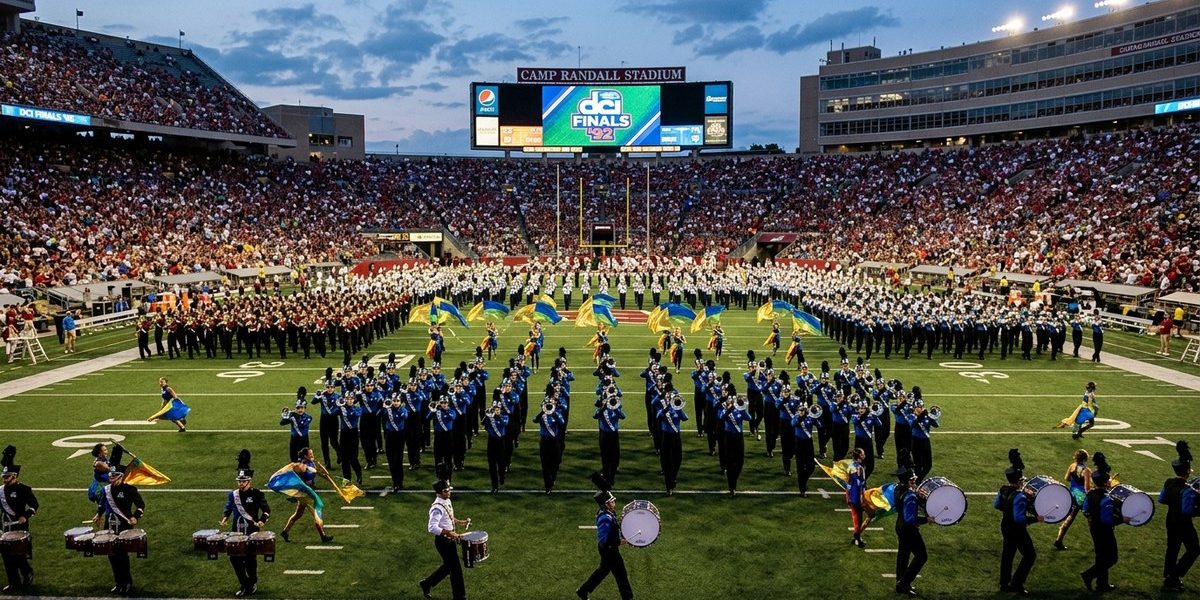
The 1992 DCI World Championship Finals at Camp Randall Stadium in Madison, Wisconsin, felt different from the moment the first corps took the field. You could sense it in the air. The humidity was thick, the stands were packed, and every single performance carried a weight that went beyond scores. This was the weekend where the old guard met the new wave head-on. It was the weekend where artistic ambition finally matched competitive drive. And it was the weekend that set the template for every drum corps show you have seen since.
The 1992 DCI Finals marked a seismic shift in drum corps history. It was the year Star of Indiana proved that theatrical design could win championships, the Cavaliers and Cadets pushed technical precision to new heights, and the activity permanently moved away from military tradition toward art. Understanding this weekend helps you see where modern drum corps came from and why it looks the way it does today.
The Perfect Storm of Talent and Change
By 1992, Drum Corps International had been around for two decades. The activity had grown from VFW parades into a competitive summer sport. But the early 1990s brought something new: a willingness to break the rules of design. Corps started experimenting with narrative arcs, complex harmonic language, and visual staging that looked more like theater than a marching band.
The 1992 season was the tipping point. You had three distinct powerhouses at the top of their game, each representing a different philosophy of what drum corps could be. The Cavaliers stood for precision and machinelike uniformity. The Cadets (then known as the Cadets of Bergen County) were the masters of drill complexity and storytelling. And then there was Star of Indiana, the new kid from Bloomington that had spent millions of dollars chasing a single vision.
What happened that weekend in Madison did not just determine a champion. It forced the entire activity to choose a direction.
The Shows That Defined the Weekend
Let us look at the three performances that made the 1992 Finals unforgettable.
The Cavaliers Delivered a Masterclass in Control
The Cavaliers performed “The Cavaliers: The Man, The Myth, The Legend.” It was a show about a superhero, complete with comic book flair and a brass line that played with surgical precision. Their visual package was so clean that it looked like a single organism moving across the field. The Cavaliers scored 97.5, taking third place. But their influence that weekend was about reminding everyone that technical perfection still had a home in drum corps.
The Cadets Brought the Drama
The Cadets performed “To Tame the Perilous Skies,” a show about aviation and the human desire to fly. It had soaring melodies, a massive drill that seemed to defy physics, and a level of theatricality that had not been seen before in DCI finals. The Cadets scored 97.0, landing in second place. Their show was a direct challenge to the idea that drum corps had to be purely abstract. They wanted you to feel something specific.
Star of Indiana Changed Everything
Star of Indiana performed “American Variations” on the way to their first DCI championship. The show was built around a commissioned score by James W. Ripley that wove together American folk themes with modern classical techniques. But the real story was the visual design. Star used a curved, asymmetrical drill that looked nothing like the block formations everyone else was using. They marched with a relaxed style that prioritized musical phrasing over rigid posture. And they won with a score of 97.8.
That championship was a shock to the system. Star of Indiana had only been competing in DCI since 1988. They had never won a title before. And they did it by rejecting almost every visual convention that had dominated the activity for years.
How the 1992 Finals Changed Design Forever
The impact of that weekend went far beyond the final standings. Here are the three biggest shifts that started in 1992.
-
The death of the straight line. Before 1992, most top corps marched with an emphasis on perfect lines and right angles. Star of Indiana proved that curved forms and staggered staging could create more visual interest and better sound projection. Within five years, nearly every corps had adopted curved drill designs.
-
The rise of the commissioned score. Most corps in the 1980s relied on arrangements of existing music. Star of Indiana’s decision to commission an original score opened the door for other corps to work with living composers. This changed the harmonic language of drum corps and made shows feel more like concert pieces.
-
The shift from military to artistic. The old school of drum corps valued uniformity above all else. 1992 showed that audiences and judges were ready to reward individuality and artistic risk. The activity stopped trying to be the best marching band and started trying to be the best performance art on a football field.
“The 1992 Finals were the moment drum corps stopped looking backward and started looking forward. We realized that we could be artists, not just athletes in uniforms.” — George Zingali, former drill designer
What the Scores Tell Us
The scores from that weekend reveal a lot about how close the competition really was and how much the judging community was wrestling with these new ideas.
| Corps | Score | Placement | Style |
|---|---|---|---|
| Star of Indiana | 97.8 | 1st | Theatrical, curved drill, commissioned music |
| The Cadets | 97.0 | 2nd | Aviation theme, complex drill, dramatic narrative |
| The Cavaliers | 97.5 | 3rd | Superhero theme, precision marching, traditional brass |
| Blue Devils | 95.3 | 4th | Jazz influence, high energy, classic west coast sound |
| Santa Clara Vanguard | 94.2 | 5th | Classical repertoire, elegant visual design |
Notice that Star of Indiana did not win by a huge margin. The Cavaliers were only three tenths behind. But the direction of the win mattered more than the spread. The judges chose the show that took the biggest risk.
The Legacy of the 1992 DCI Finals
Thirty-four years later, the 1992 Finals are still referenced by designers, historians, and fans. Here is why that weekend continues to matter.
- It proved that money and vision could disrupt the establishment. Star of Indiana’s financial backing allowed them to take risks that other corps could not afford. That changed how corps thought about fundraising and sponsorship.
- It introduced a generation of performers to the idea that drum corps could be emotionally resonant. The best shows today still chase the feeling that Star of Indiana created in 1992.
- It marked the beginning of the end for the “military style” of marching. Within a decade, nearly every corps had adopted a more natural, musical approach to movement.
If you want to understand why modern drum corps looks the way it does, you have to start with 1992. It was not just a great finals weekend. It was the moment the activity chose art over tradition.
How to Watch the 1992 Finals Today
You can still find recordings of the 1992 DCI Finals online. If you are new to this era of drum corps, here are a few things to watch for.
- Pay attention to the feet. Compare Star of Indiana’s relaxed stride to the Cadets’ high-mark time. The difference in philosophy is visible in every step.
- Listen to the brass arrangements. Star of Indiana used dissonance and unresolved chords in ways that were rare for the time. The Cadets leaned into sweeping, cinematic melodies.
- Watch the crowd reactions. The audience in Camp Randall Stadium knew they were witnessing something special. Their energy is part of the historical record.
Why This Weekend Still Matters in 2026
The drum corps world of 2026 looks very different from the world of 1992. Shows are more theatrical. Designers have access to technology that did not exist thirty years ago. The rules have changed. But the core lessons from that weekend in Madison are still alive.
Every time a corps takes a creative risk, they are walking the path that Star of Indiana carved. Every time a designer chooses a curved form over a straight line, they are building on the visual language that debuted in 1992. Every time a performer is asked to act, to feel, to tell a story, they are honoring the shift that happened on that field.
The 1992 DCI Finals were not just the most important weekend in drum corps history. They were the weekend that taught the entire activity that winning was not the only goal. The goal was to matter.
If you are looking to build your own skills as a performer or designer, the best place to start is understanding the history that shaped the activity. Check out our guide on how the Cadets pioneered visual storytelling and changed drum corps forever to see how the lessons of 1992 evolved into the techniques used today. You can also read about how Star of Indiana spent millions and changed drum corps economics forever to understand the business side of that legendary season.
The Lesson That Keeps Teaching
The 1992 DCI Finals remind us that progress comes from people who refuse to do things the way they have always been done. Star of Indiana did not win because they had the most money. They won because they had the clearest vision. The Cadets did not lose because they lacked talent. They lost because their vision was slightly less bold.
For anyone who loves drum corps, the 1992 Finals are a gift. They are proof that the activity can grow without losing its soul. They are proof that risk is rewarded. And they are proof that one weekend in August can change everything.
So the next time you watch a modern drum corps show, take a moment to thank the performers and designers of 1992. They are the ones who made it possible. And if you ever feel stuck in your own practice or design work, remember what happened at Camp Randall Stadium. Sometimes the best move is to try something no one else has tried before.