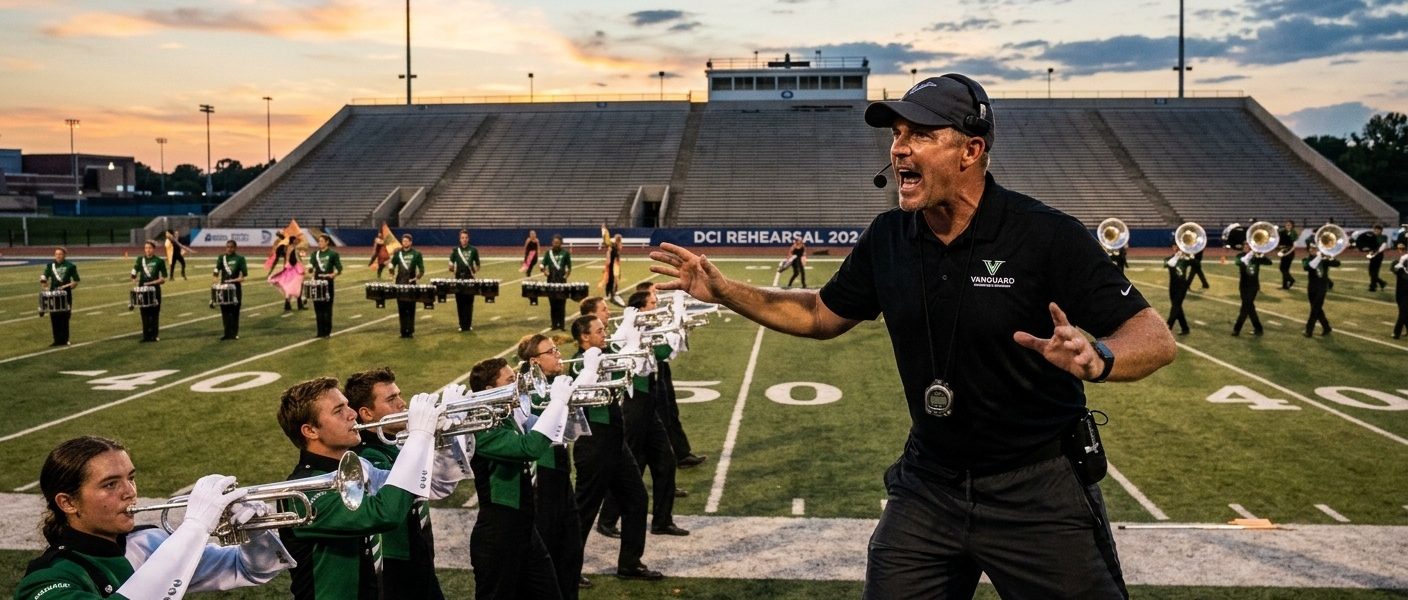
Watch a drum corps rehearsal for ten minutes and one thing becomes obvious fast. The same phrase plays over and over. And then again. And then once more after a water break. Repetition is not filler in this activity. It is the actual method. But repetition alone does not build a locked-in section. The instructor’s voice does a lot of heavy lifting between each rep, and most people watching from the sidelines do not fully understand how those two things work together to shape a performance-ready ensemble.
Key Points
- Repetition in drum corps is deliberate and structured, not mindless grinding
- Vocal cues function as real-time anchors for timing, entries, and dynamic shaping
- Instructors layer verbal direction progressively as a section matures
- Short, specific commands reduce cognitive load during high-rep drill cycles
- Combining reps with targeted verbal feedback builds physical memory faster than reps alone
Why Repetition Is the Engine of a Drum Corps Rehearsal Block
In competitive marching arts, precision is the baseline. Not just playing the right notes but playing them at exactly the right moment, with the right shape, in tune, while moving. That is a lot to hold in your body at once. The only way to make that automatic is to do it enough times that conscious thought is no longer required.
This is the real purpose behind high-repetition drilling. When a battery instructor asks the snare line to play a lick thirty times in a row, the goal is not punishment. The goal is to move that passage from working memory into something closer to physical habit. Research in music education has documented the connection between deliberate repetition and long-term retention in ensemble performance for decades. The repeated execution of a passage under focused conditions strengthens the neural pathways responsible for that physical task.
Drum corps instructors understand this intuitively. They have spent years watching sections transform a shaky passage into something airtight. But they also know that raw repetition without guidance produces sloppy repetition. That is where the voice comes in.
What Vocal Cues Actually Do in a Drill Cycle
A vocal cue is not just a correction shouted between reps. It is a precision tool. When an instructor calls out “watch your concert F going into measure 32” before running the phrase again, they are directing attention to a specific problem at a specific moment. The section goes into that rep with a mental flag already planted.
This is why the role of vocal cues in shaping performance matters beyond the marching arts world. The way a director’s voice functions as a guide within a repeated structure applies across musical disciplines. In drum corps, those principles are pushed to their limit. Verbal direction has to cut through outdoor noise, travel across a full football field, and land in the ear of a marcher who is also reading a dot chart in their head.
Effective instructors train themselves to give cues that are short, specific, and actionable. “Softer” is weaker than “piano at the top of the phrase.” “Better” tells a marcher nothing. “Your entry was a sixteenth late” gives them something to fix on the next pass. The precision of the language matters as much as the frequency of the reps.
How Instructors Layer Cues as a Section Matures
Early in a learning cycle, verbal cues tend to be high in both volume and frequency. An instructor might stop after every single rep to address something. That is appropriate when a section is first learning a phrase. Marchers need constant recalibration while the pattern is still forming in the body.
As the section improves, good instructors begin to pull back on the density of verbal corrections. They start letting multiple reps run without stopping. When they do speak, the cues become more refined. Instead of addressing entries and dynamics and articulation in the same breath, the instructor starts targeting one element at a time and letting the section own the rest.
This layering is intentional. It mirrors the way skill acquisition actually works. Early learners need constant external feedback. More experienced performers need internal feedback with targeted external calibration. The shift in cue density is the instructor tracking where the section is in that development arc and adjusting accordingly. That responsiveness is one of the markers that separates an average block from a genuinely productive one.
The Difference Between a Count-Off and a Command
Not all instructor vocalizations function the same way. There is a meaningful difference between a count-off and a command, and sections that blur those two things tend to have sloppy entries.
A count-off establishes tempo and marks the starting point for a passage. It is a rhythmic anchor. A command is a directive that changes or reinforces something about how the music is executed. “Five, six, seven, eight” is a count-off. “Grow the phrase through the end of that lick” is a command. Both are verbal tools, but they serve completely different functions inside the drill cycle.
Instructors who are skilled at this work blend both with intention. They might count off cleanly, let the section run the phrase, then deliver a single focused command before the next rep. That structure gives marchers a clear rhythm to the rehearsal itself, which reduces anxiety and improves focus. The section knows what to expect and can channel energy into execution rather than anticipation.
Reading the Room: When to Push and When to Reset
One of the more underrated instructor skills is knowing when a section has hit the wall on a given rep cycle. Cognitive fatigue is real. After a certain number of runs through the same passage, execution actually starts to degrade. A sharp instructor recognizes the signs: rushing tempos, drooping dynamics, eyes going glassy.
At that point, more reps are counterproductive. The right call is either a full break or a step back to a simpler version of the material. This might mean isolating a single measure, or running the passage at reduced tempo with stronger metronome presence. The verbal cue at this moment shifts from a directive to something more like a reset signal. “Let’s back up and own measure 14 before we run the whole phrase” is not a defeat. It is good teaching.
Sections that understand this cycle get more out of their rehearsal time than sections that just grind through fatigue. The goal is quality repetitions, not maximum repetitions. Every instructor should have a mental threshold for when to pull back, and every marcher benefits from understanding why those resets happen.
Verbal Patterns That Build Section Culture Over Time
Drum corps instructors often develop a vocabulary specific to their section. Certain phrases get repeated so often that they become shorthand. The section hears “lock the top” and every marcher immediately knows to match dynamic ceiling with the person next to them. That kind of shared language only develops through consistent verbal reinforcement across many rehearsals.
This is one of the more powerful long-term effects of a strong vocal cue system. It builds a communication culture inside the section. Marchers start to cue each other using the same language the instructor introduced. A snare caption leader calling out “concert hall” before a run means soften everything, blend into the texture. That shared vocabulary shortens the loop between instruction and execution in ways that pay off big during performance.
Common types of section-specific cues that instructors develop include:
- Dynamic shorthand: single words or short phrases that trigger a specific volume or shape target without requiring a full sentence
- Entry anchors: consistent verbal or gestural signals that mark the attack point for a particular phrase in the show
- Feel cues: directional language that shapes how a passage is approached emotionally, not just technically
- Reset calls: signals that pull the section out of execution mode and back into a focused learning posture
The longer a section works together, the more compressed this vocabulary becomes. A single word carries the weight of a full sentence because the section has heard that word paired with the concept dozens of times. That compression is the payoff of consistent, intentional verbal direction over a full season.
A Rehearsal Framework You Can Run at the Next Block
Theory is useful. A framework you can actually run is better. The structure below incorporates high-repetition drilling with deliberate vocal cue strategy. Instructors can adapt it to any section or instrument family. Marchers can use it as a lens for understanding what a well-run block looks like from the inside.
- Isolate the target: pick one passage or one problem area, not the whole show. Define the start and end point clearly before the first rep so everyone knows the boundaries.
- Run a baseline rep: do not correct immediately. Let the section play through without stopping. Listen and observe before speaking. This gives you real information instead of assumptions.
- Name one thing: after the baseline, identify the single most important issue. Deliver one short, specific command. Then run the rep again with that direction in play.
- Stack progress: only add a second correction after the first shows improvement. Piling on multiple fixes per rep overwhelms marchers and muddies the feedback signal.
- Reduce cue density: once the passage starts to lock in, let two or three reps run without stopping. Use verbal cues only to reinforce what is working or to catch regression before it settles.
- Close the loop: end the cycle with a clean, confident rep and a verbal acknowledgment of what improved. Marchers carry that confirmation into the next block.
What makes this framework work is the discipline to stick to it, especially the step that says name one thing. Most rehearsal inefficiency comes from instructors trying to address everything at once. The vocal cue system only reaches its full potential when marchers know exactly what to listen for between reps, and that clarity starts with the instructor making one precise call at a time.
Putting the Voice and the Reps Together
Repetition and verbal direction are not separate tools. They form a single system. The reps give the body time to build a pattern. The vocal cues give the mind a target to aim for within that pattern. Strip one out and the other loses half its power.
The best sections in competitive drum corps are not always the most talented groups on the lot. They are the sections whose instructors have built a communication culture where every rep has a purpose and every word has weight. That does not happen by accident. It is built one rehearsal block at a time, using exactly the kind of deliberate, cue-driven structure described above.
If you are a marcher, start listening to the cues your instructor gives between reps with more intention. Notice what they target first, what they wait on, and how they adjust. If you are an instructor, audit your own verbal patterns. Are your cues specific? Are they timed well? Are you layering them as your section grows? The answers to those questions will tell you more about your rehearsal effectiveness than any warm-up drill ever could.