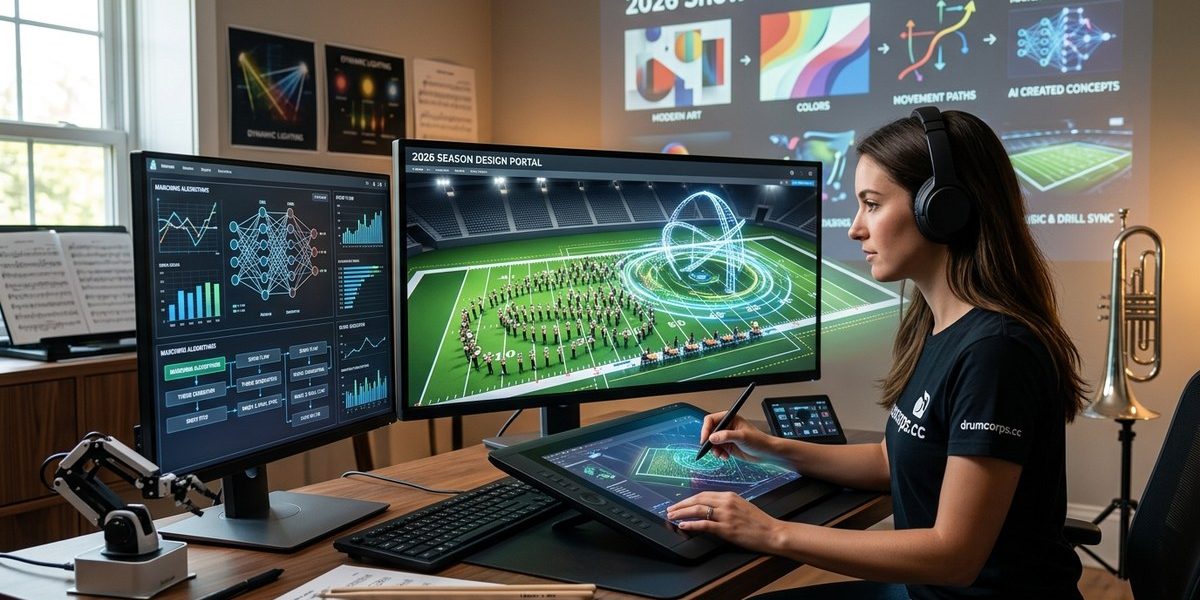
The first time I watched a drum corps show designed with help from artificial intelligence, I didn’t notice anything unusual. That was the point. The drill was clean, the transitions felt natural, and the soundscape had a texture that seemed almost too perfect. When I found out an AI had suggested the spacing for the company front and helped shape the audio mix, I realized something big was happening in the marching arts. This is not about robots replacing designers. It is about giving creative teams new tools to push what a field show can be.
AI drum corps show design is not replacing human creativity. It is a powerful assistant that helps designers test drill sets, generate musical sketches, and visualize staging options in hours instead of weeks. For 2026, several top corps are already using these tools to refine their productions before a single performer steps on the field.
How Designers Actually Use AI for Show Concept Development
The process of building a competitive field show has always started with a blank page. Designers gather around a table with coffee, whiteboards, and a shared vision. They talk about emotion, story arcs, and musical peaks. But in 2026, many of those conversations now include a laptop running specialized software.
Here is a practical look at the workflow some design teams are adopting:
- Thematic brainstorming — Designers feed the AI a set of keywords, emotions, or visual references. The tool returns mood boards, color palettes, and even suggested musical motifs. This helps teams narrow down a theme before committing to a full score.
- Drill prototyping — Instead of manually plotting every coordinate, designers input the field dimensions, performer count, and desired formations. The AI generates multiple drill options that respect spacing rules and flow. The human designer then selects, adjusts, and refines.
- Audio simulation — AI can take a rough MIDI sketch of the brass book and generate a realistic mockup. This lets arrangers hear how a passage will sound in a stadium before a single rehearsal.
One design team I spoke with said this process cut their pre-season planning time by nearly 40 percent. That is time they can spend on the finer details that make a show memorable.
Where Human Judgment Still Wins
AI is a tool, not a magician. It can suggest a formation or generate a chord progression, but it does not understand why a ballad should feel lonely or why a drum break needs to hit with raw energy. Those decisions still belong to experienced designers who know how to move an audience.
Think of it like a calculator for a math student. The calculator does the arithmetic, but the student still needs to know which formula to apply and why. In the same way, AI handles the repetitive calculations of drill geometry or audio mixing, but the artistic vision stays human.
“The best use of AI in show design is as a tireless assistant that never gets tired of trying new ideas. It lets us fail faster, which means we find the good stuff sooner.” — A design team member from a top-12 World Class corps.
Common Mistakes When Using AI for Show Design
Not every corps gets this right. Some teams lean too heavily on the technology and end up with a show that feels generic. Others ignore it completely and miss out on time-saving tools. Here is a breakdown of what works and what does not.
| Technique | What It Looks Like | Common Mistake |
|---|---|---|
| Generative drill prototyping | AI creates 10 formation options from a prompt | Accepting the first suggestion without human adjustment |
| Audio mockup generation | AI turns sheet music into a realistic playback | Over-relying on the mockup and ignoring live acoustics |
| Thematic mood boarding | AI builds a visual palette from keywords | Letting the AI choose the theme instead of the design team |
| Transition smoothing | AI suggests movement paths between sets | Forgetting that performers need breathing room in those paths |
| Repertoire analysis | AI studies past shows to find scoring patterns | Copying trends instead of creating something original |
The table shows a clear pattern. AI works best when it handles the heavy lifting and humans make the final calls. The mistakes happen when designers treat the output as gospel instead of a starting point.
The Tools That Make This Possible
If you are curious about what software is actually being used, here are a few categories that have gained traction in the marching arts community.
- Drill writing assistants — These programs use machine learning to understand standard field dimensions and performer spacing. They can generate full drill charts based on simple input like “open spread to company front in 16 counts.” Designers then tweak the coordinates by hand.
- Audio prototyping platforms — Some AI tools can take a piano reduction of a brass arrangement and orchestrate it for a full horn line. They consider range, balance, and even the acoustic properties of outdoor stadiums.
- Visual staging simulators — These create 3D renderings of the show from the judge’s perspective. You can see how the guard flags will look against the backfield or whether the brass line will be hidden during a key moment.
These tools are not cheap, but for a World Class corps with a budget, they are becoming standard equipment. Smaller corps and even high school marching bands are starting to access scaled-down versions.
What This Means for Performers and Educators
If you are a drum corps fan, you might wonder how this changes what you see on the field. The honest answer is that you probably will not notice the AI at all. You will notice cleaner drill, more cohesive storytelling, and sound that feels fuller. The technology disappears into the performance.
For music educators, this trend is worth watching. The same tools that help design a DCI show can help a high school band director plan a halftime show. If you teach at a school with limited design staff, AI could help you create professional-looking drill without hiring an outside writer. Check out our guide on how modern drum corps shows are pushing the boundaries of visual design in 2026 for more context on where this is heading.
The Future of AI in the Marching Arts
Looking ahead, the next few years will likely bring even tighter integration between AI and live performance. Some developers are already working on real-time systems that can adjust drill formations during a show based on audio feedback from the stadium. Imagine a corps that can subtly shift its spacing to match the acoustics of a particular venue on a given night.
There is also talk of AI tools that can help with individual performer feedback. A system might analyze a video of a marcher’s step and suggest adjustments to their posture or timing. That is further out, but the foundation is being laid.
For now, the most exciting part is watching how creative teams use these tools to tell stories that were too complex or too expensive to attempt before. The 2026 season is already showing us productions that feel more ambitious than anything we have seen in years.
Trusting the Process Without Losing the Art
The best advice I have heard about AI drum corps show design came from a veteran arranger. He said, “Use the computer to do the math, but use your gut to do the art.” That is the balance every design team needs to find.
Artificial intelligence can calculate the fastest path from one set to another. It can suggest a harmonic progression that fits a certain mood. It can even simulate how a chord will ring in an empty stadium. But it cannot feel the goosebumps when the brass line hits a perfect fortissimo at sunset. It cannot know when to break the rules for the sake of a moment.
If you are a designer, a teacher, or just a fan who loves the activity, keep watching this space. The tools will keep improving, but the heart of drum corps will always be the people on the field and the people in the stands. AI is just helping us connect them a little better.
To get started with your own practice and see how these concepts apply at the individual level, check out our guide on how to build a perfect 30-minute individual practice routine. It pairs well with understanding how the big picture comes together.