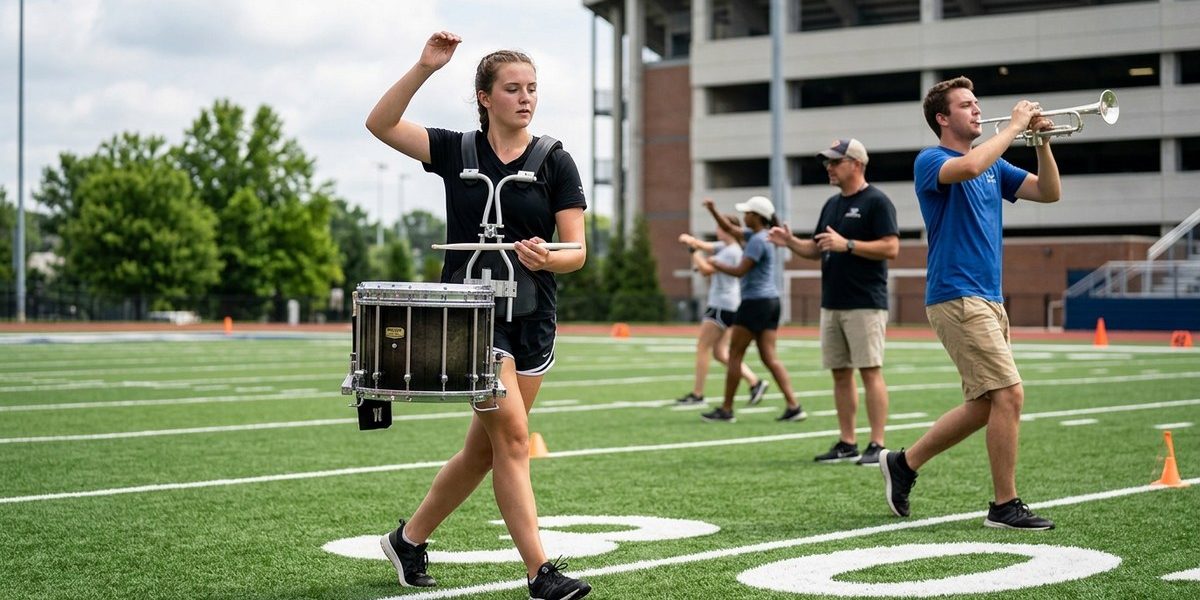
Have you ever played a note or hit a drum exactly when you thought you should, only to watch a video later and realize your foot landed a split second after the beat? That tiny gap between what you hear and what your body does can make an otherwise polished performance feel disconnected. The good news is you can close that gap faster than you think. With the right sound and movement drills, you can train your brain to treat audio and physical action as one single impulse.
This guide walks you through three straightforward sound and movement drills designed to rewire your timing in under an hour. By isolating the connection between ear and body, you will eliminate lag, build muscle memory, and walk away with a repeatable process you can use before rehearsals, performances, or workouts.
Why You Feel Out of Sync (and What to Do About It)
The disconnect between sound and movement usually comes down to one thing: separate processing. When you think about the note and then think about the step, your brain creates a tiny delay. In drum corps, that delay might cost you a tenth of a point on the visual sheet. In a dance routine, it makes your movements look reactive instead of intentional.
The fix is not more reps at a faster tempo. The fix is targeted sound and movement drills that force your auditory and motor systems to fire together. These exercises work for brass players, percussionists, dancers, and anyone who moves to a beat. They are especially useful if you are preparing for an audition or trying to tighten up a show segment. If you struggle with timing in both sound and motion, you might also benefit from understanding why your visual phrasing matters as much as your musical phrasing.
Let us break down the three drills.
Drill 1: The Pulse Stomp
This drill anchors your sound to the most reliable pulse in your body: your foot. It works best with a simple repeated pattern like a drum roll, a held brass note, or even a vocal hum.
How to do it:
- Stand with your feet shoulder width apart. Place your instrument or practice pad in playing position. If you are a dancer, just prepare to clap or vocalize.
- Set a metronome to a comfortable tempo around 80 beats per minute.
- On each click, stomp your left foot. The stomp should be firm and audible. Do not tap softly; commit to the sound.
- On the stamp, play or sing a single note. The sound and stomp must hit at the same instant. If you hear any flam (two separate attacks), you are still processing them separately.
- Continue for 16 beats. Then switch to your right foot for 16 beats.
- Alternate feet every 8 beats. Then try every 4 beats.
- Once comfortable, remove the metronome and try to keep the pulse internal, still stomping and playing together.
Common mistakes and simple fixes
| Mistake | What it feels like | The fix |
|---|---|---|
| Stomp lands before the note | You hear your foot then the sound. | Imagine the note and stomp are one event. Use your breath to initiate both simultaneously. |
| Note arrives before the stomp | The sound seems early. | Relax your shoulders. Often tension in the upper body makes you rush the sound. |
| Tempo drifts as you alternate feet | Your right foot might be slower or faster than your left. | Isolate the weaker foot. Repeat the drill with only that foot for 32 beats. |
| You lose the pulse when you stop stomping | You cannot hold internal time. | Go back to stomping, then fade the stomp volume gradually, not all at once. |
If you find that your breath is the weak link in this drill, read about 5 essential breathing exercises every brass player should master. The same principles apply to any performer.
Drill 2: The Breath Cue
Your breath is the bridge between thought and action. Most people either breathe at random moments or hold their breath during difficult passages. This drill teaches you to use your inhale as a count-in and your exhale as the downbeat.
Steps for the Breath Cue drill:
- Stand tall with your hands at your sides (or holding your instrument in resting position).
- Inhale for four counts. As you inhale, lift your arms slowly to shoulder height. The movement should match the duration of the breath exactly.
- On the exhale, play a single sustained note (or a vocal tone) and simultaneously lower your arms. The note and the arm motion must start and end together.
- Repeat until the arm descent and sound feel like one gesture.
- Now add a step. On the exhale, take one controlled step forward as you play. Your foot should land exactly when the sound begins.
- Increase the tempo gradually. Try inhaling for two counts, then exhale for two counts with sound and movement.
Tips to make it stick:
- Keep your shoulders down. If they rise when you inhale, you will create tension that delays the sound.
- Start the sound on the very first millisecond of the exhale. Do not wait until you have already started moving.
- Use a mirror or record yourself. Watch for any flinch in your face or hands before the sound comes out. That flinch is the lag.
- Practice in slow motion first. Even at 40 beats per minute, the coordination will feel uncomfortable. That is a good sign.
"Your ears and your feet are speaking the same language. You just need to let them talk."
Matt Garrison, former visual caption head for a World Class drum corps
Drill 3: The Mirror Clap
This drill turns sound and movement into a feedback loop. You will use claps, steps, and a partner (or a recording) to create instant audio feedback for every movement.
Partner version (best for rehearsals):
- Stand facing a partner about ten feet apart.
- Partner claps a steady rhythm. You copy the clap with a step: left foot for first clap, right foot for second clap.
- The goal is for your foot to land at the exact moment your partner’s hands meet. Do not watch their hands; listen for the clap.
- Once you can match the pattern, reverse roles. You clap, they step.
- Add a sound: on each step, say "tah" or blow a short air note through your mouthpiece. The sound should arrive with the foot, not after.
Solo version:
- Record a simple clapping track on your phone (four quarter notes, one measure rest, repeat).
- Play it back through headphones.
- Walk the rhythm around the room. For every clap, take one step. Do not look at your feet. Focus on the sound.
- Next, replace the step with a tap on your instrument or a vocal syllable. Keep the clap track as your guide.
- Finally, turn off the recording and try to walk the exact same tempo while producing the sound at each footfall.
This drill reveals how well you internalize tempo without relying on external cues. If your step speed drifts away from the original clap pattern, you still have a gap between hearing and moving. A great follow-up resource is how to stay in step when the tempo changes mid-phrase, which builds directly on this skill.
How to Put These Drills Together in One Session
You do not need hours of practice to see results. A focused 30-minute block works well. Here is a sample session structure:
- 0:00 – 5:00 : Pulse Stomp (start with 80 bpm, alternate feet every 8 beats, then 4 beats)
- 5:00 – 10:00 : Breath Cue (slow, four-count inhale / four-count exhale with sound)
- 10:00 – 15:00 : Mirror Clap with a recording (walk the clap pattern, then add sound)
- 15:00 – 20:00 : Cycle through all three drills without a metronome. Rely only on your internal pulse.
- 20:00 – 25:00 : Apply one of the drills to a short phrase from your show or routine.
- 25:00 – 30:00 : Repeat the phrase at performance tempo, focusing on one sync point per rep.
This routine works as a pre-rehearsal warmup or as a standalone session when you have limited time. If you want to build a more complete rehearsal plan, check out how to build a perfect 30-minute individual practice routine.
Common Mistakes When Syncing Sound and Movement
Even with good drills, some patterns can hold you back. Awareness helps you correct them early.
- Rushing the first note : Many performers start the motion or sound a hair early because of excitement. Let the metronome or your breath cue dictate the start, not your adrenaline.
- Locking your knees : When you stomp or step with straight legs, the sound becomes stiff and the timing gets harder to control. Keep a slight bend in your knees.
- Holding your breath : If you notice that you are holding your breath while playing or moving, you are splitting your attention. Breathe through the motion.
- Relying only on sight : Watching other people or a conductor can mask sync problems. Close your eyes for a few reps and listen. Your ears are more honest.
A useful analogy is the difference between reading a recipe and tasting the dish. Sight tells you what to do, but hearing tells you when it is right.
Why Consistency Beats Speed Every Time
It is tempting to crank the metronome up and try to prove you can play fast while moving fast. But speed without sync just sounds sloppy at a higher rate. The real goal is to make the connection between sound and movement so automatic that you do not have to think about it.
Think of these drills as calibration tools. Each session you spend on them tunes your internal processor a little more. If you practice the Pulse Stomp at 80 bpm for three days, then move to 90 bpm, the improvement is not just the tempo. You are also building a reference point. Your body learns what "in sync" feels like at that speed. The next time you step onto a field or stage, your timing will be closer to that memory than to a guess.
For more on building reliable timing habits, see should you practice with a metronome every day.
The Real Reward of Sound and Movement Synchronization
When your sound and movement finally line up, something shifts. Instead of reacting to the music, you become the music. Your steps feel lighter. Your notes feel fuller. The audience stops hearing separate elements and starts feeling a complete moment.
These three sound and movement drills are not just for fixing problems. They are for unlocking a level of performance where you stop worrying about timing and start focusing on expression. Pick one drill today. Do it for ten minutes. Tomorrow add the second. By the end of the week, you will notice the difference in every rehearsal, every run through, and every performance.
The field is waiting. Make your sound and movement one thing.