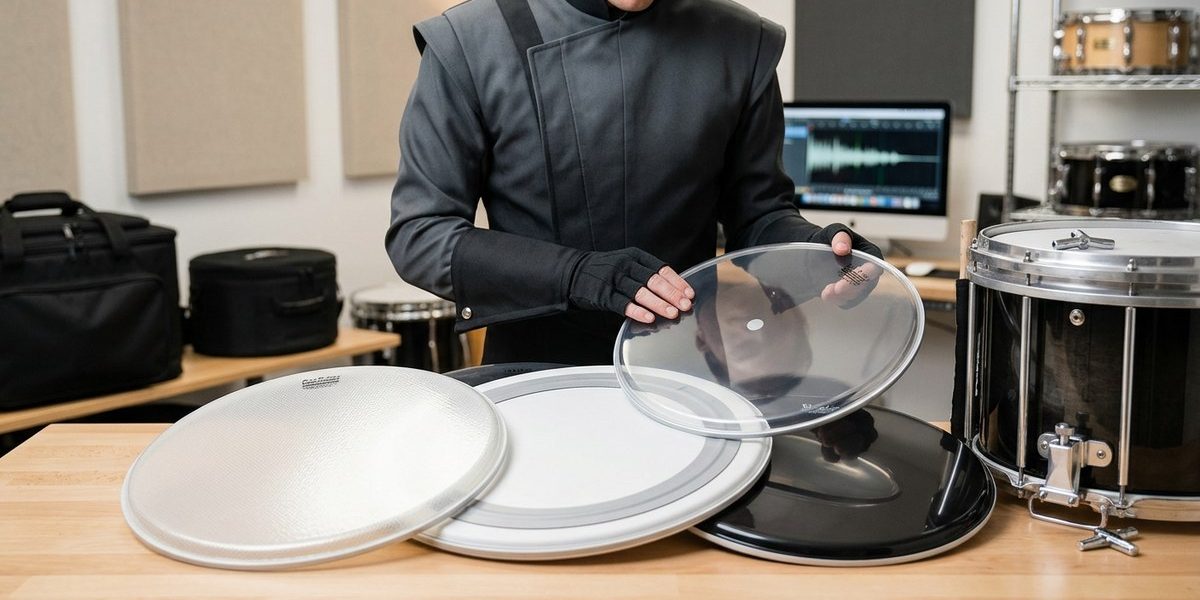
Your snare drum head is the only point of contact between your stick and your instrument. It determines your sound, your feel, and your endurance on the field. Whether you’re auditioning for a World Class corps or leading your high school drumline, picking the right head can mean the difference between slicing through the stadium and getting buried in the mix. With so many options on the shelf in 2026, it’s easy to get lost in the buzzwords and bright packaging. This guide will help you cut through the noise and find the head that works best for how you play.
Your playing style dictates everything about your head choice. If you rely on rimshots and heavy back beats, go with a two-ply Kevlar head for durability. For softer, articulate playing, a single-ply Aramid head gives you better stick response. Always match your head to your drum’s bearing edge and your corps’ tuning preferences. Test before you commit.
What Makes a Marching Snare Head Different?
Marching snare heads are built for punishment. Unlike a concert snare head, which might prioritize warmth and sustain, a marching head must project across a football field and survive hours of high-velocity playing in all weather. Most professional-grade marching heads use a material called Aramid fiber (often branded as Kevlar) or a blend of Aramid and polyester. This makes them incredibly strong and resistant to breaking under extreme tension.
The trade-off is feel. Aramid heads are stiffer and require more tension to sound good. They also respond differently to different stick types. A thick, heavy head paired with a massive stick will fatigue your hands quicker, while a thinner head gives you more rebound but less durability. Finding your balance is key.
The Three Main Types of Marching Snare Heads
| Material | Common Brands | Best For | Durability | Feel |
|---|---|---|---|---|
| Single-ply Aramid | Remo Falams XT, Evans MX5 | Clean articulation, fast rolls, indoor or low-volume outdoor | Medium | Responsive, moderate rebound |
| Two-ply Aramid | Evans MX7, Remo Suede Ambassador XT | Heavy rimshots, high volume outdoor, aggressive playing | Very high | Stiffer, less rebound but more power |
| Aramid/polyester hybrid | Remo PowerStroke, Evans Hybrid | Balanced projection with some warmth, all-around use | High | Medium feel, good stick feedback |
Single-ply heads are common in indoor percussion and smaller drumlines where finesse matters more than raw power. They allow you to play faster with less effort because the head vibrates more freely. The downside is that they wear out faster and may not hold up to the constant pounding of a summer tour.
Two-ply heads are the standard for World Class drum corps. They take abuse well and produce a focused, cutting sound that carries. The extra layer dampens some overtones, which helps maintain clarity even when you’re playing at fortissimo. Many lines tune them to a high pitch that gives that signature “pop” you hear in championship productions.
Hybrid heads try to give you the best of both worlds. They have a thicker outer ply for durability but a thinner inner ply for sensitivity. In 2026, several top lines are experimenting with hybrids to get a warmer tone without sacrificing projection.
Matching a Head to Your Playing Style
Your technique and the music you play should drive the decision. Let’s break it down by common styles.
Aggressive Players Who Love Rimshots
If your default stroke is a hard rimshot and you play music that demands strong accents and back beats, you need a two-ply Aramid head. The Evans MX7 or Remo Suede Ambassador XT are industry favorites. They can handle the abuse and still produce a crisp, articulate attack. You will lose some rebound compared to a single-ply head, but you will gain durability and the ability to tune higher without choking the drum.
Fast, Technical Players
If you play a lot of rolls, diddles, and fast passages, you want a head that responds quickly. A single-ply Aramid head like the Remo Falams XT offers a lively rebound that makes singles and doubles feel effortless. Just be ready to change heads more often, especially if you practice on concrete or asphalt surfaces. Many indoor lines swear by single-ply heads for shows that require speed and control rather than sheer volume.
All-Around Players
You play a mix of styles and need a head that can do everything. Go with a two-ply Aramid head tuned slightly lower than maximum tension. It will give you enough rebound for technical passages while still holding up for powerful hits. Alternatively, try a hybrid head like the Evans Hybrid, which has a built-in overtone control ring. It balances warmth with attack and works well bright and dry climates.
Climate and Venue Considerations
Outdoor performances in humid or rainy weather can change a head’s tension. Two-ply heads are less affected by humidity than single-ply heads. If you’re marching in the South or Pacific Northwest, consider a sealed Kevlar option that resists moisture damage. Indoor players can use thinner heads without worrying about weather.
How to Choose the Right Head in Five Steps
- Assess your playing volume. How loud do you need to be? If you’re in a drum corps that plays outdoors to 20,000 people, two-ply is almost mandatory. For indoor or smaller ensembles, single-ply may suffice.
- Consider your stick choice. Heavy sticks like the Vic Firth MS5 or IP Ralph Hardimon are powerful but can break thinner heads faster. Match your head to your stick diameter and tip shape. For more on sticks, see our best drumsticks for marching snare guide.
- Test tension preferences. If you like a tight, high-pitched sound, go with a two-ply head that can handle the tension without distorting. If you prefer a lower, more resonant sound, a single-ply head tuned medium might be better.
- Check your drum’s bearing edge. A sharp bearing edge works well with single-ply heads; a rounded edge pairs better with two-ply heads to avoid premature wear.
- Try before you buy (if possible). Many music stores let you test heads on a practice drum. Bring your own sticks and play your favorite exercises to feel the difference.
“I always tell my students to think of the head as the voice of the drum. A two-ply head is like shouting, a single-ply head is like speaking. You have to know which voice the music needs.” – Ben Thies, former snare drummer for the Blue Devils
Common Mistakes to Avoid
- Putting a concert snare head on a marching drum. It will break on the first rimshot.
- Overtightening a single-ply head. It can tear at the collar.
- Ignoring the snare side head. The bottom head (usually a clear, thin Mylar) matters just as much for snare response. Replace it at least once a season.
- Buying based on brand loyalty only. Every brand has multiple lines with different characteristics. Read the spec sheet.
If you’re struggling with uneven rolls or inconsistent sound, check out our guide on how to fix uneven double stroke rolls on snare drum. Sometimes the issue isn’t the head, but your technique.
Setting Up Your New Head for Success
Once you’ve selected your head, installation matters. Follow these tips for best results:
- Seat the head evenly on the bearing edge. Press down all around to make sure it’s centered.
- Tighten the tension rods in a star pattern, just like with a drumset. Go in quarter turns to avoid warping.
- Bring the head up to your desired pitch slowly. Let it sit for a few minutes, then retighten.
- Check the snare wires. Adjust tension so they don’t choke the head but still give you a crisp buzz.
If you’re new to tuning marching snares, read our article on can you really tune a snare drum for outdoor marching? It covers the specific techniques for getting your drum to sing in an open field.
Final Thoughts on Picking Your Head
Your snare head is the heart of your setup. It affects everything from stick control to tone projection. In 2026, the options are better than ever, with manufacturers offering specialized heads for every style. Start by identifying your playing priorities: raw power, technical finesse, or a balanced middle ground. Then pick a head that matches those priorities and your budget.
Don’t be afraid to experiment. Many drumlines order extra heads and test them during spring training before committing to one model. You can do the same on your own kit. Try a different head each season and note what you like and dislike. Over time you’ll develop a preference that becomes part of your signature sound.
For more on building your overall technique and endurance, check out 7 drumline exercises that build speed and accuracy fast. Once you have the right head, those exercises will feel even more effective.
Happy drumming. Your drumline deserves the best sound you can give them.