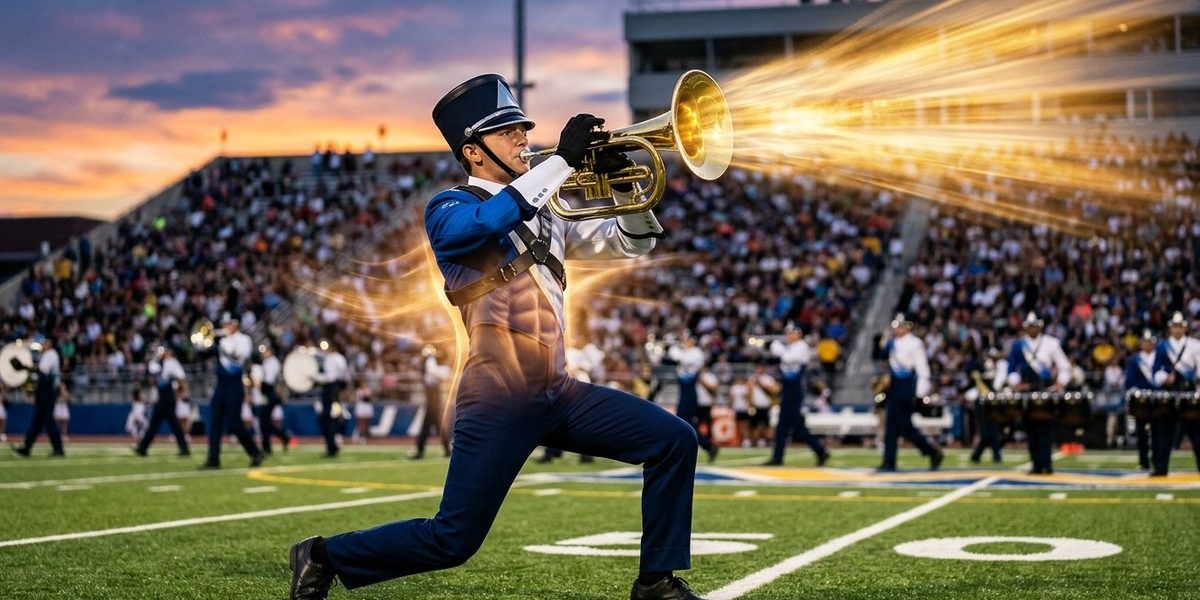
You’ve practiced your parts until you can play them in your sleep. Your tone sounds great in the practice room. But the moment you step onto the field with full gear and start marching, your sound disappears into the stadium air.
This frustration hits brass players at every level. The good news? Projection isn’t about playing louder. It’s about using your body more efficiently while moving.
Brass projection on the marching field depends on breath support, core engagement, and proper posture while moving. Players who master [diaphragm](https://www.ncbi.nlm.nih.gov/books/NBK470309/)atic breathing, maintain upper body stability, and practice playing while marching see immediate improvements in sound quality and volume. These techniques work together to create consistent, powerful projection that cuts through outdoor [acoustics](https://en.wikipedia.org/wiki/Acoustics) without sacrificing tone or causing fatigue.
Understanding why projection changes on the field
Indoor practice rooms have walls that reflect sound back to you. You hear yourself clearly and can adjust your playing based on that feedback.
Outdoor stadiums swallow sound. No walls bounce your notes back. Wind carries frequencies away unpredictably. Your sound travels in one direction and keeps going.
Add marching to this equation. Your body moves constantly. Your breathing rhythm competes with your step pattern. Your core muscles work to keep you balanced and upright instead of supporting your air column.
Most players compensate by pushing harder with their lips and blowing more air. This creates tension, ruins tone quality, and leads to early fatigue. The solution requires a different approach entirely.
Building breath support that works while moving
Your diaphragm does the heavy lifting for projection. This muscle sits below your lungs and pushes air up through your instrument when it contracts.
Shallow chest breathing won’t cut it on the field. You need deep, controlled breaths that fill your lungs completely and release air in a steady, pressurized stream.
Here’s how to develop this skill:
- Stand with feet shoulder width apart and place one hand on your stomach
- Breathe in through your nose for four counts, feeling your belly expand outward
- Hold for two counts while keeping your shoulders relaxed
- Release air through pursed lips for eight counts, feeling your stomach pull inward
- Repeat this cycle ten times daily, gradually extending the exhale duration
This exercise trains your diaphragm to work independently from your chest and shoulders. Once you can do this standing still, practice it while walking slowly. Then add your marching step pattern.
The connection between breathing fundamentals and field performance runs deep. Players who master 5 essential breathing exercises every brass player should master report noticeable improvements within two weeks of consistent practice.
Engaging your core for stable air support
Your core muscles form a cylinder around your midsection. They include your abs, obliques, lower back, and pelvic floor. When these muscles engage properly, they create a stable platform for your diaphragm to push against.
Think of your core as the foundation of a house. Without a solid base, everything above it becomes unstable. Your air column needs that same stability to maintain consistent pressure while you march.
Try this test right now. Play a sustained note at forte while standing still. Now play the same note while doing a slow march in place. Notice how much harder it is to maintain volume and tone quality.
That difficulty comes from your core muscles working to keep you balanced instead of supporting your breath. Training your core to handle both jobs simultaneously makes all the difference.
Core exercises for brass players
These movements build the specific strength you need:
- Planks held for 30 to 60 seconds
- Bird dogs with opposite arm and leg extensions
- Dead bugs lying on your back with controlled limb movements
- Standing marches with high knees while maintaining tall posture
- Russian twists with a medicine ball
Do these exercises three times per week. Focus on controlled movements and steady breathing throughout each repetition.
The goal isn’t to build six pack abs. You’re training your muscles to maintain stability and breath support simultaneously. This dual function separates good field players from great ones.
Posture principles that maximize sound
Your body position directly affects how air flows through your instrument. Collapsed posture restricts your lungs and weakens your sound. Proper alignment opens your airways and lets your air move freely.
Stand in front of a mirror and check these alignment points:
- Ears over shoulders
- Shoulders over hips
- Hips over ankles
- Chest lifted without arching your back
- Weight distributed evenly on both feet
This position feels tall and open. Your rib cage has room to expand fully. Your diaphragm can contract without fighting against compressed organs.
Now add your instrument. Your horn angle should allow you to maintain this alignment without tilting your head down or jutting your chin forward. Many players sacrifice posture to see their music or match a visual aesthetic. This costs them projection power.
“The best brass players I’ve worked with all share one trait: they refuse to compromise their playing posture for visual demands. They find ways to maintain proper alignment while executing drill. That commitment shows in their sound quality.” — Caption head from a Division I university marching band
Maintaining this posture while marching takes practice. Your body wants to lean forward, round your shoulders, or tilt your pelvis. Each of these adjustments closes off your air pathway and weakens your projection.
For more detailed guidance on posture while moving, check out 5 body alignment drills that transform your marching posture.
Practicing projection techniques systematically
Random practice won’t build consistent skills. You need a structured approach that gradually adds complexity.
Start with stationary playing. Master your breath support and tone quality without any movement. Use a tuner and recording device to track your progress objectively.
Once your stationary sound meets your standards, add simple movements:
- Play long tones while marching in place
- Play scales while walking forward slowly
- Play etudes while executing basic drill patterns
- Play show music at performance tempo with full visual demands
Each step should feel comfortable before you move to the next. Rushing this progression leads to bad habits that become harder to fix later.
Record yourself during each practice session. Listen for changes in tone quality, intonation, and volume as you add movement. These recordings reveal problems your ears might miss while you’re playing.
Building how to build a perfect 30 minute individual practice routine around these principles creates steady improvement over time.
Common mistakes that kill projection
Even experienced players fall into these traps. Recognizing them helps you avoid or correct them faster.
| Mistake | Why It Hurts | How to Fix |
|---|---|---|
| Chest breathing | Limits air capacity and creates tension | Practice diaphragmatic breathing daily |
| Collapsed posture | Restricts airflow and compresses lungs | Do alignment checks before every rep |
| Excessive mouthpiece pressure | Cuts off vibration and causes fatigue | Focus on air speed instead of pressure |
| Holding tension in shoulders | Restricts rib cage expansion | Drop shoulders and relax neck muscles |
| Inconsistent air speed | Creates uneven tone and volume | Use steady exhale exercises |
| Playing louder instead of better | Sacrifices tone quality and control | Develop efficient air use first |
The mouthpiece pressure issue deserves extra attention. Many players push their mouthpiece harder into their lips when they want more volume. This actually restricts the vibration needed for good tone and causes early fatigue.
Instead, focus on increasing air speed through your instrument. Faster air creates more volume naturally without requiring extra pressure. This approach maintains tone quality and prevents the lip damage that comes from excessive pressure.
Adapting to different field conditions
Outdoor performance environments change constantly. Wind, temperature, humidity, and stadium acoustics all affect how your sound projects.
Cold weather makes brass instruments play sharp and requires more air to get the same volume. Your lips feel stiffer and less responsive. Warm up longer and stay patient with your embouchure.
Wind creates obvious challenges. Playing into a headwind requires more air support. Playing with a tailwind can make you sound louder than expected, leading to balance issues within your section.
Stadium acoustics vary wildly. Some venues have partial roofs or walls that reflect sound. Others are completely open. High school fields differ from college stadiums. Each environment requires slight adjustments to your projection approach.
The solution? Practice in varied conditions whenever possible. Don’t limit your rehearsals to perfect weather days. Learning to project effectively in challenging conditions makes normal performances feel easy.
Connecting physical fitness to playing endurance
Marching band is an athletic activity. Your cardiovascular fitness directly impacts how long you can maintain quality projection during a show.
Better cardio means your body delivers oxygen more efficiently. This supports sustained playing without the breathlessness that ruins projection in the final minutes of a performance.
Running, cycling, or swimming three times per week builds this endurance. You don’t need intense training. Moderate cardio for 20 to 30 minutes creates noticeable improvements.
Flexibility matters too. Tight hip flexors, hamstrings, or lower back muscles affect your marching posture. This postural compromise then impacts your breathing and projection.
Stretch for 10 minutes after every rehearsal. Focus on your hips, legs, and back. This recovery time prevents the tightness that accumulates over a season and gradually degrades your playing position.
Section balance and blend considerations
Individual projection means nothing if your section doesn’t balance properly. The goal is unified sound that projects as one voice, not a collection of individual players competing for volume.
Listen across your section during every rep. Can you hear the players on either side of you clearly? If not, you might be overplaying or they might be underplaying. Either way, the section suffers.
Match your tone quality to your section’s standard. Some groups prefer a darker sound. Others want brighter projection. Your individual preferences matter less than section unity.
Dynamic contrast becomes harder to achieve on the field. The difference between forte and fortissimo feels less obvious outdoors. Exaggerate your dynamics slightly to ensure they register with judges and audiences.
Practice your show music at different dynamic levels during sectionals. Play everything at piano. Then mezzo forte. Then fortissimo. This exercise builds your ability to project at any volume while maintaining tone quality and blend.
Maintaining technique during long rehearsal blocks
Three hour rehearsals test your physical and mental endurance. Projection quality often declines as fatigue sets in.
Take smart breaks. Step away from your horn every 20 to 30 minutes. Drink water. Stretch your neck and shoulders. Let your lips recover.
During water breaks, do gentle lip buzzing without your mouthpiece. This keeps blood flowing to your embouchure without adding stress. Avoid the temptation to keep practicing difficult passages. Your lips need actual rest.
Mental fatigue affects projection too. When your brain gets tired, you stop monitoring your technique carefully. Posture collapses. Breathing becomes shallow. Core engagement disappears.
Stay mentally engaged by setting specific goals for each rep. “I’ll focus on breath support during the opener.” “I’ll maintain perfect posture through the ballad.” These targeted objectives keep your mind sharp and your technique consistent.
The warmup routine you use before rehearsal matters as much as the rehearsal itself. Problems in why your warmup might be holding you back and how to fix it often show up as projection issues later in the day.
Measuring your projection progress
Subjective feelings about your playing can mislead you. Objective measurements provide clearer feedback about your improvement.
Record yourself playing the same excerpt every week. Use the same location, same distance from the microphone, and same dynamic marking. Listen for changes in volume, tone quality, and consistency.
Ask your section leader or band director for regular feedback. They hear you from the podium and can identify projection issues you might miss. Be specific in your questions. “Does my sound project evenly throughout the show?” works better than “How do I sound?”
Video recordings capture your posture and body position while playing. Watch for the alignment issues discussed earlier. Your body position on video often looks different than it feels while you’re marching.
Use a decibel meter app during practice. While volume isn’t everything, tracking your sound level at different points in your show reveals where your projection drops. These weak spots need targeted practice.
Bringing these techniques together on game day
Performance day tests everything you’ve practiced. Nerves, excitement, and adrenaline all affect your playing.
Arrive early enough to warm up properly. Your body needs time to activate the muscle memory you’ve built. Rushing through warmups leads to inconsistent projection during the show.
Stay hydrated starting the day before your performance. Dehydration thickens your saliva and makes your lips less responsive. Both problems hurt your projection.
During the performance, trust your training. Don’t try to play louder than you’ve practiced. Don’t change your technique because you’re nervous. Execute what you’ve rehearsed and your projection will take care of itself.
After the show, do a gentle cool down. Play some long tones at a comfortable dynamic. Stretch your body. This recovery process helps you maintain technique across multiple performances during competition season.
Making projection practice part of your daily routine
Consistency beats intensity when building these skills. Fifteen minutes of focused practice every day produces better results than one long session per week.
Structure your daily practice around the fundamentals covered here:
- Five minutes of breathing exercises
- Five minutes of core engagement work
- Five minutes of playing with proper posture and projection
This routine takes minimal time but builds the foundation for excellent field projection. Add it to your regular practice schedule and track your progress over several weeks.
The techniques in this guide work for every brass instrument. Trumpets, mellophones, baritones, and tubas all benefit from better breath support, core strength, and posture. The principles remain the same even though the instruments differ.
Your sound is your signature on the field. Strong projection that maintains tone quality and consistency separates memorable performances from forgettable ones. The physical and technical work required takes time, but the results show up in every note you play.
Start with one technique from this guide. Master it completely before adding the next. This patient, systematic approach builds skills that last your entire marching career and beyond.