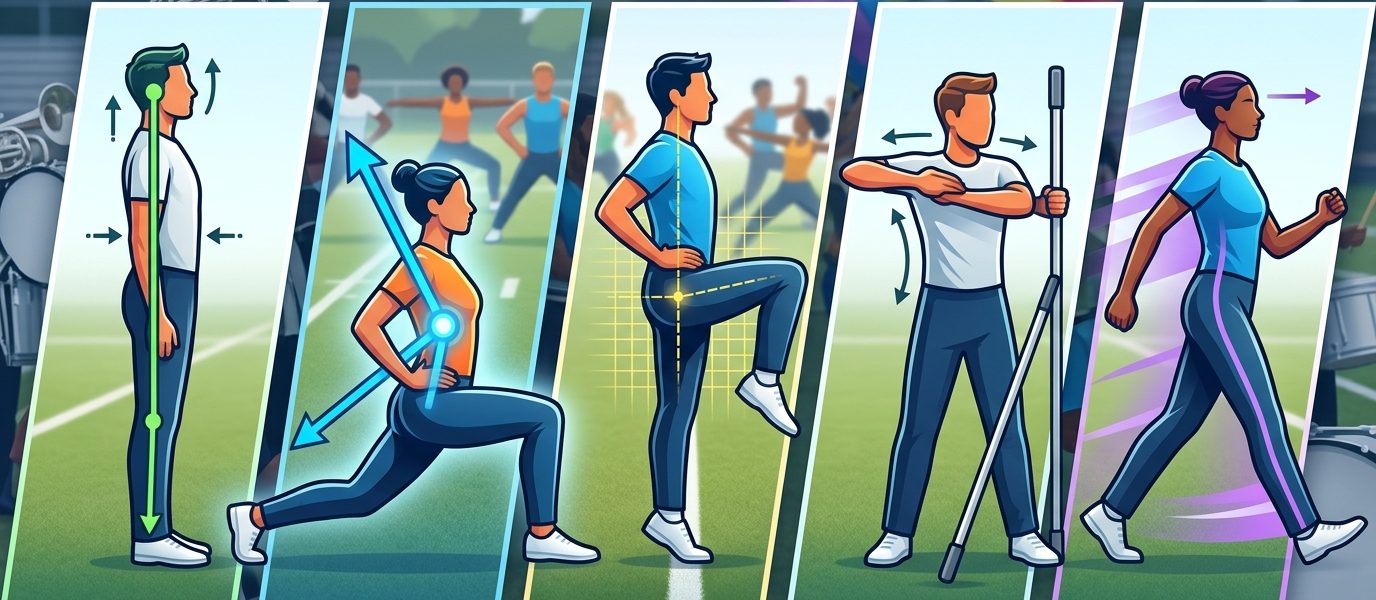
You can spot a performer with great posture from the back row of the stadium. Their shoulders sit level, their spine stays tall, and every step looks effortless. That kind of presence doesn’t happen by accident. It comes from consistent practice with the right drills.
Effective marching band posture drills target alignment, balance, and muscle memory through specific exercises like wall stands, mirror checks, and partner feedback. These techniques correct common mistakes such as forward head position, locked knees, and rounded shoulders while building the core strength needed for sustained performance. Regular practice of these five foundational drills creates visible improvements in stage presence within two to three weeks of consistent training.
Why Body Alignment Makes or Breaks Your Performance
Poor posture creates a cascade of problems on the field. Your sound suffers when your airway compresses. Your stamina drops when muscles work against each other instead of together. Your visual impact weakens when the line looks uneven.
Good alignment solves all three issues at once. Your diaphragm gets full expansion room. Your legs carry weight efficiently. Your section presents a unified front that judges notice immediately.
The difference shows up in scores. Bands that drill alignment consistently place higher in visual categories. Directors who prioritize posture work see fewer injuries and better endurance through long competition days.
The Wall Stand Test
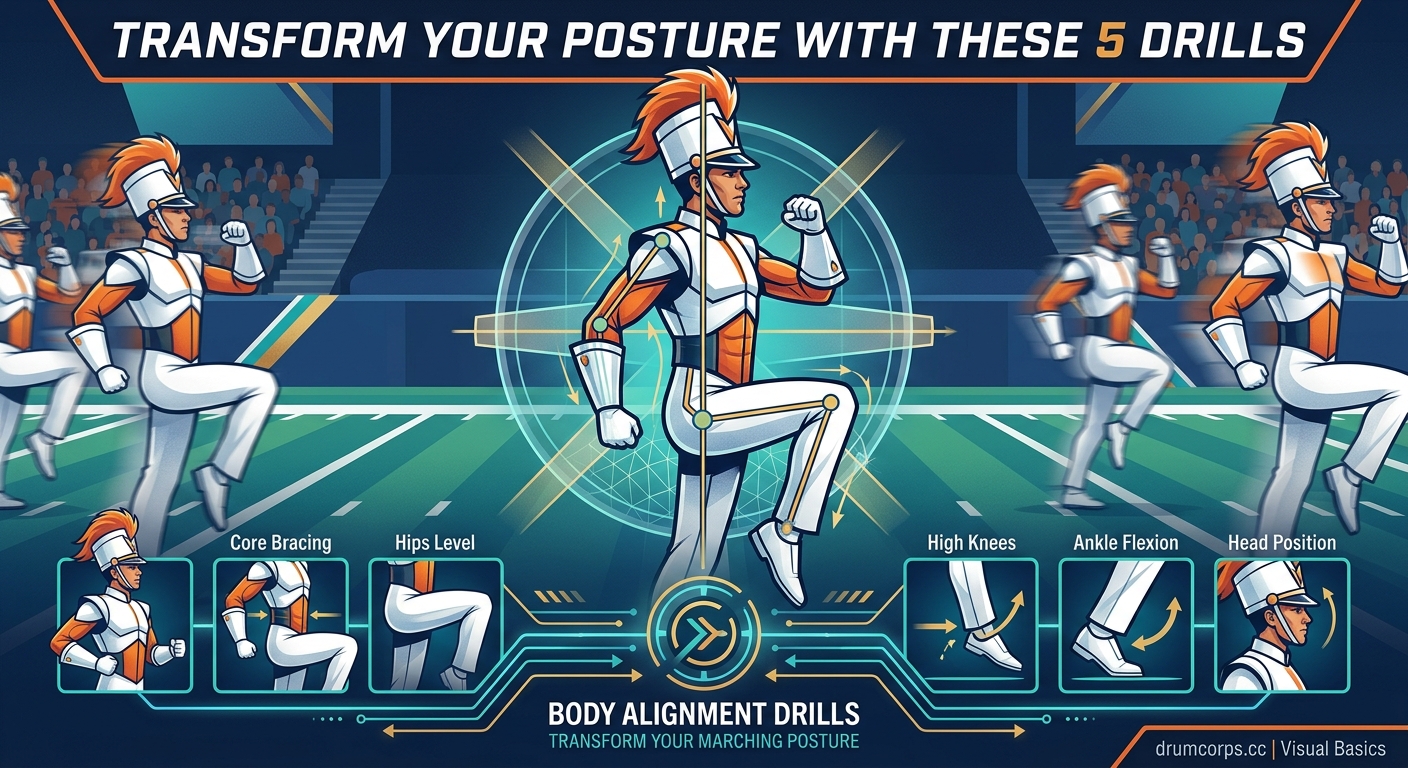
This drill reveals alignment issues you can’t feel while moving. Find a flat wall and stand with your back against it. Your heels should touch the baseboard. Let your shoulders and head make contact naturally.
Most performers discover gaps they didn’t know existed. A space behind the lower back is normal. But if your head won’t touch without forcing it back, you’re carrying forward head posture. If your shoulders pull away from the wall, you’re rounding forward.
Here’s how to use this information:
- Stand against the wall for 30 seconds while breathing normally
- Step away and hold that same position for another 30 seconds
- Walk 10 steps forward while maintaining the feeling
- Return to the wall and check if you kept the alignment
Do this sequence three times before every rehearsal. Your body learns to recognize correct position through repetition. After two weeks, the aligned position starts feeling more natural than your old habits.
The wall also works for side-to-side balance. Have someone check if one shoulder sits higher than the other. Many performers compensate for instrument weight by hiking one side up. That creates neck tension and throws off your center of gravity.
Mirror Work for Real-Time Feedback
You need to see what the judges see. Set up a full-length mirror at the end of your practice space. March toward it while holding performance posture.
Watch for these common breaks:
- Head drifting forward as you get tired
- Shoulders creeping up toward your ears
- Hips shifting side to side instead of staying level
- Knees locking on the platform of each step
The mirror doesn’t lie. Your internal sense of “straight” often differs from actual vertical alignment. Video yourself if mirrors aren’t available. Phone cameras work fine for this purpose.
Try this mirror drill during fundamentals block:
- Face the mirror in attention position
- March in place for 16 counts at performance tempo
- Freeze and assess your position
- Adjust one thing (shoulders, head, or hips)
- Repeat with the correction in place
Focus on one body part per session. Trying to fix everything at once overloads your attention. Master shoulder position one day, head placement the next, hip stability the day after.
Partner Checks for Blind Spots
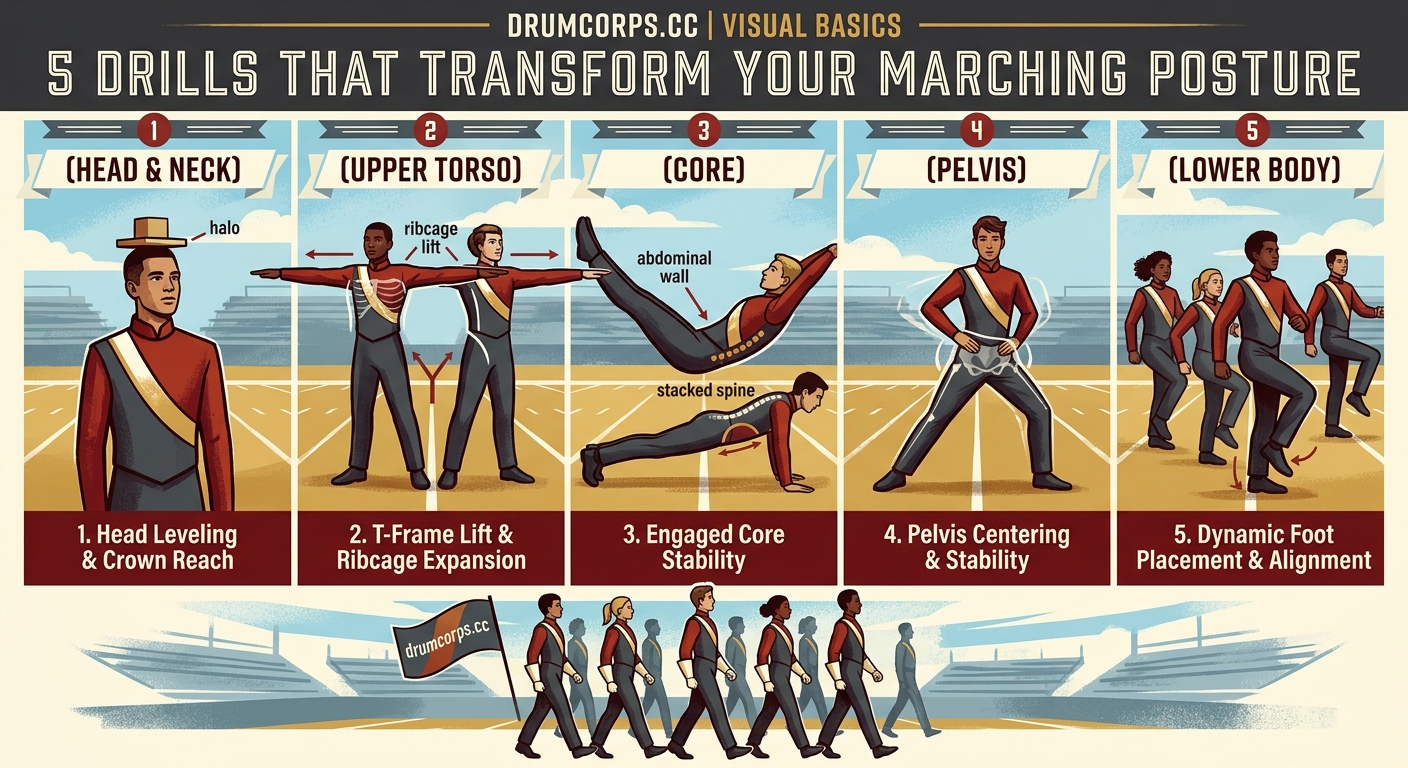
Some alignment issues hide from mirrors and walls. You need another set of eyes watching from different angles.
Pair up with someone at your skill level. Take turns marching while the other person watches from the side and back. The observer calls out specific feedback using agreed-upon cues.
| What to Check | What to Look For | Common Mistake |
|---|---|---|
| Head position | Ear over shoulder | Chin jutting forward |
| Shoulder level | Even height | One side hiking up |
| Spine angle | Vertical from hip to head | Leaning back from waist |
| Knee action | Slight flex at platform | Locked straight or over-bent |
| Foot placement | Straight forward | Toes turning out |
The person marching can’t see these details themselves. Your partner provides information you can act on immediately. Switch roles every 32 counts so both people get equal practice time.
Use specific language. “Your left shoulder is high” works better than “something looks off.” Clear feedback produces faster corrections.
The best marching technique comes from awareness, not tension. You can’t force good posture by clenching every muscle. You have to train your body to find neutral alignment and maintain it with minimal effort. That’s what separates performers who look stiff from those who look natural and confident.
Core Engagement Exercises
Strong abs and back muscles hold your spine in place without constant conscious effort. Weak cores collapse under the demands of long rehearsals and performances.
These exercises build the endurance you need:
Plank holds: Start with 20 seconds and add 5 seconds each week. Keep your body in a straight line from head to heels. Don’t let your hips sag or pike up.
Bird dogs: From hands and knees, extend opposite arm and leg. Hold for 5 seconds, then switch. Do 10 reps per side. This trains balance and back strength simultaneously.
Dead bugs: Lie on your back with arms straight up and knees bent at 90 degrees. Lower opposite arm and leg toward the floor while keeping your lower back pressed down. Return and switch sides. Complete 12 reps per side.
Do these three exercises four times per week. They take 10 minutes total. Schedule them before breakfast or after rehearsal when you have consistent free time.
The payoff shows up in the third week. You’ll notice you can hold proper alignment longer before fatigue sets in. Your back won’t ache after two-hour blocks. Your breathing stays unrestricted even during demanding drill sequences.
The Breathing Checkpoint Drill
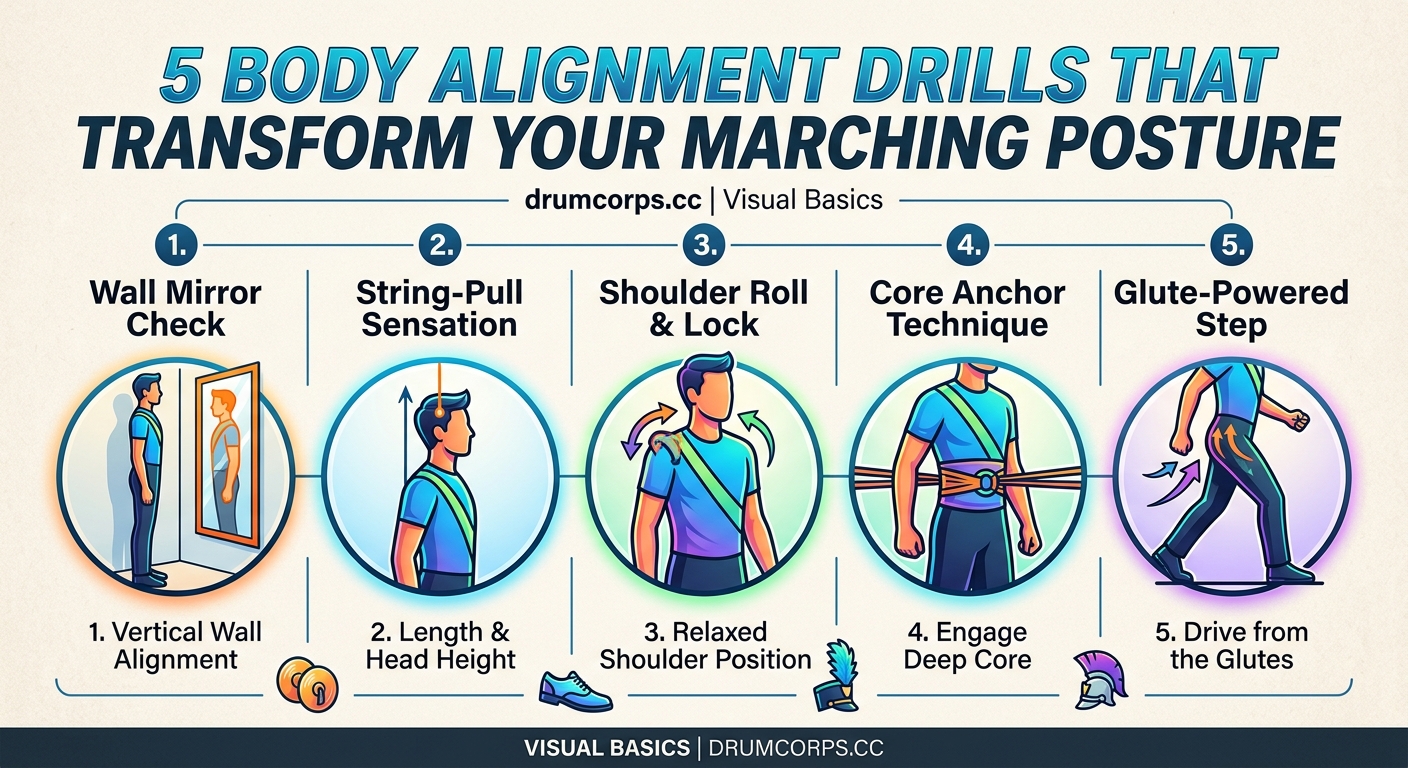
Proper alignment and efficient breathing connect directly. When your posture collapses, your air support goes with it. This drill trains both skills together.
Stand in performance position. Place one hand on your stomach and one on your chest. Take a full breath. The stomach hand should move out while the chest hand stays relatively still. That indicates diaphragmatic breathing.
Now march in place for 16 counts. Stop and check your breath again. Did your breathing shift to your upper chest? That signals posture breakdown. Your ribcage can’t expand fully when your shoulders round forward or your head juts out.
Practice this sequence:
- Set your alignment using the wall stand position
- Take three full breaths with proper diaphragm expansion
- March 32 counts at performance tempo
- Stop and immediately check your breathing pattern
- Reset your posture if needed and repeat
This drill reveals the exact moment when your form breaks down. Maybe you hold strong for 16 counts but collapse at 24. That’s your current endurance threshold. Work to extend it by 8 counts each week.
Band directors can run this as a full ensemble exercise. Call out “breathing check” randomly during drill run-throughs. Everyone freezes and assesses their air support. It builds awareness across the entire group.
Common Mistakes That Undo Your Progress
Even performers who understand good posture fall into predictable traps. Recognizing these patterns helps you avoid them.
Overcorrection: Throwing your shoulders too far back creates just as many problems as rounding forward. You want neutral spine position, not exaggerated military bearing. The wall stand test shows you where neutral actually sits.
Holding your breath: Some people tense up so much while focusing on posture that they forget to breathe normally. Tension kills good form. Your alignment should allow free, unrestricted breathing.
Ignoring foot placement: Your foundation affects everything above it. If your feet turn out or your weight sits too far forward, your whole spine compensates. Check your foot position as often as you check your shoulders.
Only drilling at the start of rehearsal: Posture work belongs throughout your practice time, not just in the warmup block. Run alignment checks between rep runs. Make it part of your water break routine.
Skipping strength work: You can’t maintain good form without the muscular endurance to support it. Core exercises aren’t optional extras. They’re fundamental to sustained improvement.
Building Muscle Memory That Lasts
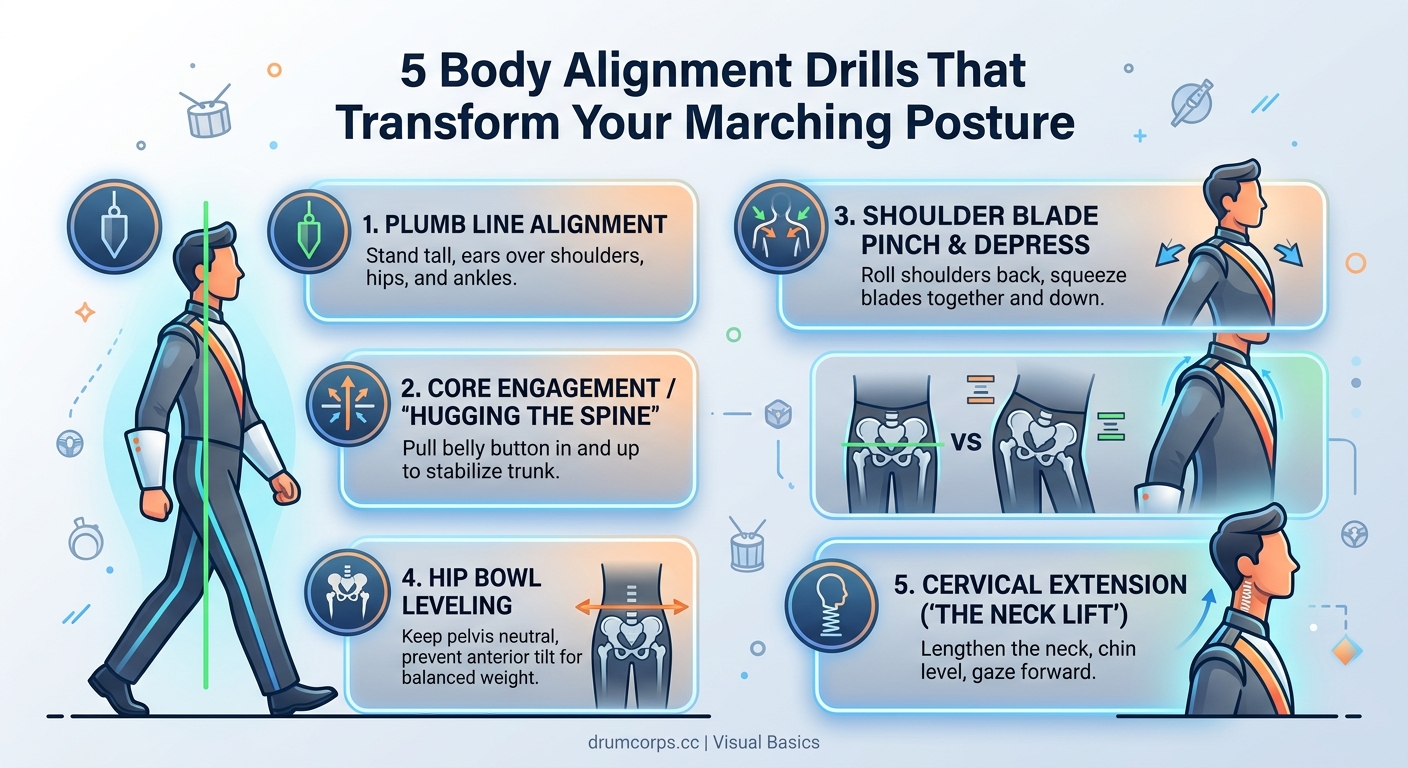
Your body learns through repetition. One perfect rep doesn’t rewire years of slouching. You need consistent practice over weeks and months.
Set specific goals for each practice session. Today you’ll focus on keeping your head back. Tomorrow you’ll work on shoulder level. Breaking improvement into small pieces makes progress measurable.
Track your wall stand time. Write down how long you can hold proper alignment before feeling strain. Watch that number climb week by week. Visible progress motivates continued effort.
Film yourself monthly. Compare footage from September to October to November. The visual evidence of improvement reinforces the value of daily drill work.
Stay patient with the process. Postural habits took years to form. They won’t disappear in three rehearsals. But consistent attention produces noticeable change within a month. By mid-season, proper alignment feels more natural than your old patterns.
Making Posture Work Stick Between Rehearsals
What you do outside the band hall matters as much as what happens during practice. Your daily habits either reinforce or undermine your marching posture.
Check your position while sitting in class. Are you slouched over your desk or maintaining a tall spine? Your body doesn’t distinguish between marching posture and sitting posture. It just learns whatever position you repeat most often.
Set phone reminders to do 30-second posture checks. Three times per day, stop whatever you’re doing and assess your alignment. Reset if needed. These micro-practices add up to significant training volume.
Sleep position affects your spine health. If you wake up with neck pain or stiffness, your pillow height might be off. You want your head and neck in neutral alignment while sleeping, just like while marching.
Stay active between seasons. Your core strength and postural endurance fade without maintenance. A simple routine of planks, bird dogs, and dead bugs three times per week preserves your gains through the off months.
Turning Drills Into Performance Quality
These exercises only matter if they transfer to the field. The goal isn’t perfect posture during drill time. The goal is maintaining alignment while playing, marching, and executing demanding choreography.
Start adding complexity gradually. Once you can hold good form while marching in place, try it while playing long tones. Then add step patterns. Then incorporate upper body work. Build up to full show conditions piece by piece.
Mental rehearsal helps bridge the gap. Before you step on the field, close your eyes and feel proper alignment in your body. Imagine yourself maintaining that position through your entire show. Your nervous system treats vivid mental practice as real experience.
Get feedback during full runs. Have someone watch you during complete show reps, not just fundamentals block. Your form under performance pressure reveals what needs more work.
Your Posture Transforms Your Presence
Great marching posture isn’t about looking rigid or robotic. It’s about creating a stable foundation that lets you move with power and precision. When your alignment is solid, everything else gets easier. Your sound improves. Your endurance increases. Your confidence shows.
Start with the wall stand test today. Spend two minutes checking your baseline. Then pick one drill from this guide and commit to doing it before every rehearsal for the next two weeks. Small, consistent actions create dramatic results. Your future self on finals night will thank you for the work you put in now.