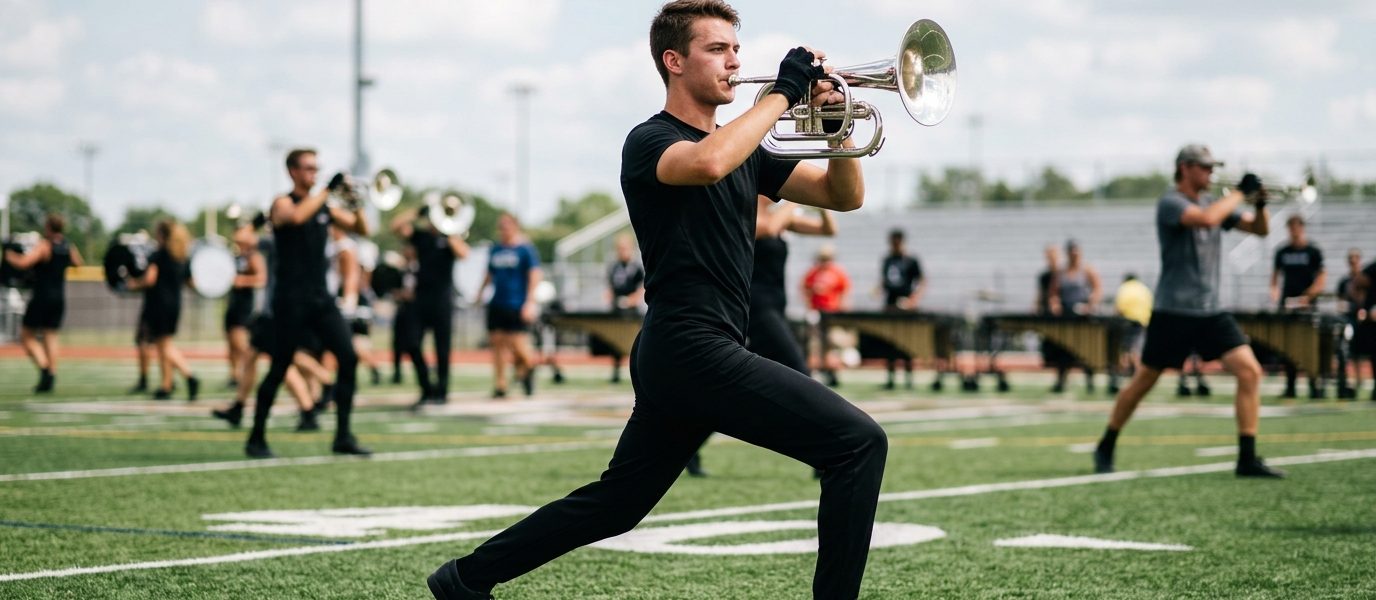
You show up early. You stretch. You run through your scales. You feel ready.
But what if that routine is actually making you worse?
Most marchers follow the same warm up pattern they learned years ago without questioning whether it still serves them. The problem is that many traditional warm up methods can create tension, reinforce bad habits, and leave you less prepared than if you’d done nothing at all. Understanding what makes a warm up effective versus counterproductive can transform your performance on the field.
Many marchers unknowingly sabotage their performance with outdated warm up routines that create tension, skip movement prep, or rush through fundamentals. The solution involves progressive activation, targeted breathing work, and movement patterns that mirror your actual performance demands. A properly structured warm up should leave you energized and focused, not fatigued or tense, setting the foundation for your best work on the field.
The three warm up mistakes killing your performance
Most corps members make at least one of these errors before they even step onto the field.
Static stretching before activation
Holding stretches for 30 seconds before you move might feel productive, but research shows it can temporarily reduce power output and coordination. Your muscles need activation first, not passive lengthening.
Skipping movement specific preparation
Running through scales while standing still does nothing to prepare your body for the demands of marching. Your warm up should include the actual movement patterns you’ll perform during the show.
Rushing through fundamentals to save time
When you’re short on time, fundamentals get cut first. That’s exactly backward. The warm up is when you reinforce proper technique, not when you skip it.
Here’s what happens when your warm up goes wrong:
- Your body stays in a low energy state
- Bad habits get reinforced under fatigue
- Injury risk increases throughout rehearsal
- Mental focus never fully engages
- Performance quality suffers from the first rep
What an effective warm up actually does
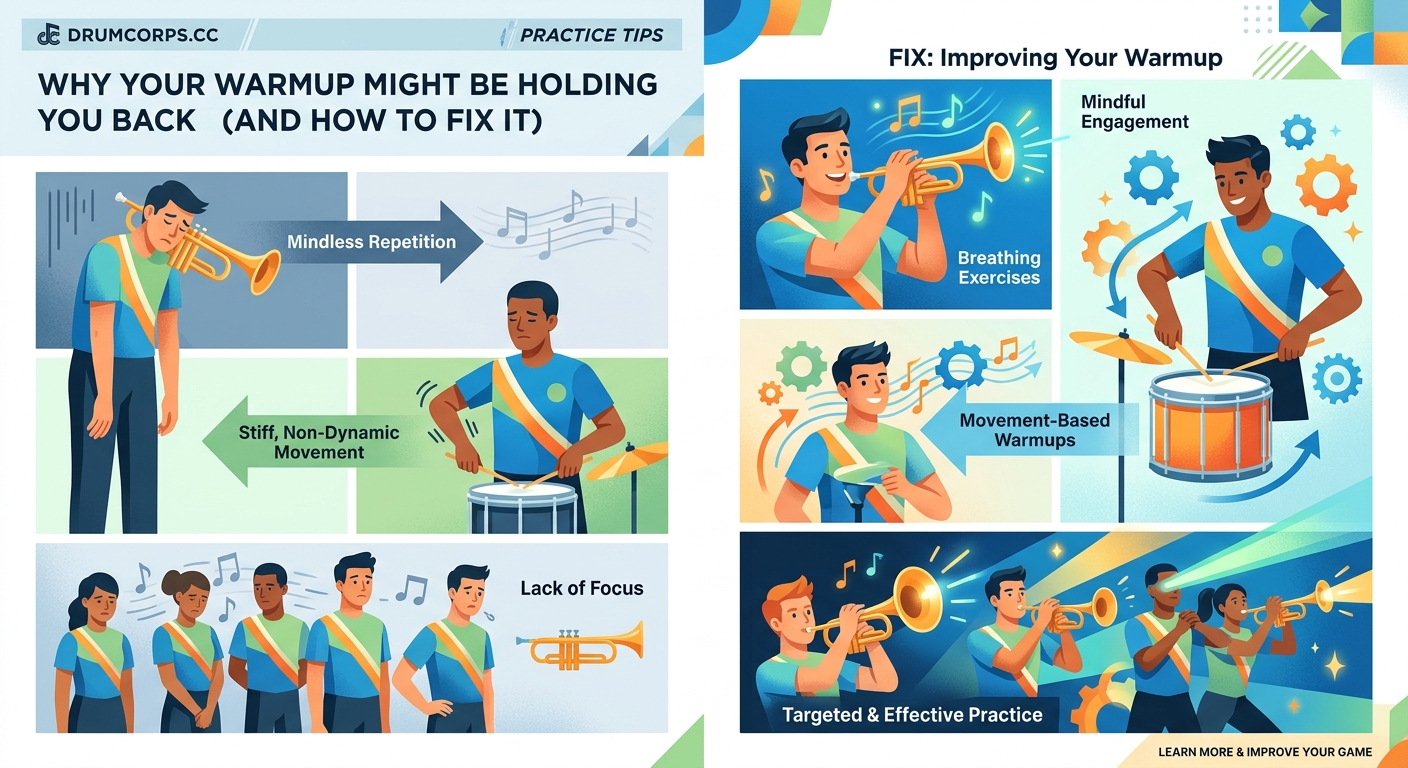
A proper warm up serves three distinct purposes, and missing any one of them leaves you unprepared.
First, it raises your core temperature and heart rate gradually. This increases blood flow to working muscles and prepares your cardiovascular system for sustained effort.
Second, it activates the specific movement patterns you’ll use during performance. This means your warm up for brass playing should include breathing exercises that target breath support, not just random air flow.
Third, it establishes mental focus and technical precision before fatigue sets in. This is when you groove correct habits, not when you mindlessly go through motions.
“The warm up is your daily reset. It’s where you remind your body what good technique feels like before you ask it to perform under pressure.” — Caption head, world class drum corps
How to structure a warm up that actually works
Follow this sequence to prepare your body properly without wasting energy.
1. Start with general movement
Begin with five minutes of light cardiovascular activity that raises your heart rate without creating fatigue. This could be:
- Walking with gradual pace increases
- Gentle jogging in place
- Dynamic movement like arm circles and leg swings
The goal is to feel warmer and slightly out of breath, not exhausted.
2. Add movement specific activation
Now introduce patterns that mirror your performance demands. For marchers, this means incorporating body alignment work before you try to march at tempo.
For brass players, this is when you work on breath support fundamentals before touching your instrument.
For percussionists, focus on grip and stroke patterns at slow tempos before building speed.
3. Progress from simple to complex
Start with basic patterns and gradually add layers of difficulty. This table shows the progression:
| Phase | Brass Example | Percussion Example | Visual Example |
|---|---|---|---|
| Foundation | Breathing without instrument | Grip and stroke basics | Posture and weight placement |
| Integration | Mouthpiece buzzing | Slow tempo patterns | Forward march at reduced tempo |
| Application | Long tones on instrument | Full exercise at tempo | Complex drill segments |
| Performance prep | Technical passages from show | Show excerpts | Full speed with music |
Each phase should take 3 to 5 minutes. Rushing through any stage undermines the next one.
The breathing warm up most brass players skip
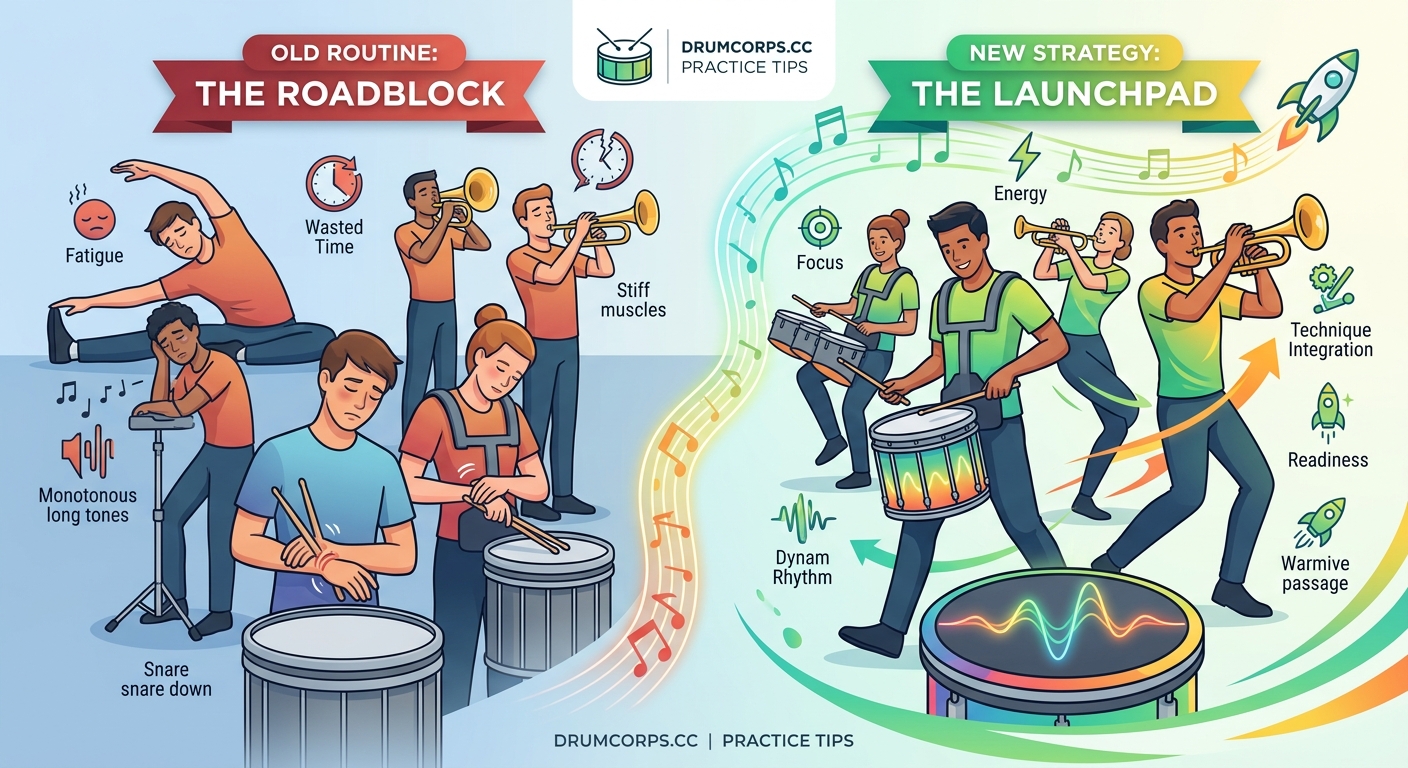
Brass players often grab their horn first and breathe second. That’s the wrong order.
Your breathing mechanism needs activation before you add the resistance of an instrument. Without proper preparation, you’ll compensate with tension in your throat, shoulders, and embouchure.
Try this sequence before you touch your mouthpiece:
- Stand in playing posture and take five slow breaths, focusing on rib expansion
- Add resistance by breathing through pursed lips for five more cycles
- Practice breath attacks without the mouthpiece, emphasizing the abdominal engagement
- Only now move to mouthpiece buzzing
This takes less than three minutes but dramatically improves your sound quality and endurance throughout the day. For more detailed breathing work, check out these tone quality exercises that build on this foundation.
Why percussionists need movement prep before touching sticks
Drummers face a unique challenge. You’re asking your body to maintain precise technique while carrying significant weight and moving through complex drill.
Most percussion warm ups focus exclusively on hands. That ignores half the equation.
Before you work on stick heights or rudiments, spend five minutes preparing your body for the physical demands of wearing a harness.
Start with shoulder and core activation:
- Plank holds for 30 seconds
- Shoulder blade squeezes
- Rotation exercises that mimic the weight distribution of your instrument
Then add your harness without sticks and practice your basic marching technique. Only after your body understands the movement pattern should you add the complexity of playing.
The visual warm up that prevents breaks all day
Visual performers often skip dedicated warm up entirely, jumping straight into drill rehearsal. This is how you get sloppy technique that compounds throughout the day.
Your body needs to understand proper marching posture before you add speed, direction changes, and musical demands.
Start every rehearsal day with these basics:
- Check your posture in a mirror or with a partner
- Practice weight placement and roll step at half tempo
- Add direction changes at reduced speed
- Only then move to drill segments at performance tempo
This progression might seem slow, but it prevents the technical deterioration that happens when you skip fundamentals. The time you invest here saves hours of cleaning later.
How to know if your warm up is working
A good warm up leaves you feeling prepared, not depleted. Here’s how to evaluate your routine.
Energy level check
After your warm up, you should feel energized and focused. If you’re breathing heavily or your muscles feel fatigued, you’ve done too much.
Technical precision assessment
Your first full tempo run through should feel cleaner than usual, not sloppier. If technique falls apart immediately, your warm up didn’t prepare the right systems.
Consistency throughout the day
A proper warm up sets the foundation for consistent performance all day. If your technique deteriorates rapidly after the first block, your preparation was insufficient.
Common warm up myths that need to die
Let’s clear up some persistent misconceptions.
Myth: More time equals better preparation
Wrong. A focused 15 minute warm up beats a distracted 45 minute routine every time. Quality matters more than duration.
Myth: You should feel exhausted after warming up
Absolutely not. The warm up prepares you for work. It isn’t the work itself. Save your energy for rehearsal.
Myth: Everyone should follow the same routine
Different sections have different demands. Brass players need different preparation than battery percussion or color guard. Customize your approach.
Building your personalized warm up routine
Now you can construct a routine that actually serves your needs.
Start by identifying your specific demands. A mellophone player needs different preparation than a bass drummer. A rifle specialist has different requirements than a flag.
Then build your sequence using this framework:
- General cardiovascular activation (5 minutes)
- Movement specific preparation (5 minutes)
- Technical fundamentals at reduced intensity (10 minutes)
- Performance level work (5 minutes)
Total time is 25 minutes. That’s enough to prepare properly without creating fatigue.
Adjust the emphasis based on your role. Brass players might spend more time on breathing and less on cardiovascular work. Percussion might reverse that ratio.
The key is progression from general to specific, simple to complex, low intensity to performance level.
If you’re building a complete individual practice routine, your warm up should be the first 25 minutes, followed by targeted skill work.
Adjusting your warm up for different situations
Your preparation needs change based on context.
Morning rehearsal block
Your body needs more time to wake up. Add an extra five minutes of gentle movement before you start technical work.
After lunch break
You’re already warm but potentially sluggish from eating. Keep the cardiovascular work light but don’t skip movement preparation.
Evening performance
You’ve been active all day. Focus on mental preparation and technical precision rather than physical activation.
Cold weather
Everything takes longer when it’s cold. Double your activation time and keep moving between segments to maintain body temperature.
Hot conditions
Reduce intensity and duration to prevent overheating before you even start. Focus on efficiency rather than thoroughness.
When to modify your routine
Sometimes your standard warm up isn’t appropriate.
If you’re recovering from minor soreness or fatigue, reduce intensity but maintain the same movement patterns. Your body needs the reminder of proper technique even when it’s tired.
If you’re dealing with actual injury, work around it rather than through it. Modify movements to avoid aggravating the problem while still preparing the rest of your body.
If time is extremely limited, prioritize movement specific preparation over general activation. Five minutes of targeted work beats nothing.
Making warm up a non negotiable habit
The best routine in the world doesn’t help if you skip it.
Build your warm up into your daily schedule the same way you schedule meals or sleep. It’s not optional. It’s the foundation of everything that follows.
Keep your gear organized so you can start immediately. Waiting around for equipment wastes the mental focus you’re trying to build.
Find a warm up partner who holds you accountable. You’re less likely to skip when someone else is counting on you.
Track your performance on days when you warm up properly versus days when you cut corners. The data will convince you faster than any article.
Your warm up sets the tone for everything else
The way you prepare determines the quality of everything that follows. A scattered, rushed warm up leads to scattered, rushed performance. A focused, progressive routine builds the foundation for your best work.
Stop treating your warm up like a box to check. Start treating it like the most important 25 minutes of your rehearsal day. Your body will respond with better technique, more endurance, and fewer injuries. Your performance will reflect the care you put into preparation.
The marchers who consistently perform at the highest level aren’t the ones with the most natural talent. They’re the ones who prepare their bodies and minds properly before they ask them to perform. Make your warm up the competitive advantage that separates you from everyone else on the field.