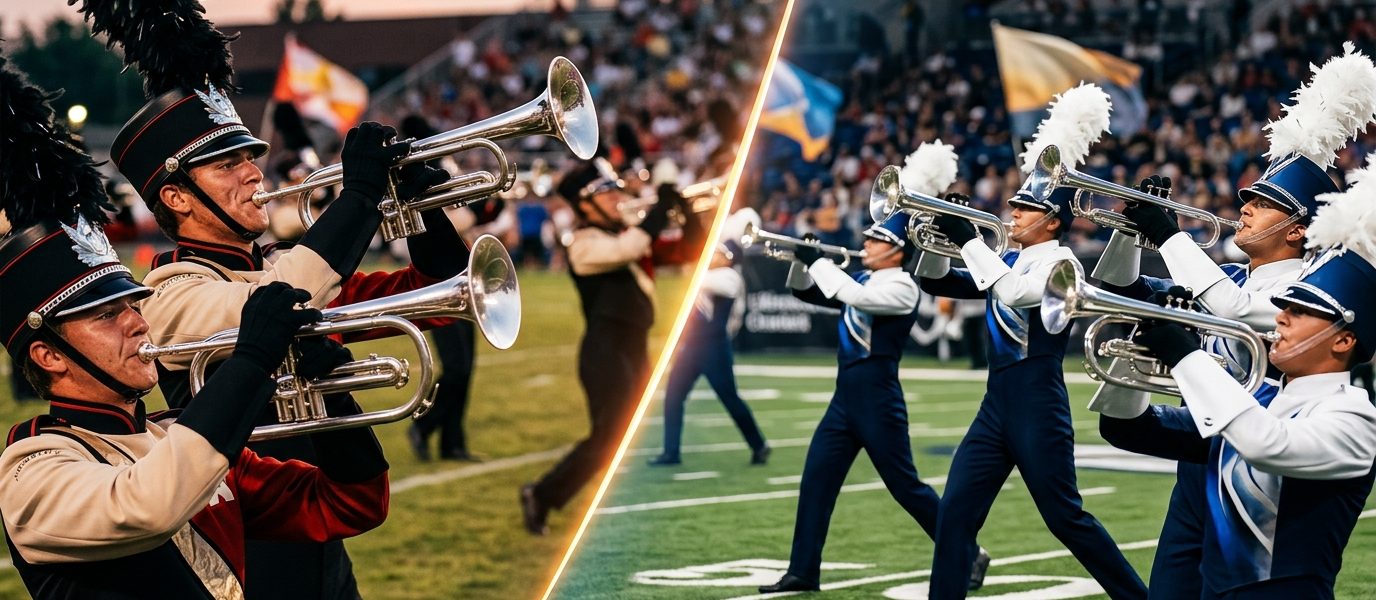
The 2000 season changed everything. After decades of tradition, Drum Corps International allowed corps to replace their signature G bugles with standard Bb brass instruments. The decision sparked fierce debates that continue today, dividing purists who cherished the unique bugle sound from progressives who embraced new musical possibilities.
The drum corps G bugle to Bb switch in 2000 replaced traditional two-valve bugles with standard brass instruments, expanding musical range and repertoire options. While the change enabled more complex arrangements and attracted new members, it eliminated the distinctive bugle timbre that defined drum corps for decades, creating a controversy that still resonates among fans and alumni today.
What Made G Bugles Different From Standard Brass
G bugles weren’t just instruments in a different key. They produced a brighter, more cutting tone that carried across football fields and stadiums.
The two-valve design limited chromatic possibilities. Players could only access notes within the harmonic series, plus a few additional pitches. This restriction shaped how arrangers wrote music for decades.
The sound itself became synonymous with drum corps. Veterans describe it as piercing, martial, and unmistakably unique. No symphony orchestra or concert band could replicate that timbre.
Physical demands differed too. G bugles required different embouchure adjustments and air support techniques compared to Bb instruments. Members who marched both types often needed weeks to retrain their muscle memory.
Why DCI Made the Switch to Bb Instruments
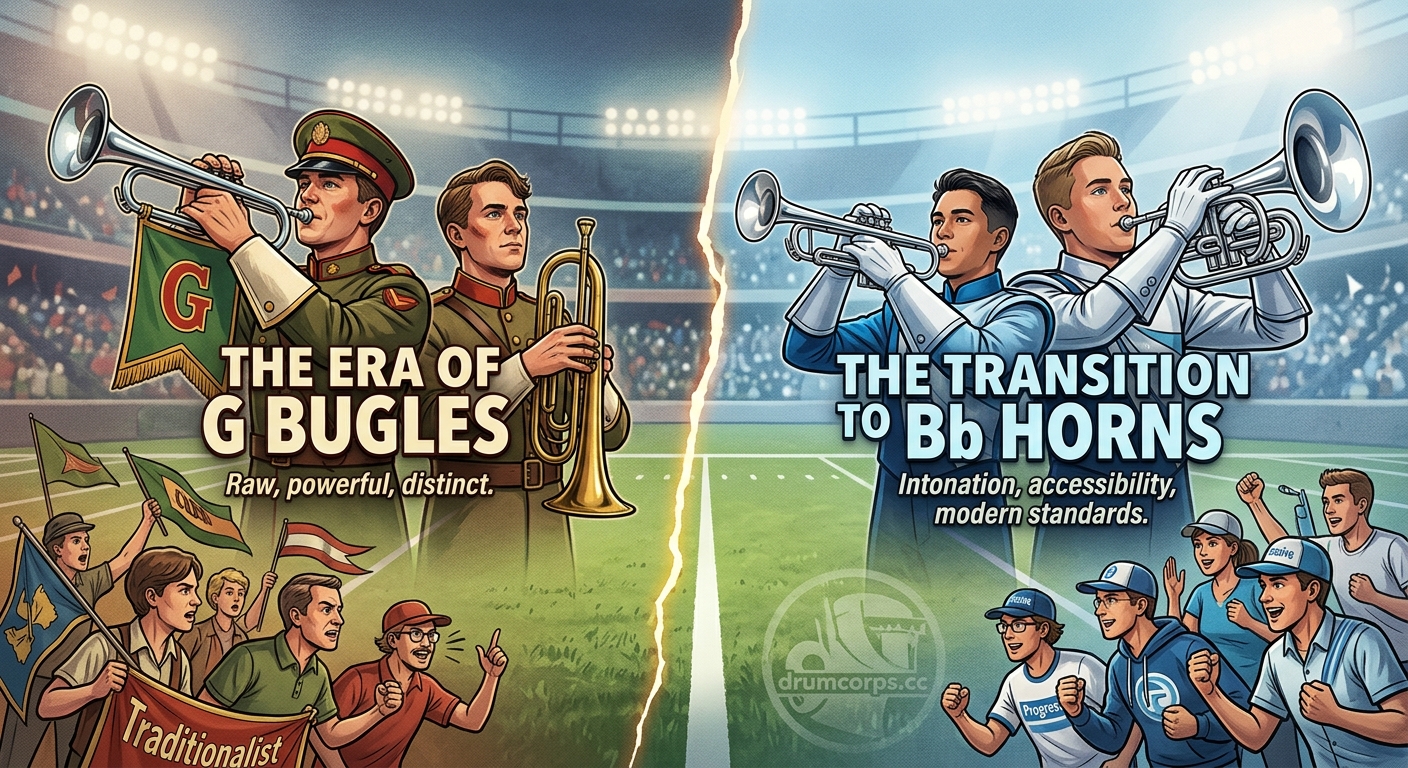
The organization faced mounting pressure from multiple directions throughout the 1990s.
Educational concerns topped the list. High school band directors argued that students who marched corps struggled when returning to school ensembles. The embouchure and technique differences between G and Bb instruments created real pedagogical problems.
Recruitment suffered as fewer students wanted to invest in learning a specialized instrument they’d only use for one summer. Corps struggled to fill brass sections, particularly in smaller organizations.
Musical limitations frustrated arrangers and brass staff. They wanted to perform contemporary music that required chromatic passages and extended ranges. The two-valve bugle simply couldn’t deliver certain notes without awkward fingering combinations or significant tuning compromises.
Financial realities mattered too. Manufacturing G bugles cost more than standard Bb instruments. Replacement parts proved harder to source. Corps operating on tight budgets saw Bb horns as a practical solution.
The vote passed in 1999, giving corps one year to prepare for the 2000 season.
How the Transition Unfolded in 2000
Corps approached the change differently based on their resources and philosophies.
Some organizations purchased entirely new Bb horn lines. Others converted existing G bugles through specialized bore modifications. A few corps delayed the switch, marching G bugles for one final season.
The Blue Devils embraced Bb instruments immediately, commissioning new arrangements that showcased the expanded range. Their 2000 show demonstrated what the new horns could accomplish musically.
Santa Clara Vanguard took a different path. They marched G bugles in 2000, viewing it as a tribute to tradition before making the inevitable transition.
Members experienced the change firsthand. Veterans who had marched G bugles needed to relearn fundamental techniques. Rookies entered a corps world in flux, unsure which instrument they’d receive at spring training.
“The first time I heard a full Bb horn line at a regional, I knew we’d crossed a threshold we couldn’t uncross. The sound was fuller, rounder, more like a concert ensemble. Whether that was better or worse depended entirely on what you valued about drum corps.” — Former DCI brass caption head
The Musical Possibilities That Bb Horns Unlocked
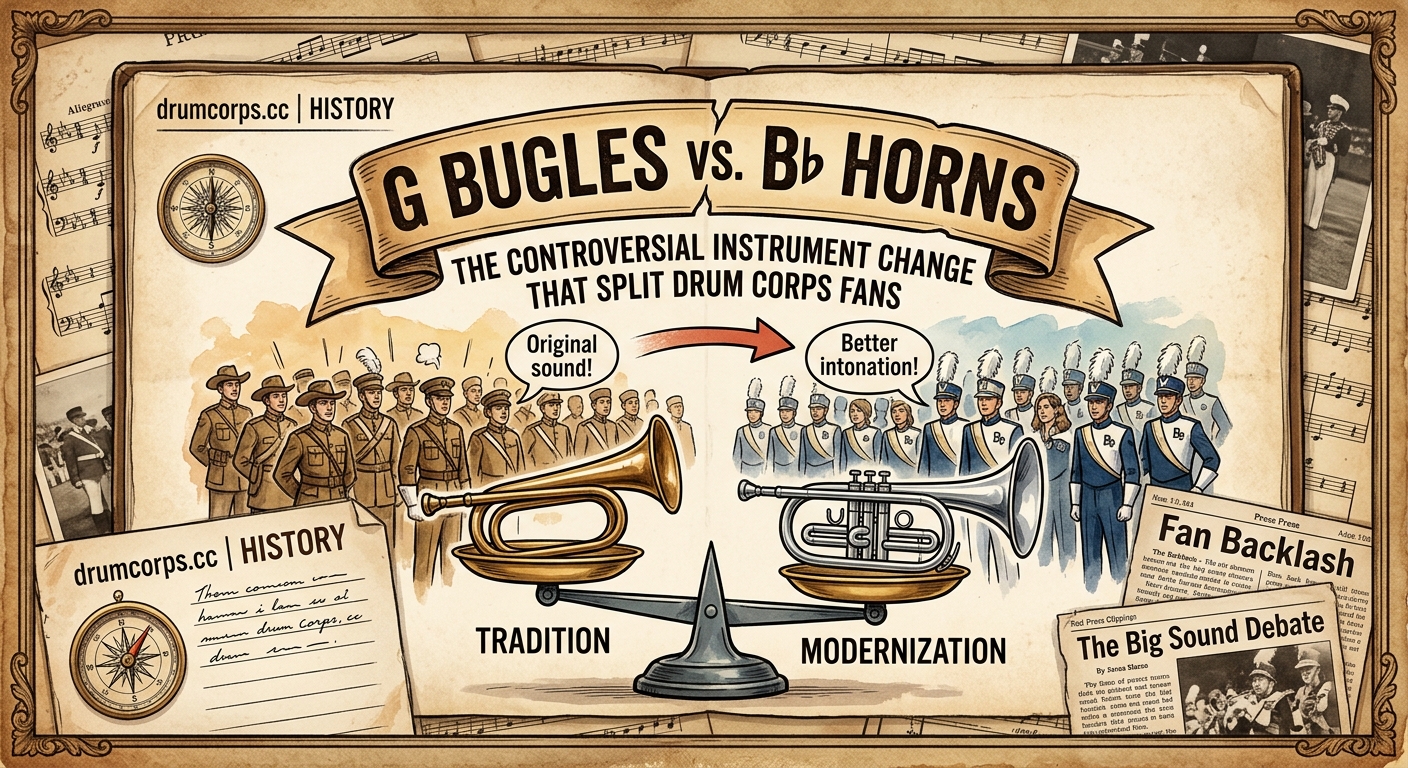
Arrangers immediately began writing music that would have been impossible on G bugles.
Chromatic passages became standard. Shows could now include jazz harmonies, contemporary classical works, and popular music arrangements without awkward workarounds.
Range expanded significantly. Sopranos could reach higher notes with better intonation. Baritones and euphoniums gained lower extensions that added depth to the brass sound.
Dynamic control improved. Bb instruments responded more predictably across their full range, allowing for subtler musical expression.
The repertoire explosion followed quickly. Corps performed Mahler, Shostakovich, and film scores that required every note of the chromatic scale. Shows like Carolina Crown’s 2013 production demonstrated the sophisticated musical vocabulary Bb horns enabled.
Transcriptions from other mediums became feasible. Arrangers could adapt orchestral works with greater fidelity to the original scores.
What Was Lost in the Transition
The distinctive bugle sound vanished almost overnight.
Alumni who marched in the 1970s, 80s, and 90s describe a visceral reaction to hearing modern Bb corps. The timbral quality they associated with drum corps no longer exists.
The martial character diminished. G bugles had a military band heritage that connected drum corps to its roots. Bb instruments sound more like concert ensembles, shifting the activity’s sonic identity.
Technical limitations had forced creative solutions. Arrangers working within the two-valve constraint developed unique voicings and harmonic approaches. Those compositional techniques largely disappeared.
The learning curve flattened. Mastering a G bugle required specialized skill that created a sense of accomplishment. Bb instruments, while still demanding, don’t present the same unique challenge.
Some argue the change homogenized the activity. When every corps sounds more similar, individual identity becomes harder to establish through timbre alone.
Understanding Both Sides of the Controversy
Traditionalists make compelling arguments about preserving drum corps’ unique identity.
They point out that the activity was never meant to replicate concert bands or orchestras. The limitations of G bugles created a distinct art form worth preserving.
Many alumni feel the change devalued their contributions. The skills they spent summers perfecting became obsolete, and the recordings they cherish sound dated compared to modern productions.
The “slippery slope” concern proved somewhat valid. After Bb instruments came amplification debates, synthesizers, and other changes that further shifted drum corps away from its roots.
Progressives counter with practical realities about the activity’s survival.
Student recruitment improved after the switch. Members could use skills learned in drum corps when they returned to school ensembles, making the summer investment more valuable.
Musical quality increased measurably. Judges’ tapes from the early 2000s show better intonation and cleaner execution as corps adjusted to Bb instruments.
The audience expanded. Shows featuring recognizable music and sophisticated arrangements attracted fans who might have found traditional bugle sounds less appealing.
Corps that struggled financially gained access to cheaper, more readily available instruments and parts.
How Different Corps Adapted Their Identity
Organizations responded to the change based on their established brand and philosophy.
The Phantom Regiment’s signature sound evolved while maintaining their dark, powerful brass approach. They proved that corps identity could survive the instrument switch through careful arranging and training.
The Cavaliers maintained their precise, aggressive style. Their 2002 championship demonstrated that Bb horns could still deliver the impact traditionalists valued.
Bluecoats used the new instruments to push boundaries. Their 2014 ‘Tilt’ production showcased possibilities that simply didn’t exist in the G bugle era.
Some corps struggled more than others. Organizations with strong G bugle traditions needed several seasons to find their new sonic identity.
The Ripple Effects on Technique and Training
Brass pedagogy in drum corps transformed after 2000.
Staff members could now reference standard brass teaching methods. Books written for Bb instruments became directly applicable to corps training.
Breathing exercises and warmup routines aligned better with school band programs. Members could maintain consistent technique year-round.
Mouthpiece selection expanded dramatically. Players could choose from the full range of commercial options rather than specialized bugle equipment.
However, some unique challenges emerged. Marching Bb instruments while maintaining proper posture and breath support required different physical approaches than G bugles.
| Aspect | G Bugle Era | Bb Horn Era |
|---|---|---|
| Chromatic ability | Limited to harmonic series plus few extra notes | Full chromatic range |
| Embouchure transfer | Required complete retraining for school band | Direct application to concert ensembles |
| Repertoire options | Military, traditional, and specially arranged works | Full range of classical, jazz, and contemporary music |
| Tonal character | Bright, cutting, martial | Warmer, rounder, more concert-like |
| Equipment costs | Higher due to specialized manufacturing | Lower with standard commercial instruments |
| Pedagogical resources | Limited to drum corps-specific methods | Access to full brass teaching literature |
Comparing Shows Before and After the Switch
The 1999 and 2001 seasons provide a stark contrast.
Listen to any top corps from 1999. The sound is unmistakably drum corps, with that characteristic bugle brightness cutting through the ensemble. Arrangements work within harmonic constraints, using creative voicings to suggest chromaticism.
Jump to 2001. The tonal palette changed completely. Brass sections sound fuller, darker, and more blended. Musical passages that would have been impossible two years earlier now appear regularly.
Santa Clara Vanguard’s 1989 ‘Phantom of the Opera’ represents the peak of G bugle arranging. The show demonstrates how skilled writers maximized the instruments’ potential.
Compare that to modern productions. Carolina Crown’s 2013 ‘E=mc²’ or Blue Devils’ 2017 ‘Metamorph’ showcase musical complexity that the two-valve bugle couldn’t support.
Neither approach is inherently superior. They represent different artistic priorities and technical possibilities.
Why Some Alumni Still Feel the Loss
Nostalgia plays a role, but the feelings run deeper than simple sentimentality.
Alumni invested hundreds of hours mastering an instrument that no longer exists in competitive drum corps. Their technical achievements feel diminished when the activity moved on.
Recordings from the G bugle era sound dated to modern ears. The timbral quality that once defined excellence now marks a show as “old school” or historical rather than current.
Corps reunions highlight the divide. When alumni play their old instruments, the sound transports them back instantly. But that sound has no place in contemporary competition.
The identity shift affects how veterans relate to current corps. Some alumni struggle to connect with modern shows that sound fundamentally different from their experience.
Others adapted and found new appreciation. They recognize that change was necessary for the activity’s survival, even if they miss certain aspects of the past.
The Broader Pattern of Change in Drum Corps
The G to Bb switch wasn’t the first major controversy, and it won’t be the last.
The 1970s brought significant innovations that older members initially resisted. The 1980s saw changes that seemed radical at the time but are now accepted tradition.
Each generation of drum corps faces a defining change that tests the balance between tradition and progress. The instrument switch happened to be the major transition for the late 1990s and early 2000s.
DCI continues evolving with new rule changes, each sparking similar debates about authenticity and advancement.
The pattern suggests that today’s innovations will become tomorrow’s cherished traditions, while also becoming the changes that future members will resist.
How to Appreciate Both Eras
Understanding the context helps bridge the divide between traditional and modern drum corps.
Listen to classic G bugle shows with appreciation for the creative arranging required. Notice how writers maximized limited resources to create compelling music.
Approach modern Bb shows recognizing the expanded possibilities while considering what might have been lost. The best contemporary corps maintain intensity and impact despite the different tonal palette.
Attend DCA competitions where some all-age corps still occasionally feature G bugles in exhibition. The sound provides a direct link to drum corps history.
Seek out recordings from the transition years. Hearing corps navigate the change in real time provides insight into both the challenges and opportunities.
Recognize that both eras produced championship-caliber performances. Legendary moments happened before and after the switch.
Steps for Processing the Instrument Transition
If you’re trying to understand or come to terms with the G to Bb switch, follow this approach:
-
Listen to championship shows from 1985, 1995, 2005, and 2015. Track how the sound evolved across these decades, noting changes beyond just the instrument switch.
-
Read contemporary accounts from when the decision was announced. Fan forums and magazine articles from 1999-2000 capture the raw emotions and arguments.
-
Watch documentary footage or interviews with members who marched during the transition. Their firsthand perspectives provide nuance that statistics can’t capture.
-
Attend a modern drum corps show in person. The live experience differs significantly from recordings and helps contextualize current artistic directions.
-
Connect with alumni from different eras. Hearing diverse viewpoints helps build a more complete picture of why the change happened and what it meant.
-
Examine the activity’s survival and growth post-2000. Consider whether drum corps would exist today without adapting to changing educational and recruitment realities.
What Current Members Should Know About This History
Today’s corps members march in an activity shaped by this decision.
The music you perform exists because arrangers have full chromatic freedom. Your technique transfers directly to school ensembles because you’re playing standard Bb instruments.
Understanding the controversy provides context for current debates about electronics, amplification, and other changes. The arguments echo similar patterns.
Veterans who critique modern drum corps aren’t necessarily opposed to progress. Many simply miss an aspect of the activity that meant something profound to them.
Your performances honor both eras when you bring intensity and precision to the field. The best qualities of drum corps transcend the specific instruments used.
Respecting the history while pushing boundaries forward continues the tradition that every generation has maintained.
Finding Common Ground in a Divided Community
The drum corps family remains connected despite disagreeing about the instrument change.
Shared values unite everyone: the commitment to excellence, the bond formed through shared struggle, the pursuit of artistic achievement.
Alumni from all eras want current members to succeed. They want the activity to thrive. Disagreements about specific changes don’t diminish that fundamental support.
Corps reunions bring together members who marched G bugles and those who only know Bb instruments. The conversations reveal more similarities than differences in their experiences.
The music may sound different, but the dedication required remains constant. The physical and mental challenges haven’t diminished. The emotional impact of performing at championships still resonates.
Where Drum Corps Goes From Here
The Bb instrument decision opened doors that continue leading to new possibilities.
Modern arrangers push harmonic boundaries that would have seemed impossible in 1995. Shows incorporate musical styles from every genre and era.
The educational value increased. Members develop skills directly applicable to college music programs and professional performance careers.
Yet questions persist about identity. As drum corps becomes more like other musical ensembles, what makes it unique? The marching? The competitive structure? The summer tour experience?
These debates will continue as long as the activity exists. Each generation must decide which traditions to preserve and which boundaries to push.
The G to Bb switch demonstrated that drum corps can survive fundamental changes to its sonic identity. Whether that’s encouraging or concerning depends on your perspective.
The Sound That Shaped Generations
The drum corps G bugle to Bb switch represents more than an equipment upgrade. It marked a philosophical turning point about what drum corps should be and who it should serve.
Both sides of the debate care deeply about the activity. Traditionalists want to preserve what made drum corps special. Progressives want to ensure its survival and relevance.
The controversy reminds us that artistic activities evolve. What seems essential to one generation becomes negotiable to the next. The recordings remain, preserving the G bugle sound for anyone who wants to experience that era.
Whether you prefer the bright cut of traditional bugles or the warm blend of modern Bb horns, the commitment to excellence continues. That standard transcends the specific instruments on the field.
Listen to both eras with open ears. Appreciate the artistry in each. The best of drum corps lives in every generation, regardless of what key the horns are pitched in.