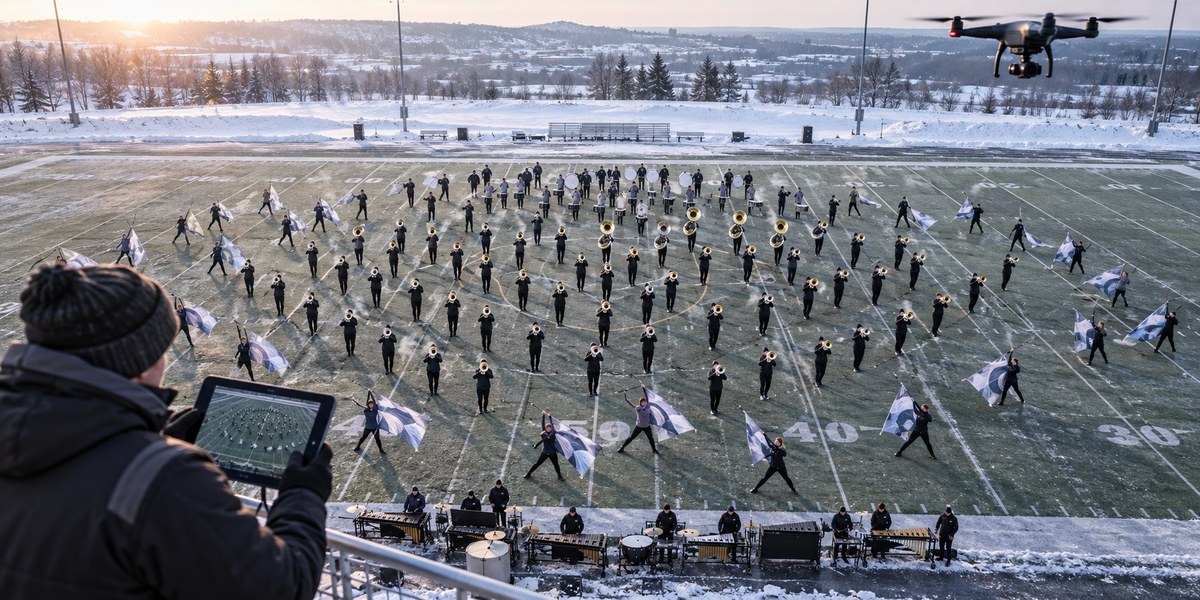
Winter training has always been the toughest test of a unit’s discipline. The cold eats into gear batteries. Snow swallows landmark features. Daylight shrinks to a precious few hours. Yet this year, a handful of forward-thinking military training centers are borrowing a tactic from an unexpected source: the marching arts. One drum corps has been quietly using drone footage to overhaul its visual rehearsals during the off-season, and the results are turning heads in the defense community. What started as a way to clean drill formations on a frozen field has become a blueprint for how drone footage can power military training in winter conditions.
Drone footage offers a real-time, high-altitude view of troop movements that ground-level observation cannot match. By applying the same aerial review methods used by a top drum corps this winter, military units can identify spacing errors, timing gaps, and route inefficiencies in minutes. This approach cuts cold-weather rehearsal time by up to 30 percent while preserving combat readiness.
Why Winter Training Demands a Different Eye
Winter creates a unique set of problems for any rehearsal operation. Frozen ground changes how soldiers move. Snow cover eliminates familiar terrain cues. Low-angle winter sun can blind observers at ground level. Traditional methods of coaching from the sideline or from a tower simply cannot keep up.
A drum corps visual team faced the same issues during their winter camp. They needed to see the full picture of their drill on a snow-dusted field. The solution was a small quadcopter drone hovering at 150 feet. From that vantage point, the visual caption head could watch the entire ensemble shift formations in real time. The same principle applies directly to military training. When you can see the whole battlespace from above, you spot problems that no one on the ground can see.
The Step-by-Step Process Used by the Corps
The corps developed a repeatable workflow that any military training unit can adapt. Here is the numbered process they followed during their winter rehearsals.
-
Pre-flight grid mapping. Before the rehearsal started, the drone pilot flew a slow grid pattern over the field at 200 feet. This created a high-resolution orthomosaic of the training area. For military use, this step maps obstacles, snow depth variations, and hidden hazards that might not be visible from ground level.
-
Live-stream rehearsal capture. The drone hovered at a fixed altitude directly above the center of the formation. The feed was streamed to a tablet held by the visual instructor. This allowed for immediate corrections. If a squad was out of alignment by even one step, the instructor could call it out in real time.
-
Post-session debrief overlay. After the rehearsal, the drone footage was overlaid with the original drill plan using simple video editing software. The side-by-side comparison showed exactly where timing lagged or spacing collapsed. The corps used this to adjust their next rehearsal. Military units can use the same technique to compare planned routes against actual movement patterns.
What the Drone Reveals That Ground Observers Miss
A human eye on the ground is limited to about a 180-degree field of view. A drone at 100 feet captures the entire formation in one frame. This changes what you can correct.
- Spacing drift. When soldiers march in a wedge or line, individual spacing tends to drift over time. From above, a one-foot gap looks like a canyon. Ground observers often miss it until the formation is already broken.
- Timing lag. A squad that is half a second behind the rest of the unit is almost invisible from the side. From directly overhead, the lag shows up as a visible wave of motion that does not match the rest.
- Route deviation. In winter conditions, a planned route across a field might be blocked by a snowdrift that was not there an hour ago. The drone footage shows the actual path taken versus the planned path. This is critical for military convoy and patrol rehearsals.
- Exhaustion patterns. The drone can record the entire rehearsal. Later, reviewing the footage in fast motion reveals when soldiers started to fatigue. Dropped shoulders, slower steps, and uneven pacing all become obvious.
Common Mistakes When Using Drone Footage for Training
Not every unit gets this right. The drum corps made several mistakes during their first winter with the drone, and they learned from each one. Here is a table of the most common errors and the fixes.
| Mistake | What Happens | The Fix |
|---|---|---|
| Flying too low | Drone noise distracts the unit and the field of view is too narrow | Maintain at least 100 feet altitude during active rehearsal |
| Recording without a plan | Hours of unusable footage that nobody reviews | Set a specific recording window for each evolution (15 minutes max) |
| Ignoring battery cold soak | Battery life drops 50 percent in freezing temps | Keep spare batteries in an insulated pouch close to body heat |
| Watching the feed alone | No shared context for the debrief | Stream to a large monitor or projector for the whole team to see |
| Over-relying on the drone | Ground-level observation is still needed for safety and detail | Use drone footage as a supplement, not a replacement |
Expert Advice from the Corps’ Visual Caption Head
The visual caption head for the corps shared a direct piece of advice for anyone adapting this method to military training.
“Do not try to fix everything at once. The drone will show you a hundred small problems. Pick the three that matter most for that rehearsal. Fix those, then move on. If you try to correct every spacing error in one session, your people will lose trust in the process. The drone is a tool for precision, not for perfection.”
This advice holds true for military applications. A platoon cannot fix every alignment issue in a single cold-weather drill. Prioritize the corrections that have the biggest impact on mission readiness. The drone footage will still be there for the next session.
How to Build Your Own Winter Drone Rehearsal Protocol
Building a protocol does not require expensive military-grade drones. The corps used a consumer quadcopter with a 4K camera. The same model costs under a thousand dollars and is widely available. Here is what you need to get started.
- A drone with a stabilized camera and live video transmission
- A tablet or laptop to receive the live feed
- A simple video editing app for overlays (most free apps can do this)
- A weatherproof case for the drone and batteries
- A clear standard operating procedure for when the drone is in the air
The corps also emphasized the importance of a ground spotter. Even with the drone feed, someone on the field must watch for hazards. In winter, that includes black ice, frozen ruts, and low-hanging branches that the drone might not see.
The Cold-Weather Gear That Makes It Work
Winter drone operations require more than just the aircraft. The corps learned this the hard way after their first battery failure in 18-degree weather. Here is the essential gear list.
- Insulated battery warming pouch
- Lens wipes for snow and fog
- Hand warmers to keep the controller from freezing
- A bright orange landing pad for visibility on snow
- A backup drone if the primary unit goes down
Military units operating in extreme cold should also consider a drone with heated elements for the camera lens. Fogging is a persistent problem when the drone moves between cold air and warm exhaust from vehicles or generators.
What the Future of Drone-Assisted Winter Training Looks Like
The drum corps that pioneered this approach is already planning upgrades for next winter. They are testing automated flight paths that follow the center of the formation without manual piloting. They are also experimenting with thermal cameras to track body heat signatures during night rehearsals.
For military strategists, the implications are clear. Drone footage is not just for reconnaissance anymore. It is a rehearsal tool that can compress training time, improve precision, and reduce the physical toll of winter operations. The same drone that scouts a route can also coach the troops who will move along it.
Applying the Corps’ Lessons to Your Unit
The drum corps model translates directly to military training. Start small. Pick one drill or movement pattern that your unit struggles with during winter. Fly the drone for that one evolution. Review the footage together. Make three corrections. Repeat the next day.
This method builds trust in the technology. Soldiers will learn to ignore the drone buzzing overhead and focus on their performance. Over time, the drone becomes a standard part of the rehearsal kit, not a novelty.
If you want to see how other rehearsal innovations are shaping the marching arts, check out our guide on how to build a perfect 30-minute individual practice routine. The principles of focused, repeatable practice apply whether you are on a parade field or a training range.
The One Question Every Unit Should Ask This Winter
Before you put a drone in the air, ask this: What is the single most important visual element in our next rehearsal? Is it spacing? Timing? Route accuracy? The drone will answer that question better than any ground observer. But you have to know what you are looking for.
Start with that one question. Fly the drone. Watch the footage. Make the correction. Then fly again. That cycle is the heart of this entire approach.
Winter does not have to mean slower progress or sloppy rehearsals. With a small drone, a clear plan, and a willingness to learn from a drum corps, any military unit can turn frozen training time into some of the most productive hours of the year. The technology is affordable. The method is proven. The only missing piece is the decision to start.