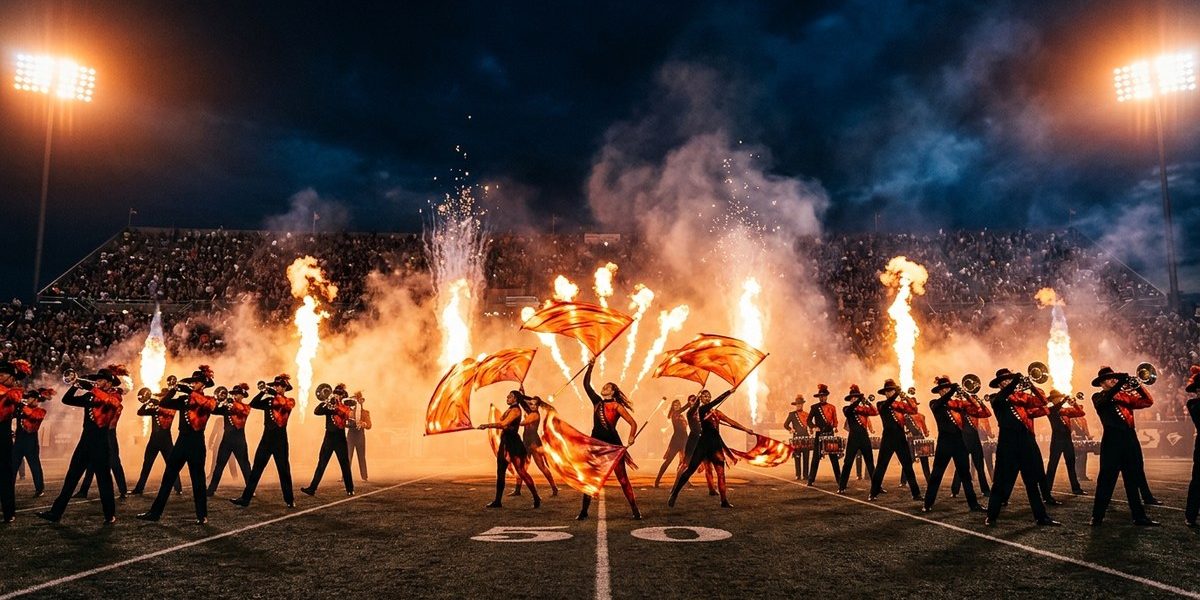
The first time I saw the Troopers 2026 production Wildfire, I forgot to breathe. It was not just the heat of the performance or the intensity of the brass. It was the way the entire field seemed to ignite in slow motion. From the opening chord to the final hold, every visual choice felt deliberate, bold, and completely immersive. This show did not just tell a story about fire. It became fire. And that is why it stands as the most visually arresting show of the 2026 DCI season.
The 2026 Troopers Wildfire show succeeded because it used color, movement, and costume design as narrative tools rather than decoration. By blending stark visual contrasts with organic drill forms, the corps created a living landscape of flame and ash. This review breaks down the specific techniques that made Wildfire the most talked-about visual production of the season.
The Opening Statement That Set the Field Ablaze
The show began in silence. A single performer stood center field, draped in a deep charcoal uniform with ember orange trim. Behind them, the corps was scattered in a formation that looked like scattered ash before a wind. Then the first brass hit came, and with it, a wave of color.
The color guard carried flags that shifted from pale gray to bright vermillion as they spun. This was not a subtle transition. It was a visual declaration. The designers chose to start with a muted, almost lifeless palette and then let the music trigger the color. That choice made the audience feel the ignition rather than just see it.
What made this opening so effective was the pacing. Many shows try to impress within the first ten seconds by throwing every visual tool at the audience. Wildfire trusted its silence. It trusted the empty space. When the fire finally came, it meant something.
How Color Became the Main Character
Most drum corps shows use color to support the theme. Wildfire used color as a character in the story. The design team divided the show into three distinct color phases.
- Phase One: Ash and Ember — The first third of the show used grays, blacks, and muted browns. The only pops of color came from small accents on the guard uniforms and the brass instruments.
- Phase Two: The Burn — Midway through, the entire palette shifted. The drill formed concentric circles that expanded and contracted like a pulse. Guard flags turned to bright orange and yellow. The uniforms caught the stadium lights in a way that made the corps look like a living flame.
- Phase Three: Afterglow — The final section cooled down to deep blues and purples, representing the smoke and twilight after a wildfire passes. This gave the show a sense of resolution that most fire-themed productions lack.
This three-phase structure gave the audience a journey. It was not just loud and louder. It was a story with a beginning, middle, and end.
The Drill Design That Mimicked Fire Behavior
The visual team for Wildfire studied actual wildfire footage to inform their drill. That research paid off in ways that were immediately obvious on the field.
The drill did not rely on straight lines and perfect grids. Instead, the corps moved in organic, flowing shapes that shifted like wind pushing flames. There were moments when the ensemble would break apart into small clusters, only to merge back into a larger mass. This mimicked the way fire behaves in nature. It spreads, it retreats, it jumps.
One of the most memorable sequences came during the percussion feature. The battery spread across the field in a staggered line while the brass played a driving ostinato. The guard moved through the gaps with flags that trailed behind them like embers catching a draft. It was chaotic in the best way. Every element felt connected.
Costume and Prop Design That Demanded Attention
The Troopers have always had a strong visual identity, but Wildfire pushed it further. The uniforms for 2026 featured asymmetrical panels that looked like charred edges. The fabric had a subtle texture that caught light differently depending on the angle.
The props were minimal but effective. Large, angular structures were placed at the back of the field. They looked like burned tree trunks. During the ballad, the guard used them as platforms, creating vertical layers that added depth to the visual picture. Most shows use props as background decoration. Wildfire used them as active elements in the storytelling.
A table of the key visual elements and how they contributed to the show:
| Visual Element | Execution | Impact on Audience |
|---|---|---|
| Color palette | Three distinct phases from ash to flame to twilight | Created emotional arc without words |
| Drill design | Organic, fire-like movement patterns | Felt unpredictable yet intentional |
| Costume texture | Asymmetrical panels with light-catching fabric | Added depth and dimension under stadium lights |
| Prop usage | Burned trunk structures used as vertical platforms | Broke the flat field plane |
| Guard equipment | Flags transitioning from gray to vermillion | Symbolized ignition and spread |
The Moment That Stole the Show
Every season has one moment that fans talk about for years. For Wildfire, it was the transition into the closer.
The corps formed a massive circle around the front ensemble. The brass players lowered their horns and began to move in a slow, synchronized rotation. The guard entered the center of the circle and began a series of tosses that sent their flags spiraling upward. At the peak of the rotation, the entire ensemble took a collective breath and released the most powerful chord of the night.
What made this moment special was the tension. The rotation built slowly. The audience could feel something coming. When it arrived, it was not just loud. It was earned. That is the difference between a good visual moment and a great one.
What Wildfire Teaches Us About Visual Storytelling
The success of Wildfire is not just about the budget or the talent of the performers. It is about the choices the design team made. They understood that visual impact comes from contrast, pacing, and restraint.
Here are the lessons from Wildfire that apply to any drum corps show:
- Start with a clear color arc. Do not use every color at once. Let the palette evolve with the music.
- Let silence and stillness breathe. Not every moment needs movement. The empty spaces make the loud moments louder.
- Study the natural world. Wildfire looked authentic because it was based on real fire behavior. Find a real-world reference for your theme.
- Use props as active elements. Do not just place them on the field. Let performers interact with them.
- Build toward a single peak moment. The closer worked because everything before it set up that release.
“The best visual moments are the ones that feel inevitable in hindsight. When you watch Wildfire, you do not question why the guard is moving that way. You just feel that it is right.” — Visual caption head for a top-12 corps, speaking at a 2026 design seminar.
How This Show Fits Into the 2026 Season
The 2026 season was full of strong visual productions. The Bluecoats presented a show called Reverie that leaned into dreamlike imagery. The Blue Devils delivered Equinox, which was a masterclass in precision. But Wildfire stood apart because it felt alive.
Other shows felt designed. Wildfire felt organic. There was a roughness to it that made it human. The performers were not just hitting dots. They were embodying a force of nature. That is a hard thing to teach, and an even harder thing to execute under the pressure of a competitive season.
If you want to see how modern drum corps can push visual design forward, Wildfire is the benchmark for 2026. It proves that the best visual storytelling comes from a clear concept, bold choices, and trust in the performers.
Bringing the Heat to Your Own Performance
Whether you are a performer, a designer, or just a fan who loves the marching arts, Wildfire offers a blueprint for how to think about visual design. Start with a strong concept. Let your color palette tell the story. Do not be afraid to leave space. And always build toward a moment that feels earned.
The Troopers reminded everyone in 2026 that drum corps is not just about playing the right notes or marching the right drill. It is about creating a moment that people cannot look away from. Wildfire did exactly that. It burned bright, and it will be remembered for a long time.