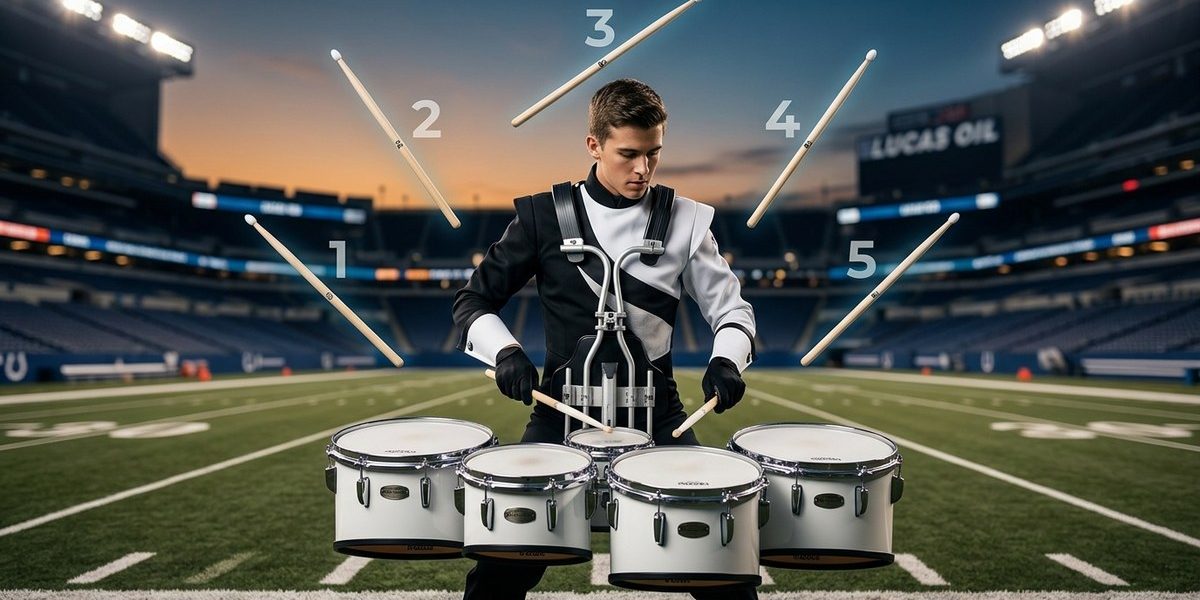
Every quad player knows the feeling. You’re locked into a passage, moving across the drums, and then it happens. A note lands early. A drum speaks when it shouldn’t. The beat splits, and your rhythm falls apart. It’s frustrating, especially when you’ve been putting in the hours. The good news is that the problem usually isn’t talent. It’s a lack of focused drills that target the specific way quads demand your hands move. These five quad drumming exercises are designed to fix that. They come straight from the practice pads of top drum corps and will help you build the muscle memory you need to stop splitting the beat for good.
Splitting the beat on quads usually comes from weak hand-to-hand consistency, poor spacing between drums, or rushing through sweeps. By practicing five targeted exercises, you can train your hands to speak with clarity at any tempo. The goal is simple: make every stroke sound intentional, even when you’re moving across all four drums.
Why Quad Players Struggle With the Beat
Before we get into the drills, it helps to understand why quad drumming is so tricky. On snare, your hands stay in one place. On quads, you’re constantly moving between drums that sit at different heights and angles. That movement can throw off your timing if your technique isn’t solid. Here are the most common reasons quad players split the beat:
- Uneven hand height when crossing from one drum to another.
- Rushing the rebound because you’re already thinking about the next drum.
- Tension in the shoulders from trying to move too fast.
- Poor stick angle that causes glancing hits instead of clean strokes.
The exercises below target each of these issues directly. They’re not just random patterns. They’re the same kind of work that DCI and WGI tenor lines use to build precision.
Exercise 1: The Single Drum Accuracy Drill
Start simple. Before you can move between drums cleanly, you need to prove that you can play a single drum with perfect time. This drill is about locking in your hand-to-hand consistency without the added challenge of moving.
- Set your metronome to a comfortable tempo, around 80 BPM.
- Play a simple eighth-note pattern on drum 2 (the second drum from your left).
- Focus on every stroke sounding identical in volume and tone.
- After 16 counts, move to drum 3 and repeat.
- Do this for all four drums, one at a time.
The point here is to build a baseline. If you can’t play cleanly on one drum, you’ll never play cleanly across four. Spend at least five minutes on this drill every practice session. If you notice your right hand sounds louder than your left, slow down and fix it. This is where building a perfect 30-minute individual practice routine can help structure your time.
Exercise 2: The Two-Drum Cross Pattern
Once your single drum sound is solid, it’s time to introduce movement. The two-drum cross pattern teaches your hands to travel between drums without breaking your timing.
- Start with your left hand on drum 1 and your right hand on drum 2.
- Play four eighth notes on drum 1, then four on drum 2.
- Repeat, but this time switch hands. Left hand on drum 2, right hand on drum 1.
- Keep the metronome going. Do not speed up until the pattern feels effortless.
| Common Mistake | What It Sounds Like | The Fix |
|---|---|---|
| Rushing the cross | The second drum hits early | Lift your stick to the same height before every stroke |
| Dropping volume on the far drum | The second drum sounds weak | Lead with your elbow, not your wrist |
| Flamming the cross | Two notes sound like one flam | Separate your hands by one full eighth note |
This drill exposes tension. If your shoulders tighten when you cross, take a breath and relax. Tension is the enemy of clean quad drumming. For more on how tension affects your playing, check out why your warmup might be holding you back.
Exercise 3: The Sweep Cleaner
Sweeps are where most quad players split the beat. A sweep is a single stroke that moves across two or more drums in one fluid motion. The trick is making sure the stick lands on each drum with equal pressure and timing.
Here’s how to practice sweeps without the mess:
- Start with a slow sweep from drum 1 to drum 4. Use your right hand.
- Play a single stroke on each drum as you move across.
- The goal is to make all four notes sound equally spaced and equally loud.
- Repeat with your left hand from drum 4 back to drum 1.
- Once that’s clean, try a sweep from drum 1 to drum 2, then drum 2 to drum 3, then drum 3 to drum 4.
“A sweep isn’t a slide. It’s a series of controlled single strokes played at the same height. If your stick is bouncing, you’re using too much arm.” — Mike Jackson, former tenor tech for the Bluecoats
Most players rush the last drum in a sweep. They think about the next pattern before finishing the current one. Fight that urge. Make every note count. If you’re struggling with this, try practicing your sweeps on a practice pad or full marching snare for home training to isolate your hand technique.
Exercise 4: The Accent Pattern Builder
Accents are what give quad drumming its character. They’re also what cause timing issues when they’re not placed perfectly. This exercise trains you to place accents without rushing or dragging the surrounding notes.
- Play a simple eighth-note pattern on drums 1, 2, and 3.
- Accent the first note of every group of three.
- The unaccented notes should be half the volume of the accented note.
- Keep your stick heights consistent. Accents come from velocity, not from lifting higher.
Here’s a table to help you visualize the dynamic levels:
| Note Type | Stick Height | Volume Goal |
|---|---|---|
| Accent | 9 inches | Forte |
| Tap | 3 inches | Piano |
| Ghost | 1 inch | Pianissimo |
The hardest part of this drill is keeping the taps quiet while maintaining speed. Most players let their taps get louder as they speed up. Fight that. If your taps are too loud, your accents won’t pop. This drill is excellent for building the kind of control that makes your quad drumming exercises sound professional. For more on building speed and accuracy, read 7 drumline exercises that build speed and accuracy fast.
Exercise 5: The Four-Drum Rotation
This is the final boss of quad drumming exercises. The four-drum rotation forces you to play across all drums in a continuous cycle. It tests your timing, your sweeps, and your accuracy all at once.
- Start on drum 1 with your left hand.
- Play one note on drum 1, then move to drum 2 with your right hand.
- Continue to drum 3 with your left hand, then drum 4 with your right hand.
- Reverse the pattern back to drum 1.
- Do not stop. Keep the cycle going for 32 counts.
The key to this drill is keeping your hands in sync with the metronome. If you feel yourself rushing, stop and reset. It’s better to play the pattern perfectly at 60 BPM than sloppily at 120 BPM. Speed comes from control, not from force. If you’re serious about improving, you should practice with a metronome every day to build that internal clock.
How to Build These Quad Drumming Exercises Into Your Routine
You don’t need to do all five exercises in one sitting. In fact, that’s a bad idea. Your hands need time to absorb the muscle memory. Here’s a simple weekly plan:
- Monday: Exercise 1 and 2 (focus on accuracy)
- Wednesday: Exercise 3 and 4 (focus on sweeps and accents)
- Friday: Exercise 5 (full rotation drill)
- Saturday: Run all five at a slower tempo for review
Each session should last about 20 minutes. That’s enough time to build skill without causing fatigue. If you feel pain in your wrists or shoulders, stop and stretch. Proper form is more important than reps.
Common Mistakes to Avoid
Even with the best quad drumming exercises, it’s easy to fall into bad habits. Here are the three most common mistakes and how to fix them:
- Playing too fast too soon. Always start at a tempo where you can play cleanly. Increase speed by only 5 BPM at a time.
- Ignoring your weak hand. Most quad players are right-hand dominant. Spend extra time on exercises that start with your left hand.
- Forgetting to breathe. When you hold your breath, your shoulders tighten. That tension kills your timing. Take a breath every four bars.
If you notice your sweeps sound uneven, check out why your tenor sweeps sound uneven and 3 drills to fix them for additional help.
Your Next Step Toward Cleaner Quad Drumming
You now have five proven quad drumming exercises that target the specific problems causing you to split the beat. The work starts now. Grab your sticks, set your metronome, and commit to running these drills for the next two weeks. Don’t worry about how fast you can play. Worry about how clean you can play. That clarity will carry you through every audition, every rehearsal, and every performance you step into. You’ve got the tools. Now go use them.