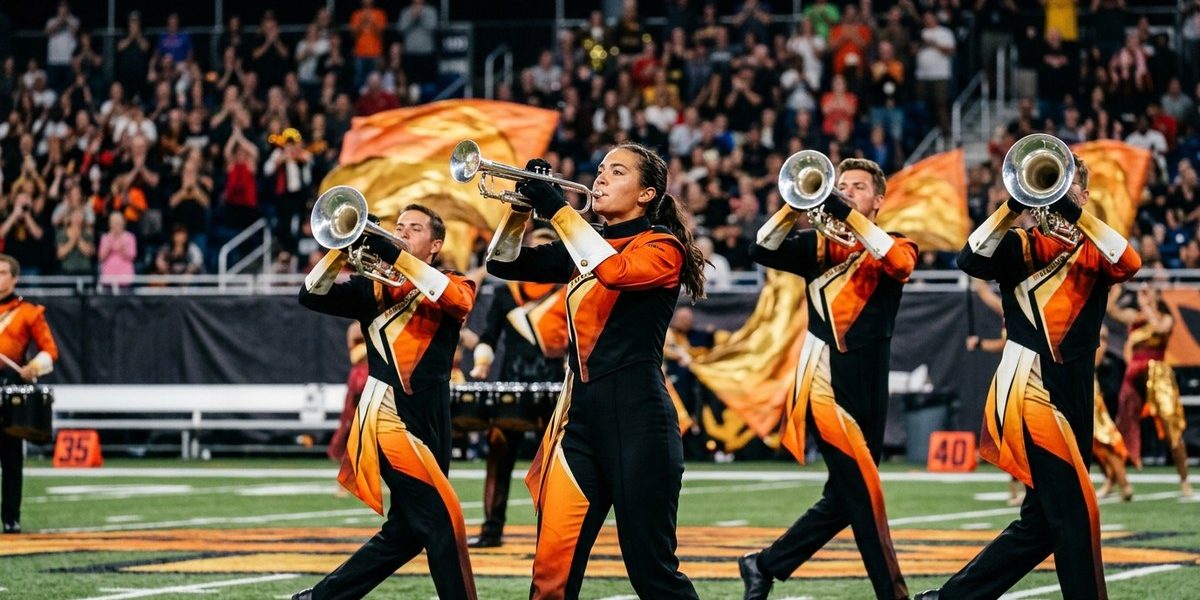
Every season, a handful of shows capture the headlines, the trophy projections, and the loudest cheers. Then there are the productions that creep up on you. The ones you hear about from a friend who saw a regional and cannot stop talking about it. The Mandarins 2026 show, “Satori,” is exactly that kind of experience. It did not win the fan favorite polls in June. It did not go viral overnight. But if you sat in the stands for even one performance, you felt something shift. This is a show built on stillness, on clarity, and on a kind of emotional honesty that is rare in any competitive art form. It deserves every bit of the standing ovation it has been quietly earning all summer.
“Satori” is not a show that screams for your attention. It earns it slowly, through a masterful blend of Japanese minimalism, precise visual pacing, and a brass book that rewards patience. If you missed it during the early season or dismissed it as too subtle, you owe it to yourself to watch it again. This could be the most artistically complete production the Mandarins have ever fielded.
A Show That Refuses to Rush
The word “satori” comes from Zen Buddhism. It means a moment of sudden understanding, a flash of intuitive clarity. The Mandarins took that concept and built an entire 11-minute show around it. Instead of piling on fast drill transitions and constant volume, the design team let moments breathe. There are sections where the field almost goes silent. The battery drops to a whisper. The brass holds a single chord and lets the sound decay naturally.
This is a risky move in a competitive environment where judges often reward density and speed. But the risk paid off. The show creates a space for the audience to actually listen, not just watch. If you have ever felt overwhelmed by the nonstop intensity of modern drum corps, “Satori” feels like a reset. It trusts the audience to lean in.
Where the Music Finds Its Power
The musical book for “Satori” draws from traditional Japanese folk melodies and contemporary wind ensemble pieces. The arranging team blended pentatonic scales with modern harmonic language. The result is a sound that feels both ancient and fresh.
The ballad is the emotional center of the show. It features a solo flugelhorn player standing alone at the front sideline. The melody is simple. It does not show off. But the way the rest of the brass section swells underneath, like a slow sunrise, is devastating. By the time the full ensemble hits the release, you can hear people in the stands holding their breath.
The percussion writing follows the same philosophy. The front ensemble uses marimba and vibraphone to create shimmering textures. The battery stays locked into a groove that supports the melody rather than fighting for attention. There is a moment in the percussion feature where the tenors play a pattern that sounds like rain on a wooden roof. It is subtle, precise, and completely captivating.
The Visual Story: Less Is More
The Mandarins have always been known for their visual package. In 2026, they took a different approach. The drill is clean, but it is not cluttered. Forms are geometric and symbolic. You see circles, straight lines, and sudden angles that represent the journey from confusion to clarity.
The color guard uses fans and silk panels instead of traditional flags and rifles. These props create flowing, organic shapes that match the music. There is no frantic equipment work. Instead, the performers move with deliberate slowness, like calligraphy being written across the field.
Three moments that define the visual arc:
- The opening formation: A single circle of brass players facing inward, as if in meditation.
- The transition into the ballad: The entire corps melts from a block into a scattered pattern, representing the mind wandering before finding focus.
- The final set: A straight line across the 50 yard line, all members facing forward, unified. No drama. Just resolution.
Why It Is Being Overlooked
Let us be honest about the competitive landscape. The 2026 season featured heavy hitters with massive productions. Blue Devils, Bluecoats, and Carolina Crown all brought shows that were engineered for finals night success. Those shows are loud, fast, and visually dense. They are designed to score well.
“Satori” does not compete on those terms. It competes on artistry. And sometimes, the judging sheets do not know what to do with a show that is intentionally quiet. Early in the season, the Mandarins placed outside the top six at several regionals. Fans who only saw early season video clips wrote it off as a weaker entry.
That was a mistake. By late July, the show had tightened significantly. The emotional arc became clearer. The ensemble sound grew more cohesive. The final run at the Atlanta regional drew a standing ovation from a crowd that had not planned to give one. If you only watched the first two weeks, you missed the full picture.
What the Judges Missed (and What Fans Saw)
The judging community is made up of professionals who know the activity inside and out. But they are also working within a framework that rewards specific things: exposure, demand, and range. “Satori” does not have the same level of high-velocity drill as some of its competitors. It does not have a screaming high brass moment every 90 seconds.
What it does have is a unified concept. Every element of the show serves the same idea. The music, the movement, the color, the pacing. It all points toward that single moment of understanding. Fans sitting in the stands feel that coherence even if they cannot name it. They feel the show as a complete statement, not a collection of effects.
Table: How “Satori” Compares to a Typical Top-6 Show
| Element | Typical Top-6 Show | Mandarins “Satori” |
|---|---|---|
| Tempo range | 80 to 200 bpm | 60 to 170 bpm |
| Drill density | High, constant movement | Moderate, intentional pacing |
| Ballad approach | Climactic, loud finish | Intimate, slow build |
| Percussion style | Aggressive, exposed chops | Textural, supportive |
| Visual props | Rifles, sabres, complex tosses | Fans, silk, flowing movement |
| Audience reaction | Immediate applause | Delayed, deeper appreciation |
How to Watch “Satori” for the First Time (Again)
If you have already seen the show once, watch it again. But watch it differently. Here is a practical process for getting the most out of the experience.
- Close your eyes for the first 60 seconds. Listen to the brass intonation and the way the front ensemble sets the mood. Do not look at the field yet.
- Watch the guard during the ballad. Focus on one performer and track their breath. Notice how their movement matches the phrasing of the flugelhorn solo.
- Watch the drum major during the percussion feature. The tempo control in the quiet sections is incredibly difficult. See how the drum major communicates that stillness to the battery.
- Watch the final 30 seconds without blinking. The last chord is held for eight counts. The sound decays naturally. The field goes dark. Let the silence hit you.
This is not a show you can judge from a single view on a phone screen. It needs the full context of the stadium, the acoustics, and the live energy.
“The best shows don’t always win the trophy. Sometimes they win the memory. ‘Satori’ will be the show people talk about ten years from now, not because of where it placed, but because of how it made them feel.” — Former DCI brass caption head
Why This Show Matters for the Activity
Drum corps is always evolving. There is a constant tension between entertainment and competition, between art and sport. Shows like “Satori” push back against the idea that louder is always better. They prove that restraint can be just as powerful as intensity.
The Mandarins have been building toward this identity for years. They have always drawn from their cultural heritage and their California roots. But in 2026, they fully committed to a vision that is uniquely theirs. They did not try to copy the Blue Devils or chase the same design trends. They made something that only the Mandarins could make.
That is a lesson for every performer, designer, and fan. The most memorable shows are not always the ones that score the highest. They are the ones that have a clear voice. “Satori” has a voice. It is quiet, confident, and worth listening to.
Final Thoughts on “Satori”
The 2026 season will be remembered for many things. The Blue Devils continued their legacy of excellence. The Bluecoats pushed the boundaries of electronic integration. Carolina Crown delivered another technically flawless production. But when fans look back, many of them will point to the Mandarins and say, “That was the one that stayed with me.”
If you have not given “Satori” a full, focused listen, do it before finals week. Find a good recording. Put on headphones. Let the show wash over you without distraction. You might find that moment of clarity the show is named after. And when you do, you will understand why this production deserves a standing ovation, regardless of what the scoreboard says.
For performers looking to capture the same kind of control and breath support in their own playing, check out our guide on 5 essential breathing exercises every brass player should master. And if you want to build the kind of individual discipline that makes a show like this possible, our how to build a perfect 30-minute individual practice routine is a great place to start.