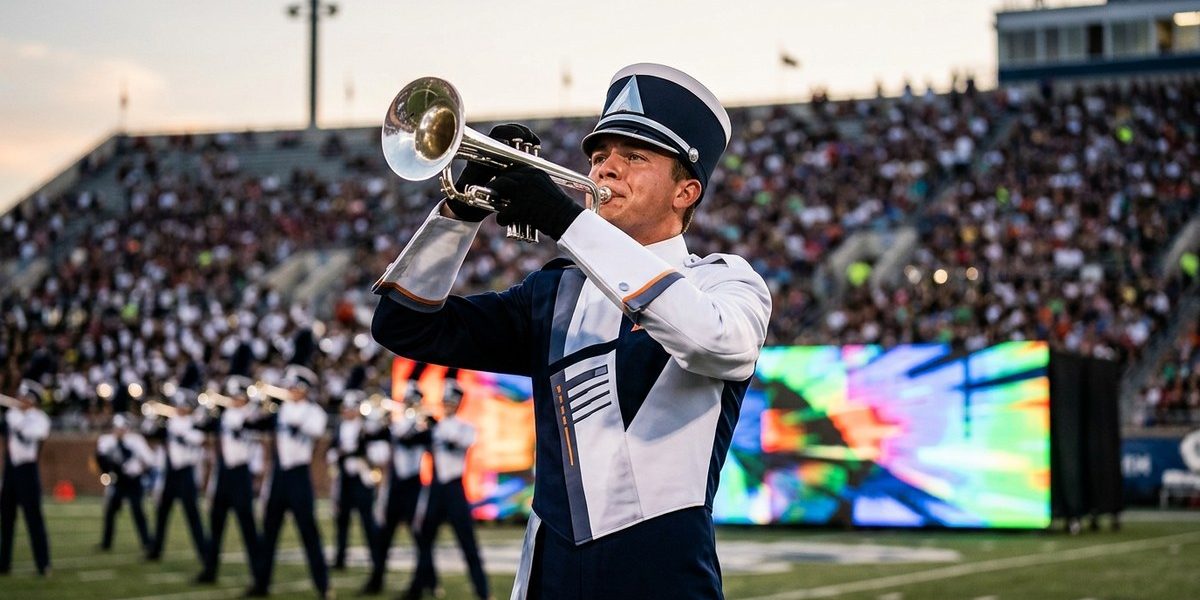
You sit in the stands at Lucas Oil Stadium, the air thick with anticipation. The Bluecoats take the field, and within the first thirty seconds you feel a tightness in your chest. By the time the ballad arrives, you are fighting back tears. That was the experience of watching “Reverie” in 2026. This show did not just impress with technical mastery. It grabbed you by the heart and refused to let go. Fans across the country are calling it the most emotionally gripping production of the season, and the Bluecoats 2026 Reverie review you are about to read will show you exactly why.
Bluecoats 2026 “Reverie” combines a deeply personal narrative of memory and loss with a stunning score that builds from intimate piano phrases to a full brass climax. The show uses subtle visual cues, like mirrored formations and a single prop that vanishes, to mirror the emotional arc. The result is a production that feels less like a competition and more like a shared human experience.
A Story of Longing and Letting Go
Every great drum corps show needs a narrative spine. “Reverie” borrows its name from the French word for daydream, and that is exactly what the designers created: a floating, dreamlike journey through the mind of someone processing grief. The show opens with a lone piano note, repeated like a heartbeat. Then the brass enters softly, almost hesitantly. The members move in slow, swirling patterns, as if they are wandering through fog.
The emotional anchor of the show is a single white prop shaped like a small house. It stands alone on the back sideline for the entire first movement. As the music builds, performers reach toward it but never touch it. That house represents a memory, a person, a home you can no longer return to. It is a simple image, but it works because the corps commits to it fully.
“We wanted the audience to feel what it is like to hold onto something beautiful even as it slips away. Every musical phrase, every visual transition in Reverie was designed to serve that ache.” — Bluecoats program designer (from a post-season interview)
What Made the Music So Moving
The source material for “Reverie” draws heavily from contemporary composers like Hania Rani and Max Richter, whose minimalist piano works are built for emotional weight. The Bluecoats arrangement team did not just copy those pieces. They reimagined them for the marching field, adding layers of brass color and percussion texture that amplify the tension.
Three musical moments deserve special attention:
- The opening piano line: played by a single pit member live, unamplified. It cuts through the stadium noise and demands silence.
- The trumpet duet in the middle of the ballad: two trumpeters separated by fifty yards play the same melody a half step apart, creating a haunting dissonance that resolves into unison.
- The full ensemble release at 8 minutes 30 seconds: after a long, quiet build, the entire corps releases a massive fortissimo chord that feels like a cathartic scream.
These moments are not random. They follow a clear emotional arc. The table below shows how the music and visuals work together.
| Show Section | Musical Technique | Visual Effect | Emotional Payoff |
|---|---|---|---|
| Opening (0:00-1:30) | Sparse piano, no percussion | Linear drill, all facing away from the audience | Isolation, confusion |
| Ballad (3:00-5:00) | Layered brass entrances, trumpet duet | Curving pathways, hands reaching toward the prop | Yearning, nostalgia |
| Climax (8:00-8:45) | Full ensemble fortissimo with battery percussion | Coordinated sprint to a single point, then freeze | Release, sorrow, acceptance |
| Closer (9:00-10:30) | Lone piano returns, fading out | Prop tilts and disappears through a trap door | Letting go, quiet resolution |
This table shows the deliberate pacing. The show does not rush to emotion. It earns it.
Three Moments That Defined the Show
If you only remember three things from “Reverie,” let these be them. They are the points where the performance transcended technique and became art.
-
The moment the house prop tilts: at the peak of the musical climax, the white house prop slowly tilts to a 45-degree angle. It is a simple mechanical cue, but it looks like the world is falling over. Several members freeze mid-step, staring at it. You can hear actual gasps from the stands.
-
The trumpet duet discord: as mentioned earlier, the two trumpeters play a half step apart for exactly sixteen counts. The dissonance is uncomfortable. It makes you lean forward. Then they slide into perfect unison, and the tension breaks. It is a textbook example of using harmonic instability to mirror emotional instability.
-
The final image: after the house disappears, the corps forms a single horizontal line across the field. They are facing the back. One by one, each performer lifts their head to the sky. The lights go dark on the last person. There is no applause for a full three seconds after the last note. That silence, that collective breath, is the show’s greatest achievement.
Why Reverie Stands Above the Other 2026 Shows
The 2026 season had many strong productions. The Blue Devils delivered their usual precision. Carolina Crown brought a powerful brass book. But no other show connected with audiences on a raw emotional level the way “Reverie” did. Why?
Some of the reasons:
- The narrative is universal. You do not need a program to understand loss. The show works on pure feeling.
- The pacing respects the audience. It does not try to cram ten ideas into ten minutes. It breathes.
- The performers believe it. Watch any video of the closer. The faces of the members tell the story. They are not just playing notes. They are living the emotion.
- The design team trusted silence. The quiet moments are as powerful as the loud ones.
The Legacy of “Reverie” in Bluecoats History
The Bluecoats have always been known for innovation. Shows like “Tilt” (2014) changed how designers think about space and sound. “Reverie” continues that tradition, but in a different direction. Instead of technical wizardry, it focuses on emotional authenticity. If you are interested in how the corps evolved over the years, check out our piece on how Bluecoats 2014 Tilt redefined modern drum corps design. The shift from geometric abstraction to human storytelling is remarkable.
“Reverie” also joins the ranks of other deeply emotional shows like Carolina Crown’s 2013 E=mc², which used scientific metaphors to explore love and loss. Both shows prove that the best drum corps connects with the heart before the head.
How You Can Capture That Feeling in Your Own Practice
You do not have to be on a world-class field to learn from “Reverie.” The show’s emotional power comes from attention to detail. Every breath, every step, every note has intention. As a performer, you can bring that same mindset to your own rehearsals.
Consider these practical steps:
- Identify the emotional core of your show. Ask yourself: what do I want the audience to feel at the end?
- Map the dynamic arc. Where are the quietest moments? Where is the biggest climax? Plot them like a story.
- Use your body. Your posture, your facial expressions, your breath all communicate emotion. Practice in front of a mirror.
- Build trust with your section mates. The trumpet duet in “Reverie” only worked because the two players listened to each other. Do the same in your ensemble.
If you want to strengthen the fundamentals that support that kind of performance, try our guide on 5 essential breathing exercises every brass player should master. Breath control is the foundation of emotional expression.
A Season to Remember
The 2026 Bluecoats “Reverie” will be remembered as a show that changed how we talk about emotion in drum corps. It did not rely on gimmicks or volume. It relied on truth. The performers gave us permission to feel something real, and we walked out of the stadium changed.
Next time you watch a recording of “Reverie,” pay attention to the small things. The way a singer takes a breath before a phrase. The way a marcher’s hand lingers in the air a beat too long. Those moments are the ones that stay with you. And that is what makes a show truly unforgettable.