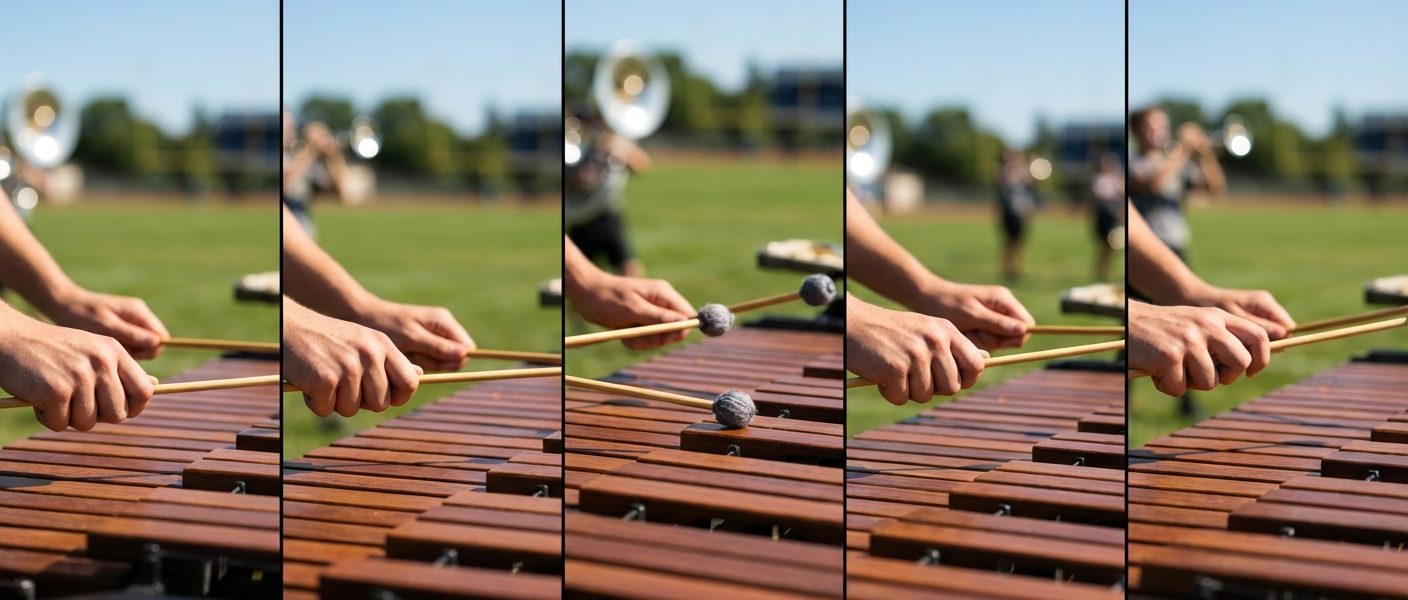
You’re standing in front of your marimba, sticks in hand, and the clock is ticking before rehearsal starts. Your hands feel cold. Your brain hasn’t quite connected to your muscles yet. You know you should warm up, but scrolling through scales feels aimless and boring.
The truth is, most front ensemble players practice without a real plan. They noodle around, play a few runs, maybe hit some scales if they’re feeling motivated. But the players who sound consistently great? They follow structured warm up routines that target specific technical challenges.
Effective marimba warm up exercises build muscle memory, improve stroke consistency, and prepare your mind for musical performance. The five exercises covered here target fundamental techniques like single strokes, double strokes, four mallet independence, roll development, and interval accuracy. Spending 15 to 20 minutes on these routines before every practice session will dramatically improve your playing consistency and reduce performance anxiety during shows.
Why structured warm ups matter for front ensemble
Your body needs preparation before athletic activity. Playing marimba is no different.
Cold muscles move slowly and imprecisely. Your fine motor control suffers. Your dynamic range shrinks. You’re more likely to develop tension in your shoulders and wrists, which leads to fatigue during long rehearsals.
A proper warm up routine serves three purposes. First, it gradually increases blood flow to the muscles in your hands, wrists, and forearms. Second, it activates the neural pathways between your brain and your hands, improving coordination. Third, it establishes a mental focus that carries into your practice or performance.
The exercises below follow a logical progression from simple to complex. Each one addresses a specific technical challenge that front ensemble players face in modern drum corps and indoor percussion literature.
Single stroke roll exercise
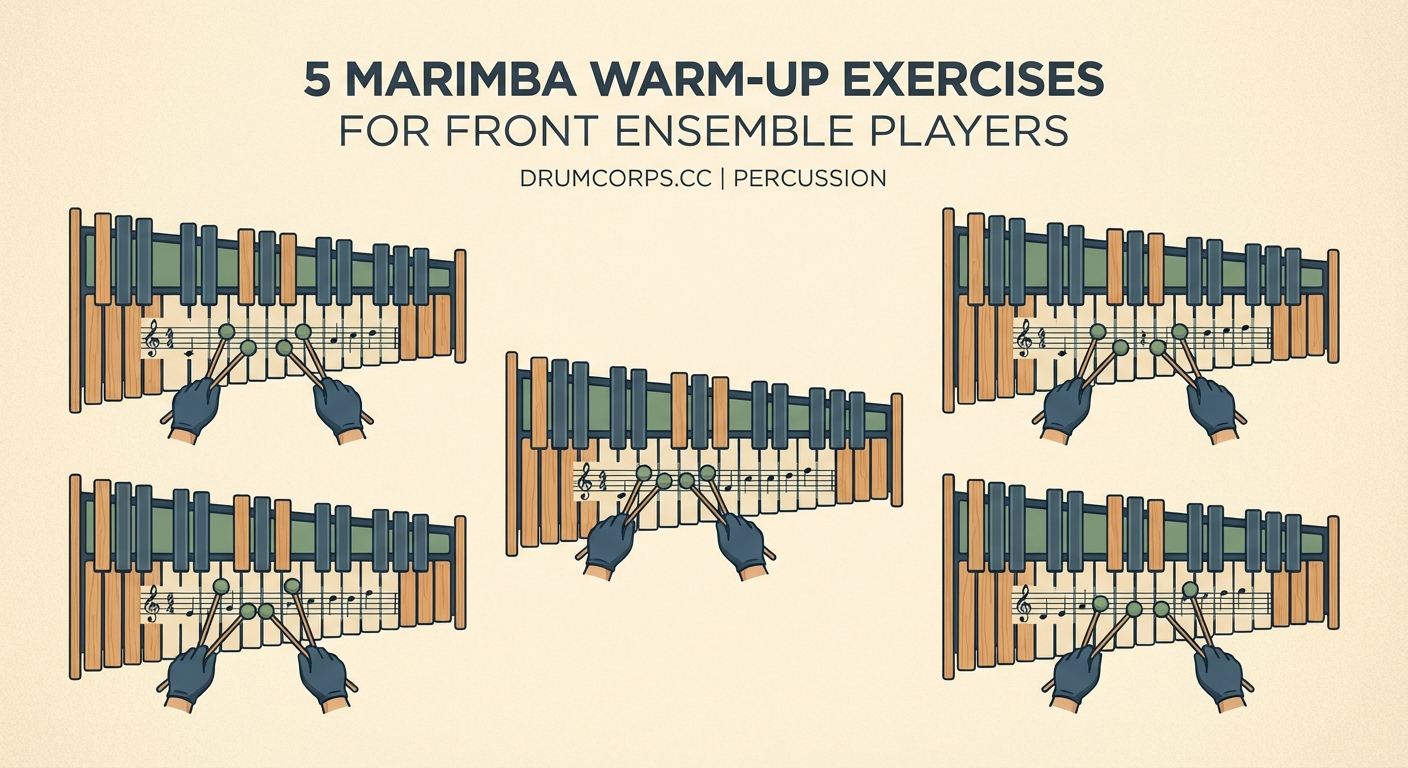
This is your foundation. Everything else builds from here.
Start at a comfortable tempo, around 80 beats per minute. Play continuous single strokes (right, left, right, left) on a single bar of the marimba. Focus on producing identical sound from both hands.
Here’s the progression:
- Play four bars of continuous eighth notes at 80 bpm
- Increase tempo by 10 bpm increments every four bars
- Continue until you reach your maximum controlled speed
- Decrease tempo by the same increments back to 80 bpm
The key is consistency. Listen for volume differences between your hands. Most players have a dominant hand that naturally plays louder. Your goal is to eliminate that difference completely.
“The single stroke roll isn’t just a warm up. It’s a diagnostic tool. If your strokes sound uneven at slow tempos, they’ll sound terrible at performance speeds. Fix the fundamentals first.” – Jeff Moore, percussion educator
Pay attention to your grip pressure. Many players squeeze the mallets when they try to play louder, which actually reduces resonance and increases tension. Your grip should remain relaxed regardless of dynamic level.
| Technique | Correct Approach | Common Mistake |
|---|---|---|
| Grip pressure | Relaxed, allowing mallet to rebound naturally | Squeezing mallets tightly, restricting motion |
| Stroke height | Consistent height for each hand | Dominant hand lifting higher |
| Sound quality | Warm, resonant tone from mallet center | Thin, clicky sound from edge strikes |
| Tempo control | Steady pulse using metronome | Rushing or dragging without reference |
Double stroke exercise
Double strokes challenge your wrist control and finger technique differently than singles.
Begin at 60 bpm playing eighth note doubles (right right, left left, right right, left left). The goal is making both notes of each double sound identical in volume and spacing.
The first note of each double typically comes from a wrist stroke. The second note requires a finger controlled rebound or a second small wrist motion. Experiment with both approaches to find what works for your grip style.
Common problems include:
- Second note of the double sounding quieter than the first
- Uneven spacing between the two notes (playing diddle instead of two equal notes)
- Tension building in the forearms after 30 seconds of continuous playing
If you notice tension, stop and shake out your hands. Tension is your body telling you something is wrong with your technique.
Progress through these variations:
- Eighth note doubles at 60 bpm for two minutes
- Sixteenth note doubles at 60 bpm for two minutes
- Gradually increase tempo to your maximum controlled speed
- Add accents on the first note of each double
- Add accents on the second note of each double
That last variation is particularly challenging. Accenting the second note of a double requires excellent finger control and often reveals weaknesses in your rebound technique.
Four mallet independence patterns
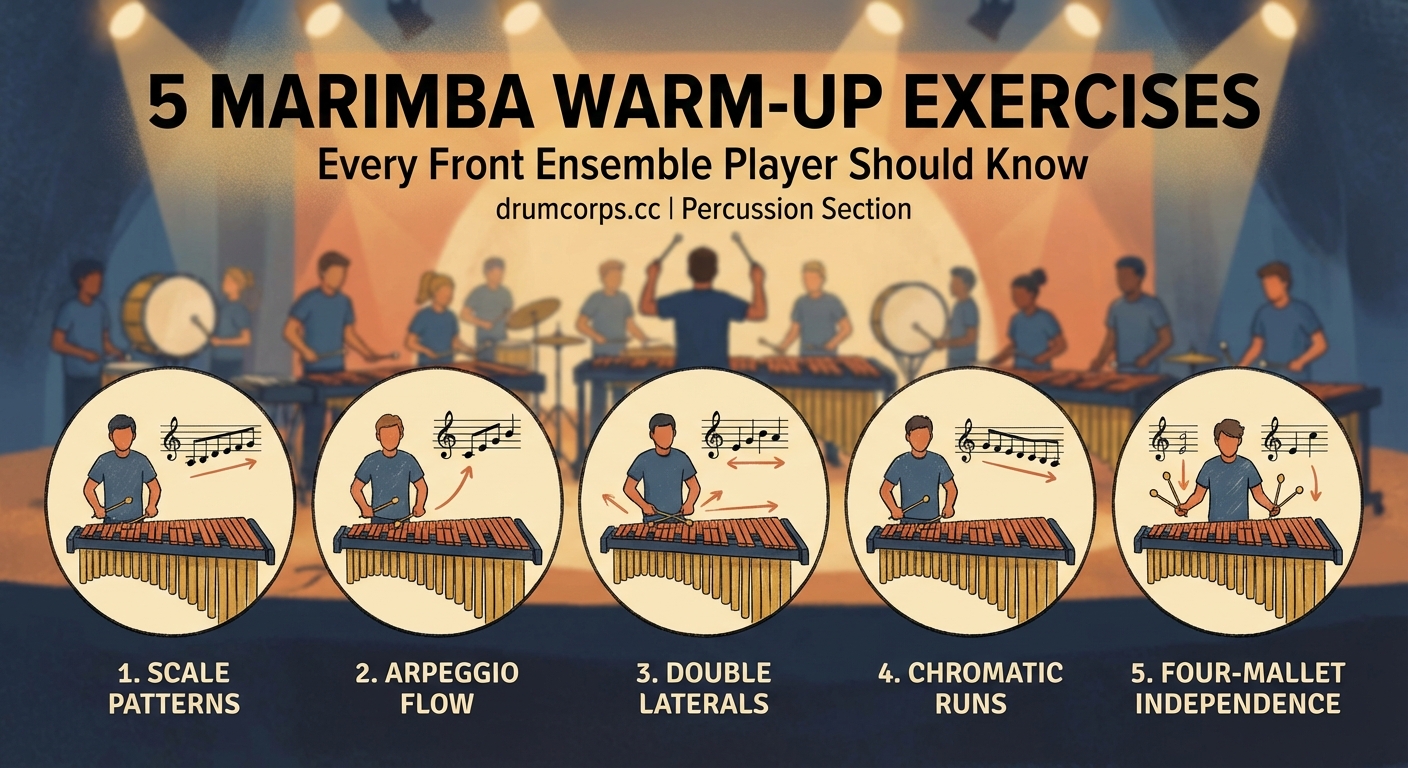
Most modern front ensemble writing requires four mallet technique. This exercise builds the independence you need for complex passages.
Set up with a standard four mallet grip (Stevens, Burton, or traditional). Position your mallets over four adjacent bars on the marimba.
Play this pattern at 70 bpm:
- Outside mallets together (both outer mallets strike simultaneously)
- Inside mallets together (both inner mallets strike simultaneously)
- Right hand mallets together
- Left hand mallets together
- All four mallets together
Repeat this five note pattern continuously for three minutes. Focus on producing exactly the same sound quality whether you’re playing two mallets or four.
After you’re comfortable with the basic pattern, add these variations:
- Play the pattern ascending through a two octave major scale
- Play the pattern descending through a two octave major scale
- Alternate the dynamic level of each strike (forte, piano, forte, piano)
- Change the interval between your hands (thirds, fourths, fifths, sixths)
The interval changes are particularly valuable. Most players practice with their hands in one comfortable position. But show music rarely accommodates your comfort. You need to sound good at any interval.
Roll development across registers
Marimba rolls sound different depending on which octave you’re playing. Lower notes require slower roll speeds. Higher notes need faster speeds to maintain a smooth, connected sound.
This exercise teaches you to adjust your roll speed intuitively based on register.
Start with your mallets on the lowest C of your instrument. Play a whole note roll at 60 bpm. Count how many strokes per beat you need to create a smooth, sustained sound. For most players on a low C, this will be around 5 to 7 strokes per beat.
Now move up one octave and repeat. You’ll need to increase your stroke rate to maintain the same smooth quality. Continue moving up octave by octave until you reach the top of your instrument.
Here’s what you’re learning:
- How roll speed correlates with bar size and pitch
- How to adjust stroke rate without conscious counting
- How to maintain consistent volume across all registers
Many players develop a “default” roll speed that they use everywhere. This creates rolls that sound too slow and separated in high registers, or too fast and nervous in low registers.
Practice this exercise daily for two weeks. Your ears will start making the adjustment automatically.
Interval accuracy exercise
Playing the right notes matters. This exercise improves your spatial awareness and reduces the visual searching that slows down sight reading.
Choose a major scale. Start on the tonic. Play this interval sequence:
- Tonic to second (step up)
- Tonic to third (skip up)
- Tonic to fourth
- Tonic to fifth
- Tonic to sixth
- Tonic to seventh
- Tonic to octave
After completing the ascending intervals, reverse the process and play each interval descending from the tonic.
The goal is accuracy without looking. Most players watch their mallets constantly. This creates a dependence on visual confirmation that breaks down under performance pressure when you’re also reading music, watching the conductor, and managing nerves.
Start slowly. Use a metronome at 60 bpm with one interval per beat. As your accuracy improves, increase tempo and add these challenges:
- Play the intervals with your eyes closed
- Play the intervals while looking at a fixed point across the room
- Play the intervals in different keys without resetting your position
- Add dynamics (play some intervals forte, others piano)
| Skill Level | Target Accuracy | Practice Duration |
|---|---|---|
| Beginner | 80% correct notes without looking | 5 minutes daily |
| Intermediate | 95% correct notes at 80 bpm | 10 minutes daily |
| Advanced | 100% correct notes at 120 bpm | 5 minutes daily for maintenance |
This exercise pays huge dividends during show season. When you can trust your hands to find the right notes without constant visual checking, you free up mental bandwidth for musicality and ensemble awareness.
Building your daily routine
Now you have five exercises. The question is how to fit them into your practice time without spending an hour on warm ups.
Here’s a realistic 20 minute routine:
- Single strokes: 5 minutes (include tempo pyramid up and down)
- Double strokes: 3 minutes (focus on evenness)
- Four mallet independence: 4 minutes (include one scale variation)
- Roll development: 4 minutes (hit at least three different registers)
- Interval accuracy: 4 minutes (work through one complete key)
This routine covers all the fundamental techniques. You’re ready to tackle repertoire after 20 minutes.
Some days you’ll have less time. On those days, pick three exercises and spend 5 to 7 minutes on each. Consistency matters more than duration. Ten minutes of focused warm up every day beats an hour of unfocused practice once a week.
Track your progress. Keep a practice journal noting which tempos you achieved, which exercises felt difficult, and which techniques improved. This data helps you identify weaknesses and celebrate progress.
Adapting exercises for different skill levels
These exercises work for everyone, but the expectations should match your current ability.
Beginning players should focus on sound quality and relaxation over speed. If you can play single strokes at 100 bpm with beautiful tone and zero tension, that’s far more valuable than rushing to 160 bpm with tight shoulders and thin sound.
Intermediate players should add musical elements. Play exercises at different dynamic levels. Add accents and sticking variations. Practice exercises in different keys to improve your keyboard geography.
Advanced players should use these exercises as diagnostic tools. If your doubles suddenly feel uneven, something in your technique has shifted. Use the exercise to identify and correct the problem before it affects your show music.
You can also adapt exercises to address specific challenges in your repertoire. If your show has a passage with rapid interval leaps in the right hand, modify the interval exercise to emphasize right hand accuracy. If there’s a section with sustained four mallet rolls, extend the roll exercise to build the endurance you need.
Common warm up mistakes to avoid
Even with good exercises, poor execution undermines your progress.
Playing without a metronome is the biggest mistake. Your internal sense of tempo is unreliable, especially when you’re focused on technique. The metronome provides objective feedback. Use it.
Practicing too loud is another common problem. Many players equate volume with intensity and think louder practice means better results. Actually, loud playing masks technical flaws and builds tension. Practice most warm ups at a medium volume where you can hear every detail of your sound.
Skipping warm ups when you’re short on time seems logical but backfires. Even five minutes of structured warm up improves the quality of your remaining practice time. Cold, unfocused practice ingrains bad habits.
Doing the same routine forever creates diminishing returns. Your body adapts to repeated stimuli. Change one element of your warm up every few weeks. Adjust tempos, add variations, or swap in a different exercise for one of the five.
Ignoring pain is dangerous. Discomfort from muscle fatigue is normal. Sharp pain in your wrists, elbows, or shoulders is not. If something hurts, stop and evaluate your technique. Persistent pain requires consultation with a teacher or medical professional.
Making warm ups work for you
These five exercises provide a framework, not a rigid prescription.
Some players need more time on doubles. Others struggle with four mallet technique. Adjust the time allocation to address your specific weaknesses.
The best warm up routine is one you’ll actually do consistently. If 20 minutes feels overwhelming, start with 10. Build the habit first, then extend the duration.
Record yourself periodically. Your ears hear differently when you’re playing versus listening to a recording. You’ll notice unevenness and tension that you miss in the moment.
Warm up before every practice session, not just before ensemble rehearsals. Your personal practice time deserves the same preparation as group settings.
These exercises aren’t flashy. They won’t impress anyone watching. But they build the technical foundation that makes everything else possible. The players who sound effortless during difficult passages have spent hundreds of hours on fundamentals that nobody sees.
Getting better every day
Improvement in music happens slowly, then suddenly.
You’ll practice these exercises for weeks without obvious progress. Your doubles will still sound uneven. Your four mallet independence will still feel clumsy. Then one day, something clicks. The technique that felt impossible becomes natural.
That breakthrough doesn’t happen by accident. It’s the result of consistent, focused practice on fundamental skills.
Start tomorrow morning. Set your metronome to 80 bpm. Play single strokes for five minutes. Pay attention to the sound. Notice the tension in your hands. Make small adjustments.
Do it again the next day. And the next. The exercises stay the same, but you get better. That’s how technique develops. That’s how you become the player who sounds great every time.
Your marimba is waiting. Your mallets are ready. The only question is whether you’ll put in the work.