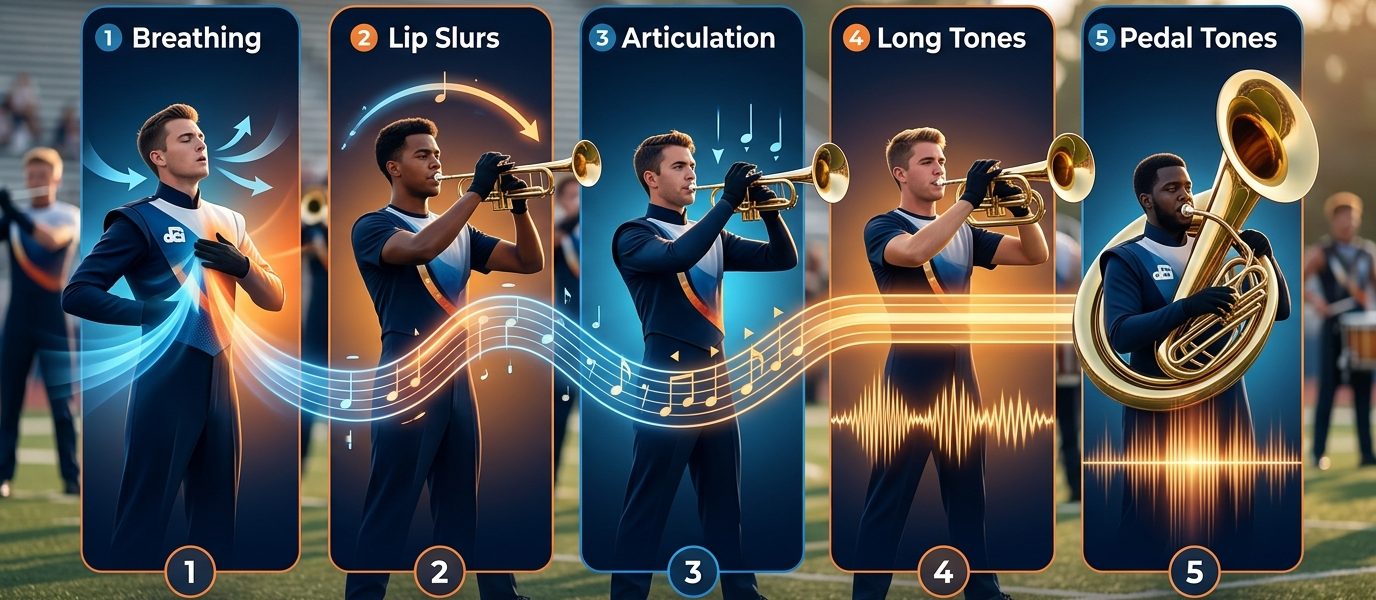
Your tone quality depends more on what happens in the first 15 minutes of practice than anything else you do that day. Most brass players jump straight into their repertoire, skipping the foundation work that separates good players from great ones. The professionals warming up backstage before a drum corps show aren’t running through their hardest passages. They’re methodically preparing their embouchure, air support, and flexibility with targeted exercises that prime their bodies for peak performance.
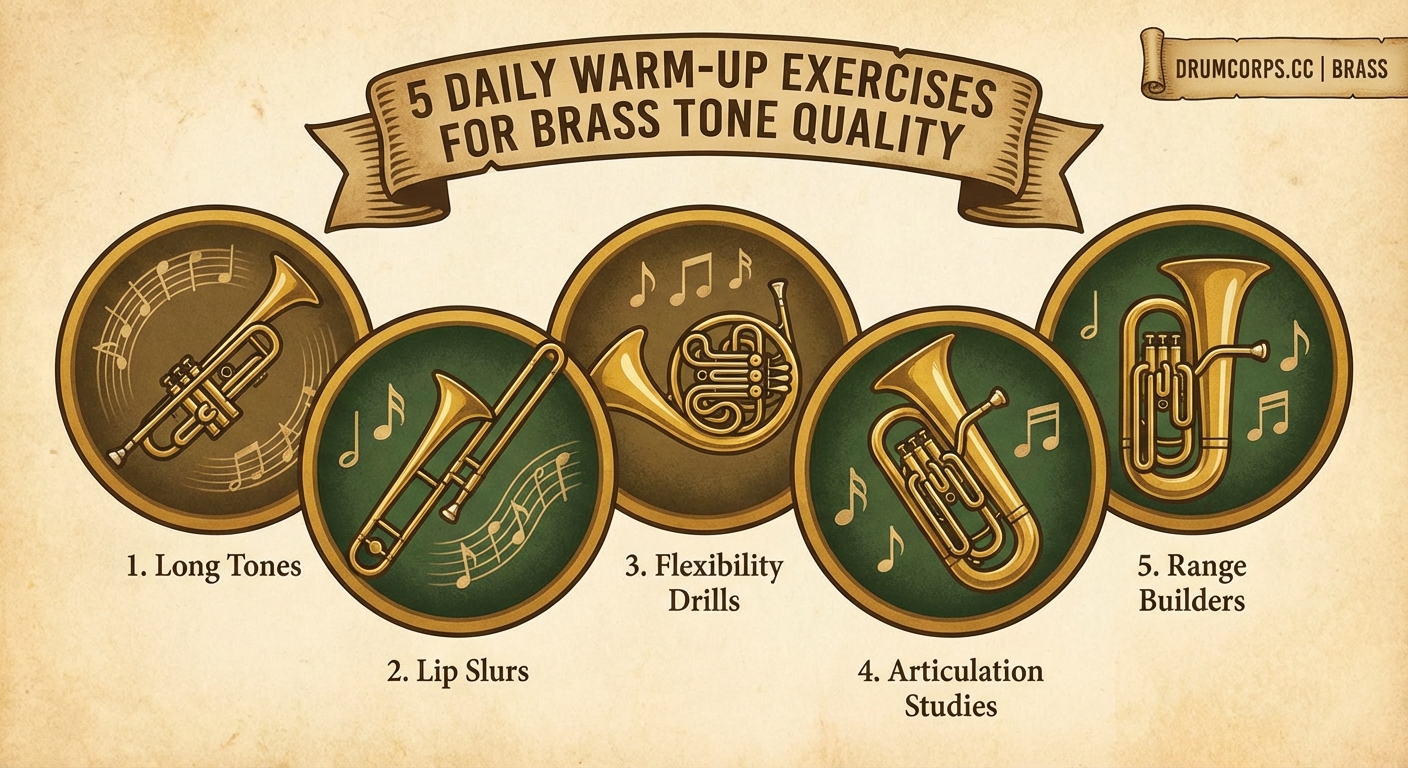
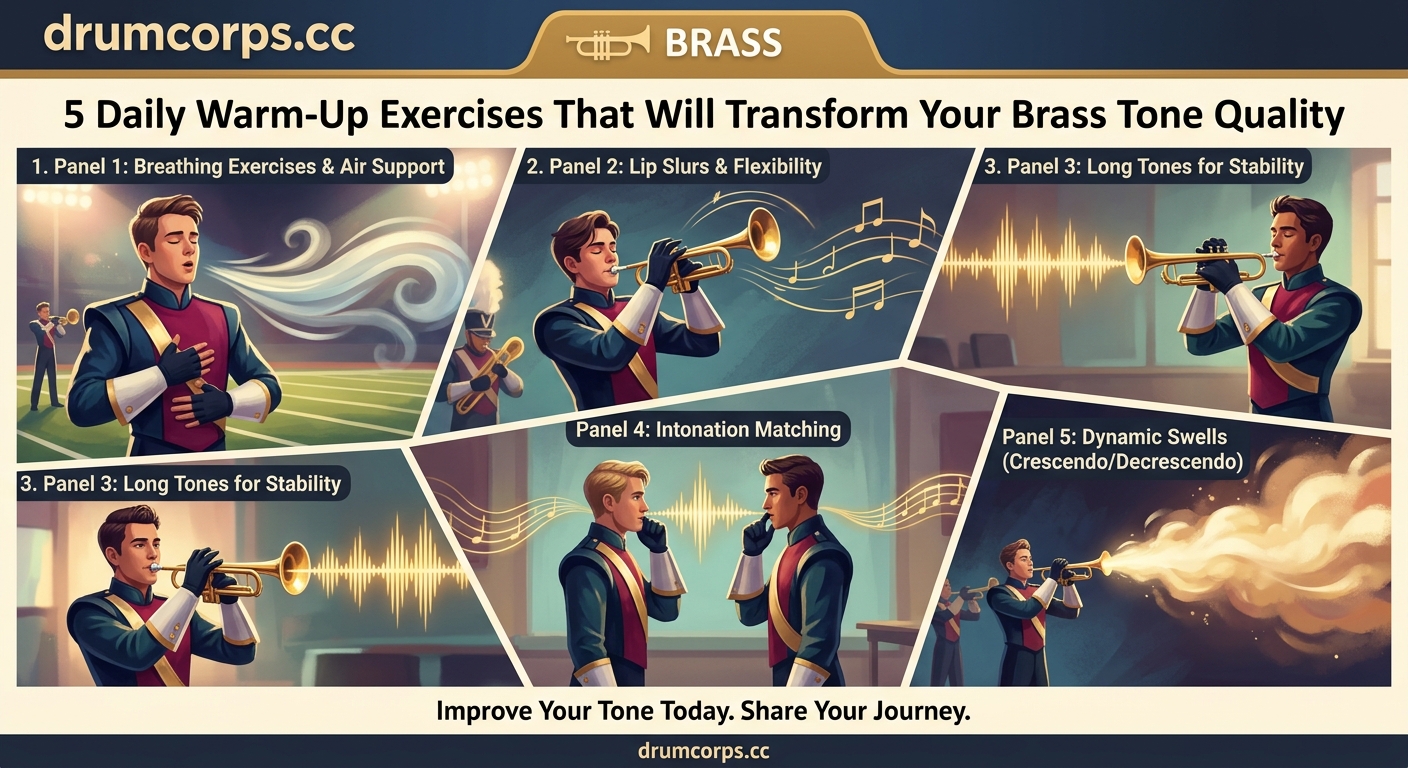
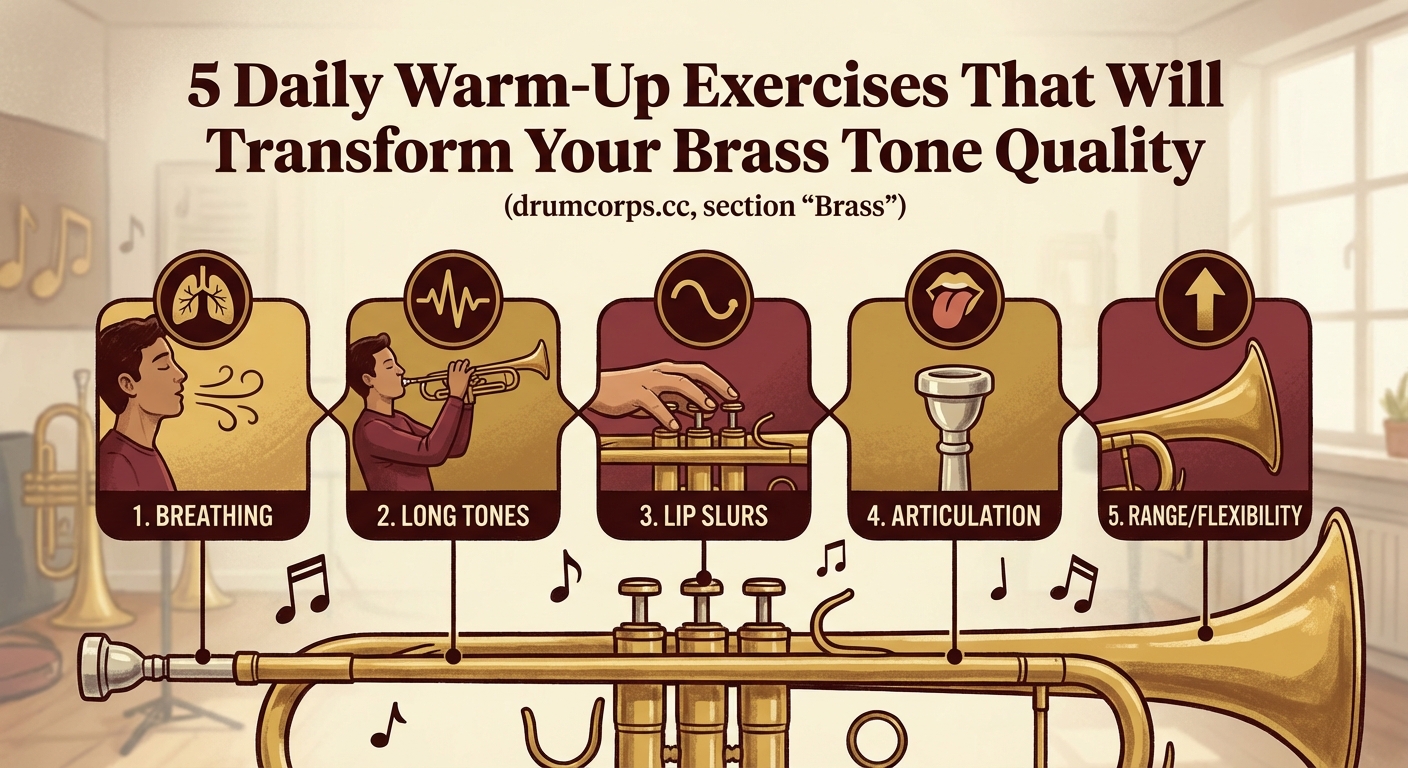
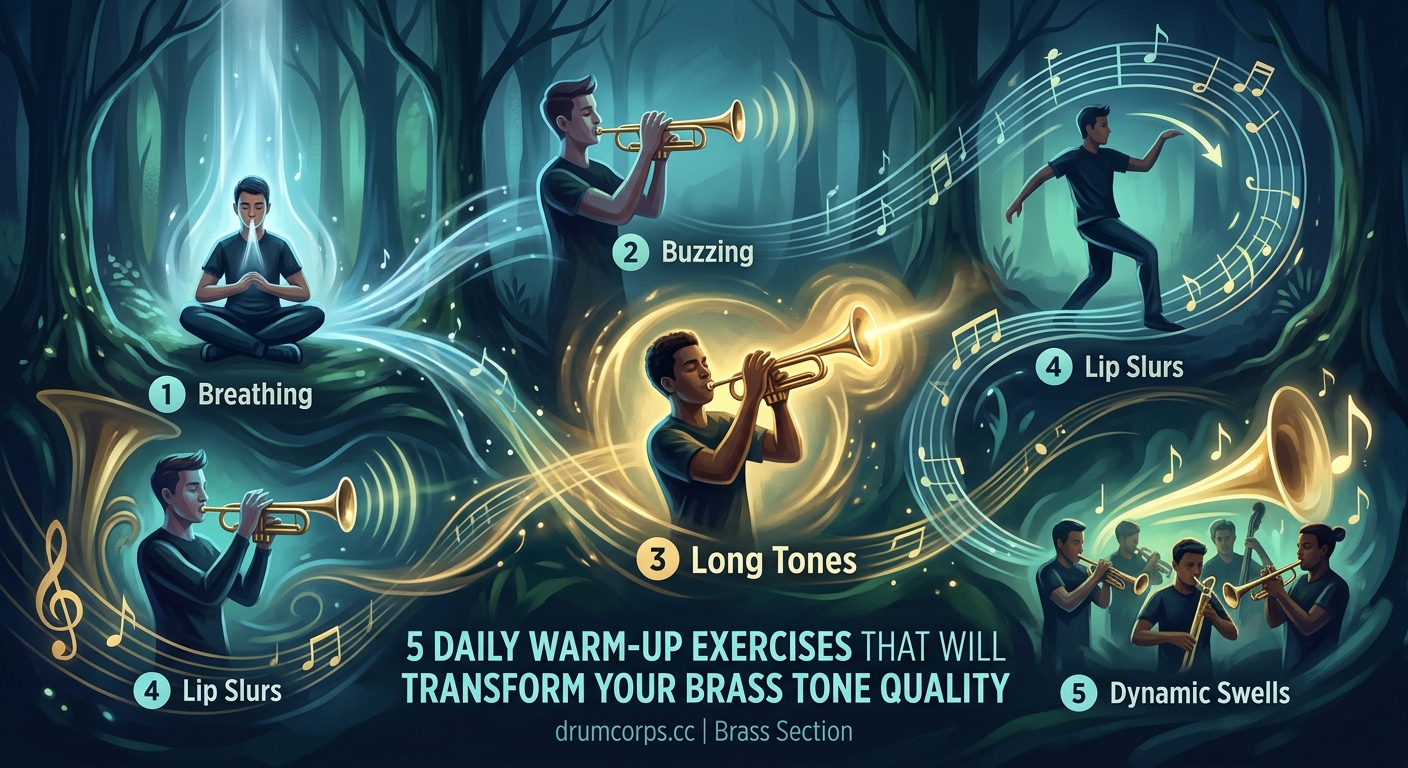
Consistent brass warm up exercises build the foundation for superior tone quality and technical precision. These five exercises target breathing, long tones, lip slurs, articulation, and flexibility. Performed daily for 15 minutes, they prepare your embouchure and air support while preventing injury. The routine works for trumpet, trombone, horn, and tuba players at intermediate to advanced levels seeking measurable improvement in their sound.
Why Your Warm Up Routine Matters More Than You Think
Your embouchure muscles need preparation just like an athlete’s legs before a sprint. Cold muscles produce inconsistent vibrations, leading to unstable pitch and thin tone. The blood flow to your facial muscles increases during a proper warm up, improving endurance and control throughout your practice session.
Many brass players treat warm ups as optional or rush through them to get to “real” practice. This approach backfires. Without proper preparation, you reinforce bad habits and risk injury to delicate facial muscles. A structured warm up also gives you a daily checkpoint to assess your physical condition and adjust your practice goals accordingly.
The exercises below follow a specific sequence. Each one builds on the previous, gradually increasing demand on your embouchure and air support.
Exercise 1: Breath Builder Foundation
Start every session by establishing proper breathing mechanics before you even touch your instrument.
Stand with feet shoulder width apart. Place one hand on your abdomen, just below your ribcage. Inhale slowly through your nose for four counts, feeling your belly expand outward. Your shoulders should stay relaxed and stationary. Hold for four counts. Exhale through pursed lips for eight counts, maintaining steady air pressure throughout the entire release.
Repeat this cycle five times. On your final repetition, exhale for 12 counts while maintaining consistent air speed. This trains the support muscles you’ll need for long phrases.
“The air does the work. Your embouchure just shapes it. If you’re fighting for sound, your breathing needs attention before anything else.” — Brass instructor feedback from multiple DCI caption heads
After the breathing cycle, pick up your instrument. Buzz your mouthpiece alone for 30 seconds on a comfortable pitch. Focus on keeping the buzz steady without wavering. The sound should feel effortless, powered entirely by your air rather than excessive lip pressure.
Exercise 2: Long Tone Pyramid
Long tones develop the core of your sound. This exercise builds both tone quality and dynamic control.
Choose a comfortable middle register pitch. For trumpet players, try second line G. Trombonists can start on F in fourth position. Horn players work well with third space C. Tuba players should begin on low F.
Follow this pattern:
- Play your chosen pitch at mezzo forte for four beats
- Rest for four beats with active breathing
- Play the same pitch for eight beats, crescendo to forte in the middle, then diminuendo back to mezzo forte
- Rest for four beats
- Play for 12 beats with the same dynamic shape
- Rest for eight beats
Repeat this pyramid on three different pitches across your range. Pick one in your low register, one in the middle, and one in the upper middle (not your extreme high range during warm up).
Listen for these qualities in your sound:
- Centered pitch from the first moment of sound
- Consistent vibration without wavering
- Even tone across the entire dynamic range
- No breath noise or air leaks
- Smooth connection between your air and the vibration
Your tone should sound the same at piano as it does at forte, just quieter. If your sound thins out or gets fuzzy at softer dynamics, you’re losing air support or adding tension to compensate.
Exercise 3: Lip Slur Sequences
Flexibility separates competent players from exceptional ones. Lip slurs train your embouchure to make smooth transitions between partials without relying on valves or slide positions.
Start on a valve combination or slide position that feels comfortable. Trumpet and horn players can use open (no valves). Trombonists can use first position. Tuba players should start on open or first valve.
Play this pattern slowly, slurring between each pitch:
| Starting Pitch | Second Pitch | Third Pitch | Pattern |
|---|---|---|---|
| Fundamental | Octave above | Fifth above that | Up and back down |
| Middle C (concert) | G above | C above | 1-5-8-5-1 scale degrees |
| Low register note | Fourth above | Octave above original | Expanding intervals |
The goal is zero tongue involvement. Your air speed and embouchure tension create the pitch changes. Move slowly enough that you can make each transition smooth and connected.
Common mistakes include:
- Using tongue to articulate the pitch changes
- Increasing mouthpiece pressure instead of air speed
- Rushing through the exercise without listening to tone quality
- Only practicing in comfortable registers
Work through five different valve combinations or slide positions. Spend 90 seconds on each. If a particular interval feels difficult, that’s exactly where you need the practice.
Exercise 4: Articulation Clarity Drills
Clean articulation requires coordination between your tongue and air stream. This exercise isolates that coordination.
Choose a single comfortable pitch in your middle register. Play these articulation patterns:
- Four quarter notes at 60 BPM with “tah” syllable
- Eight eighth notes at the same tempo with “tah”
- Sixteen sixteenth notes with “tah”
- Eight eighth notes with “dah” (softer tongue)
- Mixed pattern: two eighths, four sixteenths, two eighths
Record yourself during this exercise. Most players discover their articulation sounds mushier than they imagine. The recording doesn’t lie.
Focus on these technical points:
- Tongue touches the same spot for every note
- Air stream stays constant behind the tongue
- Pitch stays centered throughout all articulations
- Volume remains consistent across different note values
- Releases are as clean as attacks
After working one pitch, move the pattern up by half steps three times, then down by half steps three times. This challenges your embouchure to maintain articulation clarity across different tensions.
The “dah” syllable produces a legato articulation useful for lyrical passages. The “tah” creates a more marcato effect. Both have their place. Your tongue should feel relaxed throughout, never rigid or pressed hard against your teeth.
Exercise 5: Range Extension Flow Study
The final exercise gradually expands your usable range while maintaining the tone quality you built in previous exercises.
Start on a comfortable low note. Play a major scale ascending slowly, two beats per note. When you reach a pitch that feels moderately challenging (not your absolute limit), pause and play a simple arpeggio pattern on that pitch: root, third, fifth, octave, fifth, third, root.
Come back down the scale the same way. Every fourth scale degree, insert the arpeggio pattern.
This approach accomplishes several goals:
- Gradual range extension without shocking your embouchure
- Musical context for technical work
- Built-in rest periods as you descend
- Reinforcement of pitch center in challenging registers
Repeat this pattern in three different keys. Choose keys that put you in different valve combinations or slide positions. Trumpet players might use C, D, and E flat major. Trombonists could work F, G flat, and A flat major.
The upper register should never feel forced during a warm up. If you’re straining to hit a pitch, you’ve gone too far. Back off and let that range develop over weeks of consistent practice.
Building Your Personal Routine
These five exercises create a complete warm up in 15 to 20 minutes. You can adjust the timing based on your schedule, but never skip the sequence. Each exercise prepares your body for the next.
Some days you’ll feel great and breeze through the routine. Other days your embouchure will feel sluggish. The warm up gives you diagnostic information about your physical state. If long tones feel shaky, you might need more sleep. If articulation feels muddy, you might be fighting tension from stress.
Track your progress in a practice journal. Note which exercises feel easy and which need extra attention. Patterns will emerge over weeks. Maybe your flexibility improves but your articulation stays inconsistent. That tells you where to focus supplementary work outside the warm up.
Consider the environment too. Cold rooms require longer warm ups. If you’re practicing outside for marching band or drum corps, add five minutes to your routine. Your muscles need extra time to function properly in lower temperatures.
Adapting Exercises for Your Instrument
Each brass instrument has unique considerations. Trumpet players can move through these exercises faster due to smaller bore size and less air requirement. Tuba players need more time for the same material because of the air volume involved.
Horn players should pay extra attention to the hand position in the bell during warm ups. Keep it consistent to establish reliable pitch tendencies. Trombonists need to ensure their slide positions are exact during lip slurs, since imprecise positions will make flexibility work ineffective.
All brass players benefit from occasionally practicing these exercises on mouthpiece alone. This isolates embouchure function from the acoustic feedback of the instrument. If something feels wrong on the full instrument, test it on the mouthpiece. Often the issue becomes immediately obvious.
Common Warm Up Mistakes to Avoid
Playing too loud too soon damages your sound for the entire practice session. Your embouchure needs time to build resilience. Start at mezzo forte or softer for the first ten minutes.
Skipping rest periods between exercises prevents recovery. Your facial muscles need brief breaks to clear lactic acid and restore blood flow. The rests are part of the exercise, not wasted time.
Practicing in front of a mirror seems helpful but often creates visual dependence. You need to develop kinesthetic awareness of correct embouchure formation. Use a mirror occasionally to check for obvious issues, then put it away and rely on sound and feel.
Changing your warm up routine every day prevents you from tracking progress. Stick with the same exercises for at least a month before making changes. Consistency reveals trends that variety obscures.
Making Warm Ups Work on Busy Days
You won’t always have 20 minutes for a full warm up. On compressed schedules, prioritize breathing exercises and long tones. Those two elements provide the most essential preparation.
A minimal warm up looks like this:
- Three minutes of breathing cycles
- Five minutes of long tones on three pitches
- Two minutes of lip slurs in one position
This ten minute routine won’t fully prepare you for demanding repertoire, but it prevents injury and establishes basic tone quality. Save the abbreviated version for genuine emergencies, not as your default.
Some players split their warm up across the day. Morning breathing work and long tones, then articulation and flexibility before evening rehearsal. This approach works if your schedule demands it, though a single consolidated warm up remains ideal.
Measuring Your Progress Over Time
Record yourself performing these exercises once per week. Save the recordings in a dated folder. After a month, listen to your first recording and your most recent one back to back.
You should hear noticeable differences in:
- Tone stability during long notes
- Smoothness of lip slur transitions
- Clarity of articulation
- Comfort level in extended ranges
If you don’t hear improvement after four weeks of consistent practice, examine your technique with a teacher or experienced player. You might be reinforcing a subtle issue that needs correction.
Physical progress isn’t always linear. Some weeks you’ll feel like you’re moving backward. Stress, sleep deprivation, illness, and seasonal allergies all affect brass playing. The warm up routine helps minimize these variables, but it can’t eliminate them entirely.
Your Sound Starts Here
These brass warm up exercises work because they address the fundamental requirements of good playing: breath support, tone production, flexibility, articulation, and range. Master these elements and everything else becomes easier.
The players with the best sound in your section aren’t necessarily the most talented. They’re usually the most consistent with their preparation. Fifteen minutes every day builds more skill than sporadic marathon practice sessions. Your embouchure develops through regular, moderate stress, not occasional intense effort. Start tomorrow morning with exercise one and work through the sequence. Your tone quality will thank you.