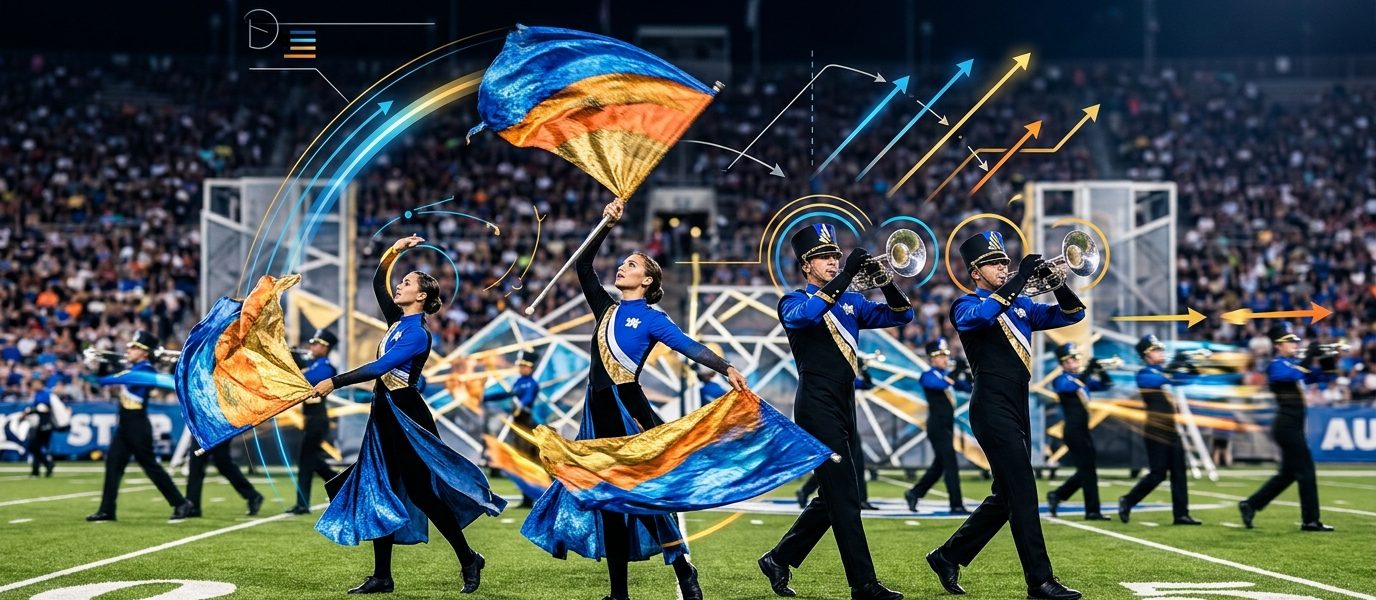
The Blue Devils walked onto the field in Indianapolis on August 12, 2017, and transformed the very idea of what a drum corps show could be. Metamorph wasn’t just a performance. It was a living, breathing visual essay on change itself, executed with surgical precision and artistic daring that left audiences stunned and judges scrambling to find new superlatives.
Blue Devils 2017 Metamorph combined abstract visual design, constant transformation, and technical mastery to create a championship show. The production used body shapes, prop manipulation, and seamless transitions to tell a story about change without traditional narrative structure. Its visual vocabulary redefined modern drum corps design through minimalist staging, maximum member involvement, and relentless motion that never settled into predictable patterns.
The Core Visual Concept Behind Metamorph
Metamorph built its entire visual framework around transformation as both theme and technique. The show didn’t tell a linear story. Instead, it created a visual language where shapes constantly evolved into new forms.
The design team stripped away traditional storytelling elements. No characters. No plot progression. Just pure visual metamorphosis.
This approach demanded total commitment from every performer. Members couldn’t rely on familiar visual cues or predictable staging. Every formation existed in flux, transitioning before it fully resolved.
The color palette reinforced this concept. Costumes shifted from white to black through strategic layering. Props transformed from simple geometric shapes into complex sculptural elements. Even the floor design refused to stay static, with projected elements that morphed alongside the performers.
How Body Shapes Created Narrative Without Words
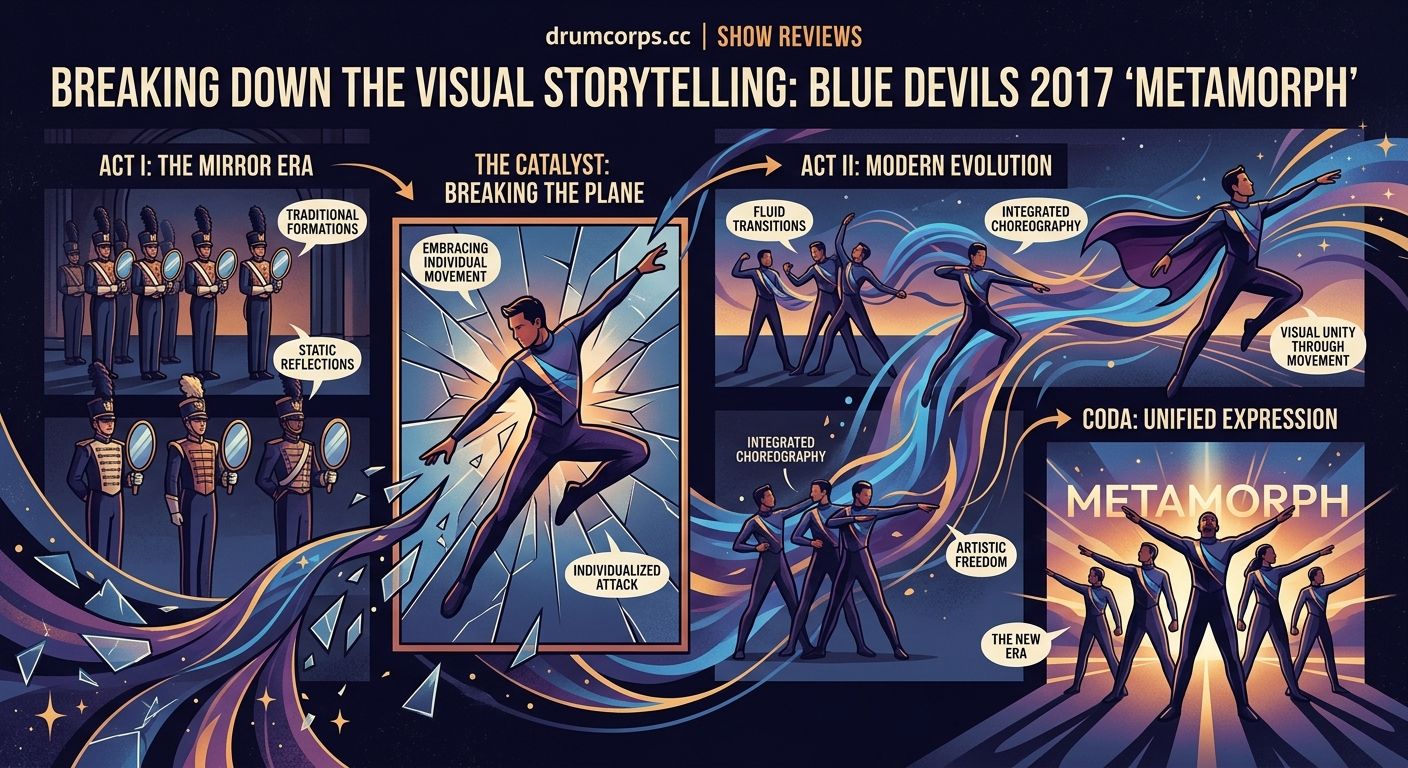
The Blue Devils built entire sections around human architecture. Members became building blocks for larger visual statements, their bodies forming shapes that dissolved and reformed with stunning speed.
Watch the opening minutes. Performers create angular, aggressive shapes that soften into curves, then snap back to sharp edges. The transitions happen so smoothly that audiences often missed the exact moment of change.
This technique required extraordinary body control. Members needed to understand not just their individual position, but how their shape contributed to the larger visual picture. A single performer out of alignment destroyed the entire effect.
The design used three primary shape families:
- Angular formations that created tension and energy
- Curved lines that suggested flow and transformation
- Geometric patterns that provided visual anchors during transitions
These shapes never existed in isolation. Each formation contained the seeds of the next, creating visual continuity that kept audiences locked into the performance.
The Strategic Use of Props as Visual Catalysts
Props in Metamorph functioned differently than in traditional drum corps shows. They weren’t scenic elements or decorative additions. They were active participants in the visual transformation.
The large white panels served multiple functions simultaneously. They created walls, became projection surfaces, formed tunnels, and split into smaller elements. Their versatility allowed the design team to create entirely different visual environments within seconds.
Members manipulated these props with choreographed precision. The panels moved in perfect synchronization, creating the illusion of a single organism rather than 150 individual performers handling equipment.
The most striking prop moment came during the ballad. Panels formed a massive cube that rotated while members performed inside and around it. The structure appeared solid from certain angles, transparent from others, creating visual ambiguity that matched the show’s theme perfectly.
The best visual design doesn’t just support the music. It creates its own parallel narrative that enhances and sometimes contradicts the sonic landscape, forcing audiences to reconcile multiple layers of information simultaneously.
Breaking Down the Three-Act Visual Structure
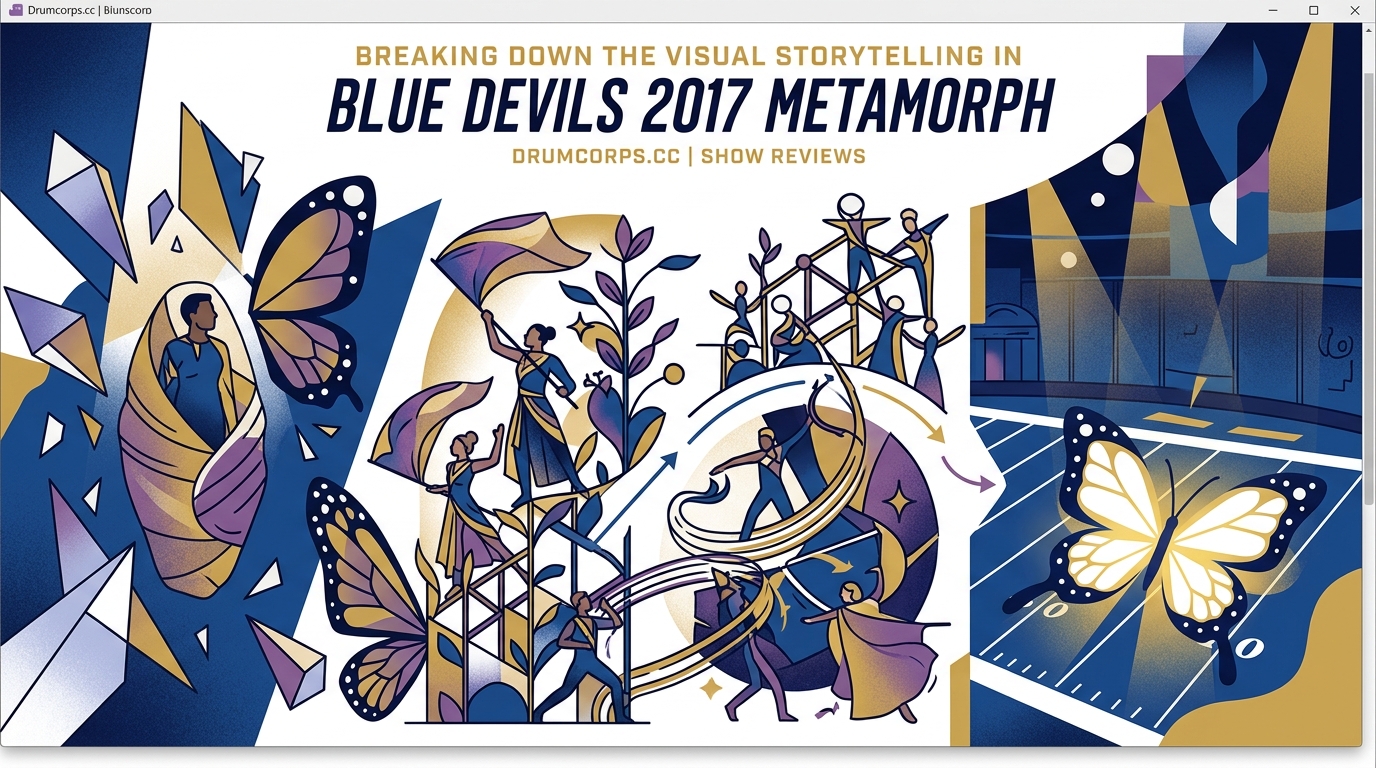
Despite its abstract nature, Metamorph followed a clear three-act structure that guided audiences through increasingly complex visual ideas.
Act One: Establishing the Visual Vocabulary
The opening established the rules. Simple shapes. Clear transitions. Minimal prop involvement. This section taught audiences how to watch the show, introducing visual concepts that would become more complex later.
Members moved in tight formations, creating stark silhouettes against the white floor. The visual design emphasized contrast and clarity, making every position choice obvious and intentional.
Act Two: Complicating the Language
The middle section introduced chaos into the established order. Formations began overlapping. Props multiplied. Transitions happened faster, sometimes interrupting themselves before completing.
This section challenged audiences to track multiple visual threads simultaneously. While one section of the ensemble executed geometric patterns, another created organic flowing shapes. The juxtaposition created visual tension that mirrored the musical development.
Act Three: Resolution Through Transformation
The closer brought all visual elements together in a synthesis that felt both inevitable and surprising. Props, body shapes, and floor design merged into a unified visual statement that resolved the show’s central question about the nature of change itself.
Technical Execution That Made the Vision Possible
The visual design only worked because of extraordinary technical execution. Every member needed to hit precise positions while maintaining the illusion of effortless flow.
The what judges actually look for during visual ensemble scoring goes beyond individual accuracy. It evaluates how well the entire ensemble creates unified visual pictures while executing complex choreography.
Here’s how the Blue Devils achieved championship-level visual execution:
-
Micro-adjustments during movement: Members constantly corrected their spacing and alignment without visible effort, maintaining clean lines even during rapid transitions.
-
Layered awareness: Performers tracked their position relative to multiple reference points simultaneously, including nearby members, props, and yard line markers.
-
Seamless prop integration: Equipment handling became invisible because members practiced transitions until prop manipulation required no conscious thought.
-
Dynamic spacing: The ensemble expanded and contracted formations while maintaining proportional relationships between all members.
Visual Techniques That Elevated Individual Moments
Certain visual choices created standout moments that audiences remembered long after the show ended.
The “mirror” section used facing performers to create symmetrical patterns that appeared to reflect each other. This technique worked because the design team carefully matched body types and movement qualities between paired members.
The “cascade” effect sent visual information rippling through the ensemble like a wave. One performer initiated a movement, which triggered the next, creating a chain reaction that traveled across the entire field in seconds.
The “isolation” moments pulled single performers or small groups out of the ensemble texture. These featured individuals executing intricate choreography while the rest of the corps created a static visual frame.
| Visual Technique | Purpose | Common Mistakes to Avoid |
|---|---|---|
| Layered depth staging | Creates dimensional interest | Blocking sight lines for judges |
| Asymmetrical balance | Generates visual tension | Appearing unintentional or sloppy |
| Negative space usage | Allows visual breathing room | Leaving too much empty field |
| Prop-body integration | Unifies design elements | Visible struggle with equipment |
| Transition choreography | Maintains visual interest | Dead spots between major moments |
The Role of Individual Performers in Ensemble Pictures
Every member of the 2017 Blue Devils contributed to the visual narrative, but certain positions carried extra responsibility for selling specific moments.
Color guard members didn’t just perform traditional flag work. They became sculptural elements, using equipment to extend body lines and create visual punctuation marks during key musical hits.
The front ensemble, typically stationary in drum corps design, participated in the visual transformation through carefully choreographed movement within their performance area. Their subtle repositioning created visual variety without sacrificing musical precision.
Brass and battery members executed body choreography that went far beyond traditional marching technique. The design incorporated elements from modern dance, creating movement vocabulary that felt fresh while maintaining the power and precision expected from championship drum corps.
How Metamorph Influenced Modern Visual Design
The 2017 show’s impact extended far beyond its championship season. Design teams across the activity studied Metamorph’s approach to visual storytelling, adopting and adapting its techniques.
The show proved that abstract visual design could engage audiences just as effectively as traditional narrative structures. This validation opened creative doors for designers who wanted to push beyond conventional storytelling.
Metamorph’s success with constant transformation influenced how other corps approached transitions. The idea that movement between major moments could be just as visually compelling as the moments themselves became a design principle for many programs.
The integration of projection and physical props created a new standard for environmental design. Corps began thinking about the performance space as a dynamic element rather than a static stage.
Similar to how Bluecoats 2014 ‘Tilt’ redefined modern drum corps design through its bold visual choices, Metamorph established new benchmarks for visual complexity and artistic ambition.
Analyzing the Choreographic Vocabulary
The movement style in Metamorph drew from multiple dance traditions while maintaining the athletic precision required for outdoor performance.
Contemporary dance influences appeared in the use of weight shifts, off-balance positions, and floor work. These elements created visual texture that contrasted with traditional drum corps posture and carriage.
The choreography emphasized full-body involvement. Even during stationary moments, members engaged their entire physical presence, creating visual energy that read clearly from the stands.
Isolation technique allowed performers to move individual body parts independently, creating mechanical, almost robotic visual effects that reinforced the transformation theme.
The complete guide to practicing visuals without a field becomes essential when learning this type of complex choreography, as members need countless repetitions to achieve the required precision.
The Color and Costume Design Strategy
Visual storytelling extended into every costume choice. The design team created a color progression that moved from light to dark, mirroring the show’s thematic journey.
Members wore white uniforms that revealed black underlayers through strategic reveals. This transformation happened gradually throughout the show, creating a visual timeline that audiences could track even without understanding the abstract narrative.
The costumes avoided traditional drum corps military styling. Clean lines and modern cuts supported the contemporary aesthetic while maintaining the professional polish expected at championship level.
Fabric choices mattered. Materials needed to move well, maintain their appearance under stadium lights, and survive the physical demands of a full season. The design team tested multiple options before finding fabrics that met all requirements.
Lighting and Environmental Design Elements
While drum corps performances happen primarily in daylight, Metamorph’s design anticipated evening performances where lighting could enhance the visual story.
The white floor design reflected light differently than traditional field surfaces, creating a performance space that felt separate from the stadium environment. This isolation helped focus audience attention on the performers and props.
Projected elements added another layer of visual information without cluttering the physical space. These projections responded to the performance, creating interactive moments where the environment appeared to react to performer movement.
The design team coordinated with stadium technical crews to ensure consistent lighting across different venues. This attention to environmental factors helped maintain visual consistency throughout the competitive season.
Member Training for Visual Excellence
Achieving Metamorph’s visual standards required specialized training that went beyond traditional marching technique.
The corps brought in guest instructors from contemporary dance backgrounds to teach movement vocabulary that many members had never encountered. This cross-training expanded the performers’ physical capabilities and artistic range.
Video analysis became a daily tool. Members watched recordings of their performances, identifying moments where visual pictures broke down or transitions lost clarity. This self-evaluation process accelerated improvement and built individual accountability.
The training emphasized understanding the “why” behind each visual choice. When members understood how their individual position contributed to the larger visual statement, they could make better real-time adjustments during performance.
Similar to how developing skills through the 10-minute mental practice routine that top corps members swear by improves overall performance, the Blue Devils incorporated mental rehearsal techniques for complex visual sequences.
The Design Process Behind the Visual Moments
Creating Metamorph’s visual design required extensive planning, testing, and revision. The design team worked months in advance, developing concepts on paper before bringing them to the field.
Computer visualization tools allowed designers to test formations and transitions virtually. This technology saved rehearsal time by eliminating ideas that looked good on paper but failed in three-dimensional space.
The team built flexibility into the design, creating modular sections that could be adjusted based on performer strengths and weaknesses. This adaptive approach allowed the show to evolve throughout the season as members developed their skills.
Field testing revealed which visual ideas translated from concept to reality. Some formations that appeared simple in drawings required extraordinary precision in execution. Others that seemed impossibly complex proved surprisingly achievable with proper training.
Comparing Metamorph to Other Championship Visual Designs
Metamorph stood out in 2017’s competitive field for its commitment to abstraction. While other top corps incorporated narrative elements or recognizable imagery, the Blue Devils trusted their visual language to carry the show without traditional storytelling crutches.
The show shared DNA with The Cavaliers’ 2002 ‘Frameworks’ built a championship through architectural precision, both using geometric shapes and structural transformation as primary design elements.
However, Metamorph pushed further into pure abstraction. Where Frameworks referenced actual architectural concepts, Metamorph created its own visual vocabulary without external reference points.
This approach carried risks. Audiences unfamiliar with abstract visual art sometimes struggled to find entry points into the show. But for those willing to engage with the design on its own terms, Metamorph offered a deeply rewarding viewing experience.
Visual Moments That Defined the Championship Run
Certain visual pictures became iconic representations of the entire show. These moments combined technical precision, artistic vision, and perfect timing to create images that audiences remembered years later.
The opening hit, with members scattered across the field in seemingly random positions, established immediate visual tension. The apparent chaos resolved into perfect geometric order within eight counts, demonstrating the control that would define the entire production.
The ballad featured a moment where the entire ensemble moved in perfect unison while maintaining complex body shapes. This combination of unity and individuality captured the show’s central theme in a single visual statement.
The closer’s final push brought every visual element together. Props, body shapes, floor design, and performer positioning merged into a climactic picture that felt both inevitable and surprising.
These moments didn’t happen by accident. The design team identified key musical moments where visual punctuation would create maximum impact, then crafted pictures that delivered emotional and artistic payoff.
Practical Lessons for Aspiring Visual Designers
Metamorph offers valuable lessons for anyone interested in visual design for marching arts.
Start with a clear conceptual foundation. The show’s success came from its unwavering commitment to the transformation theme. Every visual choice supported this central idea.
Trust your performers. The Blue Devils’ design team created ambitious visual challenges because they knew their members could execute them. This confidence allowed the designers to push boundaries rather than playing it safe.
Balance complexity with clarity. While Metamorph featured intricate visual ideas, the design team ensured that key moments read clearly from the stands. Technical complexity that audiences can’t perceive serves no purpose.
Test everything. What works in theory often fails in practice. The iterative design process, with constant testing and revision, separates good visual design from great visual design.
Performers looking to improve their visual execution can benefit from resources like 5 body alignment drills that transform your marching posture, which address fundamental techniques that support advanced visual choreography.
Why Visual Storytelling Continues to Evolve
Metamorph represents a specific moment in drum corps visual design evolution, but its influence continues shaping how designers approach their craft.
The show demonstrated that audiences would embrace challenging, abstract visual concepts when executed with conviction and precision. This validation encouraged other designers to take creative risks.
Technology continues expanding the visual designer’s toolkit. Projection mapping, LED integration, and advanced prop engineering create possibilities that didn’t exist when Metamorph premiered.
However, the fundamental principles remain constant. Clear visual communication. Purposeful use of space. Seamless integration of all design elements. Technical execution that makes difficult choreography appear effortless.
The best visual design serves the overall artistic vision while creating standalone moments of beauty and impact. Metamorph achieved this balance, creating a show that worked as both a cohesive artistic statement and a collection of memorable visual moments.
Bringing the Visual Story Home
Understanding Metamorph’s visual design requires multiple viewings from different perspectives. Watch from the stands to see how formations read at distance. Study field-level footage to appreciate the individual technique that creates ensemble pictures. Analyze slow-motion replays to catch transition details that happen too fast for real-time observation.
The show rewards this close attention. Each viewing reveals new layers of visual information, new connections between disparate moments, new appreciation for the artistic choices that made the production work.
Whether you’re a performer looking to improve your visual skills, a designer seeking inspiration, or a fan wanting to deepen your appreciation of the marching arts, Metamorph offers a masterclass in visual storytelling. The lessons embedded in its design continue influencing how we think about movement, space, and transformation on the competitive field.