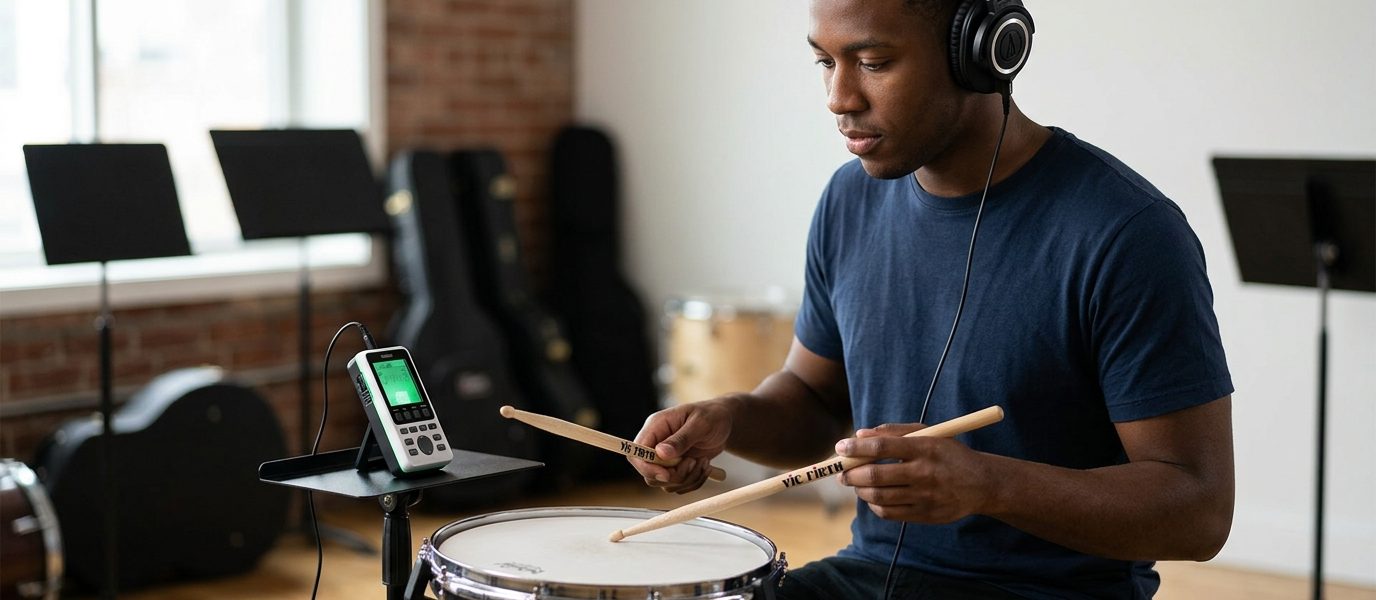
You’ve probably heard it a thousand times: “Practice with a metronome.” Your instructor says it. Online tutorials preach it. That one section leader who always nails their part swears by it.
But should you really use a metronome every single day?
The answer isn’t as simple as yes or no. A metronome can be your best training partner or your worst enemy, depending on how and when you use it. Let’s break down what actually works.
Daily metronome practice builds timing precision and exposes weak spots in your technique, but it shouldn’t dominate your entire routine. Balance metronomic accuracy with musical expression, use it strategically for problem passages, and give yourself metronome-free time to develop natural phrasing. The best musicians know when to click it on and when to trust their internal pulse.
What a metronome actually does for your playing
A metronome keeps you honest.
It doesn’t lie about whether you’re rushing that sixteenth-note run or dragging through the slow section. It won’t let you hide behind “it felt right” when the tempo clearly shifted.
Here’s what regular metronome work builds:
- Steady internal pulse that holds even under pressure
- Accurate subdivision awareness at any tempo
- Confidence in complex rhythmic patterns
- Ability to lock in with an ensemble
- Clear diagnosis of technical weak spots
When you practice a passage at 60 BPM and it falls apart, you’ve found the real problem. Not the tempo. Not the difficulty. Your fingers, embouchure, or sticking pattern has a gap that faster playing was masking.
That’s valuable information.
But here’s the catch: a metronome can’t teach you musicality. It won’t help you shape a phrase or build dynamic contrast. It can’t tell you when to breathe life into a melody or when to let a note ring just a fraction longer for emotional impact.
When metronome practice makes you better
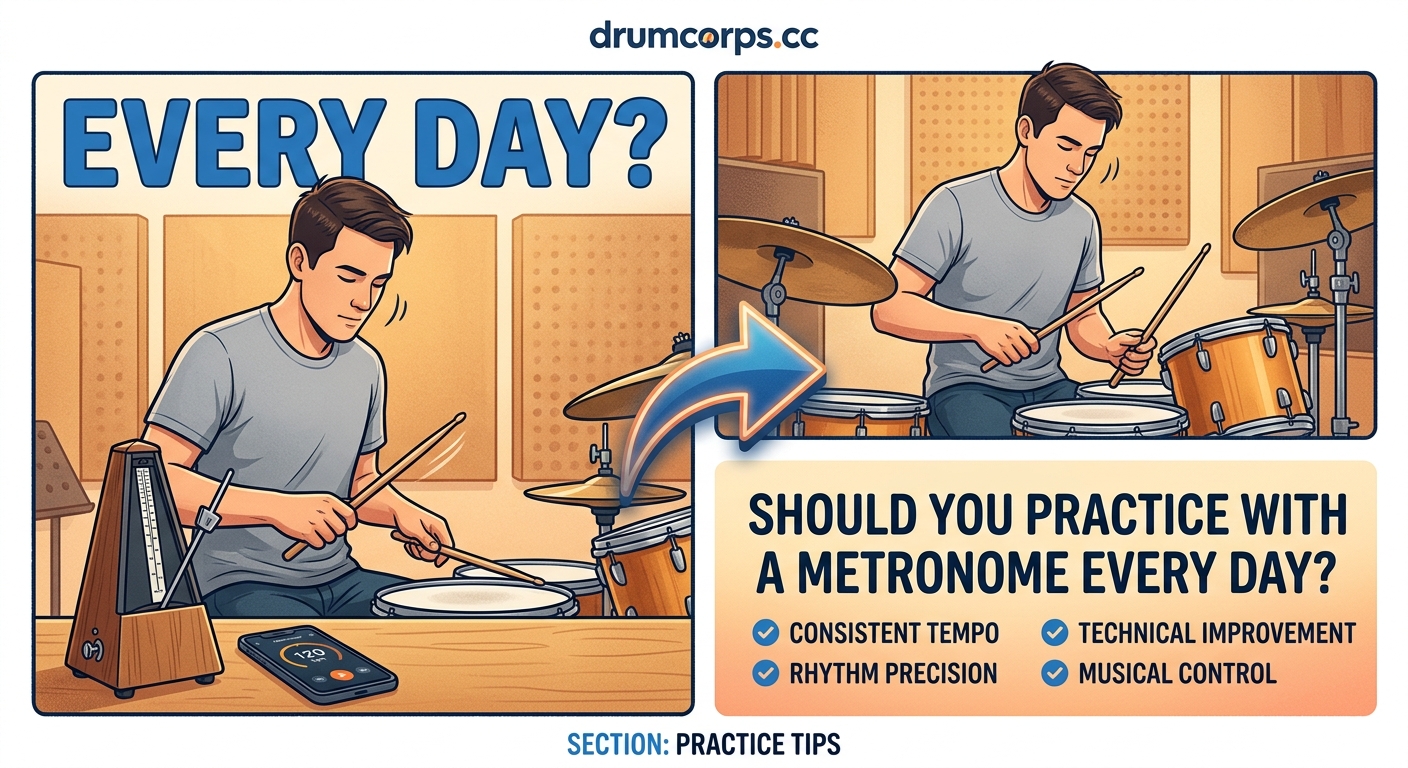
Use a metronome when you’re building new skills or fixing broken ones.
1. Learning new music from scratch
Start slow. Really slow. Slower than feels necessary.
Set your metronome to a tempo where you can play every note cleanly with proper technique. If that’s 40 BPM, that’s where you start. No ego. No shortcuts.
Increase by 4-8 BPM increments only after you can play the passage three times perfectly at the current speed. This systematic approach prevents the “almost got it” syndrome that keeps passages perpetually sloppy.
2. Isolating problem spots
That one measure that always trips you up? That’s metronome territory.
Loop it. Slow it down until it’s easy. Then gradually build speed while maintaining perfect accuracy. This targeted practice fixes issues faster than running the entire piece repeatedly and hoping the trouble spot magically improves.
3. Building speed on technical exercises
Scales, arpeggios, rudiments, and etudes all benefit from measured tempo increases.
Track your progress in a practice journal. Write down the date, exercise, and maximum clean tempo. Come back a week later and try to beat it. This gamification makes tedious technical work more engaging and gives you concrete proof of improvement.
When the metronome holds you back
Not every practice session needs that relentless click.
Playing with a metronome all the time creates mechanical, lifeless performances. You start anticipating the click instead of feeling the music. Your phrasing becomes rigid. Your dynamics flatten out.
Here are situations where you should turn it off:
Working on musical expression
When you’re learning how to shape a phrase or experimenting with rubato, the metronome kills your creativity. You need freedom to stretch time, to lean into a crescendo, to let a resolution breathe.
Music isn’t a math equation. It’s a conversation. And conversations don’t happen at perfectly metronomic intervals.
Developing your internal sense of time
If you never practice without a metronome, you never learn to trust your own pulse. Then what happens during a performance when you don’t have that click in your ear?
Spend time playing with just yourself and the music. Record it. Listen back. Did you rush? Drag? Stay steady? This self-awareness is crucial for ensemble playing and solo performance.
Initial sight-reading
When you’re reading through new music for the first time, focus on notes, rhythms, and overall shape. Adding a metronome to that cognitive load often creates more confusion than clarity.
Get familiar with the piece first. Then bring in the metronome for refinement.
A practical weekly metronome strategy

Balance is everything. Here’s a framework that works for most musicians:
| Practice Type | Metronome Use | Why |
|---|---|---|
| Technical exercises | Always | Builds precision and tracks progress |
| New music (first read) | Never | Reduces cognitive overload |
| Problem passage work | Always | Systematic improvement of weak spots |
| Musical interpretation | Never | Develops phrasing and expression |
| Full run-throughs | Sometimes | Tests performance readiness |
| Slow practice | Always | Ensures clean fundamentals |
This approach gives you the benefits of metronomic accuracy without sacrificing musical development. You’re training both your technical precision and your artistic voice.
Common metronome mistakes that wreck your progress
Playing along instead of playing with
The metronome should be in the background, not leading you. If you’re chasing the click, you’re doing it wrong. The click confirms what you’re already feeling internally.
Practice this: Set the metronome to click only on beat one of each measure. Can you maintain steady tempo through beats two, three, and four? If not, your internal pulse needs work.
Starting too fast
Ego kills progress. Starting at a tempo where you can barely keep up teaches your muscles to play sloppily. You’re literally practicing mistakes.
Start at a tempo where you feel bored. Where it’s almost too easy. That’s where clean technique lives. Speed comes later, and it comes faster when you build on a foundation of accuracy.
Never changing the subdivision
If you always practice with quarter-note clicks, you’re missing opportunities. Try setting the metronome to half notes, whole notes, or even dotted quarters.
This forces you to internalize subdivisions instead of relying on the click for every beat. It’s harder. That’s the point.
Ignoring the musical context
A metronome can’t tell you what tempo feels right for a piece. It can help you maintain whatever tempo you choose, but the choice itself requires musical judgment.
Listen to professional recordings. Pay attention to tempo choices. Then make informed decisions about your own interpretations before you start clicking away.
Alternatives and supplements to traditional metronome practice
Sometimes you need a different tool for the job.
Drum tracks and play-alongs
These add harmonic and rhythmic context that makes practice more musical. You’re not just playing against a click. You’re playing with a band.
Many backing tracks exist for scales, exercises, and common repertoire. They build timing while keeping your ears engaged with actual music.
Recording yourself
This might be the most brutally honest practice tool available. Record a passage without a metronome. Play it back. Then play it again with a metronome running in the background.
Did you rush? Drag? Fluctuate wildly? The recording doesn’t lie, and it shows you exactly where your internal clock needs calibration.
Practicing with others
Nothing beats real-time ensemble experience for developing timing. You learn to listen, adjust, and lock in with other musicians. This is the actual skill you’re trying to build. The metronome is just training wheels.
If you’re working on something like how to build a perfect 30-minute individual practice routine, consider dedicating specific blocks to metronome work and others to free playing.
How to know if you’re using it correctly
Here are signs your metronome practice is working:
You can play passages at multiple tempos with equal accuracy. You can turn the metronome off mid-practice and maintain steady time. You notice tempo fluctuations in your playing before the metronome catches them. You feel more confident in ensemble settings.
Here are signs you’re overdoing it:
Your playing sounds mechanical and emotionless. You panic when asked to play without a metronome. You can’t adjust tempo flexibly based on musical context. You’ve stopped listening to the actual sound you’re making because you’re so focused on the click.
The goal isn’t to become a human metronome. The goal is to develop reliable timing that serves your musical expression.
Building this into your larger practice routine
Metronome work is one tool in your practice toolkit, not the entire toolkit.
Your practice session should include technical work with the metronome, musical work without it, and everything in between. If you’re also focusing on fundamentals like 5 essential breathing exercises every brass player should master, you’ll want to coordinate your timing work with your air support development.
A balanced practice routine might look like this:
- Warmup without metronome (focus on sound quality and body awareness)
- Technical exercises with metronome (scales, arpeggios, rudiments)
- Problem passage work with metronome (slow, methodical, incremental)
- Musical interpretation without metronome (phrasing, dynamics, expression)
- Full run-throughs with occasional metronome checks (performance simulation)
This structure builds both precision and artistry. You’re not sacrificing one for the other.
What tempo should you actually practice at?
There’s no universal answer, but here’s a reliable guideline.
For new material, start at 50-60% of performance tempo. If the final tempo is 120 BPM, start at 60-72 BPM. This gives you room to focus on every detail: finger placement, breath support, stick height, articulation clarity.
For technical exercises, work at the edge of your comfort zone. Fast enough to challenge you, slow enough to maintain perfect form. When form breaks down, you’ve gone too fast.
For problem passages, go slower than you think you need. If you’re making mistakes at 80 BPM, drop to 60 BPM. Find the tempo where you can play it perfectly ten times in a row. That’s your starting point.
Then increase gradually. The 5% rule works well: if you can play something cleanly at 60 BPM, try 63 BPM next. Small increments prevent the technique breakdown that happens when you jump too quickly.
The mental game of metronome practice
Metronome work can be frustrating. You’ll have days where passages you nailed yesterday suddenly fall apart. Where your fingers won’t cooperate. Where the click feels like it’s mocking you.
That’s normal. Progress isn’t linear.
The metronome reveals inconsistencies in your playing that you might not notice otherwise. That’s uncomfortable but necessary. Those inconsistencies were always there. Now you can fix them.
Approach metronome practice with curiosity, not judgment. When something doesn’t work, ask “what’s happening here?” instead of “why can’t I get this?” The first question leads to solutions. The second leads to frustration.
Take breaks. If you’ve been grinding on the same four measures for 20 minutes and you’re getting worse instead of better, stop. Walk away. Come back later. Your brain needs time to process new motor patterns.
Integration with ensemble playing
Individual metronome practice prepares you for ensemble work, but it’s not a replacement for it.
In an ensemble, you’re not playing to a click. You’re playing to a conductor, a section leader, or the collective pulse of the group. That requires different skills: listening, adjusting in real-time, matching articulation and phrasing.
The best ensemble players have strong internal time that they can flex when needed. They can lock into a steady pulse or stretch time for musical effect. They can lead a section or blend into it.
Metronome practice builds the foundation, but you need ensemble experience to develop the full skill set. If you’re working on visual elements alongside your musical preparation, resources like the complete guide to practicing visuals without a field can help you coordinate timing across multiple performance dimensions.
Different instruments, different needs
Percussion and rhythm section instruments benefit most from daily metronome work. Your primary job is keeping time. The metronome is your quality control.
Melodic instruments need more balance. Yes, you need solid time. But you also need to develop phrasing, tone, and expression. Split your practice time accordingly.
Brass players working on endurance and tone quality might find that 5 daily warm-up exercises that will transform your brass tone quality pairs well with targeted metronome work on technical passages later in the practice session.
Guitarists and string players often benefit from metronome work on picking patterns and position shifts, but need metronome-free time for developing vibrato, bending, and other expressive techniques.
Know your instrument’s demands and adjust your metronome use accordingly.
Technology and app options worth considering
Modern metronomes offer features that traditional mechanical ones can’t match.
Many apps allow you to program complex time signatures, accent patterns, and subdivision options. Some can gradually increase tempo over time (speed trainers). Others integrate with backing tracks or offer visual cues alongside audio clicks.
Popular options include:
- Soundbrenner (wearable vibrating metronome)
- Pro Metronome (highly customizable app)
- Time Guru (randomly mutes beats to test your internal pulse)
- Tempo Advance (tracks practice statistics)
The fancy features don’t matter if you don’t use them consistently. A simple, reliable metronome you actually turn on beats a sophisticated app you ignore.
Making it stick as a long-term habit
The musicians who benefit most from metronome practice are the ones who use it consistently over months and years, not the ones who binge on it for a week before an audition.
Build it into your routine gradually. Start with 10 minutes per practice session. Once that feels natural, increase to 15 or 20. Don’t try to transform your entire practice routine overnight.
Track your progress. Keep a practice journal with dates, tempos, and observations. Seeing improvement over time motivates you to keep going.
Make it non-negotiable for specific activities. Maybe you always use a metronome for scales and never use one for sight-reading. Clear rules prevent decision fatigue.
When to trust yourself over the click
You’ll reach a point where your internal sense of time is reliable enough that you don’t need constant external confirmation.
That’s the goal. Not dependence on the metronome, but confidence in your own timing that you can verify with the metronome when needed.
Professional musicians use metronomes in practice but rarely in performance. They’ve internalized the skill. They can feel when they’re rushing or dragging and self-correct without external help.
You’re building toward that same independence. The metronome is a teacher, not a crutch. Learn from it, then trust yourself.
Your timing foundation starts today
The question isn’t really whether you should practice with a metronome every day. The question is how to use it intelligently as part of a complete practice approach.
Use it when you need precision, accountability, and systematic progress. Turn it off when you need to develop musicality, expression, and artistic voice. Balance both approaches and you’ll build timing that’s both accurate and musical.
Start with one exercise today. Set your metronome to a comfortable tempo and work through a scale, a rudiment, or a problem passage. Focus on matching the click perfectly, not just playing near it. Then turn it off and play the same thing from memory, trying to maintain that same steady pulse.
That’s the skill you’re building. Not playing to a click, but playing with reliable time that you own.