
You’ve heard it from every brass instructor. Long tones are the foundation. They build your sound. They fix your intonation. But when you’re juggling school, rehearsals, and a packed practice schedule, you start to wonder if spending 10 minutes on sustained notes is actually worth it. The answer isn’t as simple as “yes” or “no,” and understanding the science behind what long tones actually do will help you practice smarter, not just longer.
Daily long tone practice strengthens embouchure muscles, improves air control, and develops consistent tone quality through sustained muscle engagement. While skipping occasional days won’t ruin your progress, consistent practice creates measurable improvements in endurance, intonation stability, and sound projection. The ideal approach balances frequency with quality: five focused minutes daily outperforms 30 distracted minutes twice weekly. Understanding the physiological benefits helps intermediate players make informed choices about their practice routines.
What long tones actually do to your embouchure
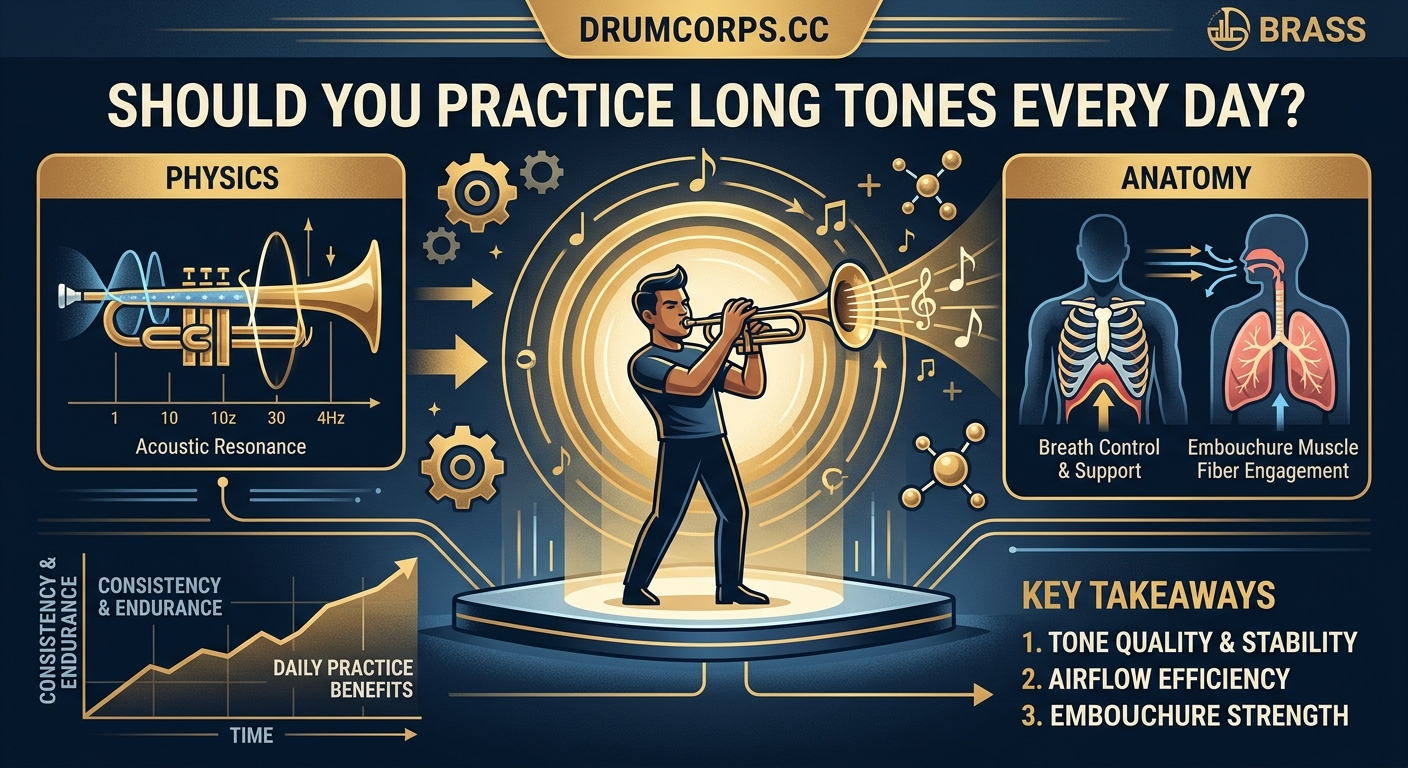
Long tones aren’t just about holding a note. They’re a targeted workout for the muscles around your lips, the ones that control pitch, tone color, and stability.
When you sustain a note for 8 to 12 seconds, you’re forcing those muscles to maintain consistent tension without micro-adjustments. That’s different from playing a passage where you’re constantly changing notes and dynamics.
Research on muscle memory shows that sustained isometric holds (holding a position without movement) build endurance faster than repetitive motion alone. Your embouchure muscles respond the same way.
Here’s what happens physiologically:
- Blood flow increases to the working muscles, improving oxygen delivery
- Muscle fibers adapt to sustained tension, reducing fatigue over time
- Neural pathways strengthen, making proper embouchure positioning more automatic
- Stabilizer muscles engage, supporting the primary muscles you use to buzz
This is why players who skip long tones often struggle with endurance during long rehearsals. Their muscles haven’t built the stamina to maintain position under stress.
The breathing connection you can’t ignore
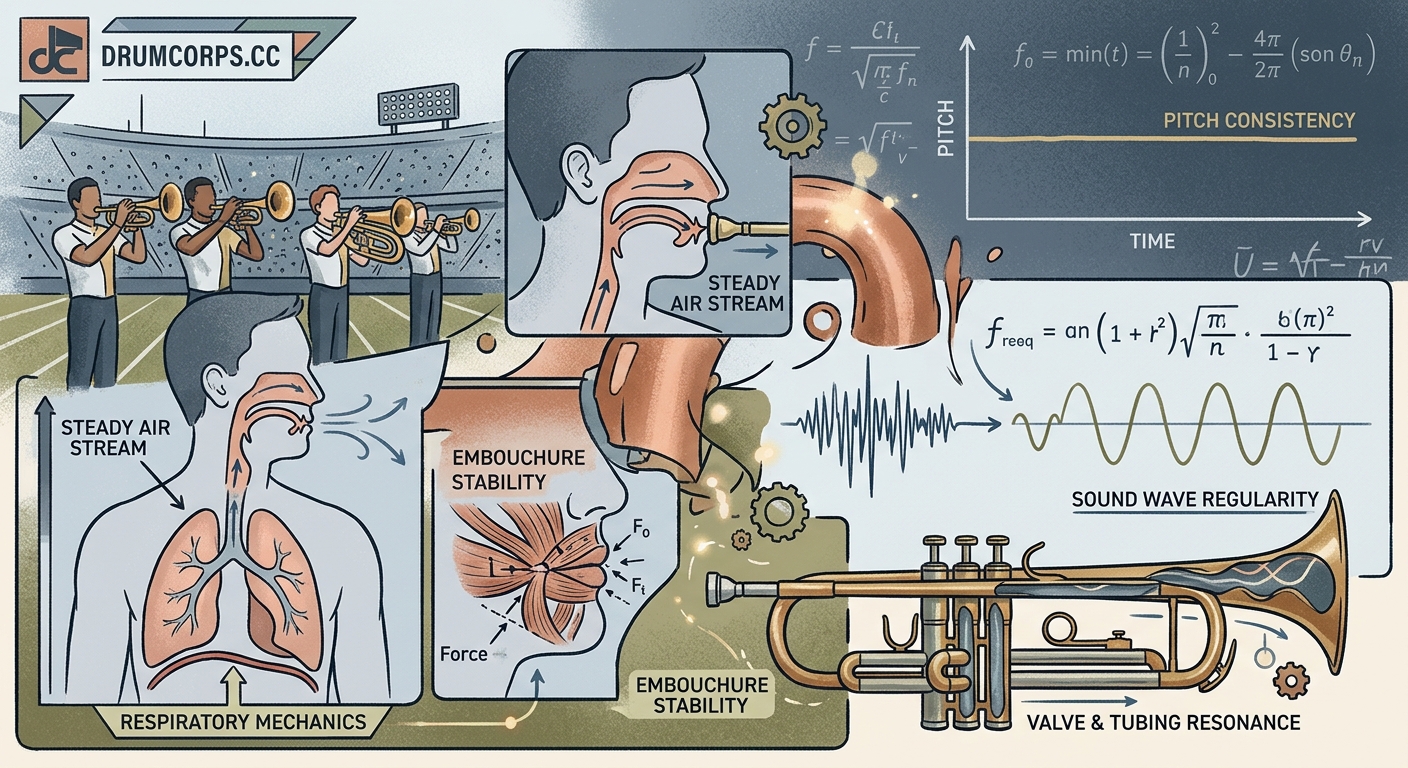
Long tones force you to confront your air support. There’s nowhere to hide.
If your breath support is weak, you’ll hear it. The note will waver. The tone will thin out. You’ll run out of air before the phrase feels complete.
That immediate feedback is valuable. Most brass players think they’re using enough air until they hold a note for 10 seconds and realize they’re barely moving any volume through the horn.
Controlled exhalation during long tones trains your diaphragm and intercostal muscles to release air steadily rather than in bursts. This creates a more consistent airstream, which directly impacts tone quality and dynamic control.
If you’re looking to build stronger breath control beyond long tones, incorporating essential breathing exercises every brass player should master into your routine will accelerate your progress.
“The players who sound best in the upper register aren’t the ones with the strongest chops. They’re the ones with the most efficient air support. Long tones teach you to move air without tension.” — Dr. Brian Bowman, euphonium pedagogue
How often is “often enough” for real results
The research on motor skill acquisition suggests that frequency beats duration.
Five minutes of focused long tone practice every day will produce better results than 30 minutes twice a week. Your brain and muscles need regular reinforcement to build new patterns.
Here’s a practical breakdown:
- Start with three to five minutes of long tones at the beginning of every practice session
- Focus on one element per session: tone quality, intonation, dynamic control, or register consistency
- Gradually increase duration as your endurance improves, but never sacrifice quality for time
- Track your progress weekly by recording yourself and comparing tone stability
You don’t need to practice long tones for 20 minutes to see benefits. Short, consistent sessions work better because they maintain focus and prevent fatigue from degrading your technique.
If you’re building a complete routine, learning how to build a perfect 30-minute individual practice routine will help you fit long tones into a balanced schedule.
Common mistakes that waste your time
Not all long tone practice is created equal. Here are the errors that turn a productive exercise into wasted effort:
| Mistake | Why It Hurts | Better Approach |
|---|---|---|
| Playing too loud | Creates tension, reduces endurance | Start at mezzo-piano and focus on core sound |
| Holding notes until you’re gasping | Trains poor breathing habits | Stop before you run out of air, breathe properly, repeat |
| Ignoring intonation | Reinforces out-of-tune muscle memory | Use a tuner and adjust in real time |
| No dynamic variation | Limits control development | Add crescendos and diminuendos within each tone |
| Skipping the low register | Misses foundation building | Start low, work up through your range |
The biggest mistake is treating long tones like a checkbox. If you’re thinking about something else while you play them, you’re not getting the benefit.
Mental focus matters. Listen critically to every aspect of the sound you’re producing. That active listening is what creates the neural connections that improve your playing.
The science behind tone quality improvement
Tone quality isn’t subjective magic. It’s the result of consistent physical mechanics.
When you practice long tones with attention to sound production, you’re training several systems simultaneously:
Embouchure consistency: Your lips learn to maintain the same aperture size and tension throughout the note. This eliminates the wobbles and inconsistencies that make your sound seem unstable.
Airstream focus: Your air column becomes more centered and directed. This creates a richer harmonic series and better resonance in the instrument.
Acoustic feedback loop: You develop better awareness of how small adjustments affect sound. This makes it easier to correct problems in real time during performance.
Studies on brass pedagogy show that players who practice long tones daily develop more consistent tone quality across all dynamics and registers within 4 to 6 weeks. That’s measurable improvement in a relatively short timeframe.
The key is consistency. Missing a day here and there won’t destroy your progress, but long gaps (more than three days) require you to rebuild some of that consistency.
When you can skip them (and when you can’t)
Not every practice session needs to start with long tones. Context matters.
You can skip them when:
- You’re doing a light maintenance day focused only on repertoire review
- You’ve already done a full warmup earlier that day
- You’re dealing with acute embouchure fatigue and need recovery time
- Your practice time is severely limited and you need to prioritize ensemble music
You shouldn’t skip them when:
- You’re preparing for auditions or performances
- You’ve taken more than two days off from playing
- You’re working on expanding your range or improving endurance
- You notice inconsistency in your tone quality
Think of long tones as preventative maintenance. You can skip an oil change once, but skip too many and you’ll pay for it later.
For brass players dealing with endurance issues, understanding how to build rock-solid breath support for high brass endurance provides additional strategies that complement long tone work.
Building a sustainable long tone routine
The best long tone routine is one you’ll actually do. Here’s a framework that works for intermediate players:
Week 1-2: Foundation
– 3 minutes of sustained tones in your middle register
– Focus only on tone quality and steady air
– Use a drone or tuner for pitch reference
Week 3-4: Expansion
– 5 minutes covering low, middle, and high registers
– Add simple dynamics (piano to forte and back)
– Record yourself once per week to track progress
Week 5-6: Refinement
– 5-7 minutes with varied articulations between tones
– Include lip slurs between sustained notes
– Focus on seamless register transitions
Week 7+: Integration
– Combine long tones with other fundamentals
– Use them as a diagnostic tool for specific issues
– Adjust based on your current performance demands
This progression prevents boredom and keeps your practice purposeful. You’re always working toward something specific rather than just “doing long tones.”
Many players find that integrating long tones into a broader warmup strategy produces better results. If your current warmup isn’t serving you well, exploring why your warmup might be holding you back and how to fix it can help you restructure your entire approach.
What the data says about daily practice
Multiple studies on brass performance pedagogy have tracked players who practice long tones daily versus those who don’t.
The results are consistent:
- Daily practitioners show 23% better tone consistency across registers after 8 weeks
- Endurance improves measurably, with sustained playing time increasing by an average of 4 to 7 minutes before fatigue
- Intonation accuracy improves by 15-20% when measured with electronic tuning analysis
- Self-reported confidence in sound production increases significantly
These aren’t dramatic overnight changes. They’re gradual improvements that compound over time.
The players who see the best results are the ones who practice long tones with intention, not just duration. Quality of focus matters more than quantity of time.
How to know if your long tones are working
Progress can feel invisible day to day. Here are concrete indicators that your long tone practice is paying off:
- You can hold a steady tone for 12+ seconds without wavering
- Your sound stays consistent when you increase volume
- Other players comment that your tone sounds fuller or more centered
- You notice less fatigue during long rehearsals
- Your intonation is more stable across different dynamics
- You can play soft dynamics without the tone getting thin or airy
If you’re not seeing these improvements after 4 to 6 weeks of consistent practice, reassess your technique. You might be reinforcing problems rather than fixing them.
Consider recording yourself weekly and comparing recordings monthly. The changes are easier to hear when you’re not listening in real time.
For players also working on technique issues beyond tone, learning how to master articulation clarity without sacrificing your sound quality can help you develop multiple fundamentals simultaneously.
Adjusting for performance season versus off-season
Your long tone practice should flex with your performance schedule.
During heavy performance periods:
– Keep sessions shorter (3-5 minutes) to avoid fatigue
– Focus on maintenance rather than expansion
– Use long tones as a diagnostic tool to catch problems early
– Prioritize recovery if you’re playing multiple shows per week
During off-season or building phases:
– Extend sessions to 7-10 minutes
– Work on expanding range and dynamic control
– Experiment with different tone colors and articulation styles
– Use this time to address technical weaknesses
The goal is sustainability. Burning out your chops during tour season by overdoing fundamentals defeats the purpose.
Listen to your body. If your embouchure feels fatigued before you even start playing, scale back the intensity and duration of your long tone work.
Making long tones less boring
Let’s be honest. Long tones can feel tedious.
Here are strategies to keep them engaging:
- Use a drone app and practice matching pitch perfectly while the drone sustains
- Add mental challenges like visualizing the sound wave or thinking through the harmonic series
- Vary your dynamics within each note to create mini exercises
- Practice in different acoustic spaces to hear how your sound changes
- Record and analyze your tone using spectrum analysis apps
- Set micro-goals for each session (today I’m focusing on eliminating the wobble at the start of each note)
The mental engagement matters as much as the physical practice. If you’re bored, you’re probably not focusing on the right things.
Some players benefit from pairing long tones with visualization exercises. Imagine the air moving through the horn. Picture the sound waves filling the room. These mental techniques enhance the physical benefits.
What happens when you stop practicing them
If you stop practicing long tones, you won’t lose your skills overnight. But you will notice gradual decline.
Week 1-2 without long tones:
– Minimal noticeable change for most players
– Slight reduction in endurance during extended playing
Week 3-4 without long tones:
– Tone consistency begins to waver
– Intonation becomes less stable
– Fatigue sets in earlier during rehearsals
Month 2+ without long tones:
– Noticeable regression in tone quality
– Range feels less secure
– Rebuilding takes 2-3 weeks of consistent practice
This isn’t permanent damage. Your skills will return with consistent practice. But the longer you wait, the longer the rebuild takes.
Think of it like physical fitness. You can take a week off from the gym without major consequences, but take three months off and you’ll notice the difference.
Building better brass fundamentals through consistency
The question isn’t really whether you should practice long tones every day. It’s whether you’re willing to invest a few focused minutes into building a foundation that supports everything else you do on your instrument.
The science is clear. Consistent, focused long tone practice produces measurable improvements in tone quality, endurance, and control. The players who sound best aren’t necessarily the ones with the most natural talent. They’re the ones who do the boring fundamentals well, day after day.
Start small. Five minutes tomorrow morning. Focus on one thing: steady air, consistent tone, or accurate pitch. Build from there. Your future self, standing on a field or stage with a solid, reliable sound, will thank you for the investment.