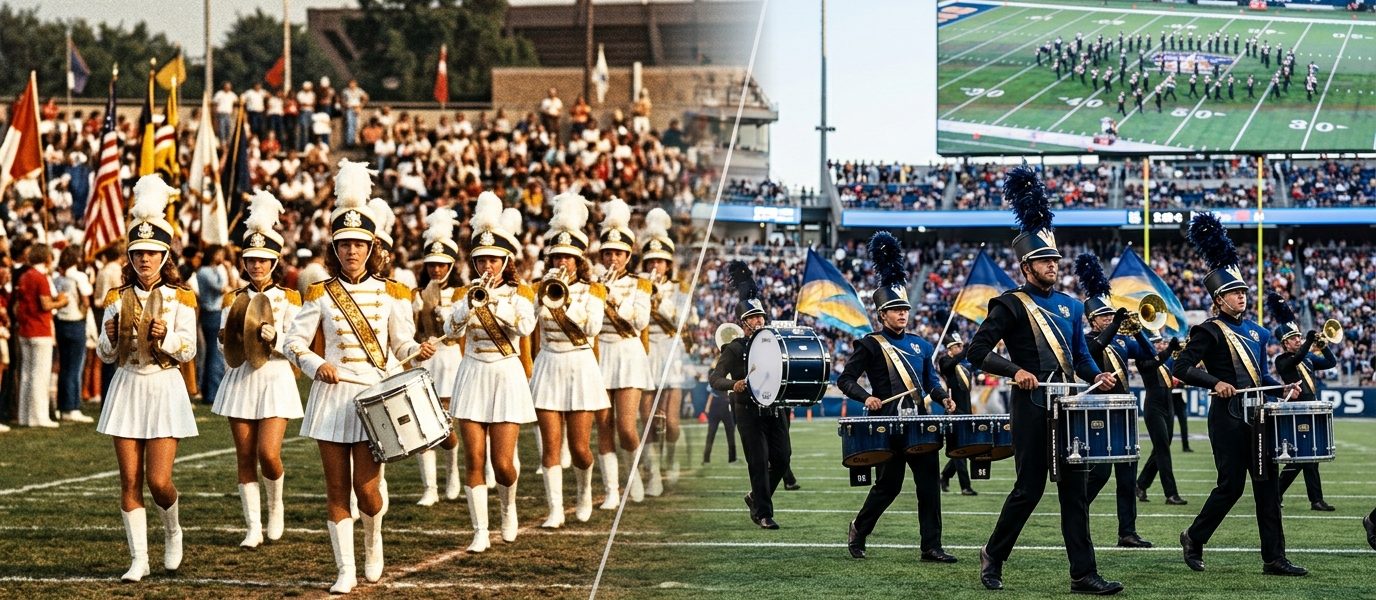
The marching arts world once featured dozens of all-female drum and bugle corps that competed at the highest levels. These groups weren’t novelty acts or exhibition ensembles. They were championship contenders with fierce reputations, dedicated memberships, and loyal fan bases. Then, within a single decade, most of them disappeared.
All-girl drum corps thrived from the 1950s through the mid-1970s, with groups like the Skyliners, Brackenettes, and Royalaires earning national recognition. Title IX, coed integration policies, and shifting cultural attitudes toward gender-segregated activities led to their rapid decline after 1975. By the early 1980s, nearly all had either merged with male corps, folded entirely, or transitioned to coed formats. Their legacy shaped modern drum corps in profound ways.
The Golden Era of All-Female Drum Corps
All-girl drum corps emerged in the post-World War II era when youth activities were heavily gender-segregated. VFW posts, American Legion halls, and Catholic Youth Organization chapters sponsored these groups just as they did for boys.
The difference? Girls’ corps often faced skepticism about their competitiveness.
That skepticism evaporated fast. By the late 1950s, all-girl corps were winning regional championships and earning respect at national competitions. Groups like the Skyliners from New York and the Brackenettes from Pennsylvania became household names in drum corps circles.
These weren’t scaled-down versions of male corps. They performed the same demanding drill patterns, played identical brass arrangements, and competed under the same judging criteria. Many developed signature styles that influenced the activity for decades.
“The Skyliners could march circles around half the boys’ corps at any given show. They weren’t just good for a girls’ group. They were good, period.” – Former DCI judge and brass instructor
The competitive landscape included:
- The Royalaires (Baltimore)
- The Blue Angels (New Jersey)
- The Chordettes (Massachusetts)
- The Rosebuds (Chicago)
- The Bon Bons (Pennsylvania)
- The Imperialettes (New York)
How All-Girl Corps Shaped Drum Corps Culture
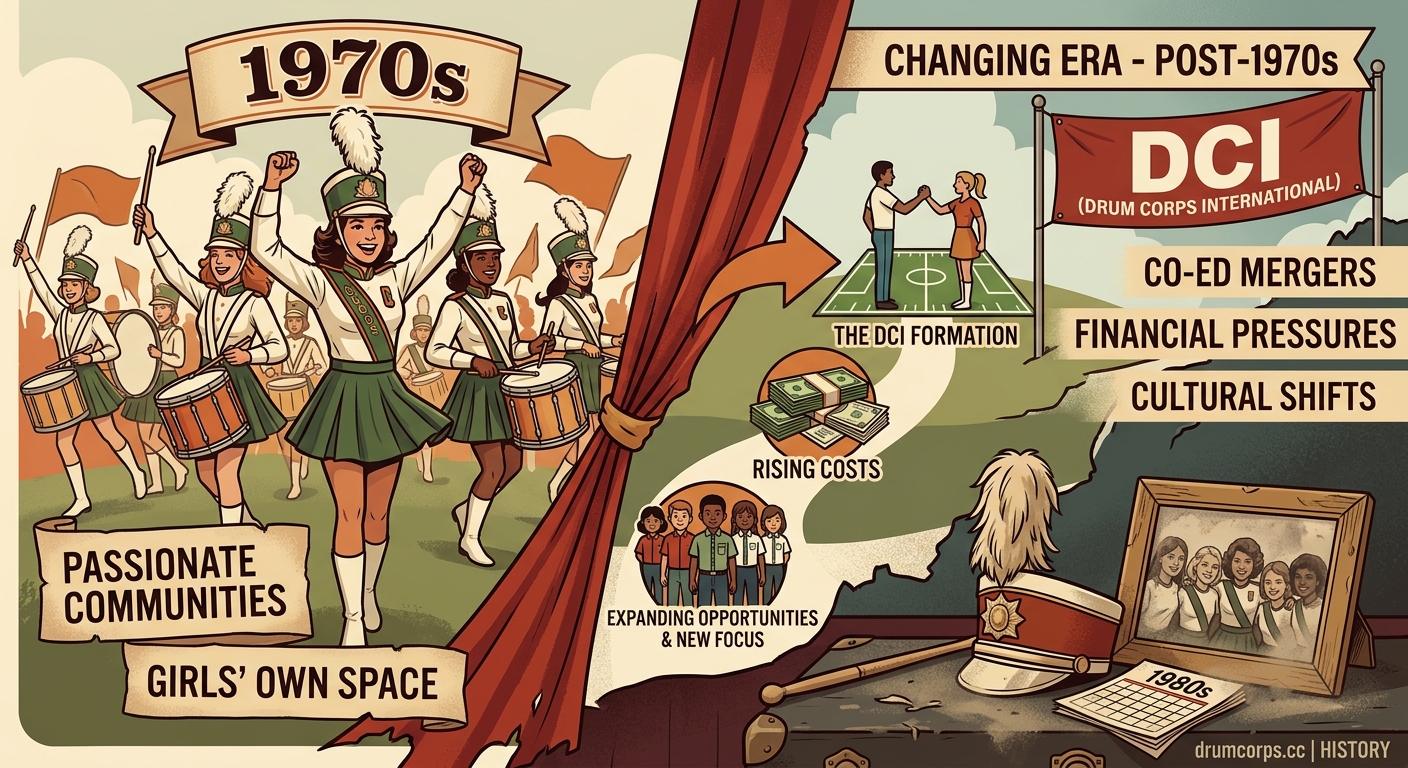
Female corps brought distinct innovations to the marching arts. Their visual programs often emphasized precision and synchronization over raw power. Drill designers created intricate formations that showcased unified movement.
Many groups pioneered what we now call “body work” in modern drum corps. Hand movements, upper body carriage, and expressive gestures became integrated elements of their shows before most male corps adopted these techniques.
The brass sound differed too. Without the sheer volume that larger male corps could produce, all-girl groups focused on blend, intonation, and musical nuance. This approach influenced how judges actually look for during visual ensemble scoring in later decades.
Their percussion sections developed unique teaching methods. Smaller physical stature meant different approaches to stick heights, grip pressure, and body mechanics. These innovations eventually informed modern technique books used by all drummers today.
| Innovation Area | All-Girl Corps Contribution | Modern Legacy |
|---|---|---|
| Visual Design | Precision formations, synchronized body work | Standard in contemporary shows |
| Brass Pedagogy | Emphasis on blend over volume | Core teaching principle |
| Percussion Technique | Adapted mechanics for smaller frames | Influenced ergonomic approaches |
| Uniform Design | Functional yet elegant solutions | Inspired modern costume design |
The Social Landscape of the 1960s and Early 1970s
All-girl drum corps thrived during an era when gender-segregated activities were the norm. High school sports teams, social clubs, and youth organizations rarely mixed genders in competitive settings.
Parents felt comfortable sending daughters on summer tours with all-female groups. The supervision structure, housing arrangements, and social dynamics were straightforward. Tour schedules followed the same circuit as male corps, but housing often happened in separate facilities.
Sponsoring organizations supported these groups enthusiastically. A VFW post or American Legion chapter could sponsor both a boys’ and girls’ corps, doubling their community presence and fundraising potential.
The 1960s saw peak membership numbers. Some all-girl corps fielded 128 members or more. Competition circuits included dedicated all-girl classes at regional and national championships.
But cultural shifts were already underway. The women’s movement questioned why activities needed gender separation. Title IX legislation, passed in 1972, began changing how educational institutions approached gender equity in activities and athletics.
Title IX and the Beginning of the End
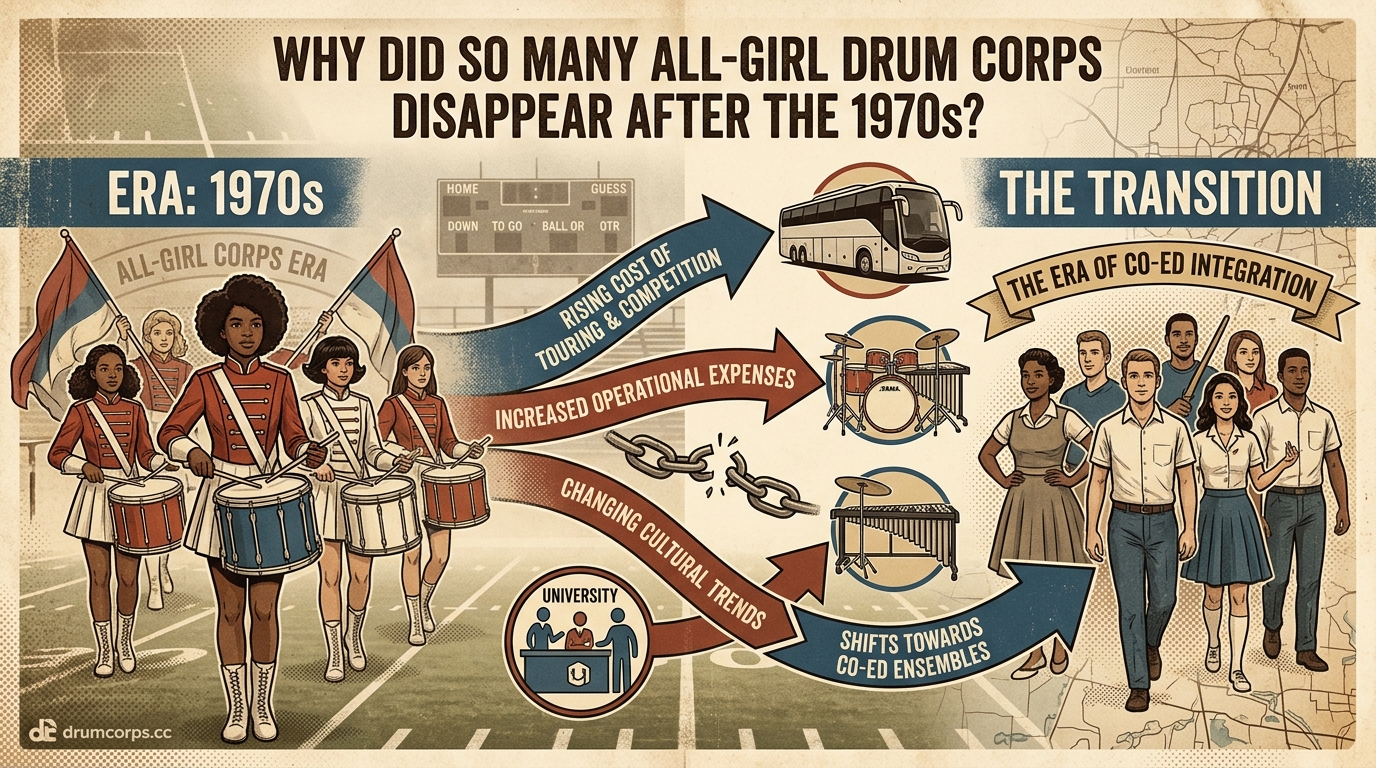
Title IX didn’t directly govern drum corps. Most groups operated as independent nonprofit organizations, not school programs. But the law’s cultural impact rippled through youth activities everywhere.
Parents and participants began questioning why drum corps needed gender separation. If girls could compete with boys in academics and increasingly in sports, why not in marching music?
Drum Corps International, formed in 1972, initially allowed member corps to set their own membership policies. Some groups went coed immediately. Others maintained single-gender rosters. A few all-girl corps joined DCI and competed successfully in the early years.
The Skyliners, Brackenettes, and other top groups faced a strategic dilemma:
- Maintain all-girl status and watch potential members join coed groups
- Accept male members and lose their distinct identity
- Merge with established male corps to pool resources
- Fold operations entirely
Financial pressure intensified these choices. Running a competitive drum corps required significant funding. Sponsoring organizations faced economic challenges in the 1970s. Supporting two separate corps (one male, one female) became financially unsustainable for many sponsors.
The Rapid Decline After 1975
Between 1975 and 1982, the all-girl drum corps landscape collapsed. The reasons compounded:
Membership drain: Talented female performers now had options. They could join prestigious coed corps like the Blue Devils revolutionized modern drum corps in the 1970s or stay in all-girl groups with shrinking rosters.
Financial crisis: The late 1970s brought economic recession. Sponsoring organizations cut budgets. All-girl corps, often smaller than male counterparts, had less fundraising capacity.
Competitive disadvantage: As top female performers migrated to coed groups, all-girl corps struggled to field championship-caliber ensembles. Lower competitive placements meant less sponsorship interest and declining ticket sales.
Cultural momentum: By 1980, maintaining gender-segregated youth activities seemed outdated to many participants and supporters. The cultural conversation had shifted decisively toward integration.
The timeline of major closures:
- 1975: Several regional all-girl corps fold or merge
- 1977: The Skyliners perform their final season
- 1978: The Brackenettes cease operations
- 1980: Fewer than ten all-girl corps remain nationally
- 1982: The last competitive all-girl corps in DCI converts to coed format
What Happened to the Members and Staff
When all-girl corps closed, their members faced choices. Many aged out of eligibility and moved on from drum corps entirely. Others auditioned for coed groups and found success.
The transition wasn’t always smooth. Some coed corps had never taught female brass players or marchers. Teaching methods developed for male performers didn’t always translate. Female members sometimes encountered resistance from veteran staff who questioned whether coed integration would work.
But talented performers proved themselves. Within a few years, coed corps normalized. Female section leaders, drum majors, and featured soloists became common. The skepticism faded as performance quality remained high.
Instructional staff from all-girl corps brought valuable expertise to coed programs. Their teaching methods, particularly around how to build rock-solid breath support for high brass endurance, influenced brass pedagogy across the activity.
Some former all-girl corps directors started or led coed groups. Their experience designing shows for female performers informed a more inclusive approach to visual and musical programming.
The Legacy That Survived
All-girl drum corps may have disappeared, but their influence persists. Modern drum corps incorporate many innovations these groups pioneered.
Contemporary visual design owes a debt to the precision work developed by all-girl corps. The emphasis on unified body movement, expressive gestures, and detailed choreography traces directly to their approach.
Brass instruction today balances power with musicality, a synthesis of traditionally “male” and “female” pedagogical approaches. The blend-focused sound that all-girl corps championed became a cornerstone of modern brass teaching.
Equipment design evolved partly because of lessons learned from all-girl corps. Lighter-weight brass instruments, adjustable harness systems, and ergonomic drum carriers all reflect insights gained from teaching performers of different physical sizes.
The cultural legacy matters too. The existence of successful all-girl corps proved that female performers could compete at the highest levels. When coed integration happened, that proof already existed. Female members didn’t have to establish credibility from scratch.
Comparing All-Girl Corps to Modern Coed Programs
Modern drum corps members might wonder how all-girl corps compared to today’s groups. The differences were significant but not always in expected ways.
Musical sophistication: All-girl corps performed complex brass and percussion arrangements. The difficulty level matched male corps of the same era. Modern arrangements are more technically demanding than anything from the 1970s, but that reflects overall activity evolution, not gender differences.
Visual complexity: Drill design in the 1970s was less demanding than contemporary standards. All-girl corps performed formations and maneuvers comparable to male groups of their time. Modern visual programs, regardless of gender composition, far exceed 1970s complexity.
Competitive intensity: All-girl corps took competition seriously. Members practiced year-round, attended winter camps, and toured extensively. The commitment level matched male corps. Today’s drum corps require even more intensive preparation, but again, that reflects activity-wide changes.
Performance quality: Top all-girl corps delivered performances that audiences and judges respected. They weren’t charity cases or exhibition groups. They earned their competitive placements through skill and preparation.
Lessons for Today’s Marching Arts
The all-girl drum corps story offers insights for modern programs. Gender-specific teaching methods can be valuable without requiring gender-segregated groups. Coed corps benefit when instructors understand different physical and psychological approaches to teaching.
Body mechanics matter. Teaching techniques developed for one body type don’t automatically transfer. The best modern instructors adapt methods to individual performers, drawing on lessons learned during the all-girl corps era.
Inclusive culture requires intentional effort. The transition from all-girl corps to fully integrated coed programs took years and wasn’t always smooth. Modern groups that prioritize inclusive environments create better experiences for all members.
- Adapt teaching methods to individual physical characteristics
- Value precision and musicality alongside power and volume
- Create supportive environments that respect all members
- Learn from historical approaches that worked well
- Recognize that diversity in approach strengthens programs
Remembering the Groups That Shaped the Activity
Specific all-girl corps deserve recognition for their contributions. The Skyliners from New York competed at the highest levels throughout the 1960s and early 1970s. Their brass line set standards for intonation and blend that influenced teaching methods for decades.
The Brackenettes from Pennsylvania developed visual programs that showcased synchronized precision. Their drill designs influenced how later corps approached formation work.
The Royalaires from Baltimore brought musical sophistication to their shows. Their ballad work demonstrated that emotional impact didn’t require maximum volume.
Smaller regional corps also mattered. Groups like the Blue Angels, Chordettes, and Rosebuds provided performance opportunities for thousands of young women. They built communities, taught discipline and teamwork, and created memories that participants carried throughout their lives.
These groups didn’t disappear because they failed. They vanished because the cultural context that supported gender-segregated youth activities shifted. Their competitive quality remained high until the end.
The Path Forward for Gender and Drum Corps
Today’s drum corps are overwhelmingly coed. A few all-male groups persist, mostly connected to specific sponsoring organizations with traditional membership policies. No competitive all-female corps remain at the DCI or DCA level.
Some educators and historians have discussed whether reviving all-girl corps might serve a purpose. Proponents argue that single-gender environments can benefit some participants, particularly during adolescence. Critics counter that integrated activities better prepare young people for diverse adult environments.
The question remains largely theoretical. The financial and logistical challenges of running competitive drum corps make starting new groups difficult regardless of membership policy. The few new corps that form each year almost all choose coed formats.
What matters more is ensuring that modern coed corps serve all members well. That means:
- Teaching methods that accommodate different body types and learning styles
- Leadership opportunities distributed equitably across gender lines
- Social environments that respect all members
- Historical awareness of how the activity evolved to its current state
Understanding all girl drum corps history helps modern participants and educators appreciate how far the activity has come. It also reminds us that seemingly permanent structures can change rapidly when cultural conditions shift.
Why This History Still Resonates
The story of all-girl drum corps matters because it reveals how social forces shape artistic activities. These groups didn’t fail artistically. They succeeded at the highest competitive levels. External cultural and economic pressures drove their disappearance.
Their legacy lives on in teaching methods, design approaches, and the very existence of female performers in modern drum corps. Every female brass player, percussionist, or color guard member today stands on a foundation built partly by all-girl corps from decades past.
For historians and educators, this history illustrates how quickly youth activities can transform. A landscape that seemed permanent in 1970 had completely changed by 1985. Understanding that transformation helps us anticipate and navigate future changes.
For current drum corps members, knowing this history provides context. The coed environment you experience today wasn’t inevitable. It resulted from specific choices, cultural shifts, and the pioneering work of performers who proved that gender didn’t determine competitive capability.
The all-girl drum corps era ended, but its influence continues. That’s the real legacy worth remembering and honoring.