You don’t need a field to get better at marching. You don’t even need your instrument. The most powerful practice tool you have is completely free, works anywhere, and runs 24/7 inside your head. Mental visualization has helped elite athletes, musicians, and performers master complex skills for decades. Now you can use the same techniques to improve your marching, musicianship, and stage presence from your bedroom, a bus, or anywhere else life takes you.
Mental visualization activates the same neural pathways as physical practice, allowing you to rehearse marching technique, musical passages, and performance skills without equipment or space. This visualization practice guide teaches you structured mental rehearsal methods that build muscle memory, reduce performance anxiety, and accelerate skill development through focused imagery sessions you can do anywhere, anytime.
Understanding How Mental Rehearsal Actually Works
Your brain doesn’t distinguish much between vividly imagined experiences and real ones. When you mentally rehearse a backward march or a difficult musical passage, the motor cortex fires in patterns nearly identical to physical execution. Neuroscientists call this phenomenon motor imagery, and it’s the foundation of effective visualization practice.
Studies on basketball players showed that those who practiced free throws mentally improved almost as much as those who practiced physically. The mental practice group shot 23% better after two weeks of visualization alone. The physical practice group improved 24%. That one percentage point difference came without touching a basketball.
This works because mental rehearsal strengthens the neural pathways that control movement. Each time you visualize a skill correctly, you’re essentially running a simulation that prepares your nervous system for the real thing. The more detailed and accurate your mental imagery, the stronger the effect.
For marchers and musicians, this means you can reinforce proper technique, fix bad habits, and prepare for performances without physical fatigue or equipment. You can practice your entire show from memory while sitting on your couch.
Building Your Foundation with Sensory Detail
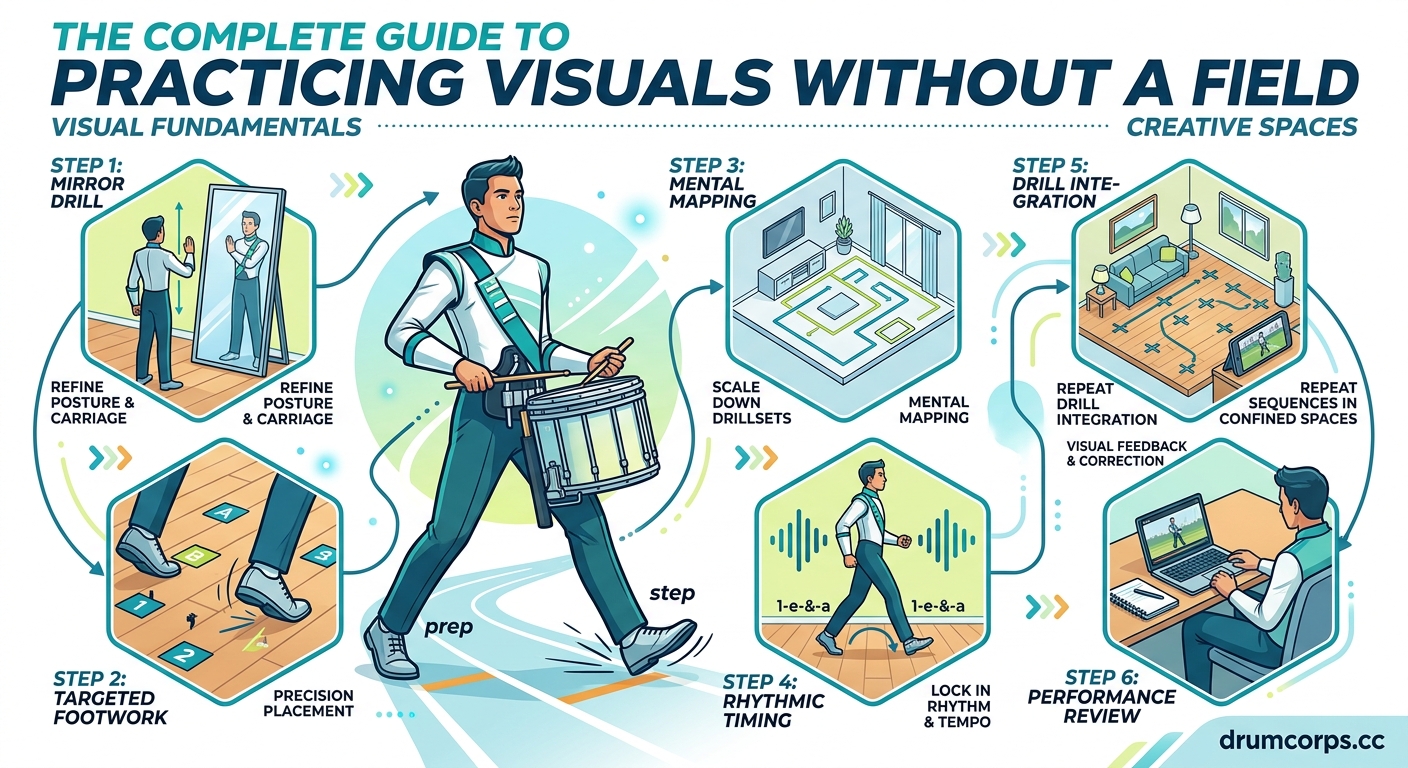
Effective visualization isn’t just seeing yourself perform. It’s recreating the complete sensory experience in your mind. The more senses you engage, the more realistic and beneficial your mental practice becomes.
Start with visual details. See yourself from both perspectives: as if watching a video of yourself, and from your own eyes looking out. Notice your uniform, the field markings, the position of other performers around you. Make the colors vivid. Add movement and flow.
Layer in physical sensations. Feel the weight of your instrument. Notice the pressure of your feet against the ground. Sense your posture, the position of your arms, the tension in your core. If you’re marching, feel the rhythm in your legs and the controlled movement of each step.
Don’t skip the auditory elements. Hear the music playing. Listen to your own sound blending with the ensemble. Notice the ambient noise of a performance venue or practice field. The more complete your soundscape, the more your brain treats this as real practice.
Include emotional and psychological components. Notice your confidence level. Feel the focus required for clean execution. Experience the satisfaction of nailing a difficult passage or drill move.
“The performers who improve fastest are those who practice mentally with the same intensity and focus they bring to physical rehearsals. Your brain responds to what you vividly imagine almost as powerfully as what you actually do.” – Dr. Shane Murphy, former sports psychologist for the U.S. Olympic Committee
Your First Visualization Practice Session
Let’s build a simple five-minute session you can do right now. This structure works for any skill, but we’ll use a basic marching sequence as an example.
- Find a quiet space where you won’t be interrupted. Sit comfortably or lie down. Close your eyes.
- Take three slow breaths, counting to four on each inhale and exhale. Let your body relax while keeping your mind alert.
- Picture yourself standing at attention in your performance uniform. See every detail clearly. Feel your posture: shoulders back, chest up, chin level.
- Begin your mental rehearsal of eight counts of forward marching. See each step. Feel the heel-toe motion. Hear the counts in your head. Notice your upper body staying completely still.
- Repeat the same eight counts three times, each time adding more sensory detail and precision.
That’s it. Five minutes. You just completed a legitimate practice session without moving.
The key is specificity. Vague daydreaming about being good doesn’t help. Precise mental rehearsal of exact movements, sounds, and sensations creates real improvement.
Techniques for Different Practice Goals
Different skills require different visualization approaches. Here’s how to adapt your mental practice for specific objectives.
For technical accuracy: Slow down your mental rehearsal to half speed or slower. Examine every detail of proper technique. If you’re working on body alignment drills that transform your marching posture, visualize the correct position of each body part individually before putting them together.
For performance confidence: Run through your entire show or piece from start to finish in real time. Include the pre-performance routine, the walk-on, and the final pose. Feel yourself executing everything perfectly while maintaining calm confidence.
For fixing mistakes: Identify the specific moment where errors occur. Visualize yourself approaching that moment, then executing it correctly. Repeat this correction visualization at least five times per session. Your brain needs multiple correct repetitions to override the incorrect pattern.
For endurance building: Mentally rehearse long passages or extended drill segments without stopping. This builds psychological stamina and helps you maintain focus during actual performance.
Common Visualization Mistakes and How to Avoid Them
| Mistake | Why It Hurts | Better Approach |
|---|---|---|
| Watching yourself fail repeatedly | Reinforces incorrect patterns | Only visualize correct execution |
| Rushing through imagery | Doesn’t engage neural pathways deeply | Use slow motion for technique work |
| Skipping emotional content | Misses performance preparation benefits | Include feelings of confidence and focus |
| Practicing only easy sections | Doesn’t address real challenges | Spend 70% of time on difficult passages |
| Irregular practice schedule | Prevents neural pathway strengthening | Daily sessions beat longer weekly ones |
The biggest mistake is visualizing yourself making errors. If you mentally rehearse a mistake, you’re practicing that mistake. Your brain learns what you repeatedly imagine, good or bad. Always reset and visualize the correct version.
Another common problem is lack of consistency. Mental practice works through repetition over time, just like physical practice. Three focused minutes daily beats one 30-minute session weekly.
Some people struggle with visual clarity. If you can’t “see” mental images clearly, focus more on the physical sensations and sounds. Not everyone has strong visual imagination, but everyone can imagine how movements feel and what music sounds like.
Combining Mental and Physical Practice
Visualization works best when paired with physical rehearsal, not as a replacement. Think of mental practice as a supplement that extends your training time and accelerates learning.
Use this integration approach:
- Before physical practice: Spend 3-5 minutes mentally rehearsing what you’re about to work on. This primes your nervous system and improves focus.
- During breaks: When you need rest from physical exertion, switch to mental rehearsal. Your body recovers while your brain keeps practicing.
- After physical practice: Review what you just worked on mentally. This reinforces the neural pathways while the physical sensations are fresh.
- On off days: Maintain skill levels with 10-15 minute visualization sessions when you can’t practice physically.
This approach is particularly valuable when you’re learning new drill or music. Physical practice teaches your body the movements. Mental practice between physical sessions speeds up the learning curve significantly.
Many top corps members use mental rehearsal during long bus rides between shows. They can run through entire performances mentally, fixing details and building confidence without the physical wear and tear. If you’re interested in structured mental work, the 10-minute mental practice routine that top corps members swear by offers additional techniques.
Advanced Visualization for Performance Preparation
Once you’re comfortable with basic mental rehearsal, you can use visualization for sophisticated performance preparation. Elite performers use these techniques to manage pressure and optimize their mental state.
Pre-performance visualization: Three days before a show, start running through the entire performance mentally once per day. Include the full experience: arriving at the venue, warming up, waiting in the staging area, the walk-on, the performance itself, and the walk-off. This familiarizes your nervous system with the complete event, reducing anxiety.
Pressure inoculation: Mentally rehearse performing under difficult conditions. Imagine making a small mistake and recovering smoothly. Picture unexpected distractions and maintaining focus anyway. This builds psychological resilience.
Ideal state anchoring: Identify a moment when you performed at your absolute best. Recreate that experience mentally in vivid detail, especially the emotional and physical sensations. Practice accessing that state on command. Before performances, use this mental anchor to trigger your optimal performance mindset.
Contingency planning: Visualize potential problems and your response. What if your reed breaks? What if you lose your spot in drill? Mental rehearsal of recovery scenarios prevents panic during actual problems.
Creating Your Personal Visualization Practice Schedule
Structure beats sporadic effort. Here’s a realistic weekly framework that fits into most schedules.
Daily minimum (5-7 minutes):
– 2 minutes: Technical work on your biggest challenge
– 3 minutes: Full run-through of one section
– 1-2 minutes: Performance confidence imagery
Three times per week (15 minutes):
– 5 minutes: Detailed technical rehearsal
– 7 minutes: Complete show or piece run-through
– 3 minutes: Performance preparation
Weekly deep session (30 minutes):
– 10 minutes: Systematic work through problem areas
– 15 minutes: Full performance simulation
– 5 minutes: Future performance visualization
Adjust these times based on your schedule and goals. The critical factor is consistency. Five focused minutes daily produces better results than occasional longer sessions.
Track your mental practice like you would physical rehearsals. Keep a simple log noting what you visualized and for how long. This accountability helps maintain consistency and lets you see patterns in your improvement.
Visualization for Musical Performance
Mental rehearsal works differently for music than for visual performance, but it’s equally powerful. Musicians can practice passages, tone quality, and expressive elements entirely in their minds.
For technical passages: Mentally “play” difficult runs or intervals. Hear the exact pitches. Feel your fingers or embouchure making the movements. Slow down to notice every detail of proper technique. This works remarkably well for building accuracy without physical fatigue.
For tone development: Imagine your ideal sound. Hear it clearly in your mind. Then imagine yourself producing that exact sound. Feel the air support, embouchure shape, and resonance that creates it. This mental model guides physical practice.
For musicality: Visualize yourself performing with perfect expression. Hear the dynamics, articulation, and phrasing exactly as you want them. Feel the musical emotion. This develops your interpretive vision before technical challenges get in the way.
Brass players can benefit from combining mental practice with breathing exercises every brass player should master, using visualization to reinforce proper breath support and air flow.
Troubleshooting Your Visualization Practice
Problem: Your mind wanders constantly. Start with just 60-90 seconds of focused imagery. Gradually extend the duration as your concentration improves. Use a timer to create clear boundaries.
Problem: You can’t visualize clearly. Focus on one sense at a time. If visual imagery is weak, emphasize physical sensations or sounds. Most people have one dominant imagery sense. Use yours.
Problem: You keep visualizing mistakes. Stop immediately when you imagine an error. Reset to a few seconds before the mistake. Visualize the correct execution. Never let yourself mentally practice errors repeatedly.
Problem: It feels silly or pointless. Remember that mental practice activates the same neural pathways as physical practice. The science is solid. Give it three weeks of consistent practice before judging results.
Problem: You fall asleep during sessions. Sit upright instead of lying down. Practice with your eyes open, focusing on a neutral point. Do mental rehearsal earlier in the day when you’re more alert.
Making Mental Practice Part of Your Routine
The hardest part of visualization practice isn’t the technique. It’s building the habit. Here’s how to make mental rehearsal automatic.
Anchor it to existing habits. Do your visualization session right after something you already do daily. After brushing your teeth. During your commute (if you’re not driving). Right before bed. Habit stacking makes consistency easier.
Start absurdly small. Two minutes feels easy. You’re more likely to maintain a two-minute daily habit than a 20-minute weekly session. Once the habit is established, gradually extend the time.
Use environmental cues. Keep a note card on your mirror or desk that says “Mental practice.” Visual reminders help when you’re building a new routine.
Combine with physical rest. When you need a break from physical rehearsal, use that time for mental work. This makes visualization feel productive rather than adding another task to your day.
Building consistency with mental practice can complement how to build a perfect 30-minute individual practice routine, extending your effective practice time without additional physical strain.
Measuring Your Progress
Mental practice produces real results, but they’re not always immediately obvious. Watch for these indicators that your visualization work is paying off.
Faster learning: New drill or music comes together more easily. You need fewer physical repetitions to nail sections.
Better retention: Skills stay sharp even after breaks from physical practice. You maintain performance level with less rehearsal time.
Improved consistency: You execute skills correctly more often. Your error rate drops.
Reduced performance anxiety: You feel more confident and prepared for shows. The performance environment feels familiar.
Clearer mental models: You understand exactly what correct execution feels like. You can identify and fix errors more easily.
Enhanced focus: Your concentration during physical practice improves. You stay mentally engaged longer.
Some performers notice improvements within a week. Others need three to four weeks of consistent practice before seeing clear benefits. The timeline varies, but the results are real for those who stick with it.
Your Next Steps with Mental Rehearsal
You now have everything you need to start a visualization practice that actually works. The techniques are simple. The science is proven. The only variable is whether you’ll use them consistently.
Start tonight with five minutes. Pick one specific skill you want to improve. Close your eyes and mentally rehearse that skill with as much sensory detail as possible. Do the same thing tomorrow. And the day after.
Your brain is ready to learn from vivid mental imagery. You can practice anywhere, anytime, without equipment or space. That’s a competitive advantage most performers never tap into. Make mental rehearsal a regular part of your training, and watch your physical performance catch up to what you’ve been practicing in your mind.