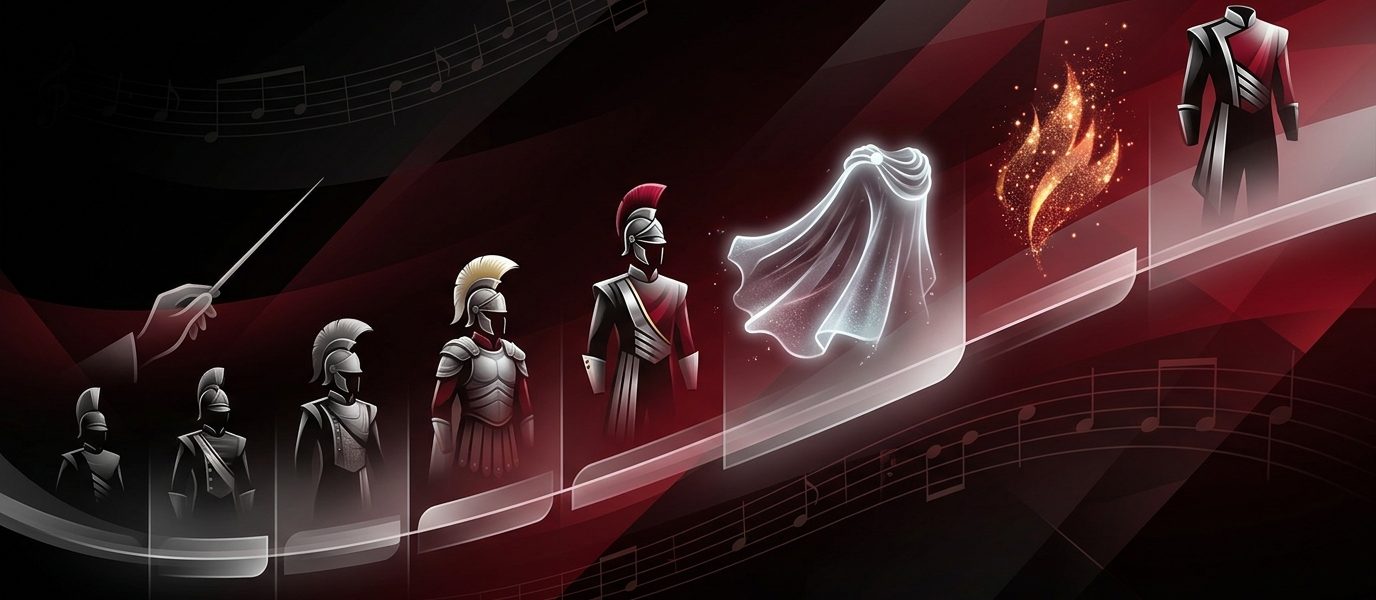
Phantom Regiment didn’t just perform classical music. They made it their identity, their calling card, their reason for existing on the field. While other corps experimented with jazz, rock, and contemporary sounds, Regiment doubled down on the masters: Tchaikovsky, Mahler, Rachmaninoff, and Shostakovich. Their commitment to this repertoire created some of the most emotionally powerful moments in drum corps history and shaped how an entire generation understands what classical music can do on a football field.
Phantom Regiment’s classical music programming evolved from straightforward arrangements in the 1970s to emotionally complex narratives by the 2000s. Their signature dark, powerful sound emerged through careful composer selection and thematic consistency. Shows like 1989’s [New World Symphony](https://en.wikipedia.org/wiki/Symphony_No._9_(Dvo%C5%99%C3%A1k)), 1996’s Paganini, and 2008’s Spartacus defined what classical repertoire could accomplish in competitive drum corps, influencing programming decisions across the entire activity.
Building the foundation through early classical experiments
Regiment’s relationship with classical music started modestly in the mid-1970s. Their 1974 production of Stravinsky’s Firebird Suite marked one of their first major classical statements. The arrangement was bold for its time but relatively straightforward compared to what would come later.
The corps spent the late 1970s and early 1980s testing different classical composers and styles. Some shows worked brilliantly. Others fell flat with judges and audiences. But each season taught the design team something valuable about which composers matched their emerging sonic identity.
By 1982, Regiment started finding their voice. That year’s program featured Prokofiev’s Romeo and Juliet, showcasing the corps’ growing ability to handle complex orchestral transcriptions. The brass section’s dark timbre began to emerge as a defining characteristic, setting them apart from the brighter sounds of West Coast corps.
The breakthrough years that defined their identity
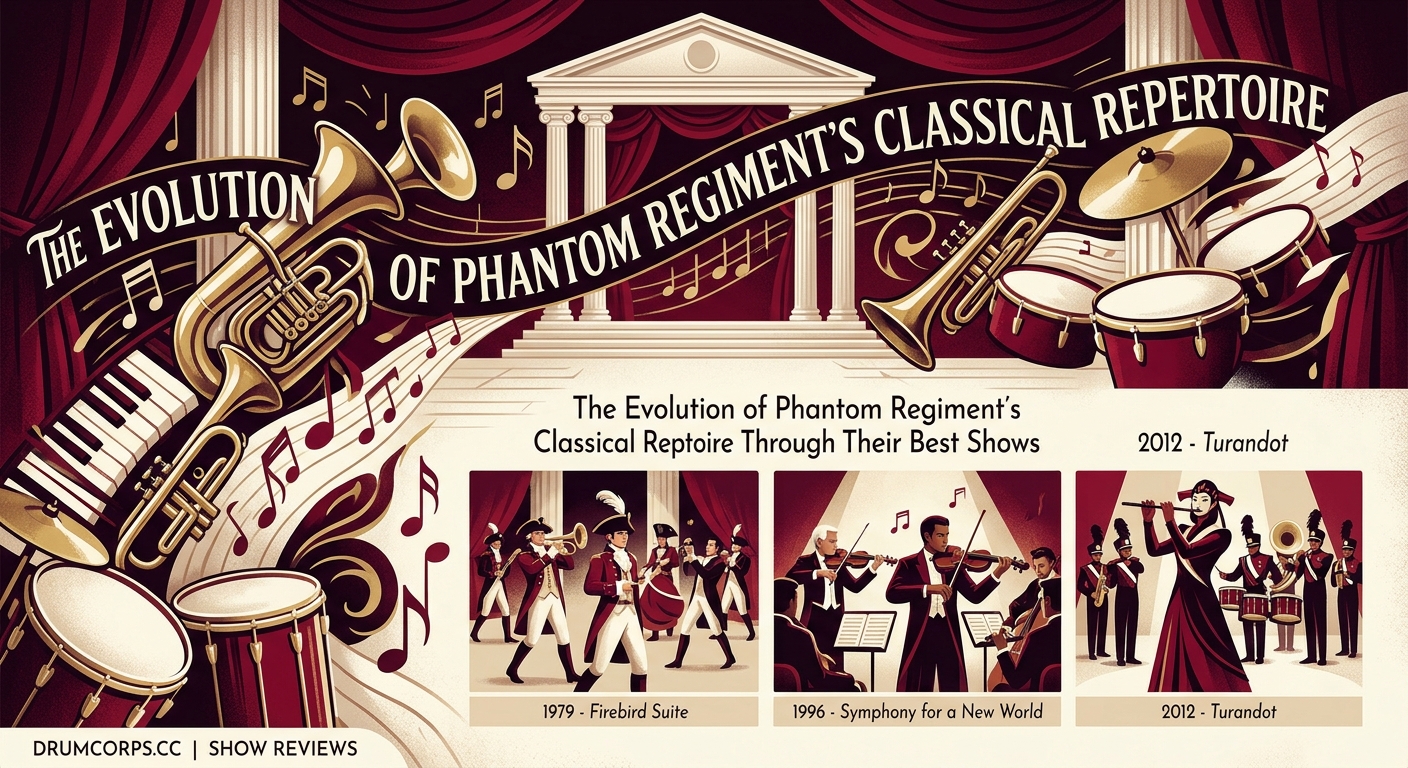
The late 1980s brought Regiment’s first true classical masterpieces. Their 1989 show built around Dvorak’s New World Symphony changed everything. The production didn’t just play the notes. It told a story, created emotional arcs, and demonstrated that classical music could be as visceral and moving as any contemporary soundtrack.
This show established several principles that would guide Regiment for decades:
- Classical repertoire works best when treated as dramatic narrative, not just pretty music
- Dark, powerful moments create more impact than constant brightness
- Silence and space matter as much as sound
- The audience should feel something, not just hear something
The 1991 production featuring Shostakovich’s Symphony No. 10 pushed these ideas further. Regiment took one of the 20th century’s most emotionally complex classical works and made it accessible to crowds who had never heard a note of Shostakovich. The ballad movement remains one of the most haunting moments in drum corps history.
Championship seasons built on classical foundations
Regiment’s 1996 championship show centered on Paganini’s Violin Concerto No. 2 and Rhapsody on a Theme of Paganini. The production proved that classical music could win gold medals in an era when many corps were moving toward more contemporary programming.
The show worked because it balanced technical virtuosity with emotional depth. The opening statement hit like a thunderclap. The ballad created genuine tension and release. The closer built to an inevitable, satisfying conclusion that left audiences breathless.
Here’s how Regiment’s championship shows compared in their approach to classical repertoire:
| Year | Primary Composer | Thematic Approach | Musical Challenge |
|---|---|---|---|
| 1996 | Paganini | Virtuosic showmanship | Extreme technical demands on brass |
| 2008 | Khachaturian | Dramatic narrative | Sustained intensity without burnout |
Their 2008 championship production of Spartacus took a different approach. Instead of showcasing technical fireworks, the show built a complete dramatic arc. Every movement served the story of rebellion, struggle, and sacrifice. The ballad movement, featuring Spartacus and Phrygia’s love theme, ranks among the most emotionally powerful moments Regiment ever produced.
Signature composers and why they worked
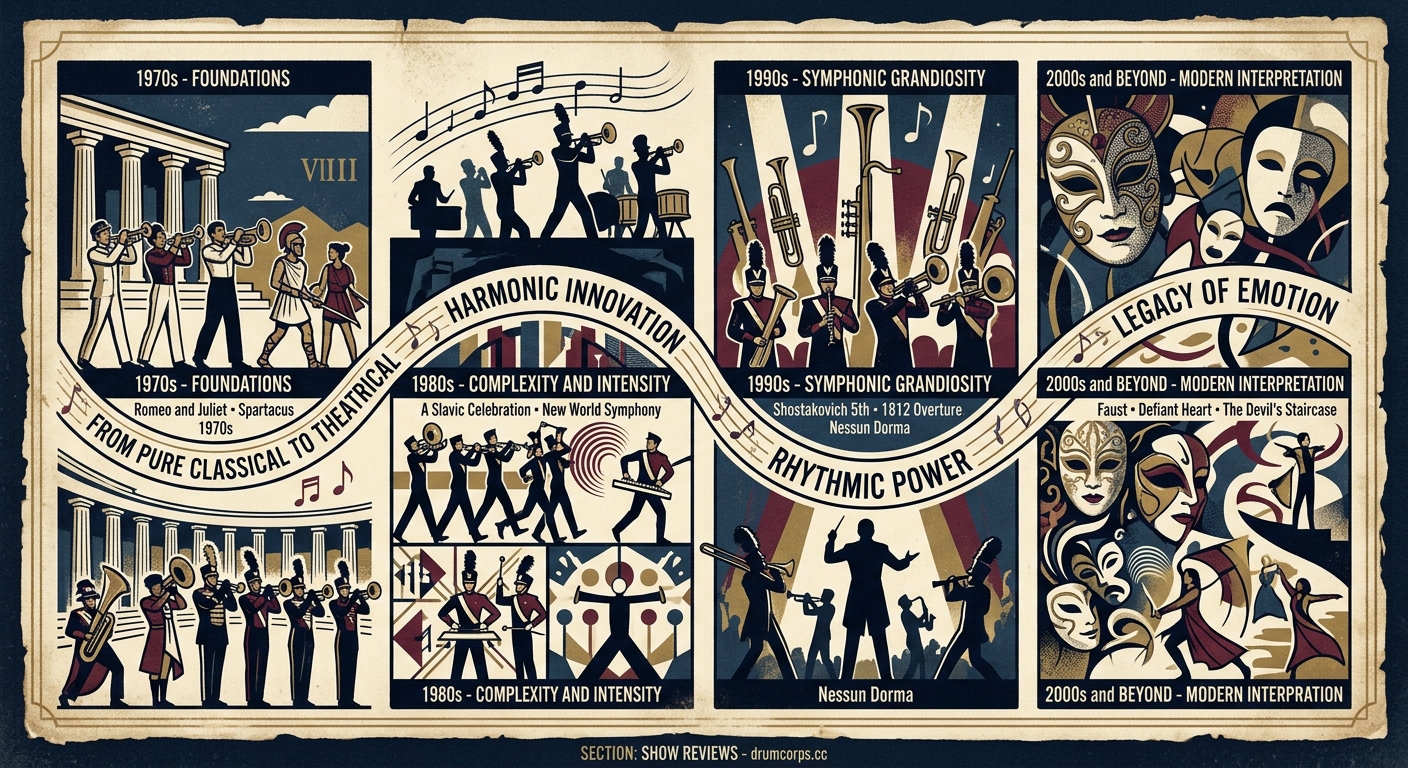
Regiment didn’t program classical music randomly. They gravitated toward specific composers whose musical language matched their sonic identity. Understanding these choices reveals a lot about how the corps built their brand.
Rachmaninoff appeared in multiple Regiment shows because his music combines technical demands with deep emotional resonance. The sweeping melodic lines suited the corps’ brass sound perfectly. Shows like 1993’s Heart and Soul and 2003’s Harmonic Journey both featured substantial Rachmaninoff sections.
Mahler became another Regiment staple. His symphonies offered the darkness and intensity the corps craved. The 2006 production Faust featured Mahler’s Symphony No. 5, particularly the famous Adagietto movement. Regiment’s interpretation brought out the music’s aching beauty without drowning in sentimentality.
Shostakovich gave Regiment opportunities to showcase power and aggression. His music’s inherent drama and edge matched the corps’ visual intensity. The 1991 and 2005 productions both featured significant Shostakovich content, each time revealing new dimensions of his compositional voice.
“Classical music in drum corps isn’t about recreating a symphony orchestra. It’s about finding the emotional core of the music and amplifying it through movement, staging, and a hundred brass players hitting the same phrase together. That’s what Regiment understood better than anyone.” (Former DCI judge and brass arranger)
The evolution of arranging and orchestration
Regiment’s classical arrangements evolved dramatically over three decades. Early shows in the 1970s and 1980s featured relatively straightforward transcriptions. The brass played the orchestral parts. The percussion provided rhythmic support. The arrangements were faithful but not particularly innovative.
By the 1990s, arrangers started reimagining how classical music could work on the field. They began treating the brass line as a single massive instrument rather than separate sections playing orchestral parts. This approach created the wall of sound that became Regiment’s calling card.
The 2000s brought even more sophisticated arranging techniques. Arrangers started weaving original material into classical themes, creating hybrid compositions that honored the source material while adding new dimensions. The 2003 show Harmonic Journey exemplified this approach, blending Rachmaninoff with original music so seamlessly that audiences couldn’t always tell where one ended and the other began.
Learning from Regiment’s classical programming approach
If you’re trying to understand how to program classical music effectively, whether for your own corps, marching band, or just to appreciate what makes these shows work, Regiment’s evolution offers clear lessons.
Follow this progression to understand their development:
- Start with the emotional core of the music, not just the famous melodies
- Choose composers whose musical language matches your ensemble’s sonic identity
- Build complete dramatic arcs rather than stringing together pretty moments
- Balance technical demands with accessibility for audiences
- Use silence and space as compositional tools, not just places to breathe
Regiment’s approach to ballad construction deserves special attention. Their ballads never felt like obligatory slow movements. They created genuine emotional peaks that often surpassed the closer in impact. The 2008 Spartacus ballad and the 1996 Paganini ballad both demonstrate how to build tension, create release, and leave audiences emotionally spent.
The corps also mastered the art of the classical closer. Their endings rarely relied on the loudest, fastest, highest approach. Instead, they built to inevitable conclusions that felt both surprising and completely necessary. The final chord of 2008 Spartacus exemplifies this perfectly.
Common pitfalls Regiment avoided
Many corps have tried to replicate Regiment’s classical success and failed. Understanding what Regiment avoided helps explain their consistency.
They never programmed classical music just because it was prestigious or intellectual. Every show choice served a clear artistic vision. The music had to connect emotionally with performers and audiences, not just impress music teachers.
Regiment avoided the trap of treating classical music as museum pieces. Their arrangements and staging brought these compositions into the present moment. They found what made Mahler or Shostakovich relevant to contemporary audiences and amplified those elements.
The corps also resisted the temptation to sanitize classical music’s rougher edges. When programming Shostakovich, they leaned into the dissonance and darkness rather than softening it for mass appeal. This authenticity made their shows more powerful, not less accessible.
The impact on modern drum corps programming
Regiment’s classical programming influenced the entire activity. Their success proved that classical repertoire could compete with contemporary music at the highest levels. This validation gave other corps permission to program classical works without fear of seeming outdated.
The corps’ approach to thematic development became a model for show design across all musical styles. Even corps programming jazz, rock, or electronic music borrowed Regiment’s techniques for building emotional arcs and creating narrative coherence.
Their brass arranging innovations spread throughout the activity. The concept of the brass line as a single massive instrument, rather than separate sections, became standard practice. Modern corps programming shows like 7 game-changing ballad moments that defined championship seasons owe a debt to Regiment’s pioneering work.
How Regiment’s sound supported their classical choices
The Phantom Regiment sound became inseparable from their classical programming. The dark, powerful brass timbre worked perfectly for Mahler, Shostakovich, and Rachmaninoff. It would have sounded wrong playing lighter classical composers like Mozart or Haydn.
This sonic identity didn’t happen by accident. Regiment deliberately cultivated their sound through equipment choices, teaching methods, and member selection. They recruited brass players who could produce a darker, more covered tone quality. Their signature sound became as recognizable as their uniform.
The percussion section developed a complementary approach. Rather than dominating the texture, they provided foundation and punctuation. This restraint allowed the brass to carry the melodic content without competition. When the battery did step forward, the contrast created maximum impact.
Technical demands and member development
Regiment’s classical shows required extraordinary technical skill from members. The music didn’t simplify difficult passages or transpose awkward ranges. If Rachmaninoff wrote it in a challenging key, Regiment played it in that key.
This approach meant the corps needed to develop members capable of handling professional-level demands. Their training program became legendary for its intensity and effectiveness. Members who aged out of Regiment often found college and professional playing easier than their drum corps experience.
The visual program matched the musical demands. Regiment’s drill design integrated seamlessly with the music rather than existing as a separate element. Members had to execute complex body movements while playing technically demanding passages. This integration required the kind of practice routine that built both musical and visual skills simultaneously.
Comparing Regiment’s approach to other corps
While Regiment focused on classical music, other top corps took different paths. Understanding these contrasts illuminates what made Regiment’s approach special.
The Blue Devils built their reputation on jazz and contemporary music. The Cavaliers emphasized precision and visual innovation. The Cadets pioneered theatrical storytelling. Each corps found success through different means, proving that no single approach dominates the activity.
Regiment’s classical focus created a distinct niche. Fans knew what to expect each season, but the corps constantly found new ways to present familiar musical territory. This balance between consistency and innovation kept audiences engaged across decades.
Some critics argued that Regiment’s classical focus limited their artistic range. Supporters countered that depth matters more than breadth. By mastering one musical language, Regiment achieved a level of artistic expression that generalists never reached.
The shows that defined each era
Certain Regiment shows stand as definitive statements of their era’s approach to classical programming.
The 1970s and early 1980s featured exploratory shows that tested different classical composers and styles. These productions laid groundwork but rarely achieved the artistic heights of later years.
The late 1980s and early 1990s brought the first mature classical productions. Shows like 1989’s New World Symphony and 1991’s Shostakovich 10 established Regiment as the premier classical corps.
The mid to late 1990s represented Regiment’s first golden age. The 1996 championship and surrounding seasons showed the corps at peak artistic and competitive strength.
The 2000s brought a second wave of innovation. Shows like 2003’s Harmonic Journey, 2006’s Faust, and 2008’s Spartacus refined Regiment’s approach to unprecedented levels of sophistication.
Why some classical shows succeeded more than others
Not every Regiment classical production achieved the same impact. Understanding why some shows resonated more deeply than others reveals important principles about classical programming.
The most successful shows balanced familiarity with freshness. They featured music audiences recognized but presented it in unexpected ways. The 1996 Paganini show worked partly because people knew the Rhapsody theme but had never heard it performed by a hundred brass players on a football field.
Failed shows often chose music that was too obscure or too familiar. Extremely obscure classical works left audiences confused about what they were hearing. Overly familiar pieces like Beethoven’s Fifth Symphony risked sounding cliche without extraordinary interpretation.
Thematic coherence separated great shows from good ones. The best Regiment productions built complete narratives where every movement served the overall arc. Lesser shows felt like collections of classical greatest hits without unifying vision.
Where Regiment’s classical legacy stands today
Regiment’s influence on drum corps classical programming remains strong decades after their peak years. New corps still study their shows when planning classical productions. Arrangers reference Regiment’s scores when learning how to transcribe orchestral music for brass and percussion.
The corps itself continues programming classical music, though recent years have seen them experiment with other styles. This evolution reflects broader changes in the activity as DCI announces major rule changes that affect programming choices.
Other corps have adopted elements of Regiment’s approach while developing their own classical voices. This diffusion of influence means Regiment’s innovations now belong to the entire activity rather than one organization.
Classical music’s future in competitive drum corps
The role of classical music in modern drum corps continues evolving. Some corps have moved away from classical repertoire entirely. Others maintain it as part of their programming rotation. A few, including Regiment, still build their identity around classical music.
Contemporary audiences respond differently to classical programming than audiences in the 1990s. Younger fans often lack the classical music exposure that earlier generations received through school music programs. This shift challenges corps to make classical music accessible without dumbing it down.
Technology has changed how corps approach classical arrangements. Digital audio workstations allow arrangers to hear their work before putting it on the field. This capability has led to more sophisticated orchestrations and better integration of electronic elements with acoustic instruments.
Lessons for today’s performers and designers
Regiment’s classical programming history offers practical guidance for current drum corps members and designers. Their approach demonstrates that artistic integrity and competitive success aren’t mutually exclusive.
For performers, Regiment’s shows prove that technical demands and emotional expression must work together. The most moving moments in their productions combined virtuosic playing with genuine feeling. Members who focused only on hitting the right notes missed the point.
For designers, Regiment’s evolution shows the value of developing a clear artistic identity. Their commitment to classical music created a recognizable brand that attracted members and fans who shared that vision. Trying to be everything to everyone often results in being nothing to anyone.
For educators, Regiment’s member development approach offers a model for building skills systematically. Their training methods, which emphasized fundamentals like breathing exercises and proper technique, created performers capable of handling professional-level demands.
How classical programming shaped Regiment’s complete identity
Classical music influenced more than Regiment’s sound. It shaped their visual aesthetic, uniform design, and organizational culture. The corps’ iconic look, with its dark uniforms and dramatic staging, reflected the music’s emotional intensity.
Regiment’s commitment to classical music attracted specific types of members. Musicians who loved orchestral repertoire sought out the corps specifically for the opportunity to perform Mahler and Rachmaninoff on the field. This self-selection created a membership culture that valued artistic depth and emotional authenticity.
The organization’s educational philosophy also reflected classical music’s values. Regiment emphasized long-term development over short-term results. They built skills methodically, trusting that proper fundamentals would eventually enable artistic expression. This patient approach mirrored how classical musicians train for orchestral careers.
The performances that still resonate decades later
Certain Regiment performances transcend their competitive results to become permanent parts of drum corps history. These moments continue inspiring new generations of performers and fans.
The 1996 DCI Finals performance of their championship show remains a masterclass in execution under pressure. Every section delivered their best performance of the season when it mattered most. The brass line’s final chord still gives listeners chills decades later.
The 2008 Finals performance of Spartacus achieved something rare in competitive arts. The corps delivered a performance so complete, so emotionally devastating, that the outcome never felt in doubt. They didn’t just win. They created a moment that belonged to everyone watching.
Earlier performances like their 1989 semifinals run and 1991 Finals appearance showed Regiment finding their artistic voice. These shows may not have won championships, but they established the template for everything that followed.
Understanding what made Regiment’s classics timeless
The best Regiment classical shows remain watchable and moving years after their competitive season ended. This longevity separates truly great productions from merely successful ones.
Timeless shows work because they tap into universal human emotions rather than relying on topical references or trendy staging. The 2008 Spartacus theme of fighting for freedom resonates across cultures and generations. The 1996 Paganini celebration of virtuosic excellence never goes out of style.
These productions also benefit from musical and visual choices that age well. Regiment avoided gimmicks and fads in favor of classic staging and straightforward presentation. This restraint means the shows don’t look dated even when viewing technology and visual expectations change.
The emotional authenticity of Regiment’s best shows gives them staying power. Performers genuinely connected with the music and themes. That connection comes through in every phrase, every movement, every moment. Audiences respond to authentic emotion regardless of when they first encounter it.
What Regiment taught the activity about classical music
Phantom Regiment’s classical programming legacy extends far beyond their own competitive success. They demonstrated that classical music belongs in modern drum corps, that it can move contemporary audiences, and that artistic depth enhances rather than limits competitive potential.
Their shows proved that respecting source material and creating accessible entertainment aren’t contradictory goals. You can honor Mahler’s compositional genius while making his music speak to people who’ve never attended a symphony concert.
Regiment also showed that developing a clear artistic identity creates sustainable success. Corps that chase trends or try to copy others’ success often struggle. Organizations that know who they are and what they stand for build loyal followings and attract members who share their vision.
Most importantly, Regiment demonstrated that classical music in drum corps isn’t about recreating orchestral performances. It’s about finding what makes these compositions emotionally powerful and amplifying those elements through the unique capabilities of brass, percussion, and movement. That insight transformed how the entire activity approaches classical repertoire.
Where to go from here with classical programming
If Regiment’s classical shows inspired you to program similar music or just appreciate it more deeply, start by listening to the original orchestral versions. Understanding what composers intended helps you recognize what makes effective drum corps arrangements work.
Study multiple Regiment shows from different eras. Notice how their approach evolved and what remained consistent. This comparison reveals core principles that transcend specific productions.
Watch performances from other corps that programmed classical music successfully. See how they solved similar challenges differently. Understanding various approaches to classical repertoire builds a more complete picture of what’s possible.
For performers preparing classical repertoire, focus on understanding the music’s emotional content, not just executing the notes. Regiment’s best performances came from members who connected personally with the material. Find what moves you in the music and let that drive your performance.
The evolution of Phantom Regiment’s classical shows tells a story about artistic vision, technical excellence, and emotional authenticity. Their best productions demonstrated that classical music can thrill modern audiences when presented with conviction and creativity. That lesson remains as relevant today as it was during their championship seasons.