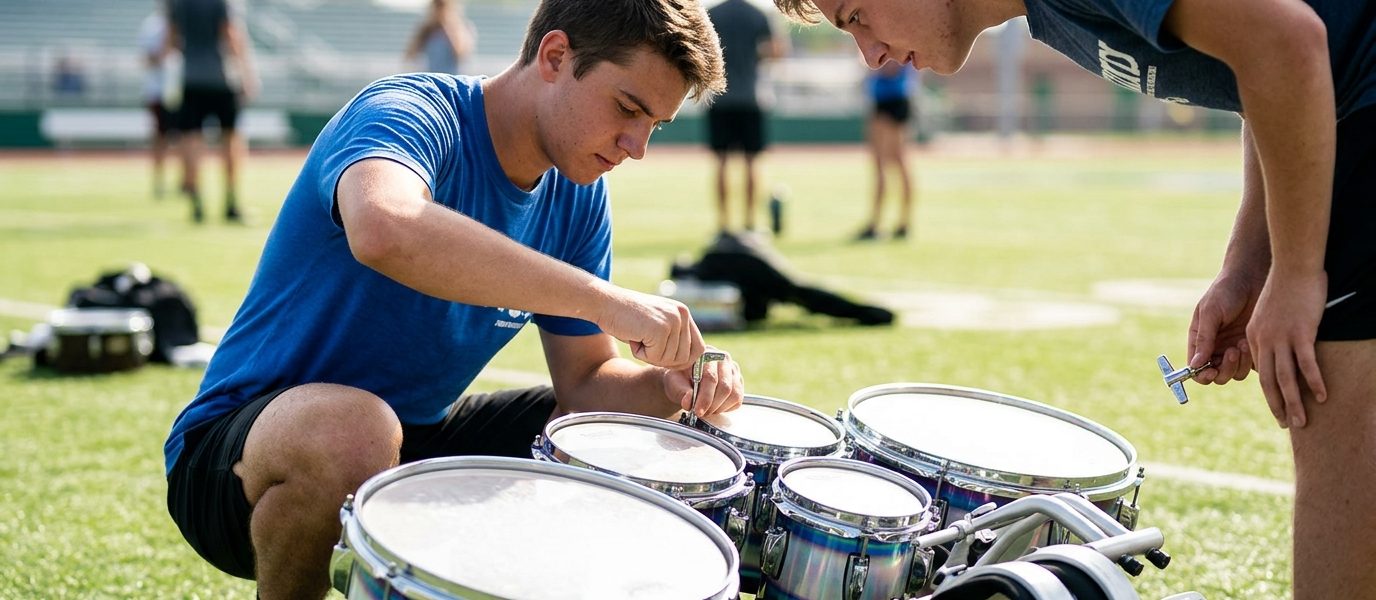
Tuning tenor drums can feel like trying to hit a moving target. You’re balancing four, five, or even six drums that need to sound distinct but also blend together as a unified voice. Add outdoor acoustics, temperature swings, and the physical demands of marching, and you’ve got a real challenge on your hands.
But here’s the good news: tuning tenors doesn’t require perfect pitch or years of experience. It requires a clear process, the right tools, and an understanding of what actually makes these drums sound great in a stadium or on a field.
Tuning tenor drums involves selecting appropriate pitch intervals, tensioning heads evenly using a star pattern, and making small adjustments based on outdoor temperature and humidity. Start with the lowest drum, work upward in musical intervals, and always check your tuning after the drums have been on the field for at least 15 minutes to account for environmental changes.
Understanding Tenor Drum Pitch Relationships
Tenor drums aren’t tuned to specific notes like a piano. Instead, they’re tuned to relative pitches that create musical intervals across the set.
Most quad setups use intervals of fourths or fifths between drums. A common configuration might have drums tuned roughly a fourth apart, creating a descending pitch pattern from drum one (highest) to drum four (lowest).
Here’s what matters more than exact pitches: the drums need to sound distinct from each other. If two drums are too close in pitch, they’ll blur together and lose clarity. If they’re too far apart, the set won’t sound cohesive.
Your lowest drum should have a deep, resonant tone without sounding dead or muddy. Your highest drum should cut through without sounding pingy or thin. The middle drums bridge that gap with clear, defined pitches.
Temperature affects everything. A drum tuned indoors at 72 degrees will sound different when it hits a 95-degree field in July. Heads tighten in heat and loosen in cold, so always do your final tuning adjustments outdoors.
Tools You Need Before Starting

You don’t need a huge toolkit, but the right tools make the job exponentially easier.
A drum key is obvious, but get a good one. Cheap keys strip tension rods and make consistent tensioning nearly impossible. A ratcheting drum key saves time and reduces hand fatigue when you’re tuning multiple drums.
A tuning app or electronic tuner helps establish starting pitches, especially if you’re new to tuning by ear. Apps like Tunable or Cleartune work well and cost less than a pair of sticks.
A small piece of tape or a marker lets you mark tension rod positions. This helps you track which rods you’ve adjusted and maintain symmetry around the drum.
Have a soft surface to work on. Tuning on concrete or asphalt can damage the bottom heads and throw off your sound. A folding table with a towel works perfectly.
Keep a notebook or your phone handy to record your settings. Write down how many turns you give each rod from finger tight. This creates a baseline you can return to if something goes wrong.
Step-by-Step Tuning Process
Tuning tenor drums follows a logical sequence. Skipping steps or rushing creates more problems than it solves.
1. Remove the Old Heads and Clean Everything
Take off both heads from each drum. Wipe down the bearing edges with a clean cloth to remove dirt, old adhesive, or debris. Inspect the edges for nicks or damage that could prevent even head contact.
Clean the tension rods and lugs. Dirt in the threads causes uneven tension and makes rods harder to turn. A small brush or compressed air clears out gunk quickly.
2. Install New Heads Properly
Place the bottom head on first. Center it carefully so the collar sits evenly on the bearing edge all the way around. Put the rim on and thread each tension rod by hand until finger tight.
Repeat with the top head. Don’t tension anything yet. Just get everything hand tight and centered.
3. Establish Your Starting Pitch
Start with drum four, your lowest drum. This becomes your foundation pitch.
Use a star pattern to tension the head. Tighten one rod a half turn, then move to the rod directly across from it. Continue this pattern around the drum.
After each complete round, tap the head about two inches from each tension rod. Listen for pitch differences. The goal is to hear the same pitch at every rod position.
Make small adjustments. A quarter turn can make a noticeable difference. Keep going around the drum until every position sounds the same.
Now tap the center of the head. This is your drum’s fundamental pitch. Use your tuner to identify it, or just listen and remember the sound.
4. Tune Drums Three, Two, and One in Sequence
Move to drum three. Follow the same star pattern process, but aim for a pitch roughly a fourth or fifth higher than drum four.
Tap near each rod, make adjustments, and check the center pitch. Compare it to drum four by playing both. They should sound distinctly different but musically related.
Repeat for drums two and one, moving progressively higher in pitch. The intervals don’t need to be perfect, but the overall ascending pattern should be clear and musical.
5. Balance Top and Bottom Heads
Bottom heads affect resonance and sustain. They’re typically tuned slightly higher than top heads, but not by much.
After tuning all your top heads, flip the drums and tune the bottom heads using the same star pattern. Aim for a pitch that’s a half step to a whole step higher than the corresponding top head.
Strike the drum normally and listen. If it sounds choked or has a short decay, the bottom head might be too tight. If it sounds unfocused or ringy, it might be too loose.
6. Make Final Adjustments on the Field
Take your drums outside and let them sit for 15 minutes. Play them. Listen to how they sound in the open air.
Outdoor acoustics are completely different from indoor spaces. What sounded great in the band room might sound thin or harsh on the field.
Make small tweaks. A quarter turn here, an eighth turn there. Play patterns that move across all the drums and listen for evenness and clarity. If you’re working with how to build a perfect 30-minute individual practice routine, this is the perfect time to integrate tuning checks into your warmup.
Common Tuning Mistakes and How to Avoid Them

Even experienced players make these errors. Knowing them saves hours of frustration.
| Mistake | Why It Happens | How to Fix It |
|---|---|---|
| Uneven tension around the drum | Skipping rods or not using a star pattern | Always use a star pattern and check pitch at every rod position |
| Over-tightening heads | Trying to get too much pitch out of a drum | Back off tension slightly; over-tight heads sound choked and can crack |
| Ignoring bottom heads | Assuming only top heads matter | Tune bottom heads for balanced resonance and proper sustain |
| Not accounting for temperature | Tuning indoors and expecting it to hold outside | Always do final tuning in the environment where you’ll perform |
| Tuning all drums to the same pitch | Not understanding interval relationships | Each drum needs a distinct pitch; use fourths or fifths as a guide |
One mistake that doesn’t get talked about enough: tuning when you’re tired or rushed. Your ears fatigue, and you stop hearing differences accurately. Take breaks. Come back fresh.
Another big one is not replacing heads when they’re dead. Old heads don’t respond to tuning the same way new ones do. If a drum sounds dull no matter what you try, the head is probably shot.
Choosing the Right Pitch Range for Your Drums
Not every tenor set should be tuned the same way. Your pitch range depends on several factors.
Consider your drum sizes. Smaller drums naturally sit in a higher range. Larger drums have more low-end potential. Fighting against the natural resonance of your shells makes tuning harder and sounds worse.
Think about your ensemble balance. If your snares are tuned high and crisp, your tenors might benefit from a slightly lower, warmer tuning to create contrast. If your bass line is deep and resonant, your tenors need enough pitch to sit clearly above them.
Personal playing style matters too. Players who focus on speed and clarity often prefer slightly higher tunings that respond faster. Players who emphasize tone and musicality might go lower for more resonance.
“The best tenor tuning is the one that makes your line sound cohesive and your parts sound clear. Don’t chase someone else’s sound. Find what works for your drums, your players, and your arrangements.” — Caption head advice from multiple DCI programs
Genre and style influence tuning choices. Traditional corps sounds often feature lower, darker tenor tunings. Modern competitive programs sometimes push tenors higher for more cut and definition.
Maintaining Your Tuning Throughout the Season
Tuning isn’t a one-time event. Drums drift, heads wear, and conditions change.
Check your tuning before every rehearsal and performance. A full retuning isn’t always necessary, but a quick tap test around each drum catches problems early.
Temperature shifts require attention. If you rehearse indoors but perform outdoors, expect to make adjustments. If you travel from a cool morning to a hot afternoon show, recheck everything during warmup.
Humidity affects heads differently than temperature. High humidity can make heads feel loose and sound dead. Low humidity can make them tight and brittle. Small adjustments compensate for these changes.
Replace heads on a schedule, not just when they break. Most competitive programs change heads every four to six weeks during heavy use. Worn heads lose tone quality and tuning stability long before they show visible damage.
Keep tension rods lubricated. A tiny drop of key oil on the threads once a month prevents seizing and makes tuning smoother. Don’t overdo it; too much oil attracts dirt.
Tuning Spock Drums and Shot Drums
If your setup includes spock drums (the small, high drums mounted above the main four), they need special attention.
Spocks are tuned significantly higher than your main drums. They’re meant to provide accent colors and sharp, cutting sounds. Tune them tight, but watch for choking. The small diameter makes them sensitive to over-tensioning.
Balance is critical. If your spocks are too loud relative to your main drums, they’ll dominate every pattern. If they’re too quiet, they won’t serve their purpose. Experiment with tuning to find the sweet spot where they cut through without overpowering.
Shot drums (the large, low drum sometimes called a gock) go in the opposite direction. These need to be tuned low enough to provide true bass tones but not so low that they sound sloppy or undefined.
The challenge with shot drums is maintaining clarity at low pitches. Tune the bottom head slightly higher than the top to control resonance. If the drum sounds like a cardboard box, it’s too loose. If it sounds choked and short, it’s too tight.
How Stick Choice Affects Your Sound
Tuning and stick selection work together. You can tune perfectly and still sound bad if your sticks don’t match your drums.
Heavier sticks produce more fundamental tone and bring out the low end of your drums. Lighter sticks emphasize attack and articulation. Most tenor players use medium-weight sticks as a compromise.
Tip shape matters more than most people realize. Round tips produce a focused, articulate sound. Barrel tips create a broader tone with more body. Teardrop tips fall somewhere in between.
If your drums sound thin despite good tuning, try sticks with more weight or a larger tip. If they sound muddy or unclear, lighter sticks with smaller tips might help. This is similar to how what’s the best stick height for maximum power without sacrificing control affects your overall approach.
Troubleshooting Specific Sound Problems
Sometimes drums just don’t sound right, even when you follow every step correctly.
Problem: One drum sounds dead or choked
This usually means the head is too tight or the bottom head is significantly out of balance with the top. Back off the top head tension slightly and check the bottom head. Also inspect the bearing edge for damage.
Problem: Drums sound good indoors but terrible outside
Outdoor environments absorb sound differently. What sounds full and resonant in a band room can sound thin and weak on a field. Try lowering your overall tuning slightly to add warmth and body.
Problem: Drums won’t stay in tune
Check your tension rods and lugs for damage or wear. Make sure heads are seated properly on the bearing edges. If rods keep backing off, you might need lock washers or a tiny drop of thread-locking compound (use the removable kind).
Problem: Weird overtones or ringing
This often comes from bottom heads that are tuned too close to top heads. Increase the bottom head tension slightly. If that doesn’t work, try dampening with small pieces of moongel or tape placed strategically on the top head.
Problem: Drums sound great alone but disappear in the ensemble
Your pitch range might be conflicting with other sections. Try adjusting your overall tuning up or down a step to find a clearer sonic space. Sometimes a small shift makes a huge difference in how you sit in the mix.
The Role of Drum Shells and Hardware
Not all tuning problems come from heads. Your equipment matters.
Shell quality affects how well drums respond to tuning. High-quality shells with consistent thickness and true roundness tune more easily and sound better. Cheap shells with irregular bearing edges fight you every step of the way.
Bearing edges need to be smooth and even. Run your finger around the edge. You should feel consistent contact all the way around. Any high or low spots prevent even head seating and make consistent tuning impossible.
Lug condition affects tension stability. Stripped threads, bent lug casings, or worn springs cause tension rods to behave unpredictably. Inspect your hardware regularly and replace damaged parts immediately.
The carrier system can influence sound too. If your drums are mounted too rigidly, they can’t resonate freely. If they’re too loose, they’ll rattle and sound unfocused. Most modern carriers have adjustable mounting systems that let you find the right balance.
Building Your Tuning Routine Into Practice
The best tuning happens when it’s part of your regular routine, not a separate chore.
Start every practice session with a tuning check. Tap each drum at multiple points around the head. Listen for consistency. Make small adjustments as needed.
Keep a tuning journal. Note the date, temperature, humidity, and any changes you make. Over time, you’ll see patterns that help you anticipate when adjustments will be needed.
Practice tuning by ear, even if you use electronic tools. Your ears are always with you, but your tuner might not be. The ability to hear when a drum is out and know which direction to adjust comes with repetition.
Involve your section in the tuning process. When everyone understands how tuning works, they can identify problems and help maintain the line’s sound. This shared knowledge makes the whole section more independent and responsive.
Getting Your Sound Performance-Ready
Tuning for rehearsal and tuning for performance aren’t quite the same thing.
Performance tuning accounts for adrenaline and intensity. You’ll probably hit harder during a show than during rehearsal. Drums tuned perfectly for practice might sound harsh when you’re playing at performance intensity.
Do a full-volume runthrough before the show. Listen to how your drums sound at performance dynamics. Make any final tweaks based on that sound, not on how they sound at rehearsal volume.
Factor in fatigue. Drums that sound great at the beginning of a show might sound different by the end when your hands are tired and your technique changes slightly. Tuning that’s slightly more forgiving helps maintain consistency throughout the performance.
Consider the performance venue. A small indoor gym sounds completely different from a massive outdoor stadium. If you’re performing in an unfamiliar space, get there early and play your drums in the actual performance area. Make adjustments based on what you hear.
Tuning Tenor Drums Is a Skill Worth Building
Learning to tune tenor drums well transforms your sound and your understanding of the instrument. It’s not magic, and it’s not reserved for experts. It’s a learnable skill that gets easier with practice.
Start with the basics: even tension, clear intervals, and patience. Use the star pattern. Check your work outdoors. Make small adjustments instead of big changes. Keep notes on what works.
Your drums will sound better, your section will blend more naturally, and you’ll have the confidence to maintain your sound regardless of weather, venue, or circumstances. That confidence shows in your playing and in your performance.
Take the time to tune correctly. Your ears, your section, and your audience will thank you.