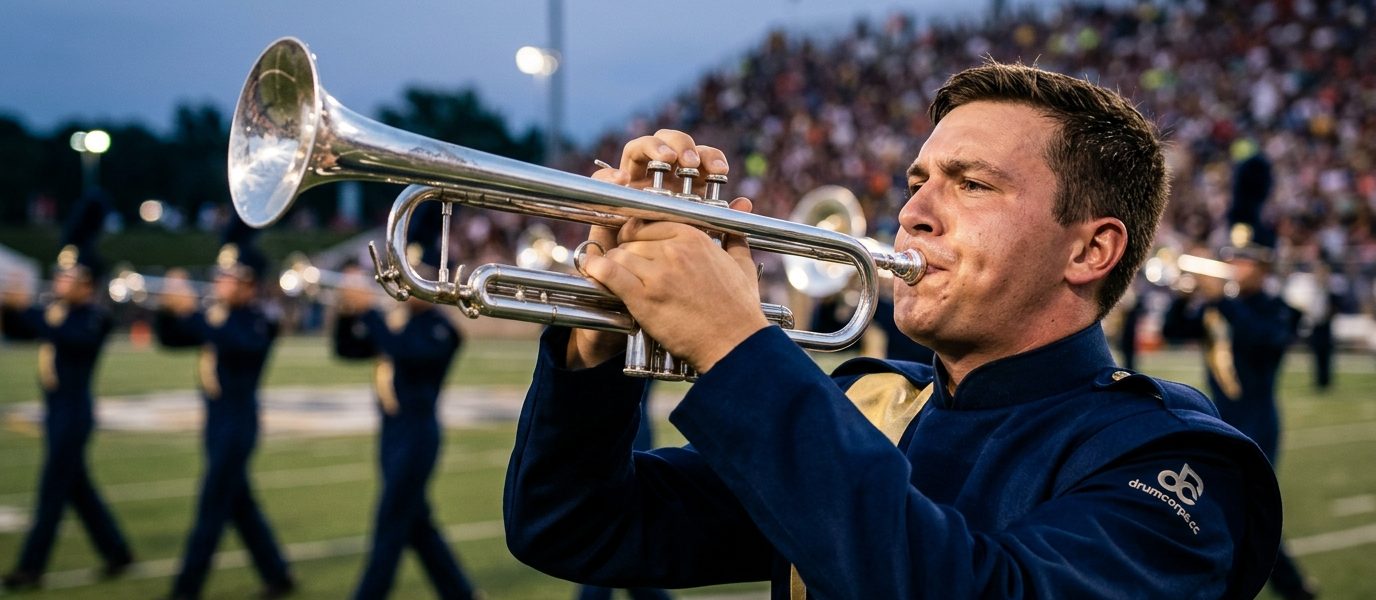
You’re crushing the ballad at mezzo forte, your sound full and resonant. Then the big company front hits. You push harder, but instead of projecting power, your tone goes brittle and small. The harder you blow, the worse it gets.
This happens to almost every brass player at some point. The paradox of loud playing is that more effort doesn’t always equal better sound. Most thin brass tone at loud dynamics comes from a breakdown in your fundamental technique under pressure, not from lack of effort.
Thin brass tone at loud dynamics typically results from shallow breathing, collapsed embouchure corners, or excessive mouthpiece pressure rather than insufficient air volume. The fix involves maintaining your air column foundation while increasing air speed, not force. Proper breath support, stable embouchure structure, and relaxed throat position preserve tone quality at any dynamic level, especially during demanding marching performances.
Understanding why your tone thins out when you play loud
Your sound quality depends on a balanced relationship between air speed, air volume, and embouchure resistance. At softer dynamics, this balance comes naturally. Your body isn’t fighting itself.
But when you see that fortissimo marking in your drill, something shifts. Your brain says “play louder,” and your body responds by tensing up. Your throat closes slightly. Your shoulders rise. Your embouchure tightens.
All of these responses work against the physics of brass playing.
The air column vibrating inside your instrument needs consistent support from bottom to top. When you tighten your throat or collapse your embouchure, you’re creating bottlenecks in that column. The result is a thin, pinched sound that lacks the core and resonance you had at moderate volumes.
Think of your air stream like water through a garden hose. Pinching the hose increases pressure but reduces flow. You get a thinner, faster stream instead of a full one. Your brass instrument works the same way.
The breath support foundation that prevents tone collapse
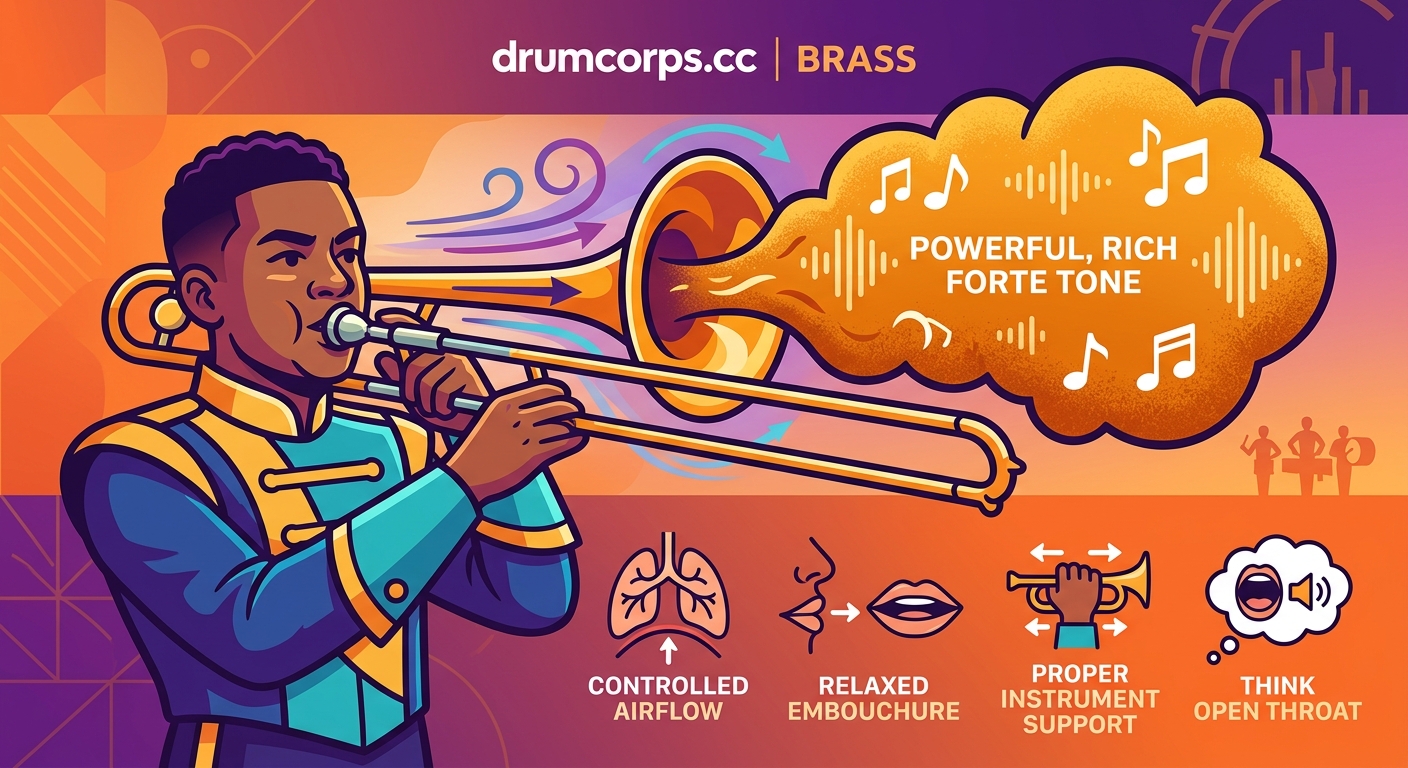
Most players think they need more air to play louder. That’s only half true. You need more air speed, but you also need more air volume in reserve.
Here’s the practical difference. When you breathe for loud playing, you should feel expansion low in your torso, around your lower ribs and back. Your shoulders shouldn’t rise. Your chest shouldn’t puff up like you’re about to lift weights.
“The players who maintain gorgeous tone at triple forte are the ones who learned to breathe like they’re filling a bucket from the bottom up, not pumping up a balloon.” – Caption head from a top 12 corps
Try this test right now. Take a breath like you’re gasping in surprise. Notice where you feel the expansion. Probably your upper chest and shoulders.
Now breathe like you’re sighing in relief after a long day. That expansion happens lower, deeper, and feels more relaxed. That’s the breathing pattern that supports loud playing without sacrificing tone quality.
The 5 essential breathing exercises every brass player should master can help you build this foundation systematically.
Breathing mechanics for sustained forte passages
- Inhale through your mouth and nose simultaneously, aiming for expansion around your entire lower torso.
- Maintain that expansion feeling as you begin playing, resisting the urge to collapse inward immediately.
- Engage your core muscles to control the air release, not to squeeze or force.
Your air should feel like it’s being released under control, not pushed out under pressure. The difference is subtle but crucial.
Embouchure structure that stays stable under pressure
Your embouchure is the other half of the tone equation. When you increase volume, your embouchure needs to provide more resistance without becoming rigid.
Many players make the mistake of pressing harder with the mouthpiece or tightening their lips into a thin line. Both responses kill your tone quality instantly.
Instead, think about firming your embouchure corners while keeping your aperture (the opening between your lips) flexible. Your corners are your anchor points. They provide the structural support that prevents your entire embouchure from collapsing when air speed increases.
| Technique Element | What Helps Tone | What Hurts Tone |
|---|---|---|
| Mouthpiece pressure | Light, consistent contact | Pressing harder as volume increases |
| Embouchure corners | Firm, engaged throughout | Loose or overly tightened |
| Lip aperture | Flexible, responsive to pitch | Fixed, rigid opening |
| Jaw position | Relaxed, slightly dropped | Clenched, pushed forward |
| Tongue position | Arched, creating space | Flat, blocking airflow |
The what’s the best mouthpiece pressure for marching brass players guide addresses this balance in detail, but the core principle is simple. Your embouchure should feel engaged but not strained.
The corner firmness drill
Set your embouchure like you’re about to play. Without your instrument, blow air through your lips at different speeds. Notice what happens to your corners as you increase air speed.
Do they stay firm, or do they start to spread outward? If they spread, you’re losing the structural integrity that supports full tone. Practice maintaining corner firmness while changing air speed.
This feels weird at first. You might even feel a slight burn in the muscles around your mouth. That’s normal. You’re building endurance in muscles that haven’t been working correctly.
Air speed versus air force
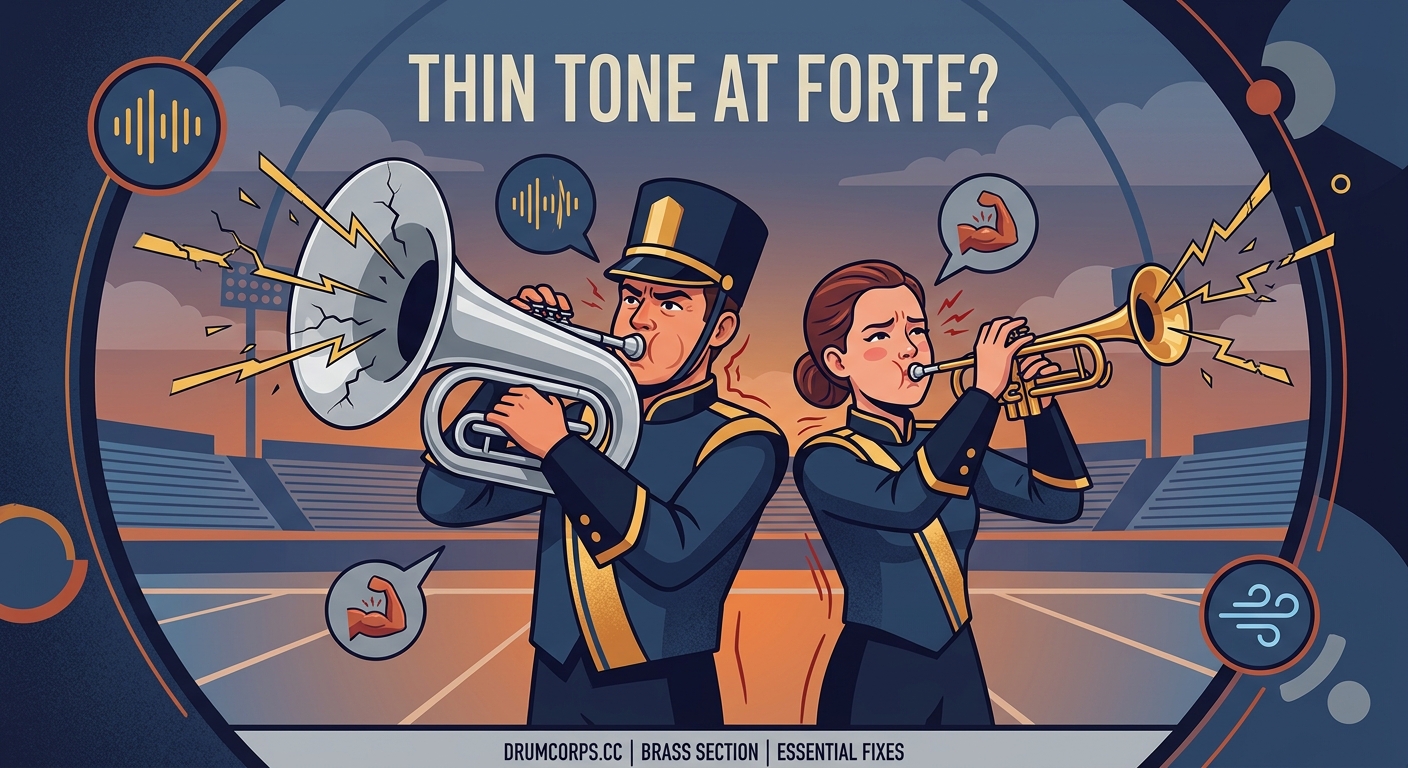
This distinction solves the tone problem for most players. Air speed is how fast the air travels through your instrument. Air force is how hard you push.
You need more speed for loud playing. You don’t need more force.
Increasing force without proper support is what creates that thin, brittle sound. You’re essentially trying to muscle your way through a problem that requires finesse.
Here’s a practical way to feel the difference. Play a long tone at mezzo forte with what feels like comfortable air support. Now crescendo to fortissimo by increasing your air speed while maintaining that same comfortable support feeling.
Your body will want to tense up. Don’t let it. Keep your throat open. Keep your shoulders down. Let the air move faster through a relaxed, open channel.
The sensation should feel more like accelerating a car by pressing the gas pedal smoothly, not by revving the engine while the brake is on.
Common air stream mistakes
- Pushing from your chest: This creates tension in your upper body and restricts airflow.
- Holding your breath: Some players actually hold back air while trying to play louder, creating internal pressure that thins the tone.
- Blowing past the note: Overblowing sends excess air past the point where it vibrates efficiently, wasting energy and thinning sound.
The throat position that opens your sound
Your throat is the gateway between your air supply and your instrument. When it closes even slightly, your entire sound suffers.
Most throat tension happens unconsciously. You’re concentrating on drill, watching the drum major, thinking about that tricky entrance in eight counts. Your body responds to that mental tension by creating physical tension.
The fix is developing awareness and then building better habits. Think about the feeling in your throat when you yawn. That’s the open, relaxed position you want for playing.
Some teachers use the syllable “oh” or “ah” to help players feel this openness. When you play, imagine you’re saying one of those syllables continuously. Your throat stays open, your tongue stays out of the way, and your air flows freely.
The how to build rock-solid breath support for high brass endurance resource covers the connection between breath support and throat position in depth.
Physical tension that sabotages your sound
Your whole body affects your tone, not just your embouchure and air supply. Tension anywhere in your body can translate into tension in your playing.
Check these common tension spots:
- Shoulders: Should stay level and relaxed, even during loud passages.
- Neck: Should feel loose, allowing your head to move naturally.
- Jaw: Should drop slightly, not clench forward.
- Grip on your instrument: Should be firm enough for control, not a death grip.
- Core muscles: Should engage to support air, not to create rigidity.
During your next rehearsal, do a body scan while playing. Notice where you’re holding tension. Then consciously release it without changing your sound. You’ll be surprised how much tension you carry that doesn’t serve your playing.
The 5 body alignment drills that transform your marching posture can help you address full-body tension patterns.
Practice strategies that build consistent forte tone
Fixing thin tone at loud dynamics requires deliberate practice. You can’t just “try harder” during ensemble rehearsal and expect different results.
The dynamic pyramid exercise
- Start at pianissimo and play a comfortable pitch for four counts.
- Crescendo to piano for four counts, focusing on maintaining tone quality.
- Continue crescendo to mezzo forte, then forte, then fortissimo, spending four counts at each level.
- Reverse the process, decrescendo back down through each level.
The goal isn’t volume. The goal is maintaining the same core tone quality at every dynamic level. If your tone thins at any point, that’s your problem spot. Work there.
Long tone variations for tone consistency
Play a single pitch for as long as your air lasts at forte. Don’t crescendo or decrescendo. Just maintain steady volume and tone quality.
Record yourself. Listen back. Does your tone stay consistent throughout the note, or does it thin out as you run out of air? That tells you whether your support system is working correctly.
Work these exercises into how to build a perfect 30-minute individual practice routine for consistent progress.
Instrument-specific considerations
Different brass instruments face different challenges with tone at loud dynamics.
Trumpet players often fight the urge to play higher when they should play louder. The two aren’t the same. Keep your pitch center stable while increasing air speed.
Horn players deal with the longest tubing in the brass family. Thin tone often comes from insufficient air speed to fill all that tubing. You need more velocity, not more pressure.
Trombone players have the advantage of a larger bore and mouthpiece, but that means you need more air volume in reserve. Don’t run out of air halfway through a phrase and try to fake it with pressure.
Euphonium and baritone players should focus on keeping their sound dark and centered, even at forte. The temptation is to brighten up for projection, but that usually results in thin tone.
Environmental factors that affect marching brass tone
Playing on a football field isn’t like playing in a concert hall. The acoustic environment changes everything.
Outdoor sound dissipates differently. There’s no resonance from walls or ceiling. What feels like fortissimo to you might barely carry to the press box.
This creates a dangerous temptation. You push harder to project, and your tone suffers. The solution isn’t more force. It’s better efficiency.
Focus on these outdoor-specific techniques:
- Direction matters: Aim your bell toward your target audience, not at the ground.
- Use the ensemble: Your sound should blend with your section, not fight to be heard individually.
- Trust your technique: Proper air speed and support will project better than forced volume.
Weather affects your playing too. Cold air makes brass instruments play flat and feel stuffy. You’ll need more air speed to compensate. Hot, humid air does the opposite. Adjust accordingly.
Maintenance and equipment factors
Sometimes thin tone at loud dynamics has nothing to do with your technique. Your equipment might be working against you.
Check your instrument for:
- Stuck valves or slides: Restricted airflow kills tone quality.
- Buildup inside tubing: Old spit and debris create resistance.
- Damaged mouthpiece: Dents or deformities change how air flows.
- Wrong mouthpiece size: Too small restricts airflow; too large makes control difficult.
The how to maintain your marching brass instrument during tour season guide covers preventive maintenance that keeps your equipment performing optimally.
Mental approach to loud playing
Your mental state affects your physical playing more than most players realize. Anxiety about loud passages creates the very tension that causes thin tone.
Instead of thinking “I need to play LOUD,” reframe it as “I need to play with full, supported air.” The mental shift reduces pressure and helps your body respond correctly.
Visualization helps too. Before a loud passage, imagine your air column as a wide, fast-moving river. Not a pressurized fire hose. The river image encourages flow and relaxation. The fire hose image encourages force and tension.
Some players benefit from the 10-minute mental practice routine that top corps members swear by to build confidence in their technical approach.
Troubleshooting persistent tone problems
If you’ve addressed breath support, embouchure, and tension but still struggle with thin tone at forte, consider these less obvious causes.
Fatigue: Tired muscles can’t maintain proper form. If your tone thins during long rehearsals but not at the beginning, you need more endurance training.
Dehydration: Dry mouth and throat create friction that restricts airflow. Stay hydrated throughout rehearsal.
Poor warm-up: Jumping into loud playing without proper warm-up sets you up for failure. Your muscles need time to engage correctly.
Breathing between phrases: If you’re not replenishing your air supply properly, you’ll run out of support mid-phrase and compensate with pressure.
Inconsistent practice: Tone quality requires daily reinforcement. Sporadic practice won’t build the muscle memory you need.
The 5 daily warm-up exercises that will transform your brass tone quality resource provides a systematic approach to preparing your body for demanding playing.
Building lasting tone quality at all dynamics
Fixing thin brass tone at loud dynamics isn’t about learning a trick or finding a shortcut. It’s about building fundamental technique that supports your sound at any volume.
The good news is that once you develop proper breath support, stable embouchure structure, and relaxed throat position, they become automatic. You won’t have to think about them consciously during performance.
Start with the breathing foundation. Everything else builds on that. Spend two weeks focusing exclusively on breathing mechanics before worrying about embouchure or air speed.
Then add embouchure stability. Practice maintaining corner firmness while changing air speed and volume. Give this another two weeks.
Finally, integrate everything while addressing tension patterns. Your body will resist at first. Old habits feel comfortable even when they’re wrong. Push through that resistance with patient, consistent practice.
Record yourself regularly. Your ears will adjust to gradual improvement and miss it. Recordings provide objective feedback about whether your tone quality is actually improving.
Work with a teacher or experienced section leader who can observe your playing and catch issues you can’t feel or hear yourself. Sometimes you need external feedback to identify problems.
The path from thin, brittle forte to full, resonant forte takes time. But every practice session that addresses these fundamentals moves you closer. Your section will notice the difference. The judges will notice the difference. Most importantly, you’ll feel the difference in how much easier and more satisfying your playing becomes.
Your sound is worth the investment.