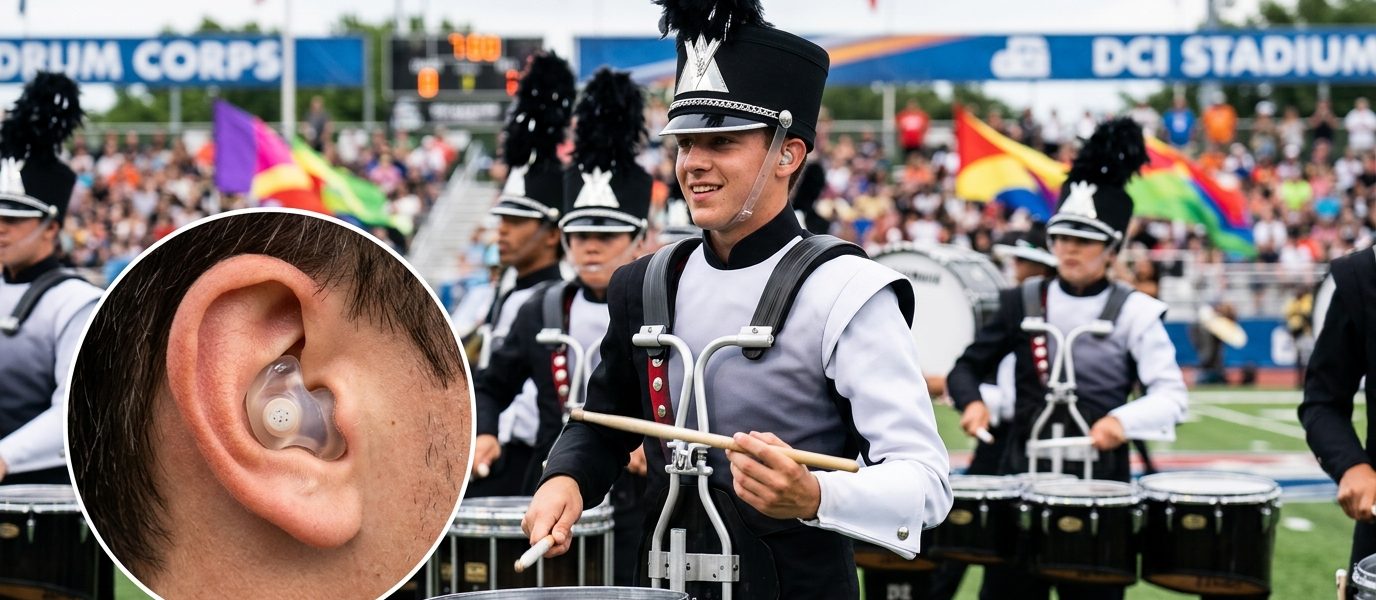
Standing on the field during a full ensemble run, you’re surrounded by 150 decibels of pure sound. The brass line hits a fortissimo chord three feet behind you. The snare line cracks out a unison accent. Your ears ring for hours afterward.
Sound familiar?
Many marchers think ear damage is just part of the activity. It’s not. Protecting your hearing doesn’t mean sacrificing your performance or awareness. It means you’ll still be able to hear music clearly when you’re 40.
Ear protection for drum corps is essential for preventing permanent hearing damage from sustained exposure to 110-150 decibel sound levels. Custom-molded musicians’ earplugs preserve sound quality and spatial awareness while reducing volume by 15-25 decibels, allowing you to perform safely without compromising your ability to hear cues, balance, or blend with your section during rehearsals and performances.
Why Drum Corps Sound Levels Actually Matter
Drum corps produces some of the loudest acoustic music on earth.
A full brass line at fortissimo reaches 120 to 130 decibels. That’s louder than a chainsaw. The battery percussion section adds another layer, with snare drums peaking around 115 decibels and bass drums hitting 110 to 120 decibels.
The Occupational Safety and Health Administration sets the safe exposure limit at 85 decibels for eight hours. Above that, your risk of permanent hearing damage increases with every decibel and every minute.
During a typical 12-hour rehearsal day, you’re exposed to dangerous sound levels for hours at a time. Add in the enclosed spaces of gymnasiums during spring training, and the sound bounces off walls, making it even more intense.
Here’s what happens to your ears during repeated exposure:
- Temporary threshold shift (that ringing after rehearsal)
- Permanent threshold shift (hearing loss that doesn’t recover)
- Tinnitus (constant ringing or buzzing)
- Difficulty distinguishing pitch and timbre later in life
The damage is cumulative. One summer might not destroy your hearing, but three or four summers without protection can cause permanent changes.
You might think you’re fine because you don’t feel pain. That’s the problem. Hearing damage happens gradually and painlessly. By the time you notice it, the damage is done.
Different Types of Ear Protection for Performers
Not all earplugs work the same way.
Foam earplugs are cheap and widely available. They reduce sound by 20 to 30 decibels across all frequencies. That sounds great until you realize they muffle everything. You can’t hear pitch accurately. You can’t judge balance. You lose spatial awareness of where other sections are on the field.
Foam plugs are fine for mowing the lawn. They’re terrible for marching.
Musicians’ earplugs use acoustic filters instead of foam. They reduce volume evenly across all frequencies, typically by 15, 20, or 25 decibels depending on the filter you choose. The sound stays clear. You can still hear pitch, blend, and dynamics. You just hear everything at a safer volume.
These come in two formats: universal fit and custom molded.
Universal-fit musicians’ earplugs cost between $15 and $40. They use a one-size-fits-most design with interchangeable filters. Brands like Etymotic, Eargasm, and Earasers make solid options. They work well for many people, but they can fall out during movement or feel uncomfortable after hours of wear.
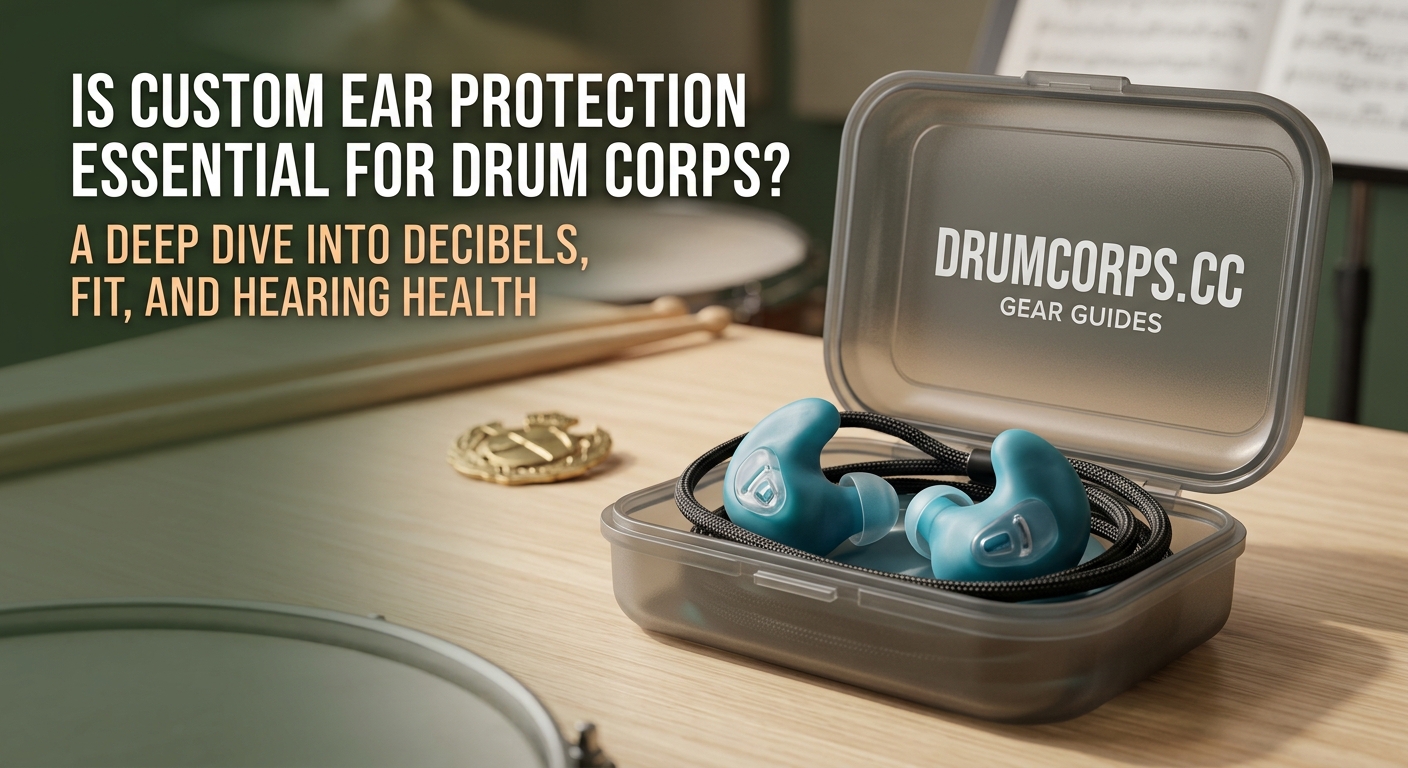
Custom-molded musicians’ earplugs cost between $150 and $300. An audiologist takes impressions of your ear canals and sends them to a lab. The lab creates plugs that fit your ears exactly. They stay in place during backward marching, crab steps, and jazz runs. They’re comfortable enough to wear for 12-hour days. The filters are replaceable, so you can adjust the attenuation level as needed.
“I switched to custom molds after my second summer. The difference was immediate. I could finally hear the rest of my section without the constant ringing afterward. My intonation actually improved because I wasn’t straining to hear myself over the fatigue.” — Former Blue Devils mellophone player
In-ear monitors are another option, though they’re more common in indoor settings. They provide both hearing protection and the ability to hear a click track or monitor mix. Some DCI corps have started experimenting with them for specific sections, but they’re not yet standard across the activity.
How to Choose the Right Attenuation Level
The filter strength you need depends on where you stand in the ensemble.
Battery percussion members face the highest exposure. Snare drummers, tenor drummers, and cymbal players should start with 20 to 25 decibel reduction. The sound sources are inches from your ears, and you’re surrounded by other loud instruments.
Brass players in the middle of the horn line need 15 to 20 decibel reduction. You’re close to other brass players and often have the battery behind you during sets.
Front ensemble players have more variable exposure. If you’re on marimba or vibes in an outdoor setting, 15 decibel filters might be enough. If you’re on synth or auxiliary percussion near amplified sound sources indoors, consider 20 decibel filters.
Color guard members typically need less protection, around 10 to 15 decibels, unless they’re frequently positioned directly in front of the brass or battery sections during high-volume moments.
Here’s a practical way to test if your protection level is right:
- Wear your earplugs during a full ensemble rehearsal.
- Check if you can still hear individual voices in your section clearly.
- Notice if you’re straining to hear tuning or blend adjustments.
- Ask yourself if you feel isolated from the ensemble sound.
If you answered yes to questions 3 or 4, you might need a lower attenuation level. If your ears still ring after rehearsal (question 1), you need more protection.
Many custom earplug manufacturers include multiple filter options with your purchase. Start with the medium attenuation and adjust from there.
Common Mistakes That Reduce Effectiveness

Wearing earplugs incorrectly defeats the purpose.
The most common error is not inserting them deep enough. Universal-fit plugs should seal completely in your ear canal. If you can see most of the plug sticking out, it’s not in far enough. Custom molds should sit flush with your ear canal opening.
Here’s the right insertion technique for universal plugs:
- Reach over your head with your opposite hand.
- Pull your ear up and back to straighten the ear canal.
- Insert the plug with a gentle twisting motion.
- Hold it in place for a few seconds while the material adjusts.
For custom molds, the process is simpler. Orient the plug correctly (they’re usually marked for left and right), insert it straight into your canal, and press gently until it seats.
Inconsistent use is another problem. Some marchers only wear protection during full ensemble rehearsals. They skip it during sectionals or individual practice because it “doesn’t seem that loud.”
Your ears don’t care about your perception. A brass sectional in a small rehearsal room can easily hit 100 to 110 decibels. That’s still damaging with prolonged exposure.
Wear your protection during every rehearsal and performance. The only exception might be very soft, small-group music rehearsals where the ensemble never exceeds conversation volume.
Dirty earplugs are surprisingly common. Earwax, sweat, and dust build up on the filters and reduce their effectiveness. Clean your plugs after every use with mild soap and water. Let them dry completely before storing them in their case.
Replace foam tips on universal plugs every few months. Replace acoustic filters on custom molds annually or when you notice reduced sound quality.
| Mistake | Why It Matters | How to Fix It |
|---|---|---|
| Shallow insertion | Breaks the seal, reduces protection by 50% or more | Pull ear up and back, insert fully, check seal |
| Wearing only during shows | Cumulative damage happens during all rehearsals | Wear protection during every high-volume activity |
| Skipping cleaning | Reduces filter effectiveness and increases infection risk | Clean with soap and water after each use |
| Using foam plugs for performance | Distorts pitch and balance perception | Switch to musicians’ earplugs with flat attenuation |
| Ignoring discomfort | Leads to inconsistent use | Get properly fitted custom molds or try different universal brands |
What to Expect During Your First Week
The adjustment period feels strange at first.
Your brain is used to processing sound at dangerously loud levels. When you first wear proper protection, everything sounds quieter (obviously), but it also sounds different. Your own playing might seem muffled or distant.
This is normal. It takes about a week of consistent use for your brain to recalibrate.
During this adjustment period:
- You might play slightly sharper or flatter than usual because you’re compensating for the perceived change in sound
- You might feel disconnected from the ensemble
- You might second-guess whether you’re playing loud enough
Push through it. By the end of the first week, your brain adapts. You’ll hear pitch and blend accurately again. The ensemble sound will feel natural, just at a safer volume.
Some marchers worry that wearing ear protection will hurt their ability to match pitch with the section. The opposite is true. When your ears aren’t fatigued from overexposure, your pitch discrimination actually improves.
If you’re working on breath support and endurance, how to build rock-solid breath support for high brass endurance can help you maintain control even as you adjust to hearing yourself differently.
How to Talk to Your Staff About Hearing Protection
Some corps actively encourage ear protection. Others are less supportive.
If your staff hasn’t mentioned it, bring it up. Frame it as a performance and longevity issue, not a complaint about volume.
Try this approach: “I’m concerned about protecting my hearing for the long term. I’m planning to use musicians’ earplugs that maintain sound quality. Is there anything I should know about how that might affect my performance or awareness?”
Most professional staff members understand the importance of hearing protection. Many of them have hearing damage themselves and wish they’d protected their ears earlier.
If you encounter resistance, emphasize these points:
- Musicians’ earplugs preserve pitch and blend perception
- Hearing protection improves endurance by reducing ear fatigue
- Professional musicians across all genres use them
- The alternative is permanent hearing damage that affects your entire life
Some corps have started including hearing protection in their member education, alongside topics like how new concussion protocols are changing drum corps training camps. Health and safety awareness is growing across the activity.
If your corps doesn’t provide or subsidize ear protection, consider it a necessary equipment cost, like your practice pad or metronome. The investment pays off over decades.
Making Custom Molds Work with Your Budget
Custom-molded earplugs are expensive upfront.
The typical cost breaks down like this:
- Audiologist appointment and ear impressions: $50 to $100
- Lab fabrication: $100 to $200
- Filters: Usually included, replacements cost $20 to $40
Total: $150 to $300 for a set that lasts years.
That’s a lot for a high school or college student. Here are ways to make it more affordable:
Check if your health insurance covers hearing protection. Some plans include coverage for custom earplugs if your primary care doctor writes a prescription citing occupational noise exposure.
Ask your audiologist about payment plans. Many practices offer them for custom devices.
Split the cost across your pre-season and tour. Order them in spring and pay them off before move-ins.
Look for group discounts. If multiple corps members order from the same audiologist at once, some practices offer reduced rates.
Consider starting with high-quality universal-fit plugs ($30 to $40) and upgrading to custom molds the following season. Universal plugs are infinitely better than no protection.
Some corps have started partnering with hearing protection companies to offer discounted custom molds to members. Ask your administration if this is an option.
Maintaining Your Ear Protection Through Tour
Custom molds are durable, but tour is hard on everything.
Keep your earplugs in their case when you’re not wearing them. Don’t toss them loose in your backpack or leave them on the field.
Clean them daily. Sweat and dust build up fast during summer tour. A 30-second rinse prevents buildup that degrades sound quality.
Bring backup universal-fit plugs. If you lose a custom mold during tour, you need something to use until you can get a replacement.
Check your filters weekly. If you notice any cracks, tears, or changes in how they sound, replace them. Most manufacturers sell replacement filters that ship within a few days.
Store your earplugs away from extreme heat. Don’t leave them in direct sunlight on the equipment truck or in a hot bus. Heat can warp the material and ruin the fit.
If you’re also working on your individual practice routine, how to build a perfect 30-minute individual practice routine includes time for proper equipment care and maintenance.
Beyond Earplugs: Other Ways to Protect Your Hearing
Ear protection is the most important step, but it’s not the only one.
Take breaks during long rehearsal blocks. Even with earplugs, continuous exposure adds up. Step away from the ensemble during water breaks. Give your ears a few minutes of relative quiet.
Avoid additional loud noise exposure outside of rehearsal. Don’t blast music through headphones on the bus. Skip the loud restaurant or concert on your day off. Your ears need recovery time.
Monitor your symptoms. If you experience any of these, see an audiologist:
- Ringing that lasts more than 24 hours after rehearsal
- Difficulty understanding speech in noisy environments
- A feeling of fullness or pressure in your ears
- Sudden changes in hearing in one or both ears
Get a baseline hearing test before your first season. Then get annual tests to track any changes. Early detection of hearing loss allows you to adjust your protection strategy before damage becomes severe.
Pay attention to rehearsal environments. Indoor facilities with hard surfaces amplify sound. If your corps rehearses in a gymnasium or warehouse, consider using higher attenuation filters than you would outdoors.
When Sound Quality Actually Matters More Than You Think
Here’s something most marchers don’t consider: ear protection can improve your performance.
When your ears are fatigued from overexposure, your pitch discrimination suffers. You think you’re in tune, but you’re actually sharp or flat. You think you’re blending, but you’re sticking out.
Ear fatigue also affects your dynamic control. You play louder than necessary because you can’t hear yourself accurately over the ringing in your ears.
With proper protection, your ears stay fresh throughout the day. You hear pitch relationships more clearly. You judge balance more accurately. You make better musical decisions.
This is especially true during long rehearsal days. By hour 10 of an unprotected rehearsal block, your hearing is so fatigued that you’re essentially performing with impaired perception.
Musicians’ earplugs keep your perception sharp from the first run-through to the last.
If you’re working on tone quality alongside hearing protection, 5 daily warm-up exercises that will transform your brass tone quality can help you develop better sound while protecting your ears.
Real Talk About Hearing Damage in the Activity
Hearing loss among drum corps alumni is common and underreported.
Many former marchers in their 30s and 40s already have significant high-frequency hearing loss. They struggle in noisy environments. They ask people to repeat themselves. They can’t hear certain consonants clearly.
Some develop tinnitus that never goes away. Constant ringing or buzzing becomes the soundtrack to their entire life.
The damage isn’t reversible. Once those hair cells in your inner ear are destroyed, they don’t grow back. Hearing aids can help, but they don’t restore normal hearing.
The tragedy is that all of this is preventable.
Every professional musician in every genre uses hearing protection. Orchestral musicians wear custom molds. Rock and pop musicians use in-ear monitors. Studio engineers use isolation headphones.
Drum corps is no different. The sound levels are just as dangerous, and the solution is just as straightforward.
Protecting your hearing doesn’t make you less dedicated or less tough. It makes you smart. It means you’re thinking about your entire musical life, not just this summer.
Your Hearing Is Worth Protecting
You have one pair of ears for your entire life.
The music you make in drum corps is incredible. The friendships, the growth, the challenge, all of it matters. But none of it is worth permanent hearing damage.
Ear protection for drum corps isn’t optional. It’s not a nice-to-have. It’s essential equipment, just like your instrument and your shoes.
Start with universal-fit musicians’ earplugs if budget is tight. Upgrade to custom molds when you can. Wear them consistently. Clean them regularly. Give your ears the protection they need to last a lifetime.
Your 40-year-old self will thank you.