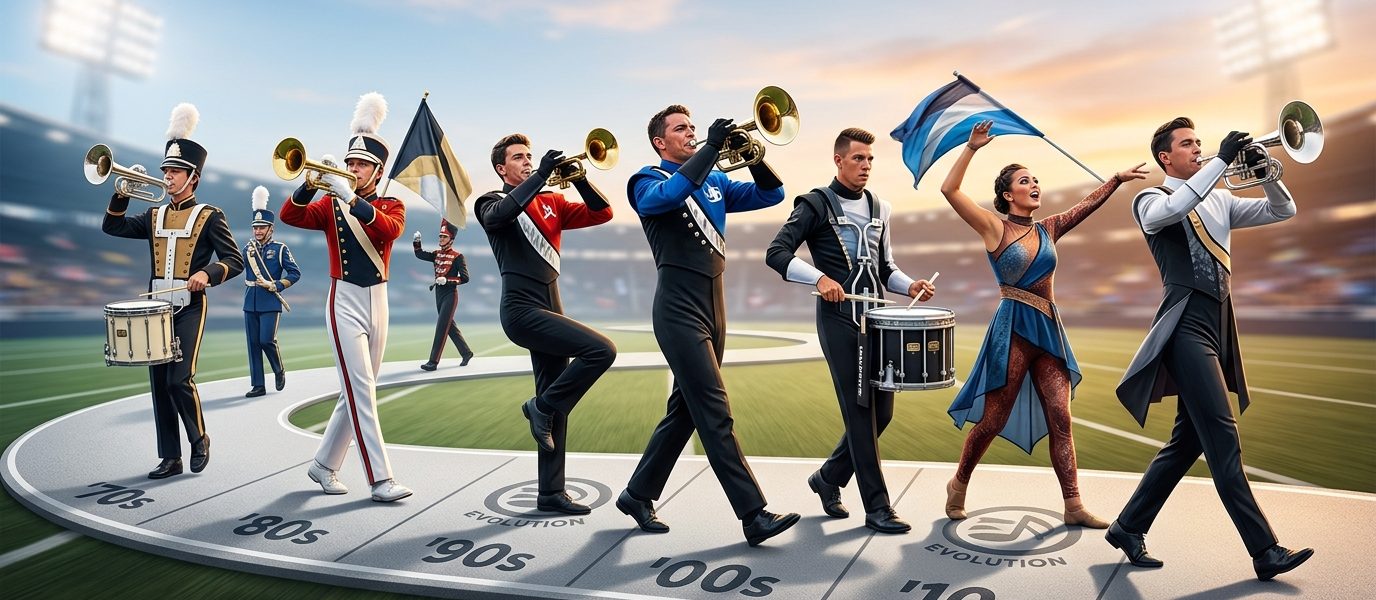
The evolution of drum corps didn’t happen by accident. It was shaped by organizations willing to challenge convention, redefine excellence, and push the boundaries of what marching music could become. These pioneering groups didn’t just win championships. They fundamentally altered how we think about musical performance, visual design, and competitive artistry on the football field.
The most influential drum corps history centers on organizations that introduced groundbreaking techniques, redefined competitive standards, and created lasting pedagogical frameworks. From the Blue Devils’ precision marching systems to the Cadets’ theatrical storytelling, these corps established the foundation for modern competitive design. Their innovations in brass pedagogy, visual vocabulary, and show construction continue shaping how today’s groups approach performance, training, and artistic expression across all competitive levels.
The Blue Devils Set the Standard for Modern Precision
When how the Blue Devils revolutionized modern drum corps in the 1970s began taking shape, few could predict the seismic shift about to occur. The Concord corps introduced a systematic approach to marching technique that prioritized body control, alignment, and visual cleanliness at unprecedented levels.
Their contribution wasn’t just about winning. It was about establishing repeatable training methods that any corps could study and adapt.
The Blue Devils developed the eight-to-five step size as a universal standard. They refined carriage positions that became industry norms. Their drill designers created geometric formations that balanced musical phrasing with visual impact, setting expectations for how shows should flow from opener to closer.
“The Blue Devils didn’t just perform at a higher level. They created the language we all use to teach marching technique today. Their influence appears in every rehearsal block across the activity.”
Their championship runs throughout multiple decades proved that systematic training produces consistent results. Other corps began adopting similar pedagogical frameworks, raising the competitive floor across DCI.
The Cadets Pioneered Theatrical Storytelling
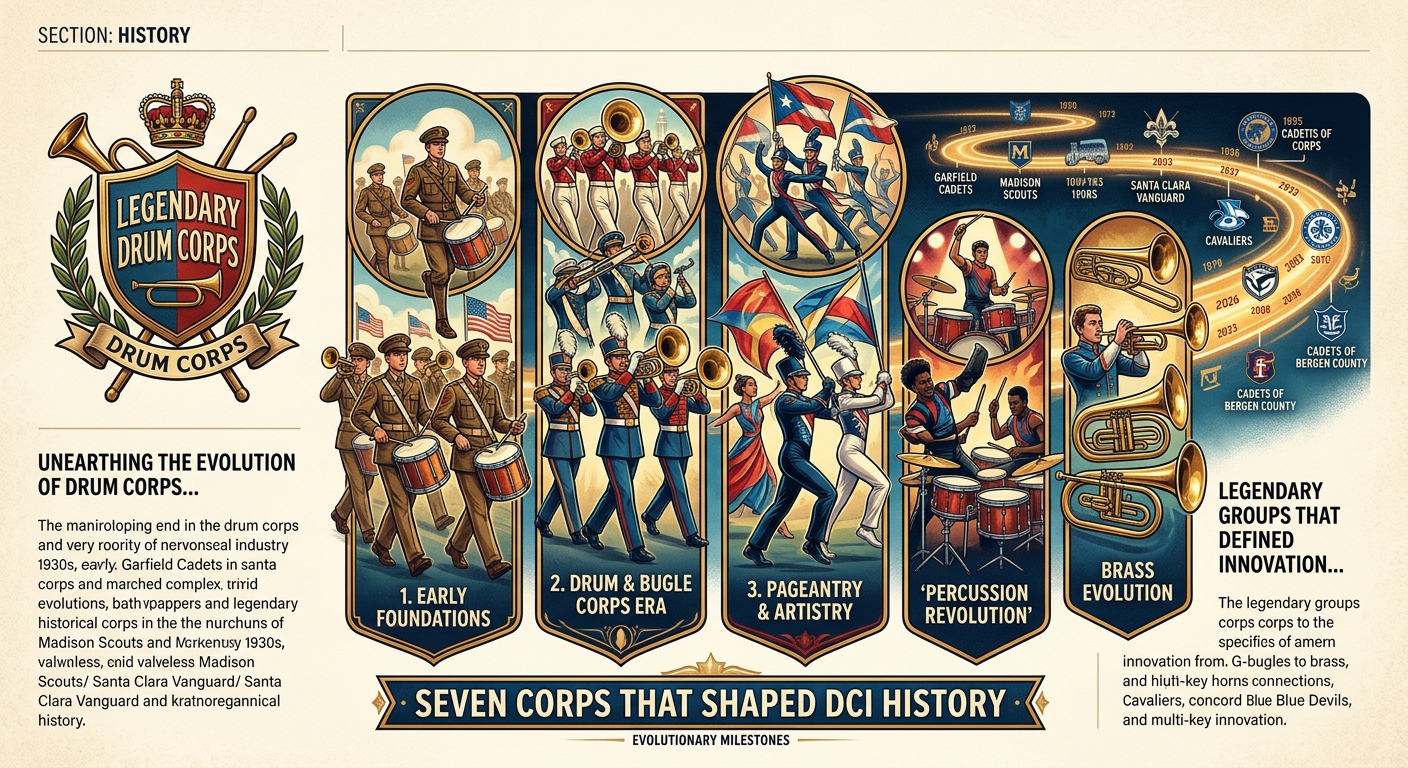
Before the Cadets transformed competitive design, drum corps shows followed predictable formats. Musical selections, visual formations, and thematic elements existed as separate components rather than unified narratives.
How the Cadets pioneered visual storytelling and changed drum corps forever through productions that integrated character development, dramatic arcs, and emotional progression. Their shows didn’t just present musical repertoire. They told stories that audiences could follow from opening statement through final resolution.
The Garfield corps introduced theatrical elements that other groups initially dismissed as gimmicks:
- Character-driven visual staging
- Narrative progression across multiple movements
- Integrated props that served thematic purposes
- Costuming choices that enhanced storytelling
- Emotional pacing that built toward climactic moments
These innovations fundamentally changed how designers approached show construction. The question shifted from “What music should we play?” to “What story do we want to tell?”
Santa Clara Vanguard Redefined Musical Complexity
The Vanguard’s contribution to the most influential drum corps history centers on their fearless approach to musical difficulty. While other corps selected accessible repertoire designed for mass appeal, Santa Clara consistently programmed challenging contemporary compositions that pushed performer capabilities.
Their brass arrangers introduced harmonic complexity that raised the musical bar. Their percussion writing incorporated odd meters, polyrhythmic passages, and technical demands that seemed impossible until the Vanguard proved otherwise.
This philosophy created a ripple effect throughout the activity. Corps that wanted to compete at the highest level had to elevate their musical standards. Audition processes became more selective. Training methods had to evolve to prepare members for increasingly demanding repertoire.
The Vanguard also championed the integration of jazz influences, world music elements, and contemporary classical compositions into competitive programs. They demonstrated that drum corps could serve as a legitimate vehicle for serious musical expression, not just entertainment.
Phantom Regiment Established the Power of Thematic Consistency
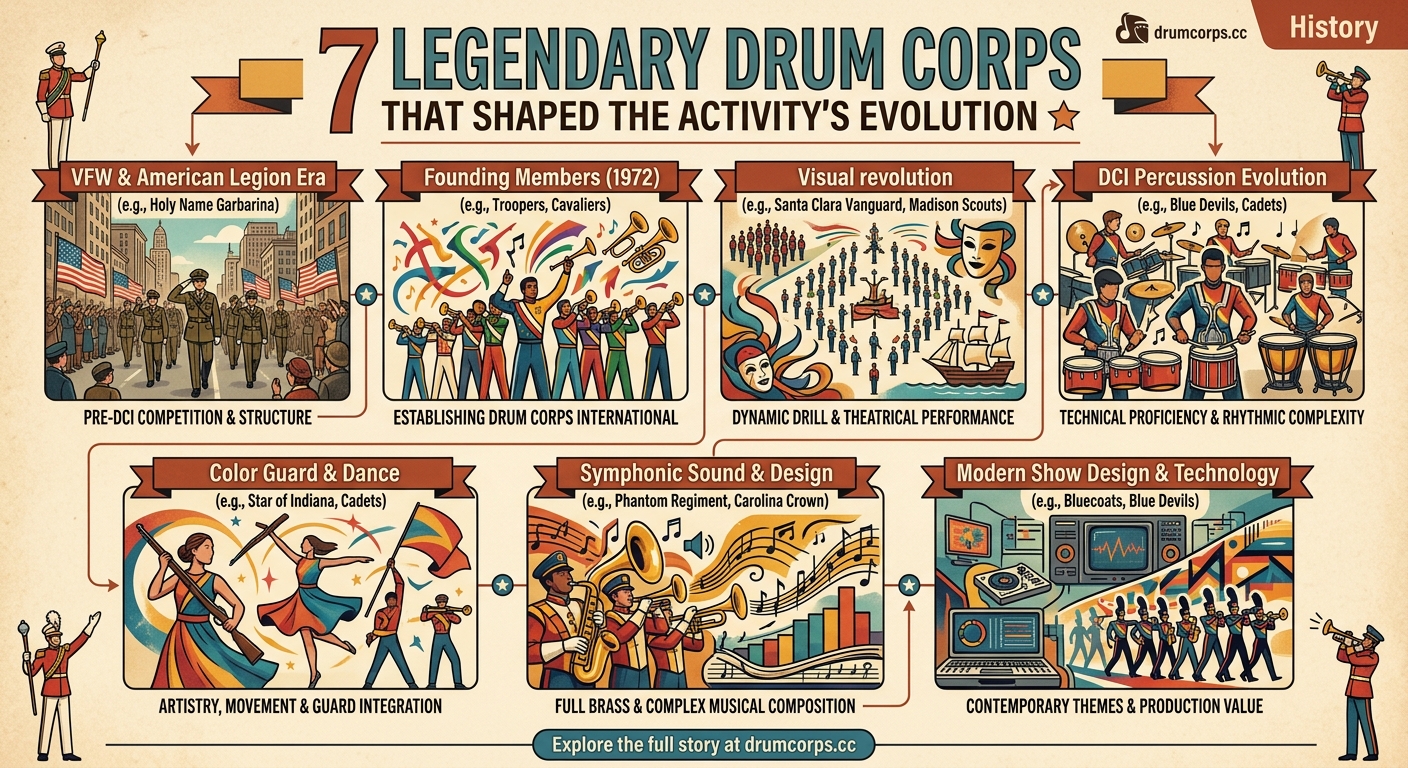
The Phantom Regiment’s signature sound became instantly recognizable through their commitment to a distinct artistic identity. Rather than chasing trends or mimicking competitors, the Rockford corps developed a consistent aesthetic centered on dramatic themes, powerful brass sonority, and emotional intensity.
Their approach proved that branding matters in competitive performance. Audiences knew what to expect from a Phantom Regiment show, and that consistency built loyalty while establishing clear artistic standards.
How Phantom Regiment’s Identity Shaped Modern Corps Branding
| Element | Phantom’s Approach | Impact on Activity |
|---|---|---|
| Musical style | Dark, powerful brass voicings | Corps began developing signature sounds |
| Visual aesthetic | Dramatic, emotionally intense | Established importance of consistent visual identity |
| Thematic choices | Classical, literary, mythological | Legitimized intellectual content in show design |
| Color guard integration | Theatrical, character-driven | Elevated guard from decoration to narrative device |
| Uniforms | Timeless, recognizable design | Proved visual branding builds audience connection |
This strategic consistency allowed Phantom to compete successfully across multiple decades without abandoning their core identity. Other organizations learned that artistic integrity and competitive success weren’t mutually exclusive.
The Cavaliers Perfected Visual Impact Through Drill Innovation
The Cavaliers’ drill designers created formations that maximized visual impact through geometric precision and strategic use of field space. Their approach emphasized clean lines, dramatic reveals, and formations that photographed beautifully from any angle.
Their contribution extended beyond pretty pictures. The Cavaliers developed training systems that allowed 150 performers to execute complex maneuvers with split-second timing. They proved that visual excellence required the same systematic pedagogy as musical achievement.
Key innovations included:
- Development of the “Cavalier style” upper body carriage
- Integration of jazz running techniques into traditional marching
- Strategic use of negative space in drill design
- Formations that enhanced rather than competed with musical moments
- Visual transitions that served as compositional elements
These techniques became standard practice across competitive drum corps. Designers studying Cavaliers shows learned how to construct drill that supported musical architecture while creating memorable visual moments.
Madison Scouts Championed Traditional Values
While other corps rushed toward theatrical complexity and electronic amplification, the Madison Scouts maintained commitment to traditional drum corps values. Their all-male membership, classic repertoire choices, and emphasis on fundamental excellence provided an important counterbalance to rapid modernization.
Their influence reminds us that innovation doesn’t require abandoning tradition. The Scouts demonstrated that timeless musical values, disciplined execution, and respect for the activity’s heritage could coexist with contemporary competitive standards.
The organization’s commitment to developing young men through music education created a distinct culture that alumni carried into their professional lives. This emphasis on character development alongside musical training influenced how other corps approached member development beyond competitive success.
Carolina Crown Modernized Visual Design Language
Carolina Crown’s rise to elite status coincided with a fundamental shift in how corps approached visual design. Their shows integrated contemporary dance vocabulary, asymmetrical formations, and movement quality that borrowed from modern dance and theater.
What made Carolina Crown’s 2013 ‘E=mc²’ so emotionally powerful demonstrated how sophisticated visual design could amplify musical content. Their designers proved that drill could function as choreography rather than simply formations that moved performers from point A to point B.
The Crown’s influence appears in how younger corps approach body movement, staging, and the integration of guard work with brass and percussion sections. They helped establish that visual design deserved the same artistic consideration as musical arranging.
Understanding the Competitive Evolution Timeline
The transformation of competitive drum corps didn’t happen overnight. Understanding the chronological progression helps contextualize each organization’s contribution.
1970s Foundation
The Blue Devils established systematic training methods. The Cavaliers developed precision drill vocabulary. These organizations created the pedagogical framework that made future innovation possible.
1980s Expansion
What made the 1980s the golden age of drum corps innovation through electronic instrumentation, amplified front ensembles, and increasingly theatrical show concepts. The Cadets led this charge while maintaining competitive excellence.
1990s Refinement
Santa Clara Vanguard pushed musical boundaries. Phantom Regiment proved thematic consistency could sustain multi-decade success. The activity weathered financial challenges while maintaining artistic growth.
2000s Modernization
Carolina Crown introduced contemporary movement vocabulary. The Cavaliers’ 2002 ‘Frameworks’ built a championship through architectural precision, demonstrating that intellectual concepts could drive competitive design.
2010s Integration
Shows like Bluecoats 2014 ‘Tilt’ redefined modern drum corps design by fully integrating visual and musical elements into unified artistic statements. The barriers between sections dissolved as designers pursued total theatrical integration.
Common Misconceptions About Influential Corps
Understanding the most influential drum corps history requires separating fact from mythology. Several persistent misconceptions deserve correction.
Misconception: Championship counts determine influence
Reality: Some corps won fewer titles but introduced innovations that competitors adopted universally. Influence often exceeds competitive success.
Misconception: Only DCI World Class corps matter
Reality: Organizations like the 27th Lancers and Bridgemen introduced concepts that shaped the activity despite not achieving sustained championship success. What happened to the 27th Lancers illustrates how financial realities can end influential organizations.
Misconception: Modern corps are objectively better
Reality: Each era’s top corps maximized the tools and rules available. Comparing across decades ignores how rule changes, equipment evolution, and pedagogical development created different competitive environments.
Misconception: Influence is immediate
Reality: Many innovations took years to gain acceptance. The Cadets’ theatrical approach initially drew criticism before becoming industry standard.
How These Organizations Changed Training Methods
The pedagogical impact of influential corps extends far beyond competitive results. These organizations developed training systems that music educators adopted in high school programs, college marching bands, and winter guard activities.
Training innovations that spread throughout marching arts include:
- Systematic brass pedagogy based on breathing exercises every brass player should master
- Visual technique progressions from basic to advanced concepts
- Section-specific warm-up protocols that prevent injury while building skills
- Mental preparation strategies that top performers use
- Equipment maintenance standards that extend instrument life
These contributions matter because they improved how hundreds of thousands of students learn marching arts fundamentals. A high school director in Iowa might never attend DCI Finals, but their teaching methods likely incorporate techniques these influential corps pioneered.
The Ripple Effect on Show Design Philosophy
Modern drum corps shows reflect design philosophies these influential organizations established. Understanding their contributions helps decode why contemporary productions look and sound the way they do.
Design elements that trace back to these pioneering corps:
- Opening statements that establish thematic content immediately
- Musical selections that support rather than dictate visual design
- Integration of color guard as narrative drivers rather than decorative elements
- Percussion features that function as compositional moments
- Ballad moments that defined championship seasons through emotional vulnerability
- Closer moments that brought audiences to their feet through careful pacing
Today’s designers stand on shoulders of those who proved these concepts could work at the highest competitive level. What happens when a drum corps show takes an unexpected risk and wins big continues the tradition these organizations established.
Measuring Influence Beyond Trophies
Competitive success provides an incomplete picture of organizational influence. Several metrics offer better insight into lasting impact:
Pedagogical adoption rate: How many other corps adopted training methods?
Alumni impact: How many members became influential designers, educators, or administrators?
Stylistic longevity: How long did innovations remain relevant?
Cross-activity influence: Did techniques spread to marching band, winter guard, or indoor percussion?
Cultural penetration: Did the general public recognize the organization’s contributions?
These metrics reveal that some moderately successful competitive organizations exerted disproportionate influence on the activity’s evolution. Their ideas mattered more than their trophy count.
Why These Organizations Still Matter Today
The most influential drum corps history isn’t just about nostalgia or historical trivia. These organizations created frameworks that continue shaping how we teach, design, and perform marching arts.
Current members benefit from refined techniques these corps developed through trial and error. Designers build on conceptual foundations these organizations established. Educators use pedagogical systems these groups proved effective.
Understanding this lineage helps current participants appreciate they’re part of an ongoing conversation about artistic excellence. Each generation builds on previous innovations while contributing new ideas that future performers will refine.
The activity’s evolution continues. Rule changes like DCI announces major rule changes for the 2025 competitive season create new opportunities for innovation. Organizations merge and adapt, as seen when three legacy drum corps merged this off-season.
But the fundamental principles these influential corps established remain relevant. Excellence requires systematic training. Artistic vision needs technical execution. Innovation builds on tradition rather than rejecting it.
The Legacy Lives in Every Rehearsal Block
Every time a brass instructor emphasizes breath support, they’re applying lessons the Vanguard refined. When a visual tech corrects upper body carriage, they’re teaching Cavaliers technique. When a designer constructs a show around narrative progression, they’re following the Cadets’ blueprint.
These influential organizations didn’t just win championships during their peak years. They created the vocabulary, techniques, and artistic standards that define competitive excellence today. Their legacy appears in every rehearsal block, every design meeting, and every performance that pushes the activity forward.
Understanding the most influential drum corps history helps current participants recognize they’re not just learning to march and play. They’re joining a tradition of artistic innovation that stretches back decades and will continue evolving long after today’s performers age out.