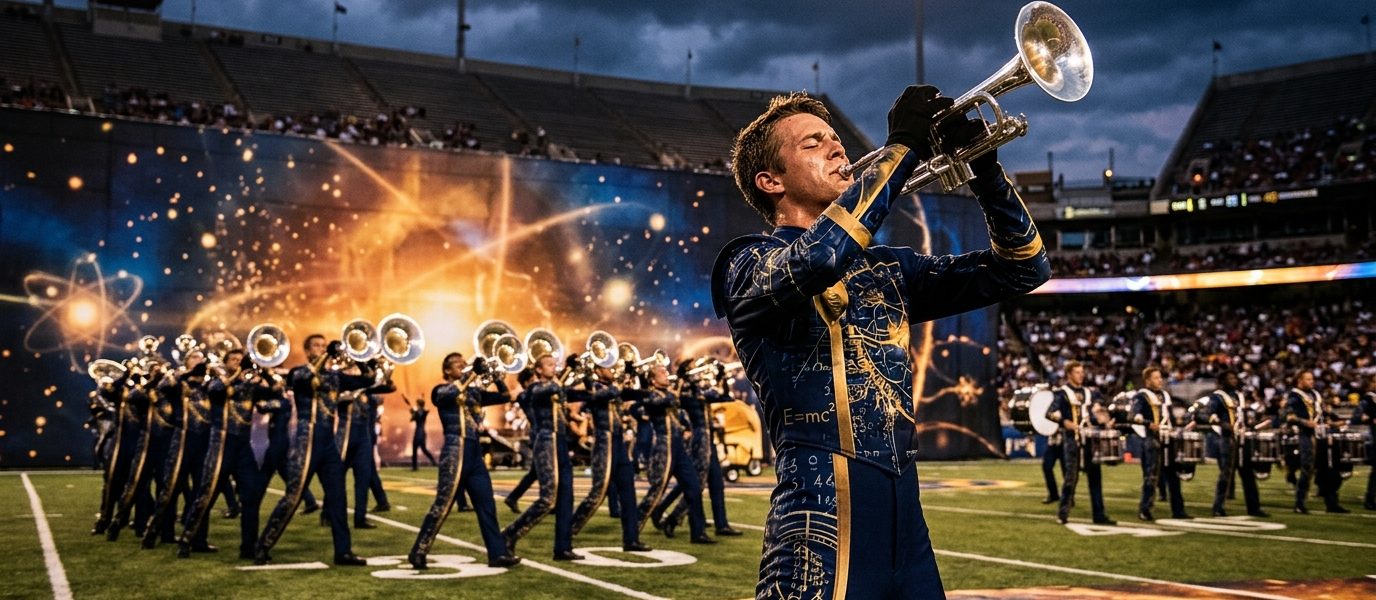
Carolina Crown’s 2013 production “E=mc²” stands as one of the most discussed shows in modern drum corps history. The Fort Mill corps finished second at DCI Finals that year, but the show’s reputation has only grown stronger with time. Fans still debate its merits, analyze its innovations, and return to recordings years later to catch details they missed the first time around.
Carolina Crown’s 2013 E=mc² combined Einstein’s theory with emotional storytelling through innovative visual design, powerful brass arrangements, and a compelling narrative arc. The show featured minimalist staging, abstract movement vocabulary, and a soundtrack blending classical and contemporary elements that pushed the boundaries of what drum corps design could achieve while maintaining accessibility for audiences.
The Concept Behind E=mc²
The show title references Albert Einstein’s famous equation relating energy and mass. But Crown’s design team didn’t create a science lecture on the field.
Instead, they used the equation as a metaphor for transformation and potential energy. The production explored how small elements could create massive impact when combined correctly.
The visual program featured stark white costuming with black accents. Props remained minimal throughout most of the show. This stripped-down aesthetic forced audiences to focus on the performers themselves and the shapes they created.
Design coordinator Michael Gaines and his team built the show around the idea that every individual member represented an atom of potential. When these atoms combined through precise drill and unified performance, they released tremendous energy.
This conceptual framework gave the production its emotional weight. It wasn’t about physics. It was about human potential and collective achievement.
Musical Architecture and Arrangement Choices
The musical book for carolina crown 2013 e=mc2 drew from diverse sources. Arranger Jay Bocook crafted the brass parts with Crown’s signature power in mind.
The opener featured “Sinfonietta: La Jolla” by Michael Daugherty. This contemporary classical piece provided angular rhythms and driving energy right from the start.
The ballad section centered on “Adagio for Strings” by Samuel Barber. This emotionally charged work has appeared in countless films and memorial services. Crown’s interpretation built slowly, allowing the horn line to demonstrate both control and raw power.
The closer incorporated “Hymn to the Fallen” from John Williams’ score for Saving Private Ryan. The arrangement gradually accelerated and intensified, building toward a climactic finish that left audiences breathless.
Between these major sections, the show included transitional moments featuring original music and additional contemporary classical selections. These bridges maintained momentum while allowing for visual transformations.
The brass book for E=mc² demanded incredible endurance and control. Players needed to sustain long phrases at extreme dynamics while executing complex drill. This combination of musical and visual difficulty became a hallmark of the production.
Visual Design Elements That Set the Show Apart
The drill for E=mc² broke from traditional drum corps forms in several ways. Rather than relying on company fronts and symmetrical pictures, the visual program emphasized asymmetry and negative space.
Large portions of the field remained empty during certain moments. This created visual tension and made the audience focus on small groups of performers rather than massive block formations.
The guard work incorporated extensive floor work and athletic movement vocabulary. Members spent significant time on the ground, rolling, sliding, and creating shapes that felt more contemporary dance than traditional flag work.
Props entered late in the show. When they appeared, they served specific narrative purposes rather than simply filling space. The minimalist approach meant every visual element carried weight.
Transitions between major moments happened through carefully choreographed transformations. Forms would dissolve and reassemble in unexpected ways. This kept the visual program feeling organic rather than mechanical.
Breaking Down the Show’s Three Acts
Understanding the structure of carolina crown 2013 e=mc2 helps explain why it resonated so strongly with fans. The production followed a clear three-act structure.
Act One: Potential Energy
- The show opened with scattered individuals across the field
- Performers gradually found each other and formed small groups
- Musical intensity built as visual forms became more complex
- The act concluded with the first major company moment
This opening section established the show’s central metaphor. Individual elements contained potential, but needed connection to release their full power.
Act Two: Transformation
The middle section featured the Barber “Adagio” and its surrounding material. Visual forms became more fluid here. The guard work intensified. Brass players held impossibly long phrases.
This act represented the moment of transformation when potential energy converts to kinetic energy. The emotional peak of the ballad provided the show’s most vulnerable moment.
Act Three: Release
The closer brought all elements together. Props appeared. The drill became more aggressive. Musical dynamics reached their maximum.
This final act showed what happens when all that built-up energy releases at once. The ending left nothing in reserve.
Technical Demands on Every Section
Each section of the corps faced unique challenges in E=mc². The technical requirements pushed members to their limits.
| Section | Primary Challenge | Design Solution |
|---|---|---|
| Brass | Sustained high dynamics with complex drill | Strategic breathing points in arrangements |
| Battery | Intricate rhythmic patterns during rapid transitions | Simplified visual responsibilities during technical passages |
| Front Ensemble | Blending classical and contemporary styles | Layered textures that supported without overwhelming |
| Guard | Athletic floor work with equipment integration | Dedicated dance training and conditioning programs |
The brass line needed exceptional endurance. Long phrases at fortissimo volume required the kind of breath support that takes months to develop.
Battery members executed complex rhythmic figures while navigating drill that constantly shifted tempo and direction. The visual demands never let up, even during the most technical musical passages.
Front ensemble parts required classical training and contemporary sensibility. Players needed to shift between styles seamlessly while maintaining the show’s emotional through-line.
Guard members spent as much time on the ground as on their feet. The physical conditioning required for this approach went beyond traditional flag work.
How the Show Challenged Judging Conventions
Carolina Crown’s 2013 production created interesting discussions in judging rooms. The show’s approach to design didn’t always align with traditional evaluation criteria.
The minimalist visual program meant judges had fewer “moments” to check off their sheets. Instead of constant visual information, the show created space and tension.
Some judges appreciated this artistic choice. Others found it harder to quantify compared to shows with more traditional drill density.
The musical program’s reliance on contemporary classical repertoire also sparked debate. How should judges evaluate the effectiveness of Daugherty compared to more traditional brass band literature?
The show’s emotional impact was undeniable. But translating that impact into numerical scores proved challenging within the existing judging framework.
These discussions helped push conversations about how drum corps should be evaluated. E=mc² demonstrated that effective design could take many forms.
Comparing E=mc² to Other Crown Productions
Carolina Crown has built a reputation for innovative design. E=mc² fits into a larger trajectory of the corps pushing boundaries.
The 2011 show “Rach Star” combined Rachmaninoff with rock elements. That production demonstrated Crown’s willingness to blend high and low art forms.
In 2012, “For the Common Good” explored themes of unity and shared purpose. The show featured more traditional drill structures but maintained Crown’s signature brass power.
E=mc² took the conceptual ambition of these earlier shows and paired it with more abstract visual design. This represented a significant step forward in the corps’ artistic evolution.
Later productions like 2016’s “Relentless” and 2019’s “Beneath the Surface” continued exploring abstract concepts through sophisticated design. E=mc² helped establish the template for these shows.
The 2013 production also influenced how other corps approached show design. Several groups in subsequent years adopted similar minimalist aesthetics and contemporary classical repertoire.
The Ballad That Stopped Time
The “Adagio for Strings” section deserves special attention. This moment became the emotional centerpiece of carolina crown 2013 e=mc2.
Barber’s composition already carries tremendous emotional weight. Crown’s arrangement and staging amplified that inherent power.
The horn line formed a tight block at the front of the field. This simple staging choice created intimacy in a massive stadium setting.
As the music built, individual performers broke away from the main group. These soloists created visual echoes of the main form, suggesting both separation and connection.
The guard work during this section abandoned equipment entirely. Members used only their bodies to express the music’s emotional content.
The moment peaked with the horn line at maximum volume, sustaining a chord that seemed to fill the entire stadium. Then, silence.
That brief pause before the music continued might be the show’s most powerful moment. It gave audiences time to process the emotional intensity they’d just experienced.
Many fans cite this ballad as one of the most effective in modern drum corps history. Similar ballad moments have defined championship seasons across different corps and years.
Why the Ending Still Sparks Debate
The closer of E=mc² remains controversial among fans. Some consider it a perfect climax. Others feel it didn’t quite deliver on the show’s earlier promise.
The final section brought in large white panels as props. These panels created tunnels and barriers that performers moved through and around.
The visual effect was striking. But some fans felt the props distracted from the human element that made the rest of the show so compelling.
The musical arrangement built to an intense peak. The horn line delivered massive chords. The battery drove relentless rhythms. Everything pointed toward a huge finish.
The actual ending came somewhat abruptly. Rather than a sustained final chord or dramatic visual picture, the show concluded with a burst of energy and then stopped.
This choice felt jarring to some audience members. They expected a more traditional resolution. The design team, however, intended this abrupt ending to represent the instantaneous nature of energy release.
Whether you love or question the ending, it’s undeniably memorable. The choice sparked conversations that continue years later.
Technical Innovations in the Production
Several technical elements of carolina crown 2013 e=mc2 pushed the activity forward. These innovations influenced how other corps approached similar challenges.
The lighting design used minimal color. White and cool blue dominated, reinforcing the show’s clean aesthetic. This restrained approach made moments of warmth more impactful.
Amplification and sound design played crucial roles. The front ensemble needed careful balancing to support without overwhelming the acoustic brass. Engineers achieved this through precise mic placement and mixing.
Costume construction incorporated performance fabrics that allowed for the demanding physical requirements. The white uniforms needed to remain pristine despite extensive floor work.
The props for the closer were designed for rapid deployment. They needed to appear, create visual impact, and not impede the drill flow. This required careful engineering and extensive rehearsal.
These technical solutions weren’t flashy. But they enabled the artistic vision to come through clearly.
Member Experience and Corps Culture
Performing E=mc² demanded total commitment from every member. The show’s difficulty went beyond individual technique.
Members needed to buy into the abstract concept completely. Without full ensemble commitment, the minimalist staging would have felt empty rather than intentional.
The physical demands required exceptional conditioning. Guard members especially needed strength and flexibility beyond traditional requirements.
Crown’s staff created training programs to prepare members for these demands. This included dedicated practice routines that addressed both technical and artistic elements.
The corps culture during 2013 emphasized trust. Members needed to trust each other, the staff, and the design vision. This level of trust takes time to build.
Many alumni from that season describe it as a transformative experience. The show’s demands forced them to grow as performers and people.
Reception at DCI Finals and Beyond
Carolina Crown entered Finals week in 2013 with momentum. The show had been well-received throughout the season. Scores had steadily climbed.
At the Semifinals performance, Crown delivered what many consider the definitive version of the show. Everything clicked. The audience response was overwhelming.
Finals night brought a strong performance, but not quite the magic of the previous evening. Small execution issues crept in. The corps finished second to the Blue Devils.
The point spread was significant. This disappointed fans who felt E=mc² deserved the championship. The debate about the show’s placement continues.
However, the show’s legacy extends far beyond its competitive placement. Recordings of E=mc² continue to circulate widely. Fans return to them repeatedly.
The production appears regularly on lists of the greatest drum corps shows. Its influence on subsequent design choices is clear.
Sometimes a show’s impact transcends its competitive results. E=mc² became one of those productions.
Lasting Influence on Drum Corps Design
The ripple effects of carolina crown 2013 e=mc2 continue today. Several design trends in modern drum corps trace back to this production.
The minimalist aesthetic influenced how other corps approached staging. More groups began using negative space intentionally rather than filling every moment with maximum visual information.
Contemporary classical music became more common in show repertoire. Composers like Daugherty appeared more frequently after Crown demonstrated their effectiveness.
Abstract conceptual frameworks gained acceptance. Designers felt more freedom to build shows around ideas rather than concrete narratives.
The integration of contemporary dance vocabulary expanded. Guard sections across the activity adopted more athletic, floor-based movement.
These changes didn’t happen overnight. But E=mc² helped accelerate trends that were already beginning to emerge.
The show demonstrated that audiences would embrace challenging, abstract design if executed with commitment and clarity.
What Makes This Show Age So Well
Many drum corps shows feel dated after a few years. Musical choices or visual styles fall out of fashion. E=mc² has aged remarkably well.
Part of this comes from the timeless musical selections. Barber’s “Adagio” will never sound outdated. The Daugherty and Williams pieces remain fresh.
The minimalist visual design also helps. Without trendy props or gimmicky staging, the show focuses on elements that don’t age: human performance and emotional expression.
The conceptual framework remains relevant. Questions about potential, transformation, and human achievement never go out of style.
The technical execution on display still impresses. The demands placed on performers in 2013 would challenge corps members today.
Shows that age well typically share certain qualities. They prioritize substance over flash. They build on fundamental performance excellence. They connect emotionally.
E=mc² checks all these boxes. That’s why fans still watch it years later and find new details to appreciate.
Common Questions About the Show Design
Fans often wonder about specific choices in carolina crown 2013 e=mc2. Understanding the reasoning behind these decisions adds depth to the viewing experience.
Why did the show use so much white space in the drill? The design team wanted audiences to focus on individual performers and small groups rather than constant mass formations. This created visual variety and emotional dynamics.
Why introduce props so late? The minimalist approach throughout most of the show made the props’ appearance more impactful. They represented the culmination of the transformation narrative.
Why choose such somber music? The emotional weight of the repertoire matched the show’s themes about potential and transformation. Lighter music would have undermined the concept.
Why end so abruptly? The sudden ending represented the instantaneous nature of energy release in Einstein’s equation. It was a conceptual choice, not an oversight.
These decisions weren’t arbitrary. Each served the overall artistic vision.
How to Appreciate the Show More Deeply
If you want to get more out of watching E=mc², try these approaches:
- Watch the show multiple times, focusing on different sections each time
- Turn off the sound and watch just the visual program
- Close your eyes and listen to just the music
- Read about Einstein’s actual equation and how the show interprets it metaphorically
- Watch the show in chronological order with other 2013 productions for context
- Look for specific visual motifs that repeat throughout the show
- Pay attention to how the guard work evolves from beginning to end
Each viewing can reveal new layers. The show rewards careful attention.
Many fans also enjoy comparing different performances from throughout the season. Crown’s Semifinals run in 2013 is particularly worth seeking out.
The Show’s Place in Drum Corps History
Where does carolina crown 2013 e=mc2 rank among the greatest shows? That depends on your criteria.
If you prioritize innovation and influence, it belongs in the top tier. The show pushed design boundaries and influenced subsequent productions.
If you weight competitive success heavily, the second-place finish complicates the discussion. Championships carry weight in historical assessments.
If you value emotional impact and rewatchability, E=mc² stands among the best. Few shows maintain their power through repeated viewings as effectively.
The production sits alongside other landmark shows that redefined what drum corps could be. Similar to how Bluecoats’ 2014 Tilt challenged conventions the following year, E=mc² demonstrated new possibilities for the art form.
Historical significance often becomes clearer with time. E=mc² has only grown in stature as its influence has become more apparent.
Why Fans Keep Coming Back
The lasting appeal of E=mc² goes beyond nostalgia. The show offers something that remains rare in drum corps: genuine artistic risk paired with exceptional execution.
Fans appreciate the commitment to the conceptual vision. The design team could have played it safer. They chose not to.
The emotional honesty of the production resonates. The show doesn’t manipulate feelings through cheap tricks. It earns its emotional moments through careful construction and committed performance.
The technical excellence on display never gets old. Watching the horn line sustain those phrases or the guard execute that floor work remains impressive.
The show also benefits from excellent recordings. High-quality video captures both the visual and sonic elements effectively.
For many fans, E=mc² represents drum corps at its best. It combines athletic achievement, musical excellence, and artistic vision into a complete package.
Lessons for Current Corps and Designers
Modern drum corps can learn valuable lessons from carolina crown 2013 e=mc2. These principles remain relevant regardless of current design trends.
Commit fully to your concept. Half measures in abstract design create confusion rather than impact. E=mc² worked because everyone bought in completely.
Trust your audience. Fans can handle sophisticated ideas and challenging repertoire if you present them clearly.
Less can be more. You don’t need constant visual information to maintain interest. Strategic use of space creates its own power.
Technical demands must serve the artistic vision. Difficulty for its own sake feels empty. E=mc² was difficult because the concept required it.
Emotional honesty matters more than manipulation. Build genuine moments rather than forcing feelings.
These lessons apply whether you’re designing for a world-class corps or a high school band.
The Equation That Became Art
Carolina Crown’s 2013 production transformed a physics equation into a meditation on human potential. The show asked what happens when individuals come together with unified purpose and maximum commitment.
The answer, delivered through eleven minutes of performance, suggested that the results can be transformative. Small elements combining correctly release tremendous energy.
Whether you experienced E=mc² live in 2013 or discovered it through recordings, the show demonstrates drum corps’ unique power. It combines athletic achievement, musical excellence, and artistic vision into something that transcends any single element.
The production’s influence continues to shape how designers approach their craft. Its lessons about commitment, clarity, and emotional honesty remain relevant for anyone involved in the marching arts. E=mc² proved that taking artistic risks, when backed by exceptional execution, can create something that resonates for years to come.