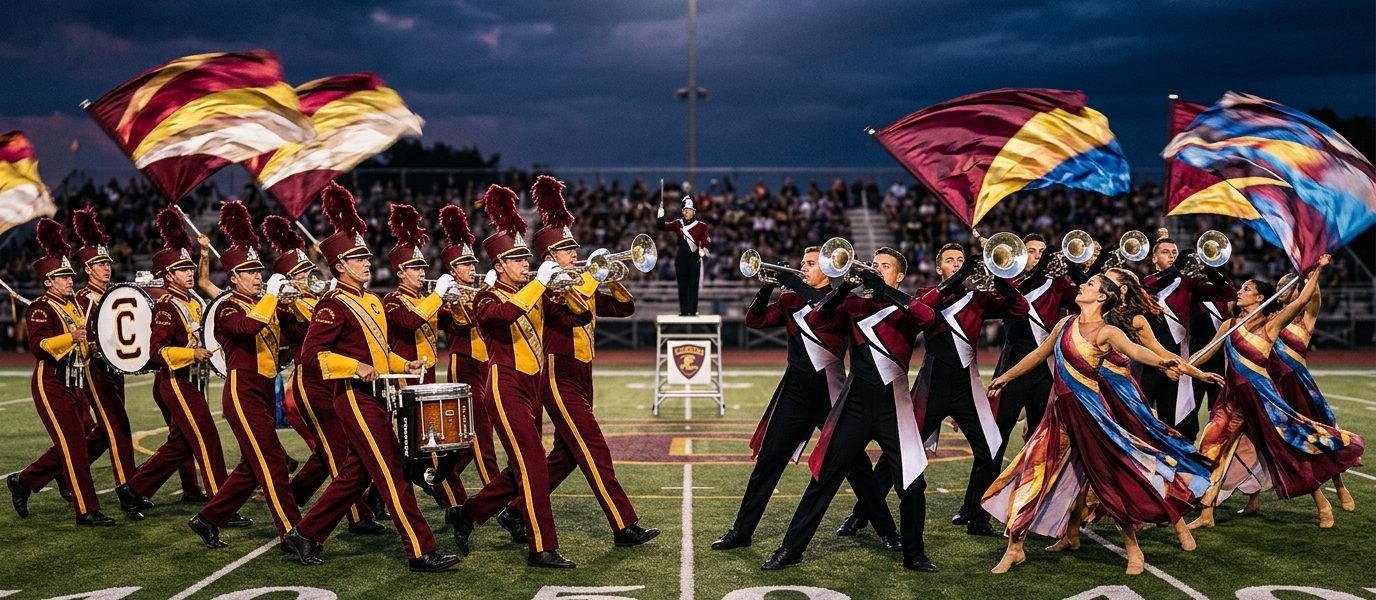
The Cadets didn’t just march. They told stories with their bodies, their formations, and their movement vocabulary in ways no one had seen before. While other corps perfected precision drill and musical excellence, the Cadets from Garfield, New Jersey, redefined what a drum corps show could be. They turned the football field into a stage and performers into actors.
The Cadets drum corps visual history centers on their transformation of competitive marching from pure precision drill to theatrical storytelling. Starting in the 1980s under George Hopkins and designer George Zingali, they introduced character-driven narratives, asymmetrical formations, and body movement vocabulary that influenced every modern corps. Their innovations created the foundation for today’s narrative-driven shows across all of DCI.
The shift from drill to drama
Before the mid-1980s, drum corps design followed predictable patterns. Corps formed geometric shapes. They hit precise coordinates. Judges rewarded clean lines and symmetrical formations.
The Cadets broke that mold completely.
George Zingali joined as visual designer in 1983 and brought theatrical training to the football field. He didn’t see marchers. He saw performers with the potential to communicate emotion and narrative through movement.
The 1983 show “The Young Person’s Guide to the Orchestra” introduced subtle character work. Members didn’t just play instruments and march. They reacted to the music. They acknowledged each other. Small gestures hinted at relationships between performers.
By 1987, the transformation was complete. “West Side Story” featured actual choreographed fights, romantic pas de deux, and gang dynamics played out through drill. Members weren’t executing coordinates. They were playing roles.
“George Zingali taught us that every step, every body position, every glance had to mean something. We weren’t just moving from point A to point B. We were telling the audience who we were and what we felt.” – Former Cadets member, 1987-1989
This approach fundamentally changed how designers thought about visual programs. The question shifted from “where do we put people?” to “what story are we telling?”
Breaking the symmetry rule
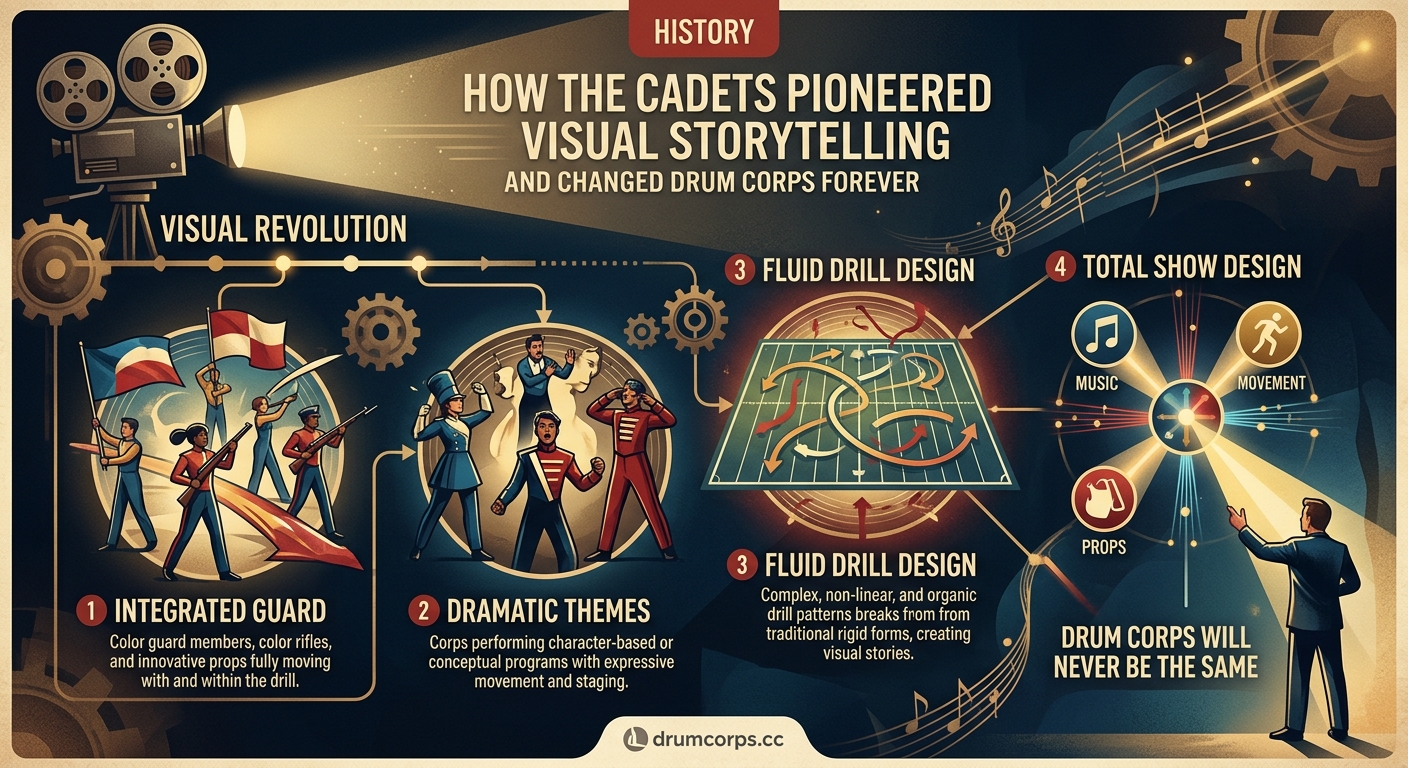
Traditional drum corps drill relied heavily on mirror symmetry. If the right side formed a diagonal, the left side mirrored it. Balanced pictures dominated the field.
The Cadets threw symmetry out the window when it didn’t serve the story.
Their 1990 show “Rhythm of the Winds” featured intentionally unbalanced formations that created visual tension. One side of the field might be densely packed while the other sat nearly empty. The asymmetry wasn’t sloppy design. It was purposeful storytelling.
This technique accomplished several goals:
- Created visual focus that directed audience attention to specific performers
- Generated emotional tension through imbalanced compositions
- Allowed different sections to represent opposing forces or ideas
- Made the field feel more dynamic and less predictable
Other corps noticed. Within five years, asymmetrical design became standard practice across DCI. The innovation that seemed radical in 1990 became foundational by 1995.
Movement vocabulary beyond marching
The Cadets introduced body movement that had nothing to do with getting from one formation to another. They borrowed from modern dance, theater, and mime to create a physical language.
Members learned to use their entire bodies as expressive instruments. Upper body movement became as choreographed as the drill itself. Hands, arms, torsos, and heads all contributed to the visual message.
The 1993 show “The Planets” showcased this evolution brilliantly. During Mars, members moved with aggressive, angular gestures. Venus brought soft, flowing arm movements. Each planet had its own physical vocabulary that matched the musical and thematic content.
This wasn’t random movement. Every gesture was taught, cleaned, and judged for execution quality just like marching technique.
The Zingali method for building movement vocabulary
- Start with the emotional core of the musical phrase
- Identify the specific feeling or idea to communicate
- Create a gesture that physically embodies that emotion
- Refine the gesture for visual clarity from 50 yards away
- Teach the movement with the same precision as marching fundamentals
- Integrate the gesture seamlessly with the drill coordinates
This systematic approach meant body movement wasn’t decorative. It was structural. It carried meaning the same way the music and drill did.
Character work and role assignment
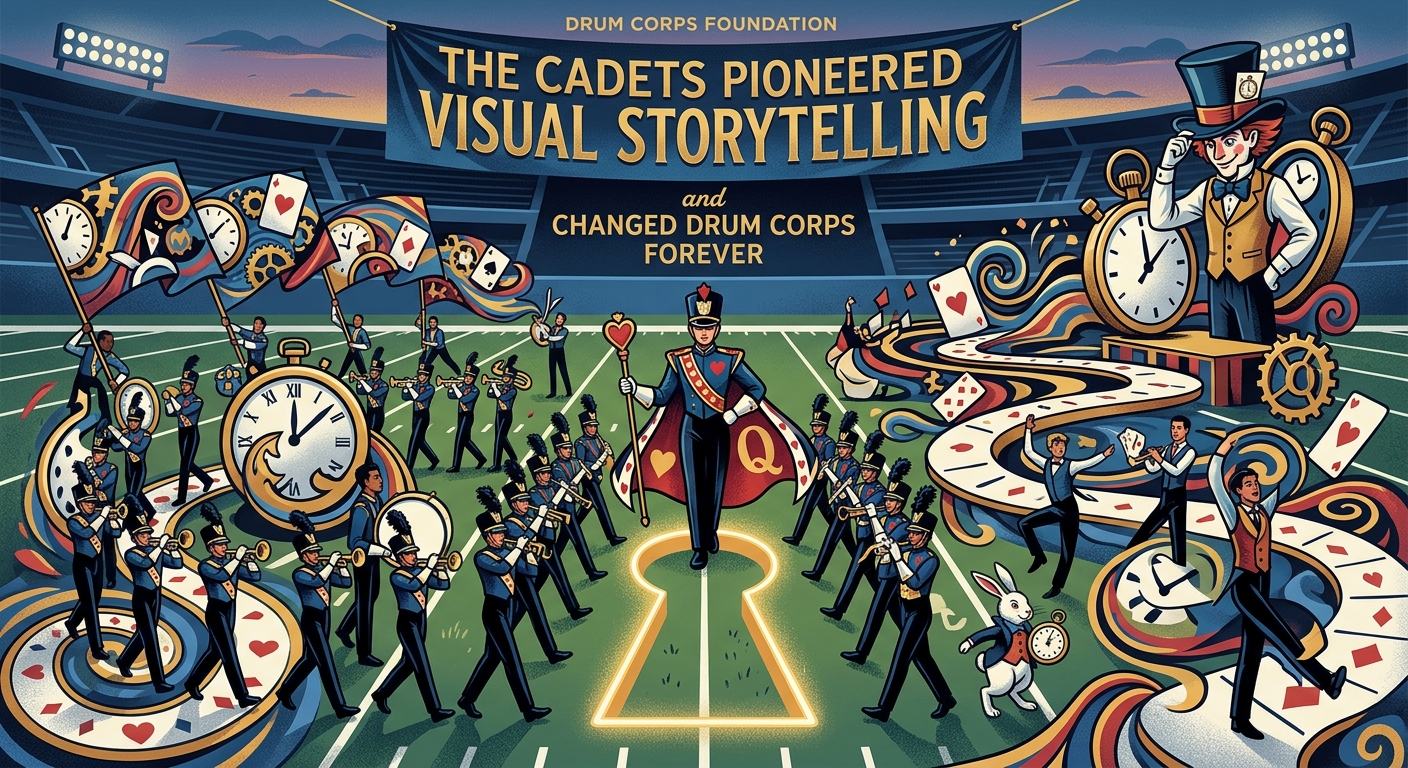
Perhaps the most radical Cadets innovation was treating corps members as characters rather than interchangeable parts.
Traditional corps design assumed every member was functionally identical. Anyone could march any spot. The drill was the star.
The Cadets assigned roles. Specific members played specific characters throughout entire shows. A soprano player might portray a protagonist. A baritone section could represent antagonists. The color guard often served as a chorus commenting on the action.
The 2000 show “Drums Along the Mohawk” took this to new heights. Members portrayed colonists, Native Americans, and British soldiers. Costume pieces helped distinguish groups. Movement vocabulary differed between factions. Interactions between characters drove the visual narrative forward.
This required a fundamental shift in how designers created drill. Instead of thinking about “the horn line” as a single unit, designers had to consider multiple groups with different motivations moving through the same space.
| Traditional drill design | Cadets character-based design |
|---|---|
| Geometric formations as primary goal | Story beats as primary goal |
| All members move identically | Different groups move with unique vocabularies |
| Symmetry creates visual balance | Asymmetry creates dramatic tension |
| Clean execution is the message | Clean execution serves the message |
| Drill coordinates drive the design | Character motivations drive the design |
The ripple effect across DCI
The Cadets’ innovations didn’t stay in New Jersey. Every major corps adopted elements of their visual storytelling approach.
How the Blue Devils revolutionized modern drum corps in the 1970s with musical sophistication, but the Cadets answered with theatrical depth. The combination of Blue Devils’ musical complexity and Cadets’ visual storytelling became the template for modern design.
By the 2000s, nearly every competitive show featured narrative elements, character work, and asymmetrical design. The Cadets had fundamentally reshaped the activity’s visual language.
Santa Clara Vanguard incorporated more theatrical staging. The Cavaliers added character-driven moments to their traditionally abstract shows. Carolina Crown built entire programs around narrative arcs.
The 2014 Bluecoats show “Tilt” represents the natural evolution of Cadets innovations. How Bluecoats 2014 ‘Tilt’ redefined modern drum corps design by taking theatrical staging and asymmetrical design to unprecedented levels, building directly on the foundation the Cadets established decades earlier.
Common mistakes when copying the Cadets approach
As corps rushed to incorporate storytelling techniques, many made critical errors that undermined their visual programs.
Mistake 1: Adding narrative without clarity
Throwing in character moments without clear storytelling confuses audiences. Every gesture needs context. Every character needs definition. The Cadets succeeded because their narratives were crystal clear, even without program notes.
Mistake 2: Sacrificing technique for theater
Body movement and character work must be executed with the same precision as traditional marching. Sloppy gestures look amateurish. The Cadets maintained world-class marching technique while adding theatrical elements.
Mistake 3: Forcing stories onto unsuitable music
Not every piece of music supports narrative interpretation. The Cadets chose repertoire that naturally suggested stories and characters. Forcing a narrative onto abstract music creates disconnect.
Mistake 4: Inconsistent character commitment
Members can’t be characters in one phrase and anonymous marchers in the next. The Cadets maintained character consistency throughout entire productions. Performers stayed in role from start to finish.
Mistake 5: Neglecting the ensemble picture
Individual character work matters, but the full-field visual composition still needs to work. The Cadets never forgot that judges and audiences see the entire field. Every storytelling moment existed within a coherent visual frame.
The Zingali legacy and beyond
George Zingali passed away in 1991, but his influence continued through designers he mentored and inspired. Michael Gaines, who worked closely with Zingali, carried the torch as visual designer through the 1990s and 2000s.
The Cadets continued pushing visual boundaries with shows like “Angels and Demons” (2005), which featured elaborate staging and prop integration alongside character work. “The Zone” (2011) used asymmetrical design to create shifting perspective and spatial illusions.
Even after organizational changes and challenges in recent years, the Cadets’ visual innovations remain embedded in drum corps DNA. Every corps that tells a story through movement owes a debt to the techniques pioneered in Garfield.
Modern designers study Cadets shows from the 1980s and 1990s the way film students study Hitchcock. The vocabulary Zingali created became the foundation for contemporary visual design.
Practical lessons for today’s designers
The Cadets drum corps visual history offers concrete lessons for anyone designing marching shows today.
- Start with emotional truth: Every visual choice should communicate something specific about the show’s emotional core
- Build movement vocabulary systematically: Don’t add random gestures. Create a consistent physical language for the entire production
- Trust asymmetry: Balanced formations aren’t always the most effective. Use visual weight to direct attention and create tension
- Assign clear roles: Even if characters aren’t literal, give different groups distinct identities and motivations
- Maintain technical standards: Theatrical elements enhance great marching, they don’t replace it
These principles work at every competitive level. High school programs can apply the same storytelling techniques the Cadets used to win DCI championships. The scale might differ, but the fundamental approach remains valid.
Understanding proper technique matters whether you’re learning how to fix your backward marching before your next competition or designing championship-level drill. Clean execution serves the story.
What the Cadets taught us about performance
The deepest lesson from Cadets drum corps visual history isn’t about specific techniques or design tricks. It’s about what performance means.
The Cadets proved that marching band could be legitimate theater. They demonstrated that young performers could handle sophisticated character work and emotional storytelling. They showed that audiences craved narrative connection, not just technical excellence.
This shifted the entire activity’s self-perception. Drum corps wasn’t just a sport or a musical ensemble. It was a performing art capable of moving audiences emotionally.
That transformation opened doors for increasingly ambitious artistic visions. Corps began collaborating with professional choreographers, theatrical designers, and narrative consultants. The standards for visual achievement rose dramatically.
Every time a corps takes the field and tells a story, they’re walking a path the Cadets cleared. Every asymmetrical formation, every character gesture, every moment of theatrical staging traces back to innovations that started in New Jersey decades ago.
The visual revolution continues
The Cadets drum corps visual history isn’t a closed chapter. It’s an ongoing influence that shapes every season of competitive marching.
New designers continue building on the foundation Zingali and the Cadets established. They push storytelling in new directions, experiment with spatial relationships, and find fresh ways to communicate emotion through movement. But they’re all working with vocabulary the Cadets created.
Watch any modern DCI finals and you’ll see the Cadets’ influence in every show. The specific stories differ. The musical styles vary. But the fundamental approach to visual design as storytelling comes directly from the innovations pioneered in those groundbreaking shows from the 1980s and 1990s.
For performers, understanding this history matters. When your designer asks you to commit to a character or execute a specific gesture, you’re participating in a tradition of theatrical excellence that transformed the activity. The work you put into selling a moment connects you to decades of performers who proved that marching band could be art.
The Cadets showed us that the football field could be a stage, that performers could be actors, and that drill could tell stories. That vision changed everything. And it continues changing how we think about marching performance today.