
Drum Corps International came within inches of collapse in the late 1990s. The organization that had defined competitive drum corps for decades was hemorrhaging money, losing corps, and facing an uncertain future. Alumni watched in horror as the activity they loved teetered on the brink of extinction.
The DCI financial crisis 1990s stemmed from poor business decisions, declining ticket sales, and mismanaged expansion. By 2000, DCI faced bankruptcy with over $1 million in debt. A complete leadership overhaul, strategic partnerships, and grassroots fundraising saved the organization. The crisis forced permanent changes to how DCI operates, including stricter financial controls and transparent governance that still guide the activity today.
What caused DCI’s near collapse
The roots of the crisis stretched back to the mid-1990s. DCI leadership made several expensive bets that didn’t pay off.
The organization invested heavily in a new headquarters facility in Addison, Illinois. The building came with significant mortgage payments that strained the budget. At the same time, DCI expanded its staff without corresponding revenue growth.
Television production costs ballooned. PBS broadcasts had been a staple of drum corps exposure, but producing those shows wasn’t cheap. DCI was spending more on production than it earned from broadcast rights.
Attendance at regional shows started declining in 1996. Families were spending less on entertainment. Gas prices climbed. The economy was shifting, and discretionary spending patterns changed.
Corps were folding at an alarming rate. Magic of Orlando ceased operations in 1998. The Glassmen struggled financially. Sky Ryders disbanded. Each corps that folded meant fewer performers, fewer fans traveling to shows, and less revenue for DCI.
The debt spiral that nearly ended everything
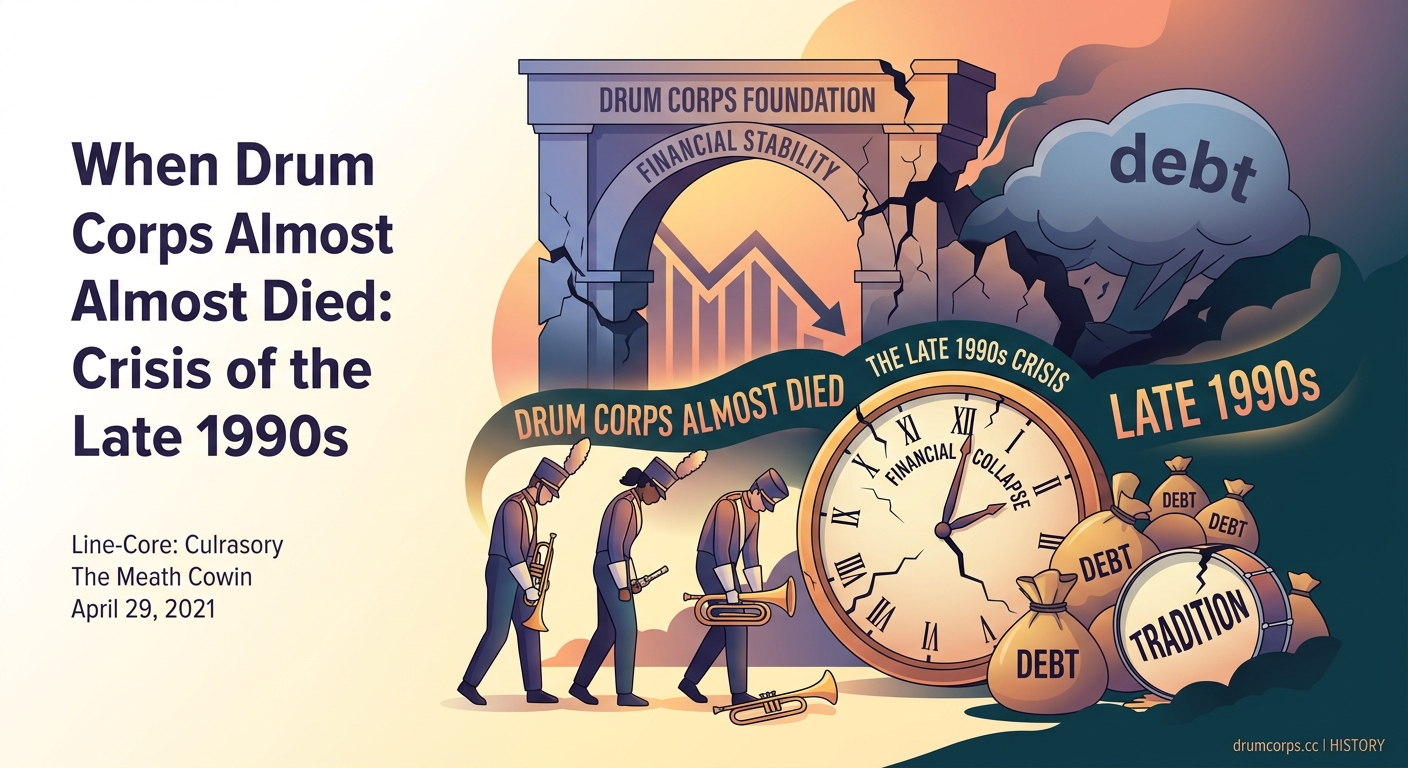
By 1999, DCI was carrying over $1 million in debt. That might not sound catastrophic for a national organization, but DCI’s annual operating budget was only around $3 million at the time.
The organization was spending $1.30 for every dollar it earned. Basic math told anyone paying attention that this couldn’t continue.
Credit lines were maxed out. Vendors weren’t getting paid on time. Corps directors started questioning whether DCI would survive to host championships that summer.
The 1999 season became a test of survival. Every show needed to sell tickets. Every sponsorship deal mattered. The staff worked without raises. Some executives deferred portions of their salaries just to keep the lights on.
“We were two bad weekends away from bankruptcy. If rain had canceled a couple of major shows, we wouldn’t have made payroll. It was that close.” – Former DCI board member, 2001 interview
The leadership crisis that made everything worse
Financial problems were only part of the story. DCI’s governance structure was broken.
The board of directors included representatives from member corps, but decision-making was slow and often contentious. Corps with different philosophies clashed over the organization’s direction.
Some wanted to reduce costs by scaling back operations. Others pushed for more aggressive marketing to grow the audience. Nobody could agree on a path forward.
The executive director position turned into a revolving door. Leadership changes happened every few years, preventing any consistent strategy. Each new director inherited problems without the organizational memory to solve them effectively.
Financial reporting was opaque. Corps directors couldn’t get clear answers about where money was going. Trust eroded between the member corps and the national office.
How DCI pulled back from the edge
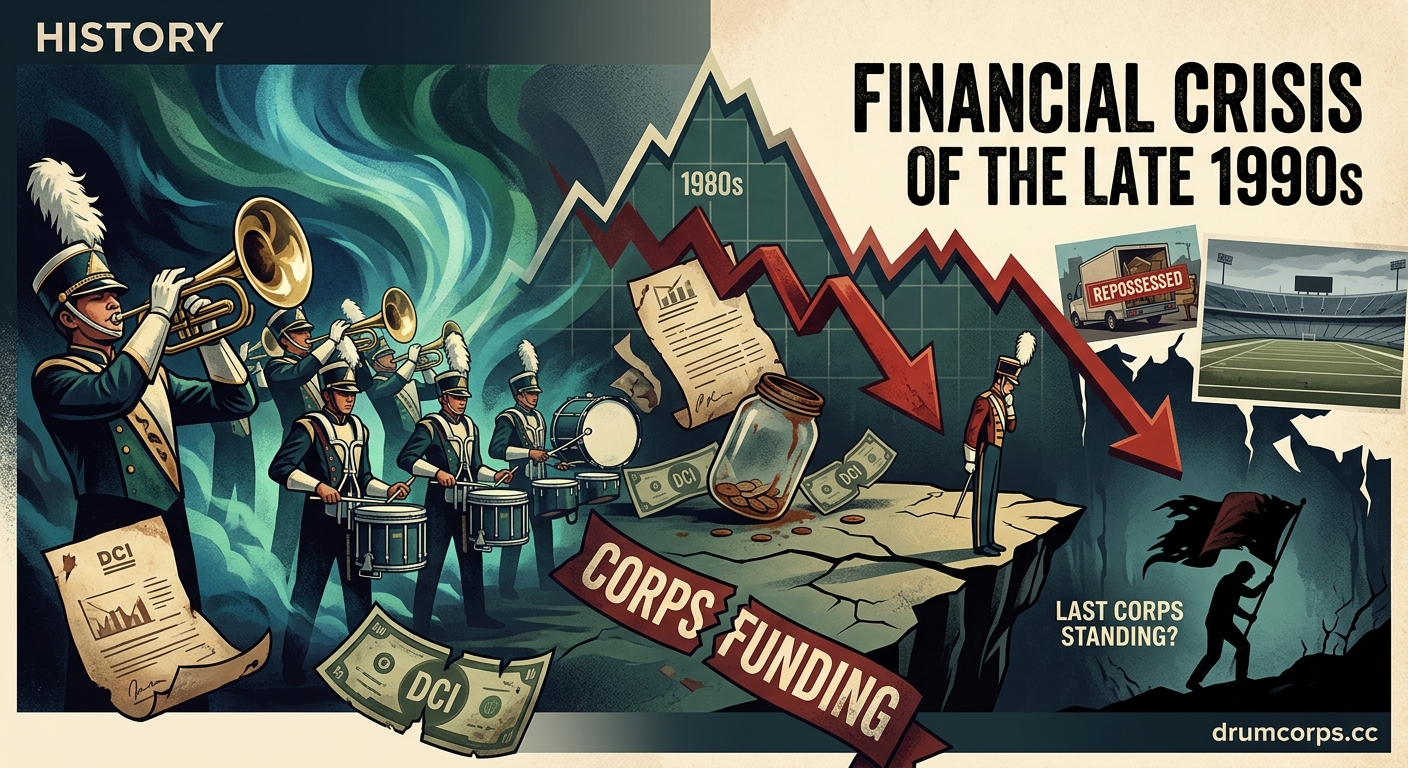
The turnaround started with a complete leadership overhaul in 2000. Dan Acheson took over as executive director with a clear mandate to fix the finances or shut down the organization.
Here’s how DCI restructured to survive:
-
Immediate cost cutting: Staff was reduced by 30%. The Addison headquarters was sold. DCI moved to a smaller, cheaper office space. Non-essential programs were eliminated.
-
Revenue diversification: DCI aggressively pursued corporate sponsorships. Partnerships with System Blue, Yamaha, and other manufacturers brought in guaranteed income. Licensing deals for video content created new revenue streams.
-
Championship restructuring: The World Championships moved to different cities each year, with host cities paying site fees. This shifted facility costs away from DCI while generating guaranteed income.
-
Transparent financial reporting: Monthly financial statements were shared with member corps. Budget decisions became collaborative rather than top-down.
-
Grassroots fundraising: Alumni networks organized to support DCI directly. Small donations from thousands of former members added up to significant help.
The changes weren’t popular with everyone. Some corps felt the new leadership was too focused on profitability. Others worried that cost-cutting would harm the competitive product.
But the alternative was bankruptcy. Everyone understood that survival had to come first.
What the activity lost during the crisis years
The financial crisis permanently changed drum corps. Some changes were necessary. Others left scars that took years to heal.
Several historically significant corps never recovered. Magic of Orlando’s closure in 1998 removed a major Florida presence. The Glassmen survived but struggled for years. Smaller corps that might have grown into powerhouse programs folded before they got the chance.
Participation dropped. Membership fees increased as corps tried to cover their own rising costs. Talented kids who might have marched chose other activities because drum corps became too expensive.
The innovation that had driven the activity forward in the 1980s and early 1990s slowed. Corps were in survival mode. Taking creative risks felt dangerous when your organization might not exist next year.
Staff turnover at both the corps and DCI level meant institutional knowledge was lost. The people who understood how things worked left for more stable careers.
Lessons that still shape DCI today
The crisis taught DCI lessons that fundamentally changed how the organization operates. These principles remain in place over two decades later.
Financial controls matter: DCI now maintains reserves equal to several months of operating expenses. The organization won’t take on debt for expansion or new programs. Every major expenditure goes through multiple approval layers.
Transparency builds trust: Financial statements are available to member corps. Major decisions involve input from directors, not just executive mandates. The secretive culture that contributed to the 1990s crisis is gone.
Diversification protects against downturns: DCI doesn’t rely on any single revenue source. Ticket sales, sponsorships, broadcasting rights, merchandise, and licensing all contribute. If one area struggles, others can compensate.
Member corps must be financially healthy: DCI now provides resources to help corps manage their own finances. The organization learned that when individual corps struggle, it hurts everyone.
| Crisis Factor | Long-term Solution | Current Status |
|---|---|---|
| Excessive debt | Zero-debt policy | Maintained since 2003 |
| Opaque finances | Quarterly reporting to members | Standard practice |
| Declining attendance | Dynamic pricing and marketing | Mixed results |
| High overhead costs | Lean staffing model | Ongoing challenge |
| Poor governance | Restructured board with term limits | Implemented 2001 |
The role of technology in recovery
The early 2000s brought technological changes that helped DCI recover. These weren’t planned solutions to the crisis, but they arrived at the perfect time.
DVD sales became a significant revenue source. Fans bought championship recordings and season highlights. The profit margins on DVD production were much better than VHS tapes had been.
The internet opened new marketing channels. DCI could reach potential fans without expensive print advertising or television commercials. Email newsletters kept alumni engaged at virtually no cost.
Online ticket sales reduced processing costs and made it easier for fans to buy seats. The convenience factor increased attendance at shows that might have otherwise struggled.
Streaming technology was still primitive in 2000, but it pointed toward future revenue possibilities. DCI began experimenting with online content that would eventually become FloMarching and other platforms.
These technological shifts didn’t save DCI by themselves. But they provided tools that made the financial turnaround possible.
Why some corps thrived while others failed
Not every organization suffered equally during the crisis years. Some corps actually grew stronger while DCI struggled.
The top-tier corps had stronger fundraising networks. Blue Devils, Cadets, and Santa Clara Vanguard had decades of alumni support. When times got tough, former members stepped up with donations and volunteer work.
Geographic location mattered. Corps in areas with strong high school band programs could recruit more easily. Access to practice facilities and local sponsors made survival easier.
Management quality separated winners from losers. Corps with professional business practices weathered the storm. Those relying on volunteer bookkeeping and informal financial tracking often failed.
Some corps made strategic decisions that paid off. Bluecoats invested in education programs that built community support. Phantom Regiment focused on maintaining performance quality even when budgets tightened. These choices built loyalty that carried them through difficult years.
The crisis accelerated a trend toward professionalization. Corps that operated like businesses survived. Those that relied on passion and tradition without sound management often didn’t.
What current members should understand
If you’re marching now, the activity you’re experiencing exists because people fought to save it. The DCI financial crisis 1990s wasn’t ancient history. It shaped everything about modern drum corps.
Your membership fees are higher partly because corps learned they can’t operate on shoestring budgets. The financial stability that lets your corps plan multi-year programs came from lessons learned during the crisis.
The competitive structure you perform in was redesigned after the crisis. Divisions, scheduling, and championship formats all changed to make the activity more financially sustainable.
DCI announces major rule changes for the 2025 competitive season with financial sustainability always in mind. The organization won’t approve changes that might destabilize corps budgets.
The emphasis on innovation you see in modern shows, like how Bluecoats 2014 ‘Tilt’ redefined modern drum corps design, only became possible after DCI stabilized financially. Creative risk-taking requires organizational security.
The ongoing challenges DCI still faces
The crisis may be over, but financial pressure never really goes away. DCI faces different challenges now than it did in 1999, but they’re still significant.
Participation costs continue rising faster than inflation. A summer of drum corps can cost $4,000 or more per member. That prices out talented kids from middle-income families.
Attendance at regional shows remains inconsistent. Some markets draw well. Others struggle to fill stadiums. The unpredictability makes budgeting difficult.
Competition from other activities intensifies every year. High school students have more options for summer programs. Drum corps competes with jobs, internships, and other performing opportunities.
The age-out rule creates constant turnover. Unlike professional sports, drum corps can’t build fan loyalty around individual performers who stick around for years. Every summer brings almost entirely new casts.
Broadcasting and streaming haven’t solved the exposure problem. FloMarching provides access, but it’s a niche product. DCI still hasn’t cracked mainstream sports media the way it hoped.
How the activity learned to do more with less
One surprising outcome of the crisis was increased creativity. Financial constraints forced innovation.
Corps learned to design shows that looked expensive without breaking budgets. Strategic use of props and staging created visual impact without requiring massive construction projects.
Uniform designs became simpler and more durable. The elaborate, frequently-changed costumes of the late 1980s gave way to more practical options that lasted multiple seasons.
Music arranging evolved to maximize the sound of smaller brass sections. Composers learned to create rich, full textures without requiring 80-member horn lines.
Rehearsal schedules became more efficient. Corps couldn’t afford endless weeks of spring training. Designers created teaching systems that prepared members faster with less time.
These adaptations didn’t just save money. They often improved the product. Leaner operations forced everyone to focus on what actually mattered for performance quality.
The human cost nobody talks about
Behind the financial statistics were real people whose lives were disrupted. This part of the story often gets overlooked.
Staff members lost jobs. People who had dedicated careers to drum corps suddenly needed new employment. Some left the activity entirely.
Students lost opportunities. Kids who had planned to march with corps that folded had to scramble for spots elsewhere or skip the summer entirely.
Alumni watched organizations they loved disappear. The emotional impact of seeing your corps cease operations is real and lasting.
Volunteers who had given decades of service saw their work seemingly wasted. When a corps folds, all those hours of dedication feel meaningless.
The stress affected families. Corps directors working without pay to keep organizations alive put strain on marriages and relationships. The crisis had ripples far beyond balance sheets.
Building something stronger from the ruins
The activity that emerged from the crisis was different but arguably healthier. The near-death experience forced changes that probably wouldn’t have happened otherwise.
DCI became a more professionally managed organization. The casual, volunteer-driven approach of earlier decades gave way to business practices that matched the scale of operations.
Corps developed stronger local support systems. The realization that DCI might not always be there pushed individual organizations to build independent stability.
The member corps relationship with DCI shifted from dependency to partnership. Corps directors gained more voice in organizational decisions. Collaboration replaced top-down mandates.
Educational programs expanded. DCI and member corps invested more in teaching and development. The activity became more focused on member experience, not just competitive results.
These changes weren’t painless. But they created a foundation that has supported growth and stability for over two decades.
Why this history matters for the future
Understanding the DCI financial crisis 1990s isn’t just about nostalgia or historical curiosity. The lessons remain relevant.
Economic downturns happen. The 2008 recession tested drum corps again. The COVID-19 pandemic in 2020 created challenges nobody anticipated. Organizations that remembered the 1990s crisis were better prepared to handle new problems.
Financial discipline prevents disasters. The habits DCI developed after the crisis kept the organization stable through subsequent challenges. Good times make it tempting to relax controls, but that’s when trouble starts brewing.
Leadership matters enormously. The right people in key positions can turn around failing organizations. The wrong leaders can destroy healthy ones. DCI learned to prioritize management competence over politics or popularity.
Community support is everything. When alumni, parents, and fans rallied to save DCI, they demonstrated that the activity meant something beyond entertainment. That emotional investment remains a crucial asset.
How the Blue Devils revolutionized modern drum corps in the 1970s by building strong organizational foundations that helped them weather later storms. Innovation matters, but so does basic business competence.
What we almost lost forever
Take a moment to consider what would have disappeared if DCI had collapsed in 2000.
No modern design innovations. No electronics. No amplification debates. The creative evolution that has defined 21st-century drum corps wouldn’t exist.
Thousands of young people would have missed transformative summers. The life lessons, friendships, and personal growth that come from drum corps participation would have gone to different activities or nowhere at all.
The cultural impact would have vanished. Drum corps influences marching band, winter guard, and other performing arts. That ripple effect would have stopped.
Economic benefits to host communities would have ended. Championships bring millions of dollars to host cities. Regional shows support local economies. All of that would have disappeared.
The artistic legacy would have been frozen. We’d remember drum corps as something that existed from the 1970s through 1990s, not as a living art form that continues evolving.
Moving forward with hard-won wisdom
The drum corps community earned its current stability through painful lessons. Nobody wants to repeat the crisis years.
Current leaders at DCI and member corps carry the responsibility of maintaining what was nearly lost. That means making unpopular decisions sometimes. It means prioritizing financial health even when it conflicts with competitive desires.
Fans and alumni can support the activity by understanding these constraints. When corps increase fees or DCI raises ticket prices, it’s not arbitrary. It reflects the real costs of operating complex organizations.
Young members should appreciate that the opportunity to march exists because people fought for it. The activity you’re experiencing was literally saved from extinction by dedicated individuals who refused to let it die.
The history of the DCI financial crisis 1990s is ultimately a story of resilience. An activity that should have collapsed found a way to survive. Organizations that were failing learned to thrive. People who had every reason to give up kept fighting.
That spirit of perseverance defines drum corps as much as any championship performance. The activity survives because people believe it’s worth saving. That belief, more than any business strategy or financial plan, is what carried DCI through its darkest period and continues to drive it forward today.