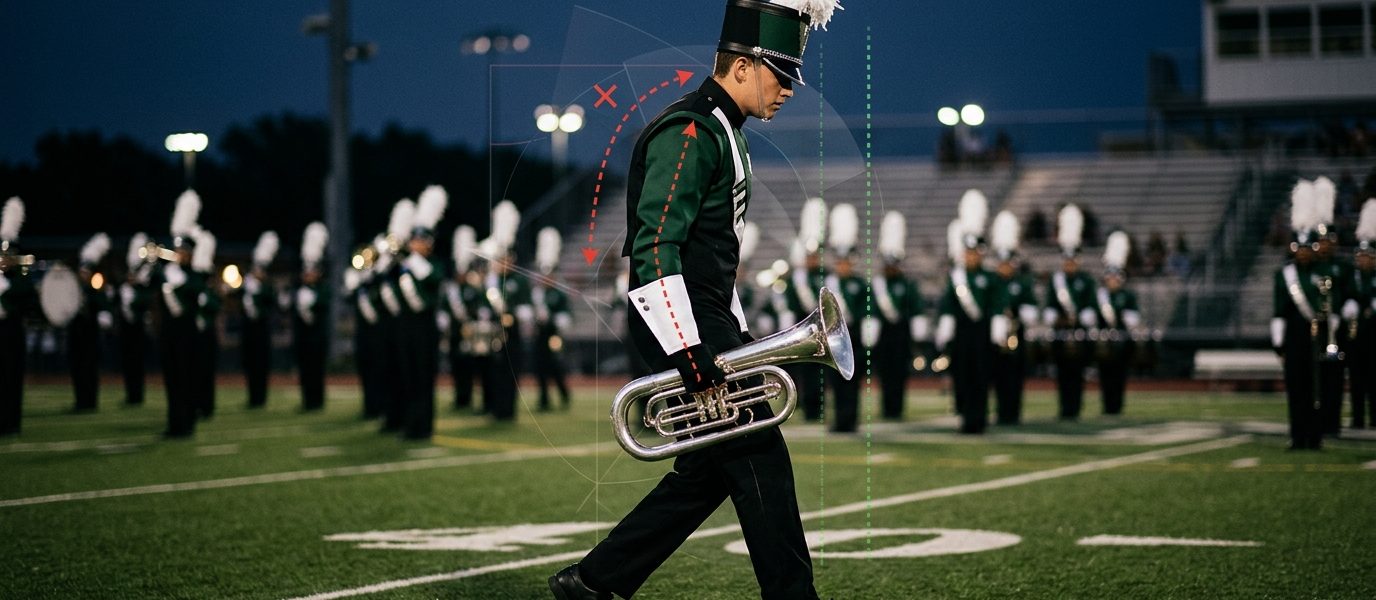
Your shoulders are tight. Your chest collapses forward. Your head drifts an inch too far past your centerline. The judges notice every millimeter, and those tiny deviations cost you tenths of a point in every run. Whether you’re sitting in the saddle or standing at the line, your upper body carriage directly impacts how judges score your technical execution and visual presentation. Most competitors focus on their lower body mechanics or their equipment, but the real breakthrough happens when you fix what’s happening from your ribcage up.
Poor upper body posture creates a cascade of technical faults that judges penalize across multiple scoring categories. Collapsed shoulders, forward head position, and locked ribcages reduce your range of motion, destabilize your core, and break the visual line that separates winning performances from middle-of-the-pack finishes. Correcting these alignment issues improves both your scores and your long-term athletic durability.
Why judges penalize posture before technique
Judges evaluate your body position before they assess your technical skills. They scan for alignment, symmetry, and carriage in the first three seconds of observation. If your shoulders roll forward or your head juts out, they’ve already noted a deduction before you execute a single maneuver.
Upper body posture affects performance because it creates visible disruption in your centerline. Equestrian judges look for a straight vertical line from ear to shoulder to hip to heel. Shooting judges evaluate how your upper body maintains stability through recoil and follow-through. Any deviation from neutral alignment telegraphs instability, and instability costs points.
The scoring rubrics in both disciplines explicitly include posture as a judged element. In dressage, rider position accounts for a significant portion of each movement’s score. In competitive shooting, upper body platform stability directly affects grouping consistency and target transition speed. You can execute perfect technique with flawed posture, but you’ll never receive perfect scores.
The three posture faults that destroy your scores
Most upper body problems fall into three categories. Each one creates specific scoring penalties.
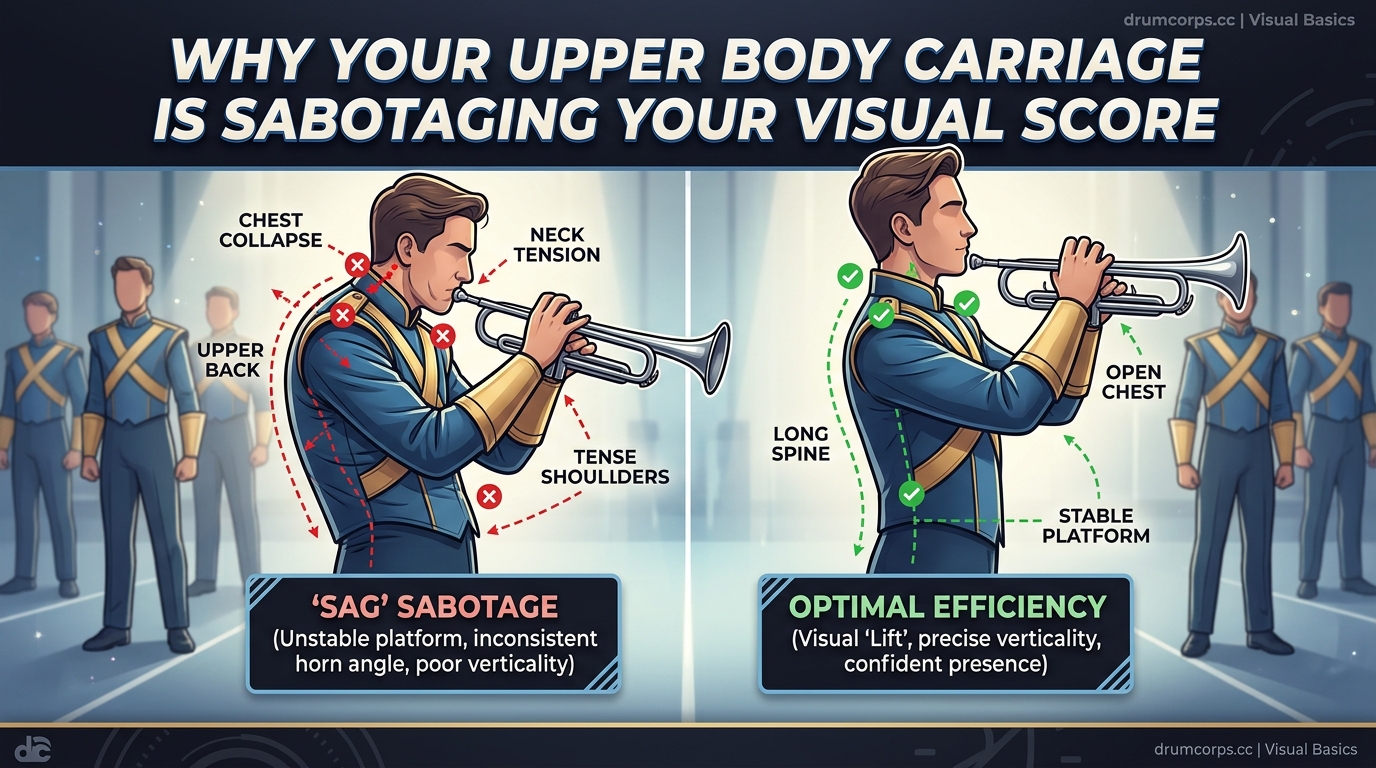
Forward head position places your skull ahead of your shoulders. This misalignment shifts your center of gravity forward and forces your lower back to compensate. Judges see this as loss of vertical alignment. It also restricts your ability to look up or track movement without additional compensation through your spine.
Rounded shoulders collapse your chest and restrict your breathing capacity. This fault appears when your shoulder blades wing away from your ribcage and your clavicles rotate downward. The visual effect is a hunched appearance that breaks the clean line judges expect. It also reduces your ability to stabilize your arms and limits your range of motion in overhead or lateral movements.
Locked ribcage happens when you hold your breath or brace your core too aggressively. Your ribs stop moving with your breath, creating a rigid upper body that can’t absorb movement or adjust to dynamic conditions. Judges perceive this as tension and stiffness, both of which lower your presentation scores.
How poor carriage creates a scoring cascade
One postural fault never exists in isolation. When your head drifts forward, your shoulders round to compensate. When your shoulders round, your ribcage locks. When your ribcage locks, your breathing becomes shallow. Shallow breathing reduces oxygen delivery to your muscles, which increases fatigue and decreases precision.
This cascade affects multiple scoring categories simultaneously. Your position score drops because your alignment is off. Your technical score drops because fatigue reduces your precision. Your presentation score drops because tension and compensation patterns make your movements look labored instead of effortless.
The compounding effect means that a single two-millimeter head position error can cost you half a point across three different judging criteria. Multiply that across a two-minute dressage test or a 60-shot match, and you’re looking at significant point loss from a problem most competitors don’t even know they have.
Building better upper body alignment in four steps
Fixing your posture requires systematic work. You can’t just pull your shoulders back and expect the change to stick. You need to retrain the neuromuscular patterns that created the problem in the first place.
-
Establish your neutral spine position while lying down. Lie on your back with your knees bent and feet flat. Let your lower back settle into a natural curve without forcing it flat or arching it excessively. Feel where your ribcage sits relative to your pelvis. This is your neutral spine reference point.
-
Transfer that position to sitting. Sit on a firm chair with your feet flat. Recreate the same spinal position you found lying down. Your ears should stack over your shoulders, your shoulders over your hips. Your ribcage should sit directly over your pelvis, not thrust forward or slumped back.
-
Add movement while maintaining alignment. Turn your head left and right without letting your chin jut forward. Raise your arms overhead without letting your ribs flare forward. Practice breathing deeply without letting your shoulders rise toward your ears. These movements teach your body to maintain neutral alignment during dynamic activity.
-
Apply the position under load. Once you can hold neutral alignment through basic movements, add your sport-specific demands. Mount your horse or assume your shooting stance while maintaining the same spinal position you practiced in the chair. The external demands will try to pull you out of alignment. Your job is to resist that pull.
This progression takes weeks, not days. Your body has spent years reinforcing the faulty patterns. You need consistent daily practice to build new ones. Even five minutes of focused alignment work before each training session will produce measurable improvement within a month.
The breathing connection most competitors miss
Your ribcage position determines your breathing efficiency. When your ribs are locked or your shoulders are rounded, your diaphragm can’t descend fully on the inhale. This restricts your lung capacity and forces you to take more frequent, shallower breaths.
Shallow breathing triggers your sympathetic nervous system, which increases muscle tension and heart rate. That tension feeds back into your posture, creating more shoulder elevation and more ribcage rigidity. You end up in a self-reinforcing loop of poor breathing and poor posture.
Breaking this loop requires conscious breath work. Inhale through your nose and feel your lower ribs expand laterally, not just forward. Your belly should rise, but your shoulders should stay down. Exhale slowly and feel your ribs return to neutral without collapsing your chest.
Practicing breathing exercises every brass player should master can translate directly to competitive sports. The same diaphragmatic control that supports sustained notes also stabilizes your core during athletic performance.
Common mistakes and their corrections
| Mistake | What It Looks Like | How to Fix It |
|---|---|---|
| Chin jutting forward | Head extends past shoulder line, especially when focusing on a target | Place one finger on your chin and gently press backward until your ears align over your shoulders |
| Shoulder elevation | Shoulders rise toward ears, creating visible tension in the neck | Inhale deeply, then exhale while consciously dropping your shoulder blades down your back |
| Chest collapse | Sternum drops toward belly button, creating a concave appearance | Imagine a string attached to your sternum pulling gently upward without arching your lower back |
| Rib flare | Lower ribs thrust forward, creating excessive arch in lower back | Exhale fully and feel your lower ribs draw back toward your spine, then maintain that position while breathing normally |
| One-sided lean | Weight shifts consistently to one side, breaking symmetry | Film yourself from behind and mark a vertical line at your centerline, then practice equalizing weight between both sides |
These corrections work best when practiced in front of a mirror. Visual feedback helps you understand what “correct” feels like, especially in the early stages when the proper position feels wrong because it’s unfamiliar.
How to integrate posture work into your training
Posture correction doesn’t require separate training sessions. You can integrate it into your existing practice routine with minimal time investment.
Start every training session with a two-minute posture check. Stand or sit in your competitive position and scan your body from head to toe. Note where you feel tension or where your alignment drifts from neutral. Make the necessary adjustments before you begin your technical work.
Between repetitions, reset your posture. Don’t just focus on the technical element you’re practicing. Check your head position, your shoulder alignment, and your ribcage placement. This constant reset prevents you from drilling faulty movement patterns.
End each session with a one-minute hold of perfect posture. Set a timer and maintain your best alignment without any other task. This focused practice builds the endurance you need to hold good posture through an entire competitive performance.
If you’re building a perfect 30-minute individual practice routine, dedicate at least five of those minutes specifically to posture work. The return on investment is higher than almost any other skill you could practice in that time.
The role of fatigue in postural breakdown
Perfect posture at the start of your run means nothing if it collapses halfway through. Fatigue is the primary driver of postural breakdown under competitive conditions.
As your muscles tire, your body defaults to compensatory patterns that feel easier in the moment but create larger problems over time. Your head drifts forward because your neck extensors are fatigued. Your shoulders round because your scapular stabilizers can’t maintain retraction. Your ribcage locks because your core is exhausted.
“The position you can hold for two minutes doesn’t matter. The position you can hold for the last thirty seconds of a maximum-effort performance is what determines your score. Train your posture under fatigue, not just when you’re fresh.” — Elite-level postural coach
Building postural endurance requires practicing your alignment when you’re already tired. Do your posture drills at the end of your training session, not just at the beginning. Hold your competitive position for progressively longer periods. Add light resistance or unstable surfaces to increase the demand on your stabilizing muscles.
This approach mirrors how backward marching before your next competition requires specific practice under realistic conditions. You can’t just assume that skills practiced fresh will transfer to fatigued performance.
Equipment and environment factors
Your equipment setup can either support or sabotage your posture. A saddle that doesn’t fit properly forces you into compensatory positions. A shooting platform that’s too high or too low requires postural adjustments that accumulate over time.
Evaluate your equipment with posture as the primary criterion. Can you maintain neutral spinal alignment while using this saddle, this rifle, this stance? If not, the equipment needs adjustment, not your body.
Environmental factors also play a role. Training in cold weather increases muscle tension, which pulls you out of optimal alignment. Training in heat causes fatigue faster, which accelerates postural breakdown. Recognize these factors and adjust your warm-up and recovery protocols accordingly.
Tracking your progress objectively
Postural improvement is hard to assess subjectively. What feels “straight” to you might still be significantly misaligned. You need objective measurement tools.
Video yourself from multiple angles at the start of your posture work. Take front, side, and back views in your competitive position. Mark key landmarks: the position of your ear relative to your shoulder, the angle of your shoulder blade, the position of your ribcage relative to your pelvis.
Repeat this documentation every two weeks. Compare the videos side by side. Look for measurable changes in alignment, not just how it feels. This objective data keeps you honest about your progress and helps you identify persistent problems that need additional attention.
You can also use scoring data as a proxy for postural improvement. If your technical execution stays consistent but your position and presentation scores improve, your posture work is paying off. Track these numbers over time and correlate them with your training focus.
When to seek professional assessment
Some postural issues require professional intervention. If you’ve worked on your alignment for six weeks without measurable improvement, consider consulting a physical therapist or sports medicine specialist who works with athletes in your discipline.
Structural issues like scoliosis, previous injuries, or joint restrictions can limit your ability to achieve neutral alignment without targeted treatment. A professional can identify these limitations and provide specific interventions that home practice can’t address.
Professional assessment is especially valuable if you experience pain during posture work. Pain is a signal that something is wrong, not a sign that you need to push harder. A qualified professional can distinguish between normal adaptation discomfort and problematic pain that requires modification of your approach.
Putting better posture to work in competition
All the practice in the world means nothing if you can’t execute under competitive pressure. Competition introduces psychological stress, physical fatigue, and environmental variables that challenge your ability to maintain good posture.
Develop a pre-performance posture routine. This is a specific sequence of movements and checks that you perform immediately before your competitive run. It might include a specific breathing pattern, a shoulder blade squeeze, and a head position reset. Practice this routine hundreds of times in training so it becomes automatic under pressure.
During competition, use transition moments to reset your posture. Between movements, between shots, between rounds. These micro-resets prevent small deviations from accumulating into major faults.
After competition, review video of your performance specifically for posture maintenance. Don’t just watch what you did technically. Watch how your alignment held up under pressure. Identify the specific moments where your posture broke down, then recreate those conditions in practice and work on maintaining alignment through them.
Making posture your competitive advantage
Most competitors ignore upper body posture until a judge explicitly tells them it’s a problem. By addressing it proactively, you gain an advantage over everyone who’s still waiting for someone else to point out their faults.
Good posture doesn’t just improve your scores. It reduces your injury risk, increases your training capacity, and extends your competitive career. The same alignment principles that help you win today protect your body for the competitions next season and the season after that.
The work isn’t glamorous. It doesn’t involve fancy equipment or complex techniques. It’s just consistent, focused attention on the fundamentals of how you hold your body in space. But those fundamentals determine whether you’re fighting for podium positions or settling for middle-of-the-pack finishes.
Start with the four-step progression outlined earlier. Add the breathing work. Integrate the posture checks into every training session. Film yourself regularly. Track your progress objectively. Give it eight weeks of consistent work, and you’ll see measurable improvement in both how you look and how you score.
Your upper body carriage is either working for you or against you. There’s no neutral position in competitive performance. Every degree of misalignment is either adding to your score or subtracting from it. The choice to fix it, and the discipline to maintain that fix under pressure, is what separates good competitors from great ones.