
Playing high notes shouldn’t feel like a battle. If your lips are throbbing after a few minutes in the upper register, you’re not alone. Most intermediate and advanced players hit a ceiling where pushing harder only leads to fatigue, swelling, and frustration. The good news? Range expansion isn’t about forcing your embouchure into submission. It’s about working smarter with air, aperture, and technique.
Expanding your trumpet range safely requires efficient air support, minimal embouchure pressure, and strategic practice habits. Focus on consistent airflow, proper aperture control, and gradual progression rather than muscling through high notes. Build endurance by practicing softly, using lip slurs, and allowing adequate recovery time. Avoid excessive mouthpiece pressure and tension that cause fatigue and limit long-term growth.
Why your embouchure gets tired in the upper register
Embouchure fatigue happens when you compensate for weak fundamentals with brute force. Many players press the mouthpiece harder against their lips, tighten their jaw, or clench their throat to reach higher pitches. These habits create temporary results but cause long-term damage.
Your embouchure muscles are small and delicate. They fatigue faster than larger muscle groups. When you rely on pressure instead of air velocity, those muscles work overtime to seal the aperture and maintain pitch. The result? Swelling, pain, and a ceiling you can’t break through.
The upper register demands faster air and a smaller, more focused aperture. But that doesn’t mean more tension. Think of it like a garden hose. Pinching the end creates a faster stream without squeezing the entire hose. Your embouchure should work the same way.
Air velocity matters more than embouchure strength
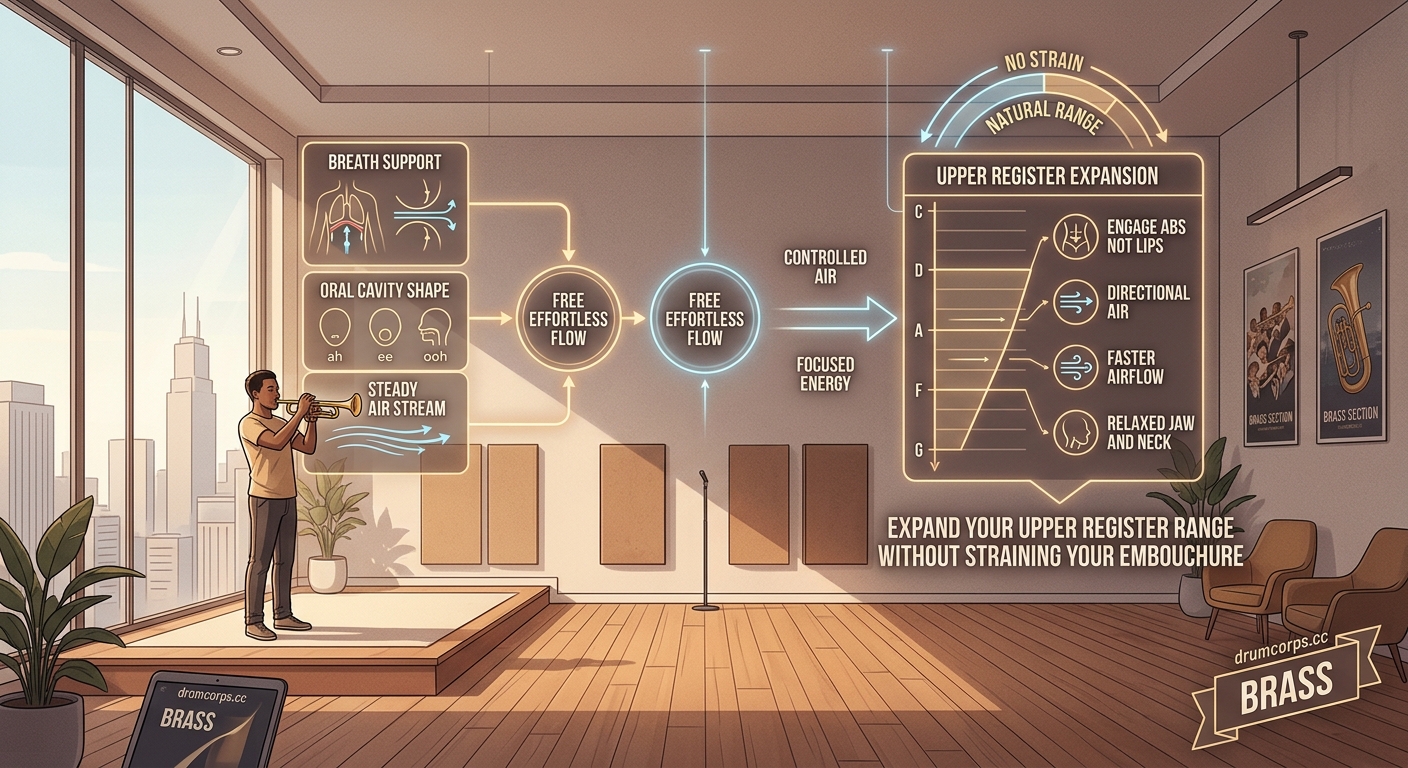
Most range problems stem from insufficient air support. Players try to compensate with tighter lips, but that’s backward. High notes need fast, concentrated air moving through a controlled opening.
Start by checking your breathing. Are you filling your lungs completely? Are you supporting from your diaphragm? Shallow chest breathing won’t cut it in the upper register. You need deep, controlled breaths that give you the fuel to sustain faster air velocity.
Try this test. Play a middle G at a comfortable volume. Now play the same note as softly as possible while maintaining pitch and tone quality. If you struggle to stay quiet, your air support needs work. Soft playing requires excellent breath control and reveals weaknesses in your foundation.
Building rock-solid breath support for high brass endurance takes time, but it’s the single most important factor in expanding range without strain.
The embouchure pressure trap
Mouthpiece pressure is a silent killer. You might not realize how hard you’re pressing until you pull the horn away and see a white ring on your lips. That pressure restricts blood flow, causes swelling, and limits your flexibility.
High notes don’t require more pressure. They require better air direction and aperture control. The mouthpiece should rest lightly on your lips, creating a seal without digging in. Your air does the heavy lifting.
Here’s a simple drill. Play a comfortable middle register note with minimal pressure. Gradually pull the mouthpiece slightly away from your lips while maintaining the same air support. The note will falter, but notice how little contact you actually need. Now apply that same light touch when approaching higher notes.
During long rehearsals or practice sessions, check in with your embouchure every few minutes. If you feel excessive pressure building, stop and reset. It’s better to take a break than to reinforce bad habits.
Three steps to safely expand your range
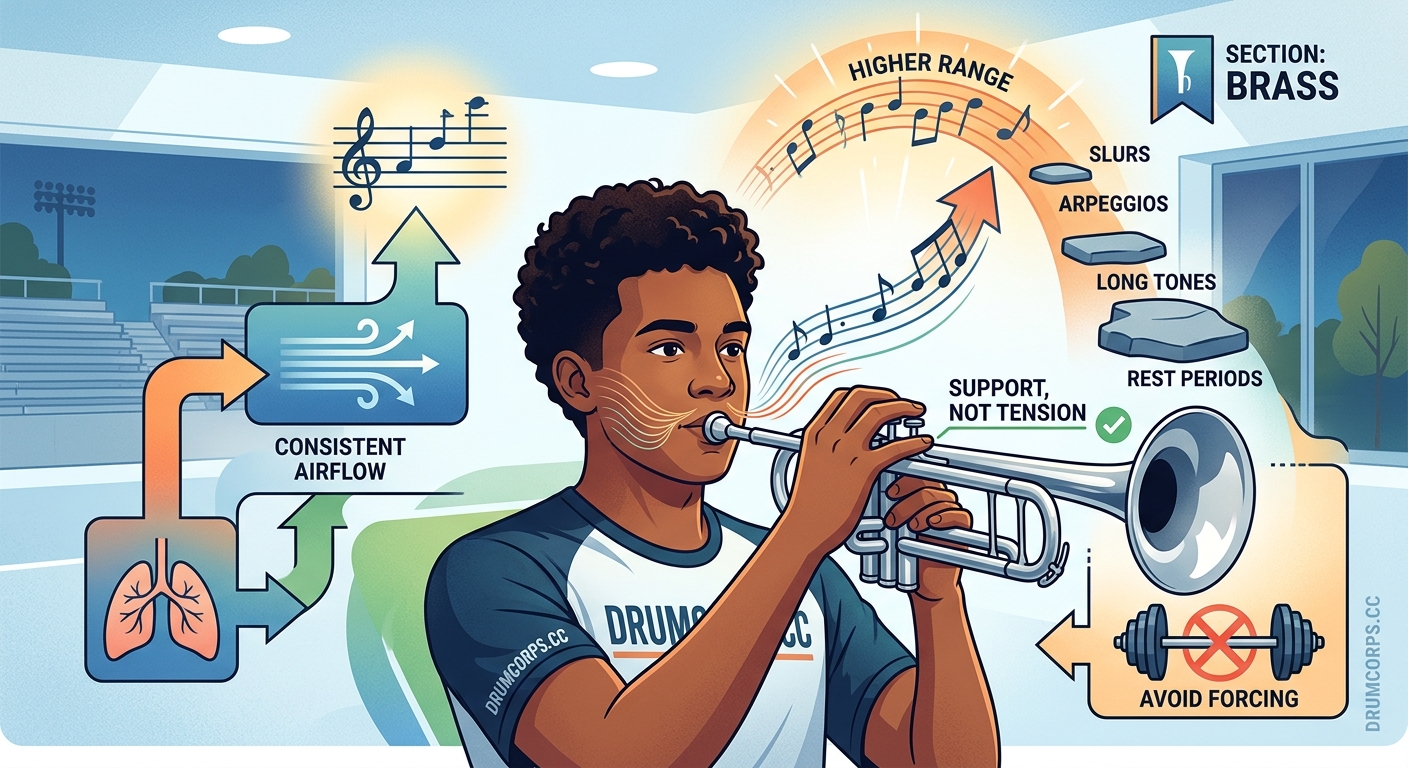
Building range is a marathon, not a sprint. Rushing the process leads to injury and frustration. Follow these steps to make steady, sustainable progress.
-
Start with lip slurs. Lip slurs build flexibility and coordination without the pressure of playing specific pitches. Begin with simple patterns in the middle register, then gradually extend upward. Focus on smooth transitions and consistent air. Don’t force anything. If a note cracks, back off and try again tomorrow.
-
Practice softly in the upper register. Loud playing masks technical flaws. When you practice high notes softly, you can’t rely on force. You have to use proper technique. Start with long tones at pianissimo. Hold each note for four to eight counts, maintaining steady pitch and tone. This builds strength and control without fatigue.
-
Limit high register work to 10 minutes per session. Your embouchure needs recovery time. Overworking the upper register leads to swelling and diminishing returns. Dedicate a small portion of your practice to range building, then move on to other fundamentals. Consistency over weeks and months beats marathon sessions that leave you exhausted.
Structuring your practice time efficiently helps you balance range work with other skills. Consider building a perfect 30-minute individual practice routine that includes targeted upper register training without overdoing it.
Common mistakes that sabotage your progress
Avoid these pitfalls if you want to make real progress without hurting yourself.
| Mistake | Why It Hurts | Better Approach |
|---|---|---|
| Playing only loud in the upper register | Reinforces tension and pressure habits | Practice high notes softly to build control |
| Skipping warm-ups | Cold muscles fatigue faster and risk injury | Always warm up thoroughly before range work |
| Practicing when already fatigued | Leads to compensation and bad technique | Stop when your embouchure feels tired |
| Using too much mouthpiece pressure | Restricts blood flow and limits flexibility | Focus on air support and light contact |
| Neglecting the middle and low register | Creates imbalance and weak foundation | Spend equal time on all registers |
The middle and low registers are just as important as the high register. They build the foundation for everything else. Don’t neglect them in pursuit of screaming high notes.
Understanding aperture control
Your aperture is the opening between your lips where air passes through. In the upper register, that opening needs to be smaller and more focused. But smaller doesn’t mean tighter.
Think about the shape of your lips. The corners should stay firm and supportive, but the center needs to stay flexible. Many players make the mistake of clamping down with their entire embouchure, which creates unnecessary tension.
Practice buzzing on the mouthpiece alone. Start with a comfortable pitch, then glide upward. Pay attention to how your lips adjust. You should feel the aperture shrinking naturally as you ascend, but your face shouldn’t feel like it’s in a vice grip.
If you’re struggling with aperture control, try this visualization. Imagine you’re saying the syllable “eee” as you ascend. This naturally raises your tongue position and helps focus the airstream without adding tension.
The role of equipment in range development
Your trumpet and mouthpiece can help or hinder your progress. A mouthpiece that’s too deep or too shallow can make the upper register unnecessarily difficult.
Most players benefit from a moderate cup depth and a rim that fits comfortably. If your current mouthpiece feels like it’s fighting you, consult with a teacher or experienced player before making changes. Switching equipment won’t fix fundamental technique problems, but the right setup can make good technique easier to execute.
Valve alignment and instrument maintenance also matter. Sticky valves or poor compression force you to work harder for every note. Keep your horn in good condition so you’re not fighting mechanical issues on top of technical ones.
Rest and recovery are part of the process
Your embouchure muscles need time to adapt and grow stronger. Overtraining leads to injury, just like it does in any athletic activity.
After a hard practice session or performance, give yourself adequate recovery time. If your lips are swollen or tender, take a day off. Pushing through pain doesn’t build character. It builds scar tissue.
Sleep, hydration, and nutrition also play a role. Your body needs resources to repair and strengthen muscle tissue. Don’t underestimate the importance of taking care of yourself outside of practice.
“The fastest way to expand your range is to practice consistently over months, not to cram in hours of high note work in a single week. Patience and smart training always win.”
Essential exercises for safe range expansion
Incorporate these exercises into your routine to build range systematically.
-
Long tones starting on second line G, ascending chromatically. Play each note for eight counts at mezzo-forte, focusing on steady air and minimal pressure. Stop when you reach your comfortable ceiling. Don’t force anything beyond that point.
-
Lip slurs using harmonic series patterns. Start on low C and slur up through the partials. Keep the air moving and the embouchure relaxed. Do three repetitions, then rest.
-
Soft attacks in the upper register. Choose a note just above your comfortable range. Attack it softly, hold for four counts, then release. Rest for eight counts. Repeat five times, then move on.
-
Descending scales from your highest comfortable note. This helps you maintain control and stability as you transition between registers.
-
Pedal tones for flexibility and blood flow. Pedal tones relax your embouchure and improve overall flexibility. Spend a few minutes on them at the end of your practice session.
Breathing exercises outside of trumpet practice can also make a significant difference. Learning essential breathing exercises every brass player should master will give you tools to improve air capacity and control.
Mental approach and patience
Range expansion is as much mental as it is physical. Fear and tension go hand in hand. If you approach high notes with anxiety, your body tenses up before you even play.
Reframe how you think about the upper register. High notes aren’t enemies to conquer. They’re just pitches that require specific technique. Remove the emotional charge and focus on the mechanics.
Celebrate small victories. If you can hold a high C comfortably for four counts this week when you could only manage two counts last week, that’s progress. Don’t compare yourself to other players. Focus on your own trajectory.
Visualization can help. Before playing a high note, imagine the air stream, the aperture shape, and the feeling of a relaxed embouchure. Mental rehearsal primes your body to execute properly.
When to seek outside help
If you’ve been working on range for months without progress, or if you’re experiencing pain that doesn’t go away with rest, consult a teacher. Sometimes an outside perspective can identify issues you can’t see yourself.
A good teacher will assess your air support, embouchure setup, and practice habits. They can provide personalized feedback and adjustments that generic advice can’t match.
Don’t wait until you’re injured to get help. Prevention is always easier than rehabilitation.
Building endurance alongside range
Range and endurance go together. You might be able to hit a high note once, but can you play it in the middle of a demanding show or rehearsal?
Endurance comes from consistent, moderate practice. Avoid the temptation to play at maximum intensity all the time. Mix in softer dynamics and easier passages. This gives your embouchure a chance to recover while still building stamina.
During drum corps season or other intensive performance periods, monitor your fatigue levels carefully. If you’re rehearsing for hours every day, you might need to scale back individual practice to avoid overtraining.
Your path forward starts with smart practice
Expanding your range without strain isn’t about finding a secret trick or magic exercise. It’s about committing to fundamentals, practicing with intention, and respecting your body’s limits.
Start with the basics: efficient air, minimal pressure, and gradual progression. Build your practice routine around these principles. Stay patient. Trust the process. Your range will grow naturally as your technique improves and your embouchure adapts. The high notes you’re chasing today will feel routine six months from now if you put in the work consistently and intelligently.