
You’re standing in the lot, minutes before your run. Your heart pounds. Your hands shake. Everyone’s watching.
The difference between nailing your show and falling apart often comes down to what happens in your head before you step on the field. Top corps members know this. They’ve learned that physical practice alone won’t cut it when the pressure hits. That’s why the best performers build mental strength the same way they build chops: with a consistent, focused routine.
A 10 minute mental toughness routine combines controlled breathing, visualization, and self-talk to build confidence and focus before high-pressure performances. Elite performers use these three components daily to train their minds like muscles, reducing anxiety and improving execution when it matters most. The routine works because it creates neural pathways that activate automatically under stress.
Why your mind needs training as much as your hands
Most performers spend hours perfecting technique. They drill fundamentals until muscle memory takes over. But when nerves strike, all that physical training can vanish.
Your brain doesn’t automatically know how to handle pressure. It needs training too.
Mental toughness isn’t about being fearless. It’s about having a system that works when your emotions try to sabotage you. The performers who look calm on finals night aren’t born different. They’ve trained their minds to respond differently.
The best part? Mental training takes far less time than you think. Ten minutes a day builds the same kind of automaticity you get from physical practice. Your brain learns patterns. It creates shortcuts. When pressure hits, those shortcuts activate without you having to think about them.
The three-part framework that builds unshakable focus
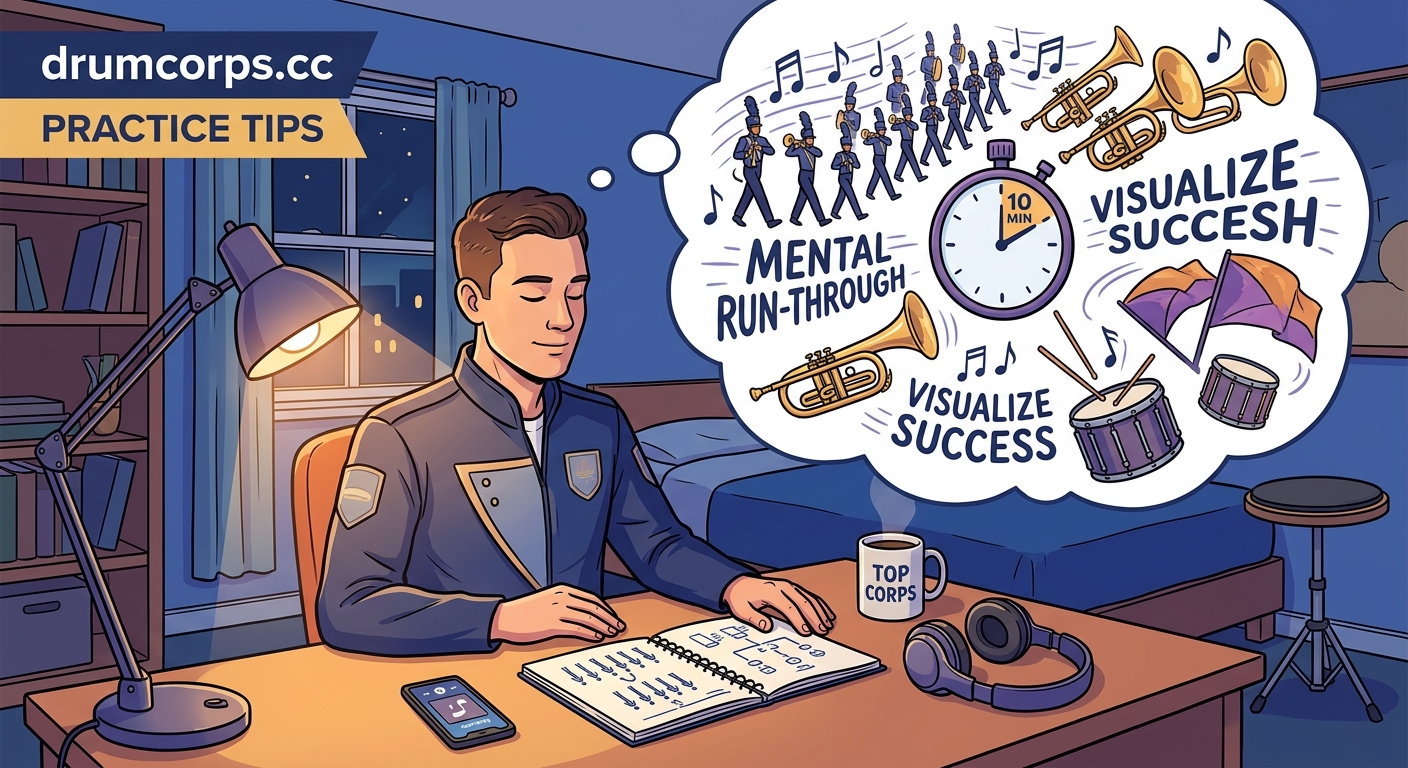
Every effective 10 minute mental toughness routine follows the same basic structure. Three components work together to prepare your mind for performance.
Centering breath work comes first. This isn’t about relaxation. It’s about control. When your heart rate spikes before a performance, your body enters fight-or-flight mode. Controlled breathing overrides that response. It signals your nervous system that you’re safe, even when everything feels chaotic.
Mental rehearsal follows breathing. This is where you see yourself succeeding. Not vaguely hoping for success, but watching yourself execute specific moments perfectly. Your brain doesn’t distinguish well between vivid imagination and real experience. When you mentally rehearse a clean entrance or a difficult phrase, you’re building the same neural pathways that physical practice creates.
Performance statements anchor the routine. These are short, powerful phrases that focus your attention on what you control. They combat the negative self-talk that creeps in under pressure. The right statement becomes a mental reset button you can press anytime doubt appears.
Building your breathing foundation in 90 seconds
Start every session with controlled breathing. This creates the mental space for everything else.
Here’s the exact pattern that works:
- Sit comfortably with your feet flat on the floor and your hands resting in your lap
- Inhale deeply through your nose for six counts, filling your belly first, then your chest
- Hold that breath for two counts
- Exhale slowly through your mouth for seven counts, emptying completely
- Repeat this cycle five times
The entire sequence takes about 90 seconds. That’s all you need to shift your nervous system out of stress mode.
The key is the exhale. Making it longer than your inhale activates your parasympathetic nervous system. This is the system that calms you down and sharpens your focus. Elite performers use this exact technique backstage, in the lot, even during water breaks.
You can layer this breathing pattern into other parts of your day too. Many brass players naturally incorporate breath control into their technical practice, building both physical and mental strength simultaneously.
Mental rehearsal that actually changes your brain
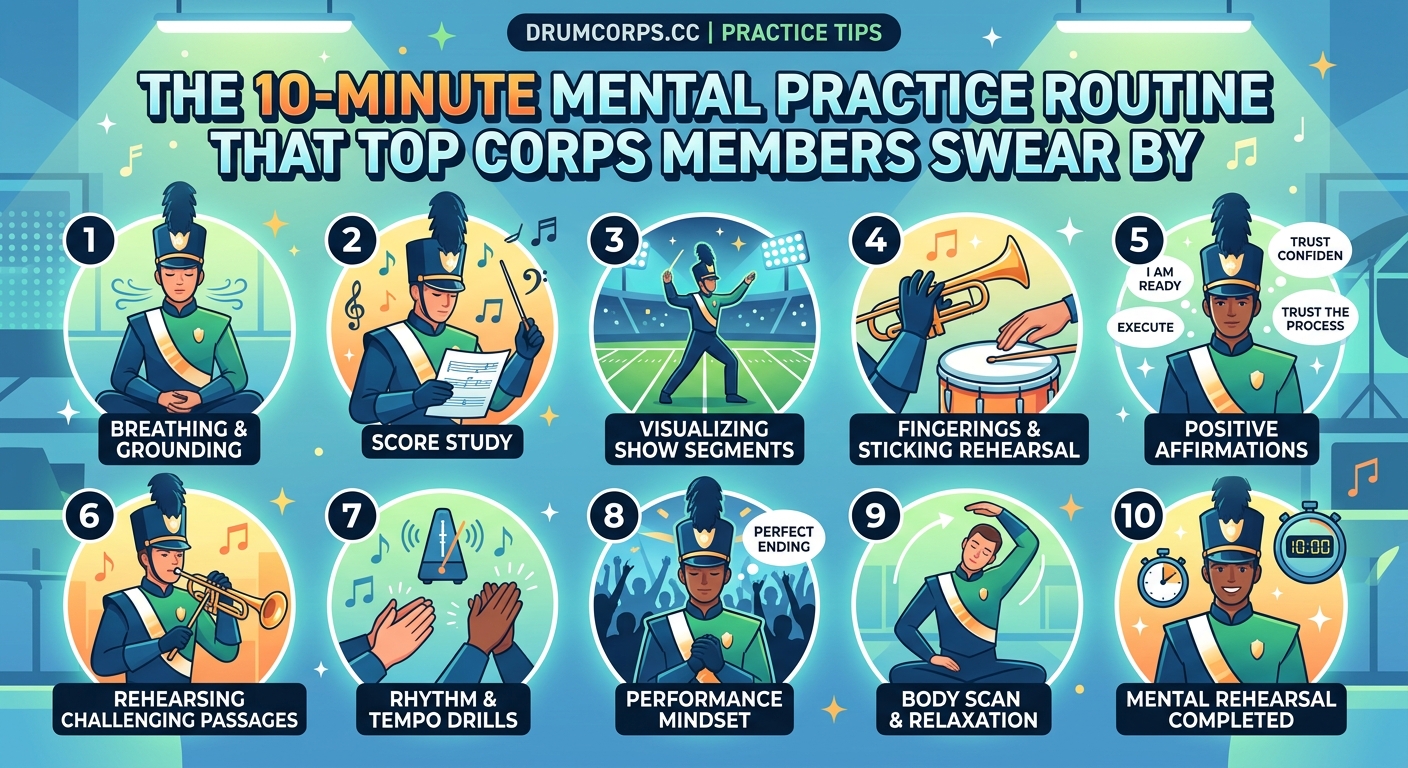
After breathing comes visualization. This is where most people get it wrong. They imagine vague success or daydream about applause. That doesn’t build mental toughness.
Effective mental rehearsal is specific and sensory. You’re not watching yourself from the outside like a movie. You’re experiencing the performance from inside your own body.
Close your eyes. See the field from your exact position. Feel the weight of your instrument. Hear the opening note of the show. Notice the temperature of the air. Smell the grass. Make it real.
Then run through your most challenging moments in detail. See yourself executing perfectly. Feel your body moving with precision. Hear yourself nailing that exposed phrase. Watch yourself recovering smoothly if something goes slightly wrong.
This takes about four minutes. Pick three specific moments from your show. Rehearse each one twice in your mind. Make every repetition perfect.
Your brain builds myelin around neural pathways you use repeatedly. Mental rehearsal triggers this same process. When you vividly imagine perfect execution, you’re literally strengthening the brain circuits you’ll use during the real performance.
Performance statements that silence doubt
The final component is your performance statement. This is a single sentence you create and repeat. It becomes your mental anchor when everything else feels unstable.
Bad performance statements are vague: “I can do this” or “Just relax.” These don’t work because they don’t give your mind anything concrete to grab onto.
Strong performance statements are specific, present tense, and action-focused. They describe what you’re doing, not what you’re trying to avoid.
Examples that work:
- “I trust my preparation and execute with confidence”
- “I stay present and focused on each phrase”
- “I perform with precision and control my breathing”
- “I commit fully to every rep and trust my training”
Pick one statement. Write it down. Say it out loud ten times at the end of your mental practice session. This takes about two minutes.
The statement works because it gives your mind clear instructions. When doubt creeps in during performance, you don’t have to figure out what to think. You already know. You repeat your statement and your brain follows the path you’ve trained.
The complete 10 minute sequence
Here’s how the full routine fits together:
| Component | Duration | Purpose |
|---|---|---|
| Centering breath work | 90 seconds | Lower heart rate and activate calm focus |
| Mental rehearsal | 4 minutes | Build neural pathways for perfect execution |
| Performance statement | 2 minutes | Create mental anchor against doubt |
| Reflection and adjustment | 3.5 minutes | Process insights and plan next session |
The reflection phase matters more than most people realize. Spend the final minutes reviewing your mental rehearsal. What felt vivid? What felt vague? Where did your mind wander?
This isn’t wasted time. You’re training your attention. Each session, you’ll notice your focus getting sharper. Your visualizations will become clearer. Your breathing will feel more natural.
Common mistakes that sabotage mental training
Even with the right framework, people mess this up. Here are the traps to avoid:
Inconsistent practice kills progress. Mental toughness builds through repetition, just like physical skills. Doing the routine once before a big show won’t help. You need daily practice, even on easy days. Especially on easy days. That’s when you build the habits that activate automatically under pressure.
Skipping the routine when you feel good is backwards. People tend to do mental training only when they’re struggling. That’s like only practicing your instrument when you’re tired. The best time to build mental strength is when you’re already performing well. That’s when your brain is most receptive to positive reinforcement.
Rushing through the steps defeats the purpose. Ten minutes feels short, but only if you actually use all ten minutes. Many people speed through breathing or skim their visualization. They check the box but don’t do the work. Slow down. Make each component deliberate. Quality matters more than speed.
Negative visualization creeps in without you noticing. If you catch yourself imagining mistakes during mental rehearsal, stop immediately. Reset with your breathing pattern. Start the visualization again. Your brain can’t tell the difference between imagining success and imagining failure. Both create neural pathways. Make sure you’re building the right ones.
“The mind doesn’t know the difference between a real experience and one that’s vividly imagined. If you mentally rehearse failure, you’re training yourself to fail. If you rehearse success with enough detail and emotion, you’re training yourself to succeed.”
Adapting the routine for different performance contexts
The basic framework stays the same, but you can adjust the details based on what you’re preparing for.
Before ensemble rehearsals, focus your mental rehearsal on listening and blending. Visualize yourself matching pitch perfectly. See yourself responding to the conductor. Hear the full ensemble sound with your part fitting exactly right.
Before individual practice sessions, rehearse specific technical challenges. If you’re working on building better breath support, visualize yourself maintaining consistent air pressure through long phrases. Feel your body supporting the sound effortlessly.
Before performances, shift your performance statement toward execution and presence. Instead of focusing on technique, focus on commitment and confidence. Your preparation is done. Now you’re activating the training you’ve already built.
Some performers integrate this routine into their broader practice structure, using mental training as a warmup before physical practice. Others prefer to separate them, doing mental work in the morning and physical practice later. Both approaches work. Find what fits your schedule and stick with it.
Tracking progress when results aren’t obvious
Mental toughness doesn’t show up on a metronome. You can’t record it or measure it with a tuner. That makes progress harder to see.
Keep a simple log. After each 10 minute session, write down three things:
- How focused did you feel during visualization? (Rate 1 to 10)
- How vivid were the mental images? (Rate 1 to 10)
- What specific moment did you rehearse most clearly?
Over two weeks, you’ll notice patterns. Your focus scores will climb. Your visualizations will get sharper. The moments you rehearse will start feeling more automatic during real performances.
Pay attention to how you feel before performances. Are you still nervous? Probably yes. But notice if the nervousness feels different. Trained performers often report that nerves shift from paralyzing fear to energizing excitement. The physical sensation is similar, but the mental response changes completely.
Watch for moments when your performance statement pops into your head automatically. That’s when you know the routine is working. Your brain has built the pathway so strongly that it activates without conscious effort.
Why ten minutes is the perfect duration
Shorter sessions don’t give your brain enough time to shift states. Longer sessions create diminishing returns. Ten minutes hits the sweet spot.
Your brain needs about 90 seconds to transition from normal alertness to focused attention. That’s why the breathing component comes first. It creates the mental state that makes visualization effective.
The four-minute visualization window is long enough to rehearse multiple scenarios with detail, but short enough to maintain intensity. If you go longer, your mind starts to wander. Quality drops. You’re just going through motions.
The two-minute statement repetition creates enough reinforcement to stick without becoming mindless. Say your statement ten times with intention, and it lands. Say it fifty times, and it becomes meaningless noise.
The remaining time for reflection keeps you honest. It forces you to notice what’s working and what isn’t. That feedback loop is what turns a routine into a system that actually builds strength over time.
Mental toughness transfers beyond performance
Here’s what nobody tells you about this routine: it doesn’t just help you perform better. It changes how you handle pressure everywhere.
The breathing pattern you practice becomes automatic in stressful conversations. The visualization skills you build help you prepare for job interviews, presentations, even difficult personal situations. The performance statements you create teach you how to talk to yourself in ways that build confidence instead of tearing it down.
Corps members who stick with this routine often notice improvements in areas that have nothing to do with marching. They sleep better. They manage conflict more calmly. They bounce back from setbacks faster.
That’s because mental toughness is a general skill. You’re not just training yourself to perform better on the field. You’re training your nervous system to handle stress more effectively everywhere.
When the routine becomes non-negotiable
You’ll know this is working when skipping a session feels wrong. Not guilty wrong. Just off, like forgetting to brush your teeth.
That’s the goal. Make this routine so automatic that it becomes part of your daily structure. Not something you do when you remember. Not something you save for important performances. Just something you do, like eating breakfast or fixing your backward marching technique.
The performers who benefit most from mental training aren’t the ones who do it perfectly. They’re the ones who do it consistently. Ten minutes a day, every day, builds more strength than an hour-long session once a week.
Start today. Set a timer for ten minutes. Do the breathing, the visualization, the statement work. Notice how you feel afterward. Then do it again tomorrow.
Your mind is trainable. Give it the right exercises, and it will get stronger. Ten minutes is all it takes.
Making mental strength stick when motivation fades
Motivation comes and goes. Discipline is what keeps you going when motivation disappears.
Build your routine around triggers that already exist in your day. Do your mental training right after you wake up, before you check your phone. Or right before your physical practice session. Or immediately after dinner. Pick a trigger that happens every day without fail, and attach your routine to it.
Don’t rely on feeling like doing it. You won’t always feel like it. Do it anyway. The sessions where you least want to practice are often the ones that build the most strength.
If you miss a day, don’t spiral. Just do the routine the next day. One missed session doesn’t erase your progress. But using one missed session as an excuse to quit does.
The mental toughness you build compounds over time. Each session adds a tiny bit of strength. After a month, you’ll notice real differences in how you handle pressure. After three months, the changes become obvious to everyone around you. After six months, you won’t recognize the performer you used to be.
Ten minutes a day. That’s the investment. The return is a mind that works for you instead of against you when everything is on the line.