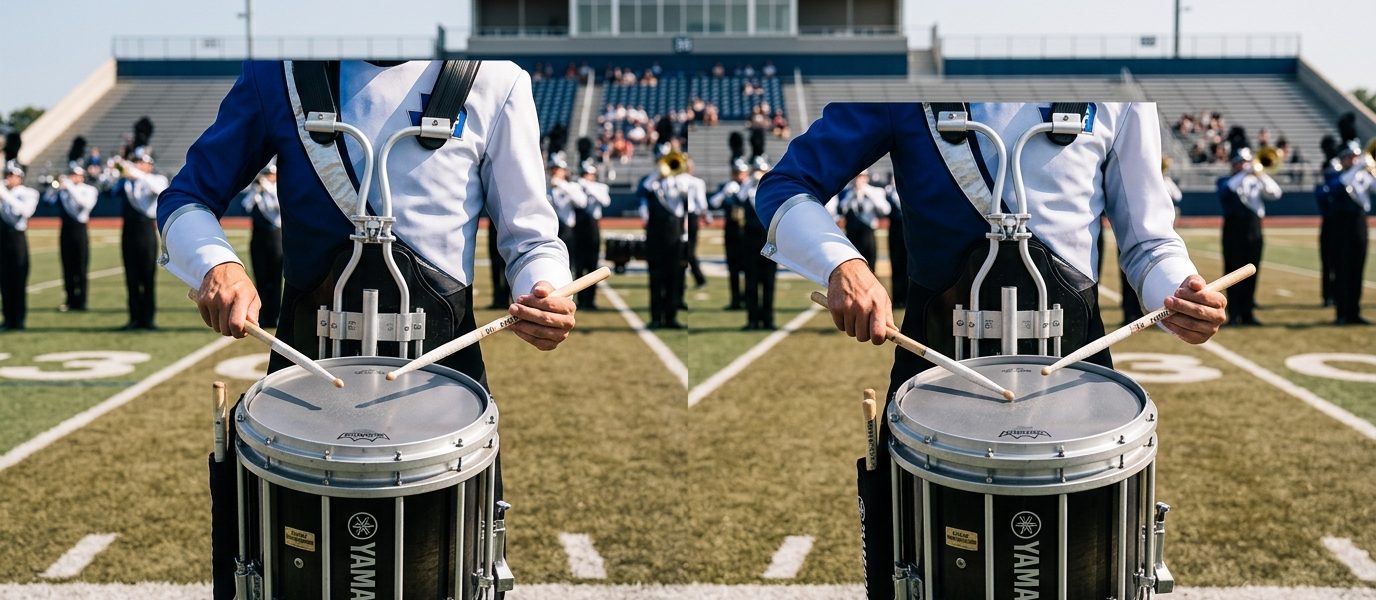
You’re standing on the lot with your snare drum carrier strapped on, watching the veterans warm up. Half the line plays with their left hand turned palm up. The other half keeps both palms down. You’re wondering which technique you should learn, and whether your choice will affect your sound, your speed, or your chances of making the line next season.
Traditional grip originated from tilted military drums and features an underhand left hand position, while matched grip uses identical overhand technique in both hands. Most modern drum corps use matched grip for power and consistency, but traditional grip remains popular in certain groups and offers unique visual style. Your choice depends on your corps requirements, personal comfort, and technical goals rather than one being universally superior.
What Makes These Two Grips Different
Traditional grip traces back to military field drumming when drums hung at an angle from a shoulder sling. Drummers needed to turn their left hand palm up to reach the drumhead comfortably. The stick rests in the webbing between thumb and index finger, supported by the ring finger underneath.
Matched grip keeps both hands in the same position. Palms face down. Both sticks are held between thumb and index finger with the remaining fingers wrapped around. It’s the grip you’ll see in most drum set playing and concert percussion.
The physical mechanics change everything about how you approach the drum. Traditional grip relies on forearm rotation for the left hand. Matched grip uses wrist motion for both hands. This affects your stroke path, rebound control, and the way you execute different rudiments.
How Traditional Grip Actually Works
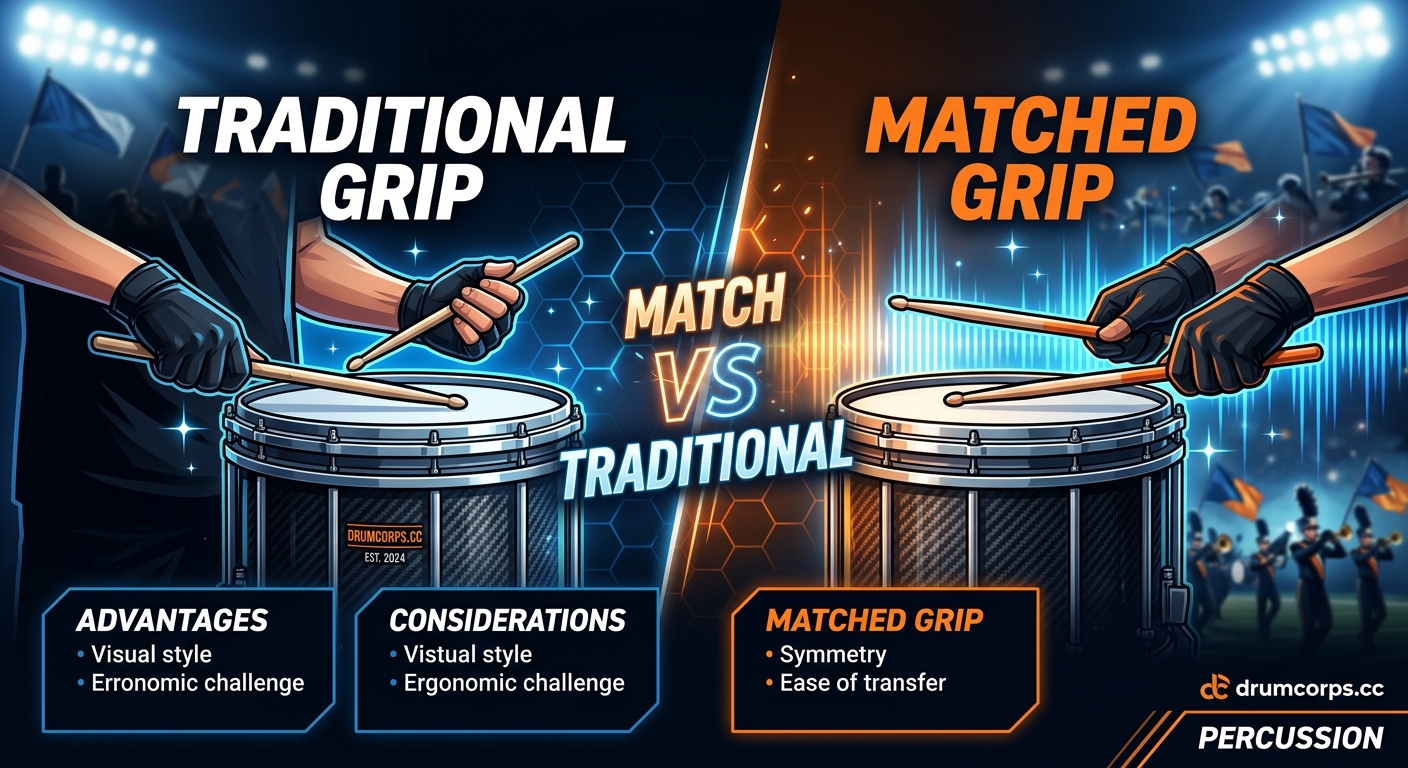
Your left hand does most of the heavy lifting here. The stick sits in that webbing space, cradled by your ring finger from below. Your thumb rests on top of the stick, about an inch or two from where it contacts your hand.
The motion comes from rotating your forearm. Think about turning a doorknob. Your wrist stays relatively flat. The stick pivots around that contact point in your hand.
Your right hand in traditional grip uses a standard overhand technique. It looks almost identical to matched grip. This creates an asymmetrical approach that takes time to balance.
Here’s what happens when you’re learning traditional grip:
- Position the stick in your left hand webbing with the bead pointing away from you
- Curl your ring finger under the stick to create a fulcrum point
- Rest your thumb on top, keeping gentle pressure without squeezing
- Rotate your forearm to lift the stick, keeping your wrist relatively flat
- Let the stick rebound naturally off the drumhead back to your starting position
The learning curve is steeper than matched grip. Your left hand needs to develop independent muscle memory that feels completely foreign at first.
Why Matched Grip Became the Standard
Most top corps switched to matched grip in the 1980s and 1990s. The reasons were practical, not just aesthetic.
Matched grip generates more power with less effort. When you’re playing a show that demands constant fortissimo passages, symmetrical mechanics help you maintain consistency. Both hands work the same way. You’re not compensating for different stroke paths.
The technique transfers directly to other percussion instruments. If you learn matched grip on snare, you’re already set up for tenors, bass drum, and timpani. Traditional grip requires adjustment when you switch instruments.
Injury prevention plays a role too. Matched grip distributes stress more evenly across both arms. Traditional grip can create imbalances if your technique isn’t solid, especially during long rehearsal blocks.
“The switch to matched grip wasn’t about abandoning tradition. It was about giving our drummers the best tool for the demands of modern drum corps arranging. When you’re playing at 200+ beats per minute for eleven minutes straight, efficiency matters.” – Caption head from a top twelve corps
The Case for Sticking With Traditional
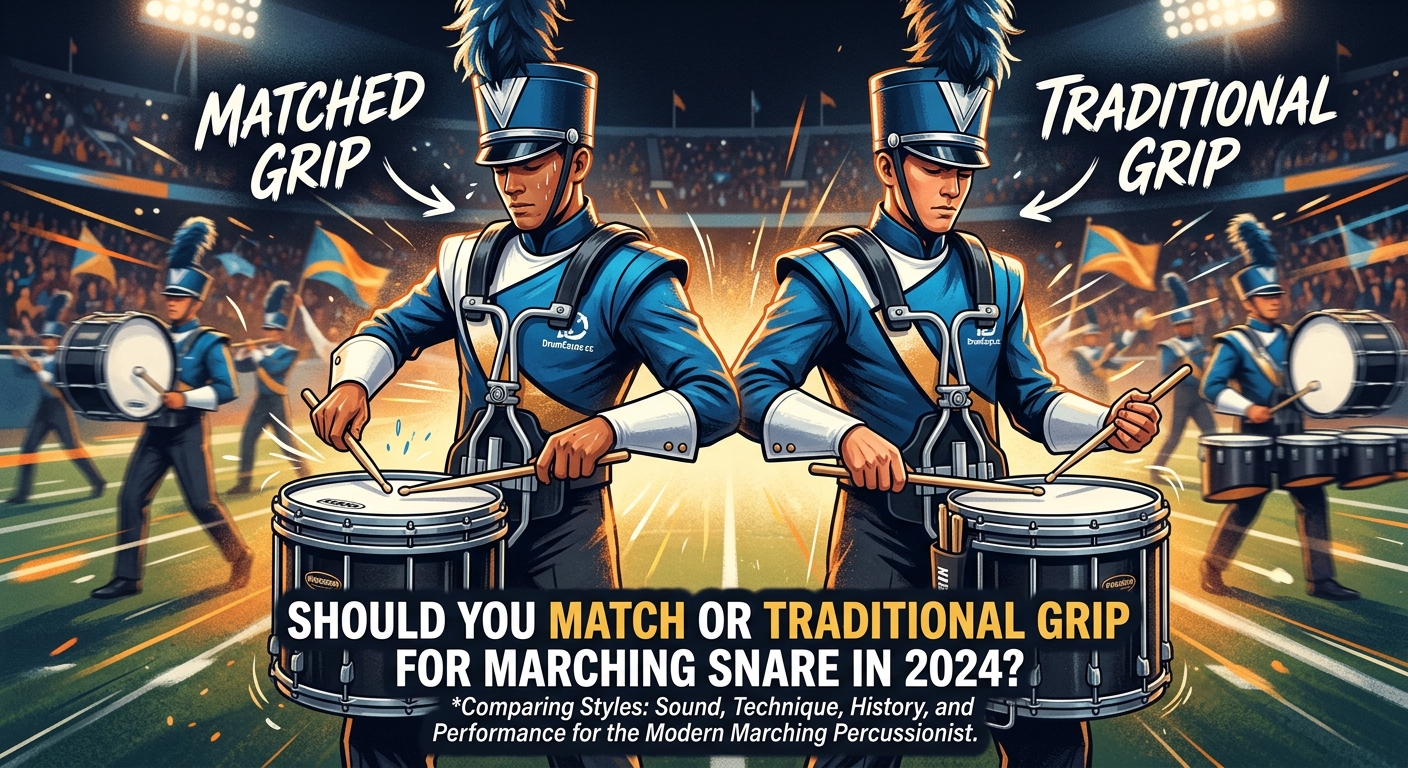
Some corps never made the switch. Traditional grip remains the standard in certain organizations, particularly those with strong ties to military drumming heritage.
Visual impact matters on the field. Traditional grip creates a distinctive look that sets a drumline apart. The asymmetrical hand positions add visual interest during standstill features. Judges don’t score you higher for it, but it contributes to your corps’ identity.
The technique forces you to develop exceptional control. Because your left hand works differently, you can’t rely on pure strength. You learn to use finesse, rebound, and timing. Many instructors believe this makes you a more musical player overall.
Traditional grip also excels at certain articulations. Soft, nuanced playing often feels more natural with the underhand left hand position. You have more direct control over stick height and rebound when playing at lower dynamic levels.
Breaking Down the Technical Differences
| Aspect | Traditional Grip | Matched Grip |
|---|---|---|
| Left hand position | Palm up, underhand | Palm down, overhand |
| Primary motion | Forearm rotation | Wrist snap |
| Power generation | Moderate, requires technique | High, uses larger muscle groups |
| Learning curve | Steep, 6-12 months for comfort | Moderate, 2-4 months for basics |
| Injury risk | Higher if technique is poor | Lower with proper form |
| Visual aesthetic | Distinctive, asymmetrical | Clean, symmetrical |
| Rudiment execution | Requires adaptation | Direct, symmetrical |
| Cross-instrument transfer | Limited | Excellent |
The stroke mechanics create the biggest practical difference. With traditional grip, your left hand paradiddles feel completely different from your right hand. You’re coordinating two different motor patterns.
Matched grip lets you mirror everything. Once your right hand learns a rudiment, your left hand follows the same path. This speeds up your learning process significantly.
What Your Corps Requires

Before you invest months learning either technique, check what your target corps uses. This matters more than personal preference.
Most DCI corps use matched grip. If you’re auditioning for Blue Devils, Bluecoats, Carolina Crown, or similar groups, matched grip is non-negotiable. Learning traditional grip won’t help your audition. In fact, it might slow down your progress on the specific exercises they teach.
Some corps maintain traditional grip as part of their identity. Certain independent groups and military-style organizations expect it. Do your research before audition season.
Your high school band might have its own requirements. Many directors let students choose. Others mandate one technique for visual consistency across the line.
If you’re undecided about where you’ll march, matched grip gives you more flexibility. You can always learn traditional grip later if needed. Going the other direction takes more time because you’re essentially starting from scratch.
Common Mistakes in Both Techniques
Traditional grip fails usually happen in the left hand. New players squeeze the stick too hard. They try to control everything with their fingers instead of letting the forearm do the work.
Your left hand should feel relaxed. The stick should almost float in that webbing space. When you tense up, you kill the rebound and create a choked sound.
Another mistake is dropping your left elbow too low. This collapses your forearm angle and makes rotation nearly impossible. Keep your elbow at a comfortable height that allows free movement.
Matched grip players often develop death grips on both sticks. You’re trying to muscle every stroke instead of using rebound. This creates tension that travels up your forearms into your shoulders.
Your fulcrum point matters in matched grip too. If you choke up too far on the stick, you lose leverage. Too far back, and you can’t control the bead. Find the balance point where the stick naturally wants to bounce.
Hand height inconsistency plagues both techniques. Your stick heights should match between hands. Set up a mirror or record yourself during practice to catch these issues early.
Building Your Practice Routine
Start with single strokes. This is true for both grips. You need to establish clean, even strokes before you tackle anything complex.
Set a metronome to 60 BPM. Play one stroke per click. Focus entirely on matching your sound quality between hands. Record yourself. Listen back. The difference between your hands will be obvious at first.
Here’s your first month practice sequence:
- Week 1: Singles at 60-80 BPM, 10 minutes daily
- Week 2: Add doubles, same tempo range, 15 minutes daily
- Week 3: Paradiddles at 60-70 BPM, 20 minutes daily
- Week 4: Combine all three patterns, gradually increase tempo
Don’t rush the tempo increases. Your technique needs time to solidify at each speed. Adding 5 BPM per week is plenty.
Use a practice pad that matches your drum’s rebound characteristics. Some pads are too bouncy. Others are too dead. You want something that responds like your actual marching snare.
The Sound Quality Question
This is where opinions get heated. Some players insist traditional grip produces a warmer, more nuanced tone. Others claim matched grip delivers superior clarity and projection.
The truth is less dramatic. Your sound quality depends far more on your stick height, timing, and striking zone than your grip choice.
A player with excellent traditional grip technique sounds better than a sloppy matched grip player. The reverse is equally true. The grip itself doesn’t magically improve or diminish your tone.
What does change is your ability to maintain consistency across different dynamic levels. Matched grip often makes it easier to play at maximum volume without sacrificing control. Traditional grip can offer more subtle control at softer dynamics.
For marching applications where you’re often playing at forte or louder, matched grip’s power advantage becomes relevant. In indoor settings with more dynamic range, traditional grip’s control benefits matter more.
Making Your Decision
If your target corps uses matched grip, learn matched grip. This is the simplest decision tree.
If you have a choice, consider your physical comfort. Some players find traditional grip feels natural within weeks. Others struggle for months and never quite click with it.
Your existing skills matter too. If you already play drum set with matched grip, sticking with that technique for marching makes sense. You’re building on established motor patterns.
Time commitment is real. Traditional grip takes longer to reach performance level. If you’re picking up snare six months before auditions, matched grip gets you ready faster.
Think about your long-term goals. Planning to march multiple instruments? Matched grip transfers better to tenors and bass. Focused exclusively on snare? Traditional grip remains a valid artistic choice.
Some players learn both. This takes dedication but opens every door. You can audition anywhere and adapt to any corps’ requirements. Just don’t try learning both simultaneously. Master one first, then add the other.
What Happens After You Choose
Your first few months will feel awkward regardless of which grip you pick. This is normal. You’re building new neural pathways and muscle memory.
Expect your hands to feel different from each other for a while. Even in matched grip, your dominant hand will be stronger initially. Traditional grip amplifies this because the techniques are fundamentally different.
Work with an instructor who knows your chosen technique inside out. Video lessons help, but nothing replaces in-person feedback. Small adjustments to your fulcrum point or stroke path make huge differences.
Join a drumline as soon as possible. Playing with others accelerates your progress. You hear how your sound blends with the section. You learn to match articulation and timing in real musical contexts.
Stay patient with the process. Most players need a full season before their grip feels truly comfortable. By your second season, it becomes automatic. You stop thinking about mechanics and start focusing on musicality.
Consider how building a perfect 30-minute individual practice routine can accelerate your progress with either grip technique.
When to Consider Switching
Sometimes you pick a grip and realize months later it’s not working. This happens. The question is whether to push through or start over.
Physical pain is a red flag. Some discomfort during the learning phase is normal. Sharp pain, numbness, or persistent soreness means something’s wrong with your technique. Get help before you develop a real injury.
Lack of progress after six months suggests a technique problem. You should see steady improvement even if it’s slow. If you’re stuck at the same level with no advancement, your fundamentals might be off.
Corps requirements change too. Maybe you learned traditional grip but decided to audition for a corps that uses matched. Making the switch is easier than you think if your traditional grip technique is solid. The underlying concepts of stick control transfer.
Don’t switch grips on a whim. Give your chosen technique at least three months of consistent practice. Most players hit a plateau around week six. This is when your brain is reorganizing motor patterns. Push through it.
Your Grip and Musical Expression
Here’s what matters more than your grip choice: your ability to play musically.
Judges don’t score traditional grip higher than matched grip. They score clean articulation, consistent timing, and musical phrasing. Your grip is just the tool you use to achieve those goals.
Focus on making every note count. Match your attacks with the rest of your section. Shape phrases with dynamics and timing. These skills matter infinitely more than whether your left palm faces up or down.
The best drummers in any corps can make music with either grip. They’ve mastered their chosen technique to the point where it’s invisible. The grip serves the music instead of limiting it.
Your practice time should reflect this priority. Spend 20% of your time on grip mechanics and stroke technique. Spend 80% on timing, dynamics, and musical execution. This ratio produces better players than obsessing over perfect form.
Learning to eliminate rim clicks and achieve clean snare articulation matters regardless of which grip you choose.
Equipment Considerations
Your stick choice interacts with your grip more than you might expect. Traditional grip players often prefer slightly different stick weights and balance points than matched grip players.
The fulcrum point changes how a stick feels. Traditional grip players typically want a stick with the balance point slightly forward. This helps with the underhand rotation motion. Matched grip players can use a wider range of balance points.
Stick length matters too. Longer sticks give you more leverage but require more control. Shorter sticks are easier to manage but limit your dynamic range. Most marching snare players use 16.5 to 17 inch sticks regardless of grip.
Your drum’s tuning and head choice affect both grips equally. A well-tuned drum with appropriate heads responds better to any technique. Don’t blame your grip if your drum sounds bad because of equipment issues.
Check out the best drumsticks for marching snare to find options that work with your chosen technique.
Real Talk About the Learning Timeline
You won’t master either grip in a month. Accept this now and save yourself frustration.
Month one: Your grip feels weird and your hands don’t match. You’re thinking about every single stroke. This is fine.
Month three: Basic rudiments start to flow. You can play simple exercises without constant mental focus. Your sound is improving.
Month six: You’re comfortable with standard rudiments. Your technique holds up under moderate tempo pressure. You sound like a real snare drummer.
Month twelve: Your grip is automatic. You’re focusing on musical expression instead of mechanics. You can handle most of what corps arrange for snare.
These timelines assume consistent daily practice. Sporadic practice extends everything. Thirty minutes daily beats two hours on Saturday.
Your progress won’t be linear. Some weeks you’ll improve dramatically. Other weeks you’ll feel like you’re getting worse. This is how motor learning works. Trust the process.
Why This Choice Matters Less Than You Think
Here’s the secret that experienced players know: your grip choice is one small piece of your overall development as a percussionist.
Your timing matters more. Your ability to blend with your section matters more. Your work ethic, your attitude, and your musical understanding all matter more than whether you play traditional or matched grip.
Corps take players with solid matched grip technique. They also take players with solid traditional grip technique. What they don’t take is players with weak fundamentals regardless of grip.
Put your energy into becoming an excellent snare drummer. Master your chosen technique. Learn to play musically. Show up to every rehearsal ready to work. These factors determine your success far more than your grip choice.
The grip debate generates endless online arguments. Ignore most of it. Pick the technique that works for your situation and commit to mastering it completely.
Your Next Steps on the Drumline
You’ve got the information. Now make your choice and start practicing.
Find an instructor who can guide your technique development. Join a local drumline or indoor percussion group. Get your hands on a quality practice pad and metronome. Set up a consistent practice schedule.
Give yourself permission to struggle at first. Every great snare drummer went through the same awkward learning phase you’re about to experience. The difference between players who make top corps and those who don’t isn’t talent. It’s persistence through the uncomfortable learning period.
Your grip choice doesn’t define you as a drummer. Your dedication to improvement does. Whether you’re rotating that left forearm in traditional grip or snapping both wrists in matched grip, you’re learning to make music on one of the most demanding instruments in the marching arts. That’s what counts.