You’ve been marching for months, maybe even years. You know the basics inside and out. Your posture is decent, your timing is solid, and you can hit your dots. But lately, something feels off. You’re not getting worse, but you’re not getting better either. That frustrating flatline in progress is what we call a marching band technique plateau, and it happens to nearly everyone at some point in their marching career.
A marching band technique plateau occurs when your skills stagnate despite consistent practice. Breaking through requires targeted video analysis, focused weakness training, varied practice methods, expert feedback, and strategic rest. Progress resumes when you identify specific problems, adjust your approach, and rebuild fundamental habits with fresh perspective and renewed intention.
Understanding why plateaus happen in the first place
Plateaus aren’t a sign of failure. They’re actually evidence that your body and brain have mastered one level of skill and need new challenges to progress further.
When you first learned to march, everything was new. Your nervous system was building fresh neural pathways. Every rep taught you something.
Now those pathways are established. Your muscle memory can execute the basics on autopilot. That’s great for consistency, but it also means you’re no longer forcing your body to adapt and grow.
Your brain has optimized for what you already know. To improve, you need to disrupt that comfort zone with intention.
Record yourself marching from multiple angles
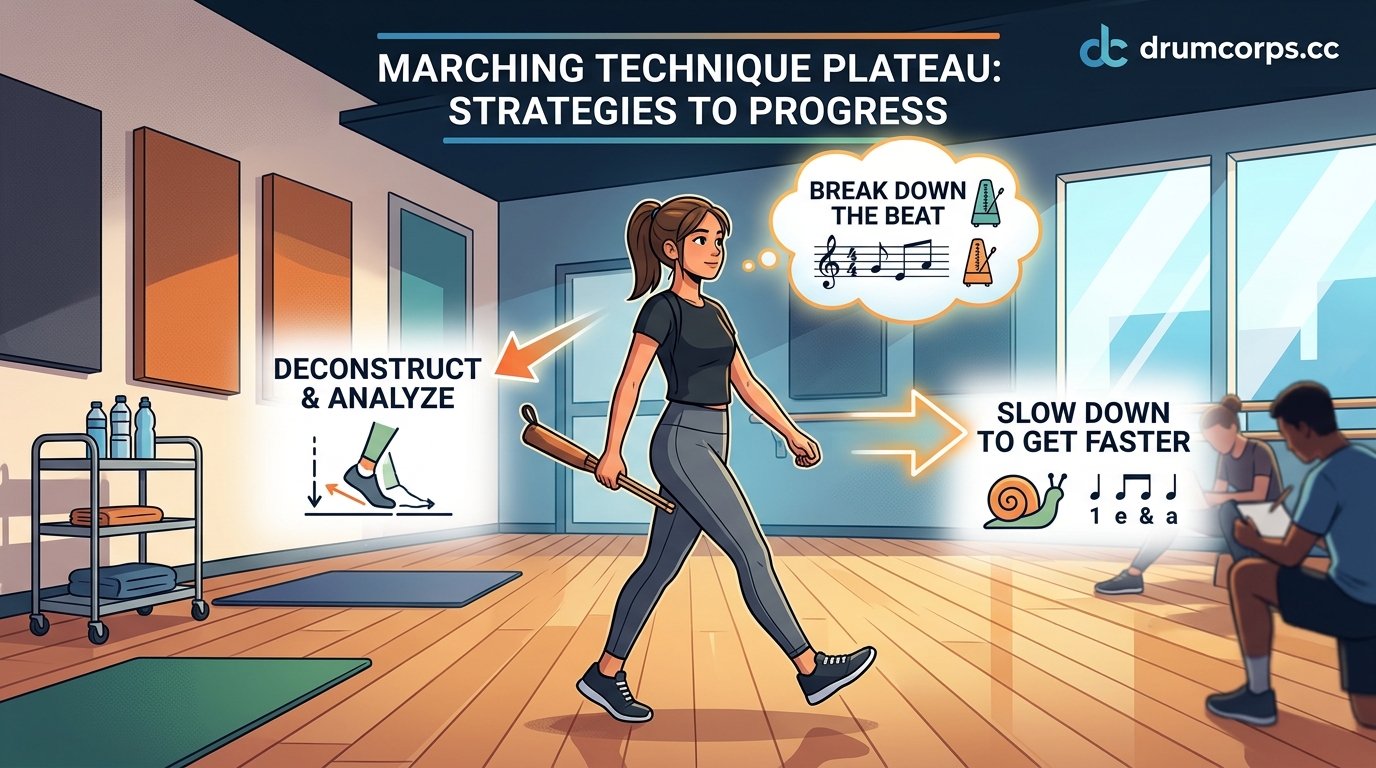
Most marchers think they know what their technique looks like. Then they watch video footage and realize their perception was completely off.
Set up your phone on a tripod or have a friend record you. Capture footage from the front, side, and back. March through a simple exercise you know well.
Watch the footage without sound first. Look for asymmetries. Does one shoulder drop? Does your upper body twist when you turn? Is your platform height consistent on both legs?
Compare your video to footage of corps members whose technique you admire. Don’t try to copy their style, but notice the fundamentals. How still is their upper body? How controlled is their leg motion? How does their foot contact the ground?
Make a list of three specific things you notice in your footage that need work. Not vague goals like “get better at backwards,” but concrete observations like “left knee doesn’t lift as high as right knee on backwards marching.”
Break down your weaknesses into isolated drills
Once you know what needs fixing, you can’t just keep running full show reps and hope it improves. You need targeted practice that isolates the problem.
If your platform height is inconsistent, spend ten minutes doing nothing but slow motion platform work in front of a mirror. No music. No drill. Just the mechanics.
If your upper body bobs when you march, practice walking around your house with a book balanced on your head. It sounds silly, but it works. Your core will learn to stabilize differently.
If your backwards marching feels shaky, try this drill. March backwards for eight counts, then freeze and hold your balance on one foot for four counts. Repeat. This builds the stability and control that backwards technique demands.
The goal isn’t to do these drills forever. The goal is to retrain specific movement patterns so they transfer back into your full marching.
“When you hit a wall in your technique, the answer is almost never to practice more of what you’re already doing. The answer is to practice differently. Find the one small thing that’s breaking down and rebuild it from scratch.” — Caption head, world class corps
Change your practice environment and timing
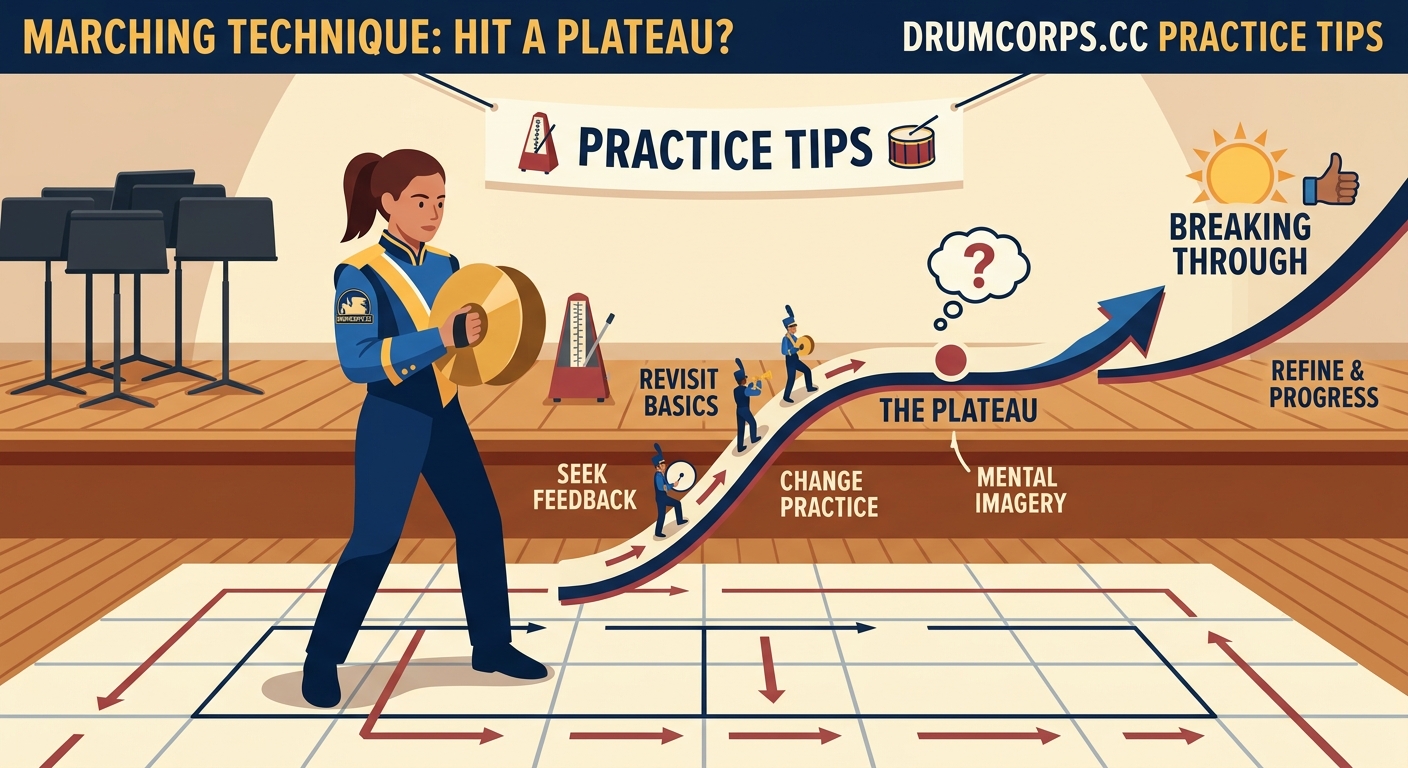
Your body adapts to the conditions you practice in. If you always march in the same parking lot at the same time of day, your technique becomes optimized for those exact conditions.
Try practicing at different times. Morning practice feels different than evening practice. Your body temperature, energy levels, and muscle tension all vary throughout the day.
Practice on different surfaces when possible. Grass, turf, asphalt, gym floors, each one gives you different feedback. A technique that works on soft grass might expose weaknesses on hard pavement.
March in different weather conditions during your individual practice time. Wind will test your balance. Heat will challenge your endurance. Cold will reveal tension you didn’t know you were carrying.
This variety forces your nervous system to adapt more broadly. Your technique becomes more robust instead of narrowly optimized.
Get feedback from someone who knows what to look for
Self-assessment only takes you so far. You need eyes that can spot things you’ll never notice on your own.
Ask your section leader or visual tech to watch you march for five minutes and give you one specific thing to fix. Not a list of ten problems. One thing.
If possible, take a lesson with a visual instructor from a different program. Fresh eyes catch different details. They might explain a concept in a way that finally clicks for you.
Consider filming yourself and posting it in online marching communities for feedback. Be specific about what you want help with. “Can someone critique my backward marching?” gets better responses than “How’s my technique?”
When you get feedback, don’t defend your current technique. Just listen. Write it down. Try implementing it even if it feels weird at first. Sometimes the thing that feels wrong is actually correct, and your body just needs time to adjust.
Study technique from different marching styles
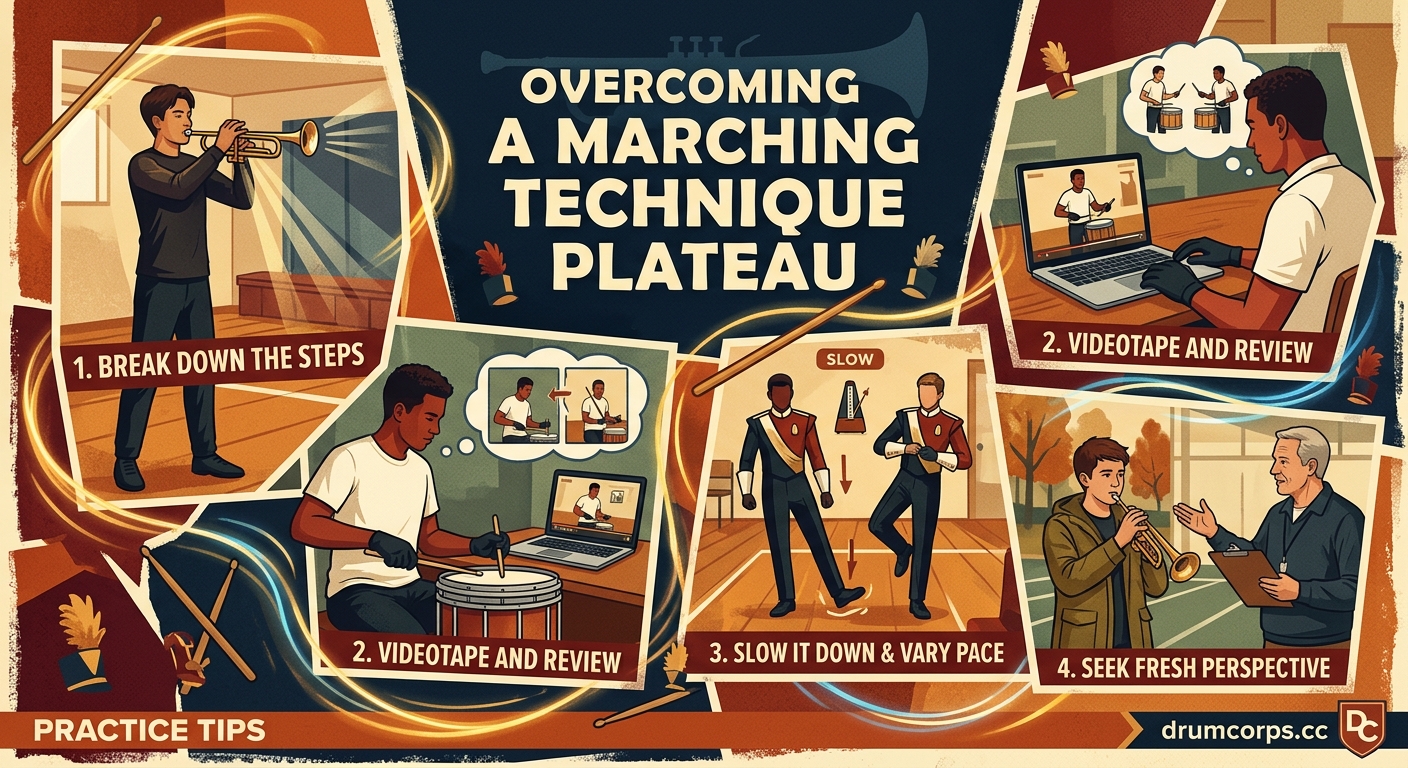
If you march in a traditional corps style program, watch some videos of groups that use different techniques. If your band uses a chair step, study footage of groups that use a roll step.
You’re not trying to change your fundamental technique. You’re looking for concepts that might transfer.
Maybe you’ll notice how certain groups emphasize weight transfer differently. Maybe you’ll see a drill that could help with a specific weakness you have.
Different styles evolved to solve different problems. Understanding those solutions can give you tools to fix your own sticking points. Learning how to fix your backward marching before your next competition often requires looking beyond your current approach.
Common plateau problems and their solutions
| Problem | What’s Actually Happening | Targeted Fix |
|---|---|---|
| Inconsistent platform height | One leg is stronger or more flexible than the other | Single leg balance drills, 30 seconds per side, twice daily |
| Upper body movement | Core isn’t engaged or shoulders are tense | Plank holds for time, march with resistance band around upper arms |
| Timing drift | Listening to others instead of internalizing pulse | Practice with metronome only, no ensemble sound |
| Shaky backwards | Weight too far forward, not trusting back leg | Backwards walking with exaggerated weight shift, eyes closed |
| Turn alignment issues | Head turns before or after body | Spot drills, freeze mid-turn and check alignment |
Build a 30-day reset plan
Breaking through a plateau requires sustained focus on specific goals. Random practice won’t cut it.
Here’s a framework you can adapt:
-
Week one is for assessment. Record yourself daily. Get feedback. Identify the single biggest weakness holding you back.
-
Week two is for isolation. Spend at least 15 minutes every day on drills that target only that weakness. Keep a practice journal. Note what feels different each day.
-
Week three is for integration. Start incorporating your improved movement back into full marching exercises. Go slowly. The goal is to maintain the improvement while adding complexity back in.
-
Week four is for testing. Record yourself again. Compare to week one footage. Get fresh feedback. Assess honestly whether the change stuck.
This cycle works because it gives each phase enough time to create real adaptation. Three days of focused practice won’t rewire your muscle memory. Three weeks can.
The structure also prevents you from jumping between different fixes every few days, which is one of the main reasons people stay stuck.
Rest and recovery matter more than you think
Sometimes a plateau isn’t about what you need to add to your practice. It’s about what you need to take away.
If you’ve been grinding hard for months without a break, your nervous system might be fried. Your muscles might be chronically tight. Your focus might be shot.
Take three full days off from marching. Not three days of light practice. Three days of nothing.
Stretch. Sleep extra. Do something completely unrelated to band. Let your body and brain reset.
When you come back, you might find that movements that felt stuck now feel easier. That’s not magic. That’s your nervous system finally having time to consolidate all the practice you’ve been doing.
Athletes in every sport use periodization and rest cycles to improve. Marchers should too. Building a perfect 30-minute individual practice routine includes knowing when not to practice at all.
Mental game adjustments that unlock physical progress
Your mindset during practice directly affects how much you improve. If you’re frustrated, tense, or mentally checked out, your reps are low quality.
Before each practice session, set one specific intention. Not “get better,” but something concrete like “keep my shoulders level during slide steps.”
During practice, narrate what you’re doing in your head. “Weight on left, push through platform, controlled landing.” This internal dialogue keeps your attention focused on technique instead of drifting.
After practice, write down one thing that felt better and one thing that still needs work. This reflection cements learning and keeps you from repeating the same mistakes mindlessly.
Treat every rep like it matters. Sloppy reps teach your body to be sloppy. Perfect practice doesn’t exist, but intentional practice does.
Signs you’re actually making progress
When you’re deep in a plateau, it’s hard to tell if your efforts are working. Here are signs that change is happening even if it doesn’t feel dramatic yet:
- Movements that used to require intense focus now feel more automatic
- You catch yourself making corrections mid-rep without thinking about it
- Your technique holds up better when you’re tired
- Feedback from instructors becomes more specific and detailed rather than addressing basic issues
- You can march and think about drill at the same time without technique falling apart
Progress isn’t always linear. You might feel worse before you feel better, especially if you’re rebuilding fundamental habits that were ingrained incorrectly.
Trust the process. Keep showing up. Keep being intentional.
What to do when nothing seems to work
If you’ve tried everything on this list for several weeks and you’re still stuck, it might be time to consider factors outside pure technique.
Are you getting enough sleep? Marching technique requires precise motor control, which degrades significantly when you’re sleep deprived.
Are you eating enough to fuel your activity level? Underfueling leads to poor recovery, which means your body can’t adapt to training stress.
Are you dealing with an injury you’re trying to push through? Pain changes your movement patterns. Fix the injury first, then rebuild technique.
Are you practicing with so much tension that you’re fighting yourself? Sometimes the fix is to relax, not to try harder.
Consider whether your plateau is actually technical or if it’s about performance anxiety, confidence, or mental blocks. Those require different solutions.
Why small improvements compound over time
You don’t need to make huge leaps to break through a plateau. You need to make small, consistent improvements that stack up over weeks and months.
A one percent improvement in platform consistency doesn’t sound impressive. But if you improve one percent every week for a season, you’re a different marcher by finals week.
The key is staying focused on process goals rather than outcome goals. You can’t control whether you make the top section or get a solo. You can control whether you do your isolated drills every day.
Focus on what you can control. The results will follow.
Moving forward with renewed purpose
Breaking through a marching band technique plateau isn’t about finding one magic drill or secret tip. It’s about approaching your practice with fresh eyes, honest self-assessment, and strategic focus.
Record yourself. Identify specific weaknesses. Practice them in isolation. Get feedback. Change your environment. Rest when needed. Stay intentional.
The plateau you’re experiencing right now is temporary. It’s not a ceiling. It’s a checkpoint. Your next level of performance is waiting on the other side of focused, intelligent work.
Get back out there and put in the reps that matter.