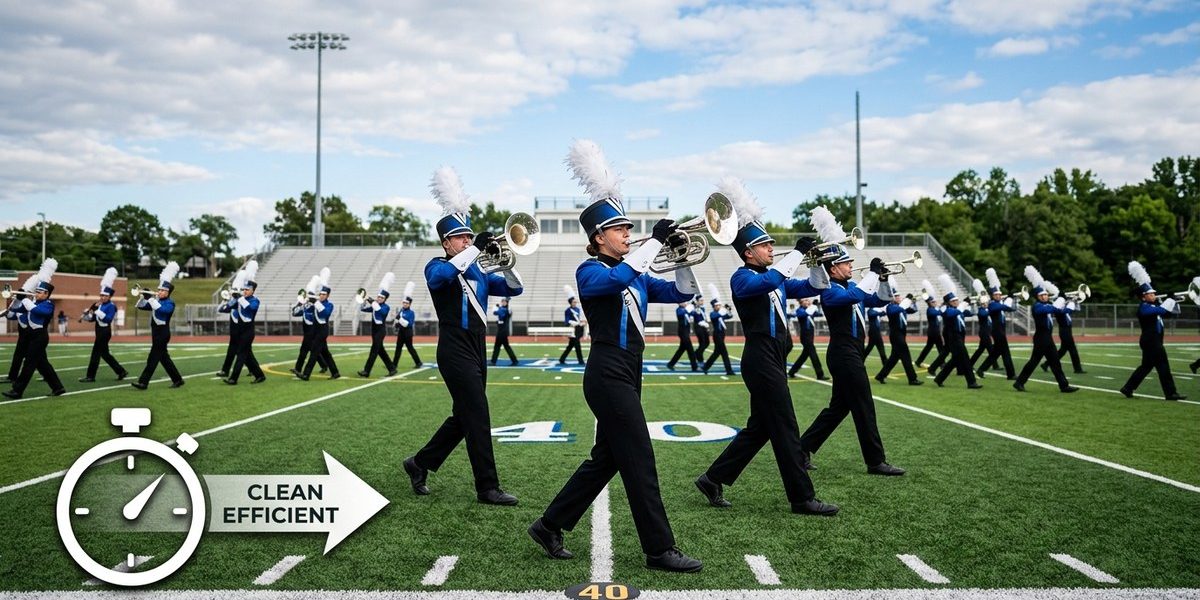
You are standing in front of your ensemble after a long rehearsal block. The music sounds good. The drill is memorized. But something feels off. The transitions are sloppy. The timing between the brass and the battery wavers. The visual moments that should land like a punch instead land like a wet sponge.
You have a show in three days and you are running out of rehearsal time.
This is the moment when most directors do the same thing: they run the show again from the top. They hope that repetition alone will sand down the rough edges. But repetition without intention does not clean a show. It just makes the mistakes more comfortable.
There is a better way. One drill trick that top drum corps have used for decades to transform a messy run into a polished performance. And it does not require more rehearsal hours. It requires smarter rehearsal focus.
The most efficient way to clean a show is not endless full runs. It is the “chunk and layer” method: isolate a short segment of drill and music, then layer in demands like tempo, dynamics, and visual precision one at a time. This builds muscle memory without wasting energy on parts that are already clean.
Why Full Runs Waste Your Rehearsal Time
Running a full show from start to finish feels productive. It gives everyone a sense of accomplishment. But it is one of the least efficient ways to clean a show in rehearsals.
Here is why: when you run the entire show, your performers spend most of their energy on parts they already know. The hard parts get a few seconds of attention each. The easy parts get minutes of unnecessary repetition. By the time you reach the moment that needs fixing, your performers are fatigued and less focused.
A study of deliberate practice in musical training shows that the most improvement happens when you target specific weaknesses in short, intense bursts. The same principle applies to cleaning a marching show.
Think of it like this: if you have a squeaky hinge on a door, you do not open and close the door fifty times hoping the squeak goes away. You oil the hinge. The “chunk and layer” method is your oil.
The One Drill Trick: Chunk and Layer
The trick is simple to describe but takes discipline to execute. Here is how it works in three steps.
Step 1: Identify the Problem Chunk
Walk through your show and find the eight to sixteen counts that consistently break down. It might be a transition between drill sets. It might be a musical passage where the ensemble splits. It might be the moment when the guard enters a new formation.
Do not guess. Watch a video from your last run or listen to a recording. Mark the exact count where things start to slip and the exact count where they recover.
Step 2: Isolate and Repeat
Take that chunk and run it alone. No lead in. No lead out. Just the problem segment. Repeat it five times in a row at half tempo. Then five times at three quarter tempo. Then five times at performance tempo.
Each repetition should have a specific goal. The first few reps are about accuracy. The next few are about consistency. The last few are about adding expression.
Step 3: Layer in the Demands
Once the chunk is clean in isolation, add one layer of demand at a time:
- Add the music at full dynamic range
- Add the visual precision (horn angles, foot placement, stick heights)
- Add the connection to the surrounding chunks
This is the “layer” part. You do not throw everything back together at once. You build it back up slowly.
Here is a table that shows common rehearsal mistakes and how the chunk and layer method fixes them.
| Common Mistake | Why It Happens | How Chunk and Layer Fixes It |
|---|---|---|
| Running the whole show repeatedly | Fatigue masks errors | Focuses energy on specific counts |
| Ignoring transitions | Transitions get less reps | Targets transitions as their own chunk |
| Playing at full volume too early | Bad habits get reinforced | Starts at half dynamic, builds up |
| Skipping visual checkpoints | Eyes are on music only | Adds visual demands one layer at a time |
| Stopping at every mistake | No momentum for clean parts | Only stops inside the problem chunk |
A Four Step Process to Clean Any Show
This process works for drum corps, marching bands, theater productions, and any live show with movement and music. It is the same method used by caption heads at the highest level of the activity.
-
Map your problem points. Watch a video of your last run. Write down the count ranges where the show falls apart. Be honest. Every ensemble has three to five spots that need work. Find them.
-
Prioritize by impact. Not all problems are equal. A moment where the entire ensemble is out of sync matters more than a single performer who is half a step late. Rank your chunks by how much they affect the overall impression of the show.
-
Apply the chunk and layer method to each problem. Spend ten minutes on each chunk. That is enough time for five to seven focused reps. Move to the next chunk only when the current one is clean at performance tempo.
-
Connect the cleaned chunks. Once you have cleaned three or four chunks, run them together in sequence. This builds the muscle memory for the transitions between them. Then add the next chunk.
“The difference between a good ensemble and a great one is not how many times they run the show. It is how precisely they target their weaknesses.” — Anonymous drum corps caption head
What to Clean First: A Priority List
When you are short on time, you need to know where to put your energy. Here is a bulleted list of what to clean first during any rehearsal.
- Entrances and exits. The first and last moments of any segment are what the audience remembers most. Make sure the first note of each phrase is together and the last visual shape is held with confidence.
- Tempo changes. Any shift in tempo is a risk point. Isolate the four counts before and after the change. Clean those until they feel automatic.
- Form changes. When the ensemble moves from one drill set to another, that is where visual errors appear. Clean the transition path, not just the arrival set.
- Dynamic peaks. The loudest moment of the show should also be the most together moment. If it is not, that chunk gets priority.
- Visual releases. The moment when performers finish a visual move and lock into a new position. If the release is ragged, the whole show looks sloppy.
Why This Method Works for Any Ensemble
You do not need a world class drum corps budget to use this method. It works for high school bands, community theater pit orchestras, and church worship teams. The principle is universal: focused repetition beats unfocused volume every time.
If you are a music director leading a school musical, you can apply this to the dance numbers. Find the eight counts where the cast is out of sync. Isolate that section. Run it without singing. Then add the vocals. Then add the staging. Layer by layer.
If you are a bandleader preparing for a concert, use the same idea on the horn section. Find the two bars where the brass and saxes clash. Play those two bars alone. Fix the voicing. Then add the rhythm section. Then add the dynamics.
The chunk and layer method adapts to any context because it respects the way human brains learn. We learn best in small, repeatable pieces with clear goals.
Common Mistakes When Using This Method
Even experienced directors make these errors when they first try to clean a show with chunk and layer.
- Trying to fix too many chunks in one rehearsal. Pick three problem spots max. Anything more and you spread your focus too thin.
- Skipping the half tempo step. Going straight to performance tempo defeats the purpose. Half tempo builds the neural pathways correctly.
- Not defining what “clean” means. Before you start a chunk, decide what success looks like. Is it all feet in the right place? Is it all notes in tune? Set a clear target.
- Moving on too soon. A chunk is not clean until it holds up under pressure. Run it three times in a row without error before you call it done.
A Sample 30 Minute Rehearsal Block
Here is how to structure a 30 minute block using the chunk and layer method. This is the kind of focused session that produces real results.
- Minutes 0 to 5: Watch video or listen to recording. Identify two problem chunks.
- Minutes 5 to 15: Work on chunk one. Start at half tempo. Add layers slowly.
- Minutes 15 to 25: Work on chunk two. Same process. Keep the energy high.
- Minutes 25 to 30: Run both chunks together at performance tempo. Evaluate.
If you have more than 30 minutes, add more chunks. But never work on more than five chunks in a single rehearsal. Your performers will retain more if you give them fewer things to master.
The Role of Mental Practice in Cleaning
Top performers do not only clean their shows on the field. They also clean them in their heads. Mental rehearsal is a proven technique for strengthening muscle memory without physical fatigue.
Ask your performers to close their eyes and run through a chunk in their minds. They should visualize every step, every note, every breath. This works especially well for visual moments where timing is critical.
If you want to add this to your rehearsal toolkit, check out our guide on how to build a perfect 30 minute individual practice routine. It includes mental rehearsal techniques that work for any performer.
How to Know When Your Show Is Clean
You will feel it before you see it. The transitions stop feeling like jumps and start feeling like flows. The ensemble breathes together. The visual moments land at the same instant across the entire group.
Here are the signs that your show is clean:
- You can run any eight count chunk at performance tempo without a single error
- The performers can play their parts while maintaining full visual precision
- The dynamics are clear and intentional, not accidental
- The transitions between chunks are invisible to the audience
When you reach this point, you are ready to add the polish. That means working on expression, nuance, and the subtle details that separate a good show from a great one.
The Final Step: Trust the Process
The chunk and layer method requires discipline. It is tempting to fall back into old habits and run the show from the top. But if you commit to this approach for even one week of rehearsals, you will see a measurable difference in your show quality.
Your performers will feel more confident because they know the hard parts are clean. Your audience will notice the difference even if they cannot name it. And you will stop wasting rehearsal time on parts that do not need it.
For more on how to structure your individual practice sessions around this method, read our article on effective practice routines to elevate your drum corps performance. It covers how to apply chunk and layer to your own warmups and fundamentals.
Turn Your Rehearsal Time Into Show Quality
You have the same number of rehearsal hours as every other director. The difference is in how you use them. The chunk and layer method is not a secret. It is a tool that has been used by the best in the activity for decades. Now it is your turn to put it to work.
Start your next rehearsal by identifying one problem chunk. Just one. Spend ten minutes cleaning it with focus and intention. Then watch what happens to the rest of your show. That one clean chunk will lift everything around it.
And when your ensemble steps onto the field or the stage for their next performance, they will feel the difference. So will your audience. That is the power of knowing how to clean a show in rehearsals the right way.