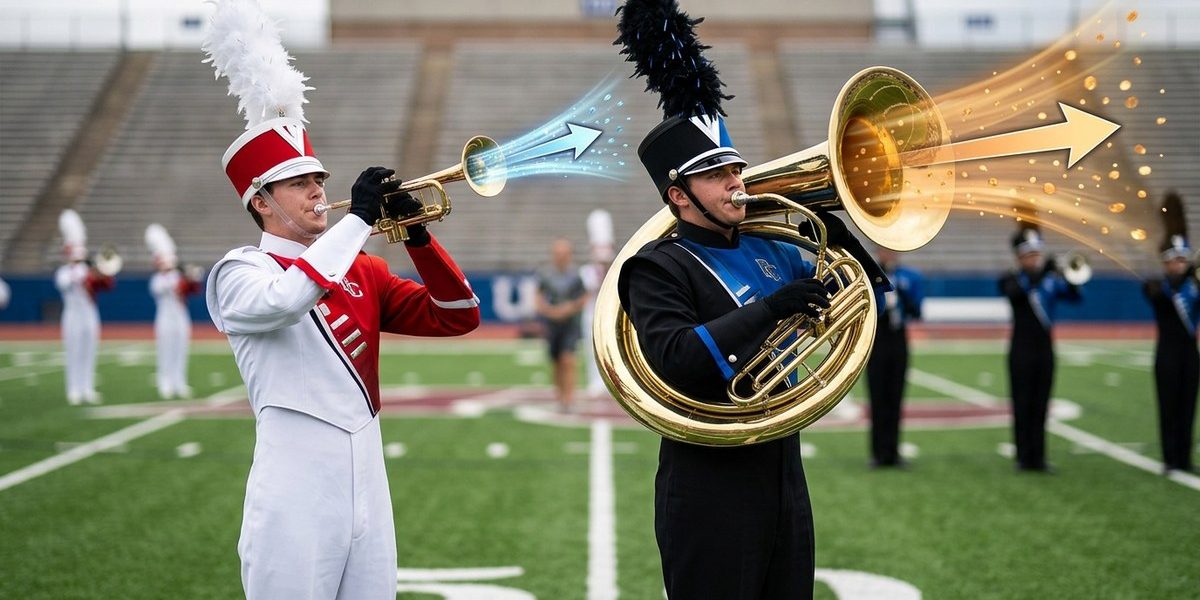
You pick up your horn during a hot July rehearsal. The show has a big hit coming in the closer, and you need to nail that high fortissimo note while marching backward at 160 beats per minute. You take a breath, you blow, and... the sound falls flat. Thin. Lacking the edge you need. You might be thinking you need more air. But what kind of air? This is where the confusion between air support and air speed causes problems for brass players at every level. They sound similar. They are not the same thing. And confusing the two can sabotage your tone, your intonation, and your endurance.
Air support is the steady, controlled pressure from your core that holds your sound together across long phrases. Air speed is how fast the air travels through the horn to produce specific pitches and dynamics. You need both to play well, but they serve different jobs. Support gives you stability. Speed gives you range and articulation. Master the separation of these two concepts, and your marching brass playing will level up noticeably.
Where Most Brass Players Get Confused
The problem starts in how we talk about breath. Directors yell "more air" during a loud passage. Then they yell "faster air" for a high note. The two commands blur together. A trumpet player hitting a double G might squeeze their abdomen tight and think they are using support, when really they are just holding their breath. A mellophone player trying to play soft across a long phrase might release all pressure, causing the pitch to sag.
Here is the simplest way to separate them in your head.
- Air support is the pressure behind the air. Think of it like the water pressure in a garden hose. The pressure stays constant whether you are spraying a flower bed or filling a bucket.
- Air speed is the velocity of the air leaving your lips. It changes based on the note you are playing, the volume you need, and the articulation style.
If you squeeze your throat or tighten your chest to get more support, you are actually restricting air speed. That is the number one reason players sound pinched on the field.
What Air Support Actually Does for You
Air support comes from your core. Your diaphragm, your intercostal muscles, and your abdominal wall work together to create a column of air that moves steadily through the instrument. This column does not wobble. It does not surge when you get nervous. It stays consistent.
- It stabilizes your pitch across all dynamics.
- It prevents your sound from thinning out on long phrases.
- It protects your embouchure from taking too much pressure.
"The best players I have ever taught sound effortless because their support never changes. Whether they are playing pianissimo or fortissimo, the foundation of their air is the same. The only thing that shifts is the speed at the aperture." * - Mark Lortz, brass caption head for multiple World Class corps*
Think of support as the anchor. It should feel the same when you play a low F on baritone as when you play a high Bb on trumpet. The muscles in your lower abdomen stay engaged. Your ribs stay expanded. You do not collapse your chest when you run out of air. You maintain the structure.
What Air Speed Actually Does for You
Air speed is what happens at the front of the airstream. When you tighten your embouchure to play higher, you create a smaller opening. Air has to move faster through that smaller space to keep the lips vibrating. If your air speed is too slow, the note cracks. If it is too fast, the pitch goes sharp and the tone turns brittle.
- Rising pitch requires more air speed.
- Loud dynamics require more air speed.
- Accented articulations require a burst of air speed at the start of the note.
Here is a table to help you see the difference in practice.
| Scenario | What You Need (Support) | What You Need (Speed) |
|---|---|---|
| Playing a sustained mezzo-forte in the middle register | Steady abdominal pressure, ribs open | Moderate air speed, consistent aperture |
| Marching a loud high passage in the closer | Core engaged, no chest collapse | High air speed, smaller lip opening |
| Soft ballad passage on low notes | Light but stable support, no fluttering | Slow air speed, relaxed aperture |
| Forte accent on a release point | Firm core push at the start | Fast burst, then immediate release |
| Playing after a long drill move | Support must stay active while moving | Speed adjusted on arrival |
Notice that support stays relatively constant while speed changes constantly.
A Step-by-Step Practice to Feel the Difference
You cannot think your way through this. You have to feel it. Here is a drill that brass techs use at camps across the country to teach players the separation between support and speed.
- Stand with good marching posture. Feet shoulder width apart. Shoulders down. Ribs lifted. Place one hand on your lower belly and one hand on your sternum.
- Inhale for four counts. Feel your lower belly expand outward. Your ribs should widen to the sides. Your shoulders should not rise.
- Exhale on a hiss for eight counts. Keep the hiss steady. The hand on your belly should feel gentle inward pressure. The hand on your sternum should stay still. This is support. It does not change.
- Buzz on the mouthpiece. Start on a comfortable pitch. Keep the same support you used for the hiss. Now bend the pitch upward slightly without changing your abdominal engagement. You just increased air speed while keeping support identical.
- Repeat on the horn. Play a middle G on trumpet or a middle Bb on baritone. Keep the same core support. Now play a C above it. The support stays. The speed increases.
Do this drill every day for a week. You will start to recognize the difference in your body.
Common Mistakes That Kill Your Sound
Players often mix up support and speed in ways that cause bad habits. Here are the most common ones.
- Pushing with the shoulders. When you try to play louder, you lift your shoulders and tighten your neck. This looks like effort but actually reduces air speed by clamping your throat.
- Squeezing the abs too hard. If your lower belly is rock solid and locked, you cannot move air. Support is active, not frozen.
- Blowing the lips apart. Faster air does not mean more air. Blowing too much volume makes your aperture spread and the pitch drops.
- Letting support drop during soft passages. Playing piano does not mean releasing your core. The support must stay up so the pitch does not sag.
If you struggle with any of these, the fix is usually the same. Return to the hiss drill. Rebuild the sensation of steady support. Then layer speed on top.
How Marching Changes the Equation
Standing still in a practice room is one thing. Marching a show is another. When you move, your body position changes. Your core has to work differently to maintain support. If you lean forward during a backward march, your abdominal engagement shifts. If you are holding a horn at carry position and then snap to playing position, your ribs may collapse.
Here is what to watch for in a marching context.
- During backward marching, keep your torso upright. Do not lean forward. Leaning forward relaxes the lower abs and weakens support.
- During high mark time, take your breath at the top of the step. Do not breathe while your knee is in the air. The impact on the ground can disrupt your air column.
- During long phrases with movement, use your exhale as part of the step. Time your support engagement with the downbeat so the air arrives with your foot plant.
You can practice this by doing the hiss drill while marching in place. Keep the hiss steady through eight counts of high mark time. If the hiss wavers, your support broke. Fix it before you add the horn.
When to Lean Into Each Skill
There are moments in a show that demand more of one than the other. Recognizing those moments helps you prepare.
- High impact moments. These need both. But the priority is speed. If your support is solid, you can add speed by focusing the aperture and increasing velocity without overblowing.
- Long melodic passages. These need support more than speed. You are sustaining notes across multiple measures. If support drops, your pitch sinks and your tone thins.
- Soft, exposed entrances. Support is critical here. Players often go too soft and lose the core. Keep the support active and let the speed be low.
- Fast technical runs. Speed at the lip changes rapidly. Support stays solid. Do not let the fast motion of your fingers cause your core to bounce.
If you are looking for more targeted exercises, check out this guide about 5 essential breathing exercises every brass player should master. It includes specific patterns that train support and speed separately.
The Most Effective Drill for Marching Brass
Of all the exercises you can do, one stands out for building the support-speed separation in a marching context. It comes from a former Blue Devils brass tech.
- Stand in a good marching posture.
- Inhale for two counts. Expand your belly and ribs.
- Exhale on a buzz for sixteen counts while walking forward at a moderate tempo.
- On count nine, change your buzz pitch upward by a third. Keep the same support.
- On count thirteen, change the buzz pitch back down. Keep the same support.
- The goal is to make the pitch change sound smooth while the core engagement never wavers.
This drill teaches you that speed can change on the fly while support remains a constant. That is the whole game.
How This Affects Your Endurance
One of the best side effects of understanding this difference is better endurance. Players who rely on mouthpiece pressure to play high notes fatigue quickly. Players who rely on air support and speed can play longer because their lips are not taking the abuse.
Faster air does the work that pressure used to do. Steady support gives your embouchure a reliable foundation instead of forcing it to compensate for weak airflow. If you struggle with chop endurance during the third movement of a show, look at your support first. Are you collapsing your ribs halfway through the phrase? Are you squeezing your abs too tight and cutting off your own air?
You might find it helpful to read about how to build rock-solid breath support for high brass endurance. That article goes deeper into the body positions that protect your playing stamina.
A Table of Signals That Tell You Which One Is Off
Sometimes you can hear the problem but cannot identify the cause. This table can help you diagnose yourself.
| What You Hear | Likely Culprit | What to Adjust |
|---|---|---|
| Pitch is flat, especially at the end of phrases | Support is dropping | Re-engage the lower abs, keep ribs open |
| Tone is thin and edgy | Speed is too high or support is too low | Back off the speed, add core pressure |
| Sound is airy and unfocused | Support is weak or speed is too slow | Firm up the core, increase velocity at the lip |
| Note cracks on the attack | Speed arrived late or support was not active | Start the phrase with support already engaged |
| Note goes sharp when you push volume | Speed increased but support did not stabilize | Keep the core steady while adding speed |
| Fatigue sets in quickly | Too much mouthpiece pressure | Rely on air speed, not lip clamp. |
Put This Into Your Routine
You do not need to overhaul your entire practice session. Just add one focused minute. Before you play anything warmup related, do twenty seconds of the hiss drill with marching posture. Then twenty seconds of mouthpiece buzzing with a pitch bend. Then twenty seconds of playing a simple scale while keeping your hand on your belly.
Within two weeks, you will hear a difference. Your tone will sound fuller. Your high notes will feel less forced. Your intonation will stabilize across the whole horn. And when your tech calls out "more air" during ensemble block, you will know exactly what kind of air they mean.
If you want to build a full practice that incorporates this work, take a look at how to build a perfect 30-minute individual practice routine. It includes warmup time for both air support and air speed exercises.
The One Thing to Remember on the Field
When you step onto that field, onto the grass, in the sun, with adrenaline pumping, your body will want to cheat. It will want to tense up. It will want to hold your breath. It will want to squeeze everything at once. The next time you feel that happening, take a breath and say one word to yourself.
Support.
Not speed. Not volume. Not high notes. Support. Get that anchor set. Then let the speed do its job. You will hit the release. You will hold the long note. And you will sound like a player who knows exactly what their air is doing.