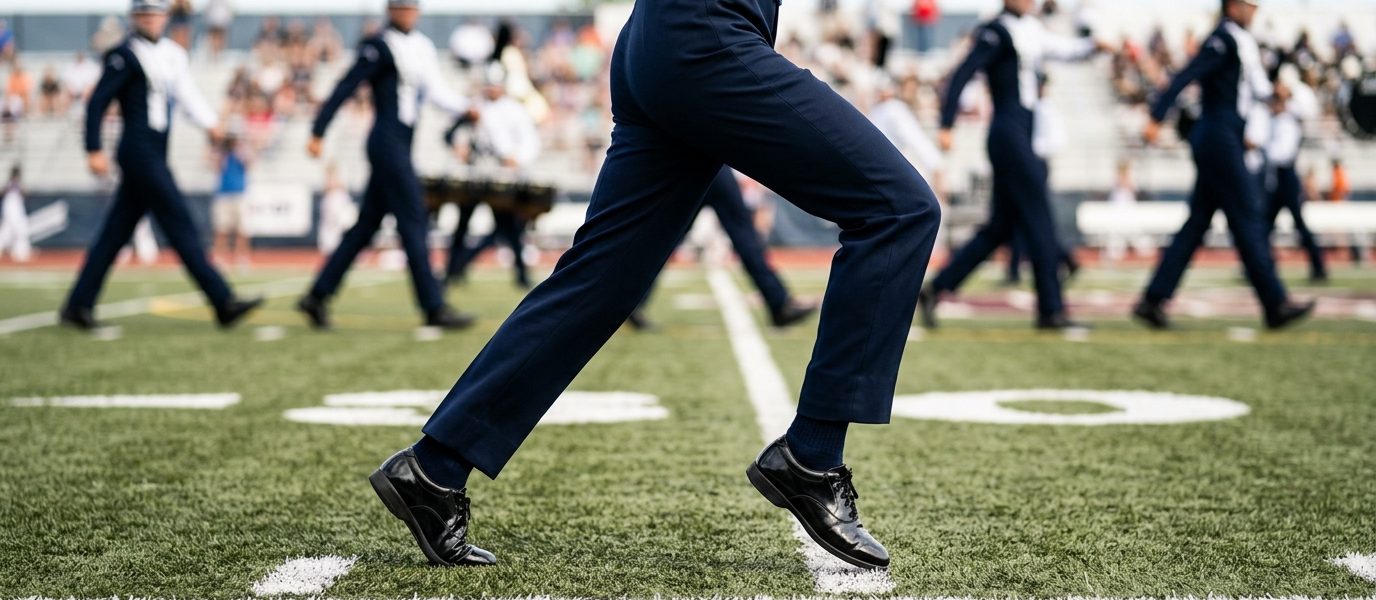
Your visual caption head calls a halt during block. She walks straight to you, points at your feet, and says nothing. Just points.
You know what that means.
Foot placement isn’t glamorous. Nobody watches drum corps videos on YouTube and says, “Wow, check out that heel placement!” But every visual instructor, every brass caption head, and every percussion tech will tell you the same thing: your feet are the foundation of everything you do on the field.
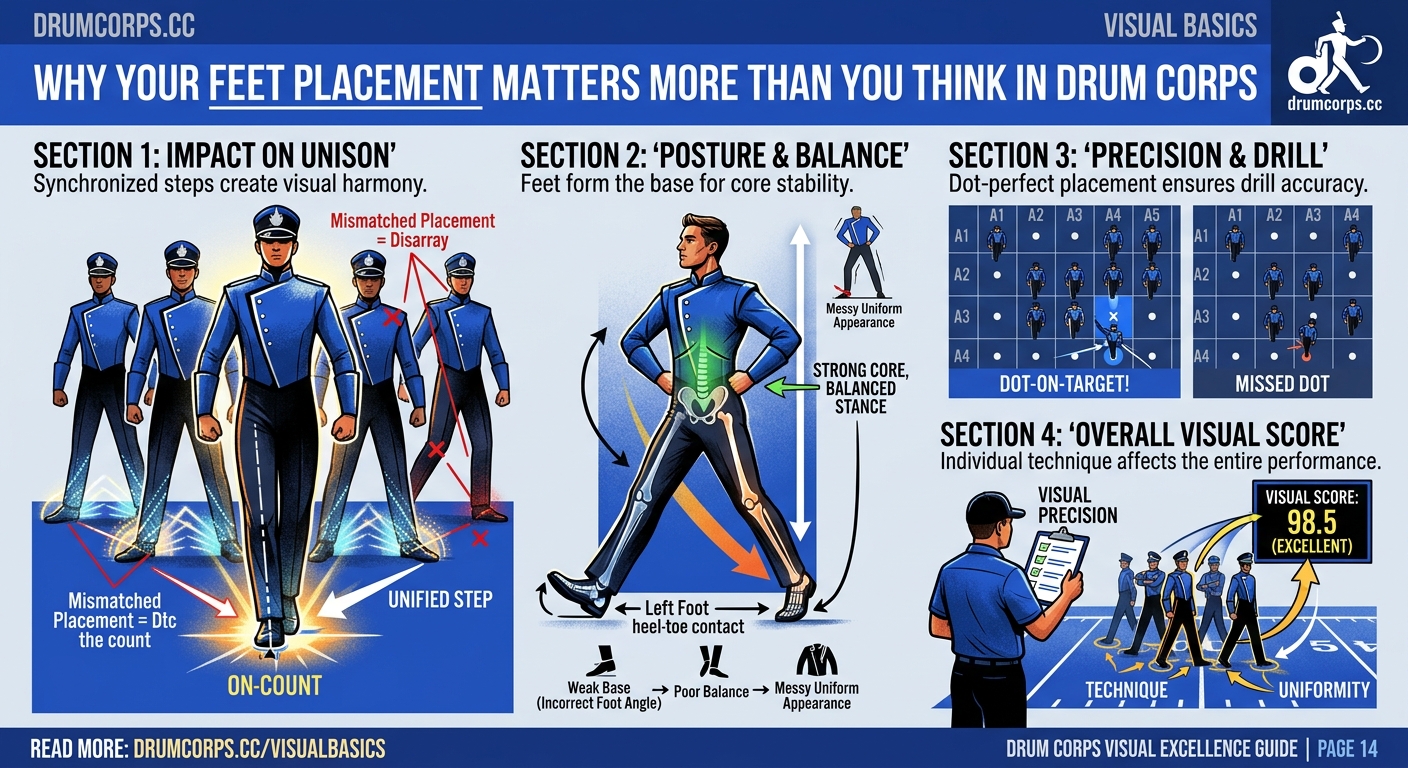
Proper drum corps foot placement creates stability for sound production, enables precise body control during movement, and prevents injury during long rehearsal blocks. Small adjustments in heel contact, toe angle, and weight distribution can transform your marching technique and boost your visual scores. Most marchers struggle with consistent platform because they never learned the biomechanics behind each step.
Why Your Feet Control Everything Above Them
Your feet are not just transportation. They are your anchor point for breath support, your stabilizer for horn angle, and your shock absorber for every step you take across turf, asphalt, and concrete.
When your feet hit the ground incorrectly, the impact travels up your legs, through your hips, into your core, and finally into your upper body. That wobble you see in your horn? That shake in your sound? That uneven shoulder line? It starts at your feet.
Brass players need a stable platform to maintain consistent air pressure. Percussionists need solid contact with the ground to control rebound and stick height. Color guard members need balanced foot placement to execute spins and tosses without drifting off their dot.
Your feet are the root of your entire performance system.
The Anatomy of Proper Drum Corps Foot Placement
Let’s break down what correct foot placement actually looks like. This isn’t about marching style or whether your corps uses straight leg or bent leg technique. This is about the universal principles that apply to every step you take.
Heel to Toe vs. Platform
Most modern drum corps teach a heel-first or full-platform technique. Here’s why:
Heel contact gives you a reference point. When your heel touches first, you know exactly where your foot is in space. This prevents you from slapping your whole foot down or landing toe-first, both of which create instability.
Platform contact means your entire foot connects with the ground almost simultaneously after the heel initiates. This distributes your weight evenly and gives you maximum stability for playing and moving.
Landing toe-first might feel faster, but it puts all your weight on the ball of your foot. That creates tension in your calves, reduces your balance, and makes it nearly impossible to control your upper body during fast tempo passages.
Weight Distribution
Your weight should sit slightly forward on your foot, around the ball, but your heel must stay in contact with the ground during the full duration of each count.
Think of your foot as a tripod: heel, ball, and toes. Remove one leg of that tripod and everything wobbles.
Many marchers make the mistake of lifting their heels too early during the step cycle. This shifts their weight backward, locks their knees, and destroys their forward momentum. Keep your heel down until the very last moment before your foot leaves the ground.
Toe Angle and Foot Direction
Your toes should point in the direction you’re moving. Sounds obvious, but you’d be surprised how many marchers let their feet splay outward or turn inward without realizing it.
Outward-pointing toes (duck feet) reduce your forward drive and make you look sloppy from the press box. Inward-pointing toes (pigeon toes) create hip tension and limit your stride length.
Check your toe angle in a mirror or film yourself marching. Your feet should track straight forward, parallel to each other, with toes pointing at your destination.
Common Foot Placement Mistakes That Kill Your Performance
Let’s talk about the errors that show up in almost every corps during spring training. These mistakes are easy to fix once you know what to look for.
| Mistake | What It Looks Like | Why It Hurts You |
|---|---|---|
| Slapping | Entire foot hits the ground at once with a loud smack | Creates bounce in your upper body, disrupts sound quality, looks uncontrolled |
| Toe-first landing | Ball of foot contacts before heel | Reduces stability, causes calf fatigue, makes backward marching nearly impossible |
| Heel lift during hold | Heel comes off the ground while standing on a count | Shifts weight backward, locks knees, creates visible wobble in horn angle |
| Wide base | Feet placed wider than hip width | Reduces mobility, makes you look stiff, limits your ability to change direction |
| Narrow base | Feet too close together | Destroys balance, makes you vulnerable to being bumped, creates upper body sway |
The slapping mistake is especially common with new members. They think landing the foot firmly means hitting it hard. Wrong. Firm means controlled. Hard means tense.
How to Build Better Foot Placement Through Targeted Drills
Fixing your foot placement requires deliberate practice. You can’t just think about it during a full run-through and expect change. You need focused drill time.
Here’s a progression that works:
-
Static platform holds. Stand in place with proper foot placement: heels down, weight slightly forward, toes straight. Hold for 30 seconds while playing a sustained note or executing stick work. Focus on feeling your entire foot in contact with the ground.
-
Slow motion stepping. Take individual steps at half tempo. Focus on heel contact, platform roll, and weight transfer. Your goal is to feel every phase of the step cycle without rushing.
-
Mirror marching. March in place in front of a mirror or film yourself. Watch your feet. Are your heels staying down? Are your toes pointing forward? Is your platform even?
-
Backwards technique work. Backward marching exposes foot placement errors instantly. If you can’t maintain heel contact and platform stability going backward, your forward technique has hidden flaws.
-
Integration with playing. Once your feet feel solid in isolation, add your instrument or equipment. The goal is to maintain foot discipline while your brain focuses on music or choreography.
These drills work because they isolate the problem. Most marchers never fix their feet because they’re always thinking about 10 other things at once. Give your feet dedicated attention and the improvement will carry over into full ensemble rehearsal.
If you’re struggling with backward technique specifically, the guide on how to fix your backward marching before your next competition breaks down the exact foot mechanics that make backward movement stable.
The Connection Between Foot Placement and Sound Quality
Here’s something most marchers don’t realize: your feet directly affect your sound.
When your feet hit the ground with proper technique, your body stays stable. Stable body means stable air column. Stable air column means consistent tone.
When your feet slap, bounce, or land unevenly, your torso moves. Moving torso means fluctuating air pressure. Fluctuating air pressure means wobbly sound.
Brass players, this is why your tone gets shaky during fast drill passages. Percussion, this is why your stick heights get inconsistent during high step sections. Your feet are creating movement that travels up your body and into your performance.
“The best marchers I’ve ever taught understood that their feet weren’t just moving them around the field. Their feet were the foundation for every note they played, every phrase they shaped, every visual moment they executed. Fix the feet, and everything else gets easier.” — Visual Caption Head, 2019 DCI Finalist Corps
The relationship between foot placement and breath support is especially critical for brass players. If you’re working on breathing technique, check out the breakdown of essential breathing exercises every brass player should master to see how proper support connects to your entire body position.
How Foot Placement Changes Across Different Marching Contexts
Not all marching is created equal. Your foot placement needs to adapt based on what you’re doing.
High step sections require more aggressive platform contact because you’re generating more impact force. Your heel needs to stay down even longer during the recovery phase to prevent your body from bouncing.
Roll step passages demand smoother weight transfer from heel to platform. The goal is to eliminate vertical movement, which means your foot contact must be precise and controlled.
Dance sections often involve more toe work and weight shifts, but the principles don’t change. Even when you’re on your toes for a visual moment, the transition back to platform must be clean.
Guard work requires exceptional foot placement because you’re managing equipment weight and tosses. Your feet need to be exactly where you think they are, or you’ll drift off your spot and miss your catch.
Understanding how body alignment supports all of these contexts helps tremendously. The drills in 5 body alignment drills that transform your marching posture show you how to connect your feet to your entire kinetic chain.
Fixing Foot Placement Under Fatigue
Everything feels easy when you’re fresh. The real test comes in hour three of a block, when your legs are tired and your brain is fried.
This is when foot placement falls apart for most marchers. Fatigue makes you lazy. Lazy feet means sloppy technique. Sloppy technique means visual deductions.
Here’s how to maintain discipline when you’re exhausted:
-
Focus on one step at a time. Don’t think about the next 64 counts. Think about the step you’re taking right now. Heel. Platform. Weight forward.
-
Use mental cues. Pick a simple phrase that reminds you of proper technique. “Heel down” or “platform solid” or whatever works for your brain. Repeat it silently during runs.
-
Check in during hold counts. Every time you hit a static moment, do a quick mental scan. Are your heels down? Is your weight forward? Are your toes straight? Make micro-adjustments before the next phrase starts.
-
Build endurance gradually. Your feet need conditioning just like your chops or your hands. Start with shorter blocks and build up. Your technique will hold longer as your stamina improves.
Fatigue management is part of the bigger picture of practice efficiency. If you’re looking to structure your individual work better, how to build a perfect 30-minute individual practice routine gives you a framework for getting more out of less time.
The Role of Footwear in Foot Placement Success
Your shoes matter more than you think.
Worn-out shoes with compressed heels make it nearly impossible to maintain proper platform contact. Shoes that are too big allow your foot to slide around inside, destroying your spatial awareness. Shoes that are too tight create pressure points that change how you distribute weight.
Check your marching shoes regularly:
- Heel compression. Press your thumb into the heel. If it collapses easily, the shoe has lost its support structure.
- Sole wear. Look at the bottom. Uneven wear patterns indicate foot placement problems.
- Fit. Your foot should feel secure without being squeezed. You need room for your toes to splay slightly on impact.
Replace your shoes before they completely fall apart. Trying to maintain good technique in dead shoes is like trying to play in tune on a broken horn.
Foot Placement for Different Sections
Each section faces unique foot placement challenges based on what they’re carrying and how they’re moving.
Brass players need to think about how their horn weight affects their center of gravity. A heavy contra or baritone pulls your upper body in a direction, which means your feet need to compensate by staying extra stable.
Battery percussion deals with equipment weight and rebound control. Your feet must stay planted during playing to give your hands a stable reference point. Any wobble in your platform shows up immediately in your stick work.
Front ensemble has the luxury of stationary playing, but during movement between equipment, foot placement becomes critical. You can’t afford to trip or stumble when you’re transitioning from marimba to vibes in 8 counts.
Color guard manages equipment tosses, spins, and catches while executing complex footwork. Your feet need to hit their marks precisely, or your entire body will be out of position for the next visual moment.
Measuring Your Foot Placement Progress
How do you know if you’re actually getting better?
Film yourself. Seriously. Set up your phone and record yourself marching through a passage that gives you trouble. Watch it back and look specifically at your feet.
Ask yourself:
- Do my heels contact first?
- Does my platform roll down smoothly?
- Are my heels staying down during holds?
- Are my toes pointing straight?
- Is my base width consistent?
Compare footage from week to week. The improvement should be visible. If it’s not, you’re not drilling the fundamentals enough.
You can also ask a section mate to watch you during block. Sometimes an outside eye catches things you can’t feel. Just make sure they know what to look for.
When Foot Placement Problems Signal Bigger Issues
Sometimes persistent foot placement problems aren’t about technique. They’re about underlying physical issues.
Ankle instability, hip tightness, knee problems, or flat feet can all make proper foot placement difficult or painful. If you’re doing everything right technically but still struggling, consider seeing a physical therapist or athletic trainer.
Don’t try to march through pain. That’s how minor issues become season-ending injuries.
Corps medical staff can often recommend exercises or supports that help you maintain proper technique while addressing the root cause. Take care of your body. You only get one.
Your Feet Are Your Foundation
Every great marcher understands this simple truth: you can’t build a solid performance on a shaky foundation.
Your feet are that foundation. They’re the first point of contact between your body and the field. They determine whether you’re stable or wobbly, controlled or chaotic, precise or sloppy.
The good news? Foot placement is completely within your control. You don’t need natural talent or perfect genetics. You just need awareness, discipline, and deliberate practice.
Start with one drill. Film one rep. Fix one mistake. Small improvements in your foot placement will ripple upward through your entire performance. Your sound will stabilize. Your visual will clean up. Your endurance will improve.
Your feet might not be the most exciting part of drum corps, but they’re absolutely essential. Give them the attention they deserve, and everything else will follow.