
The 2024 drum corps season brought unexpected news that sent ripples through the marching arts community. Three respected organizations announced they would consolidate operations, creating one of the most significant structural shifts the activity has seen in recent years. The decision surprised many fans who had followed these corps for decades, but the reasons behind the merger reveal broader trends affecting competitive drum corps across the country.
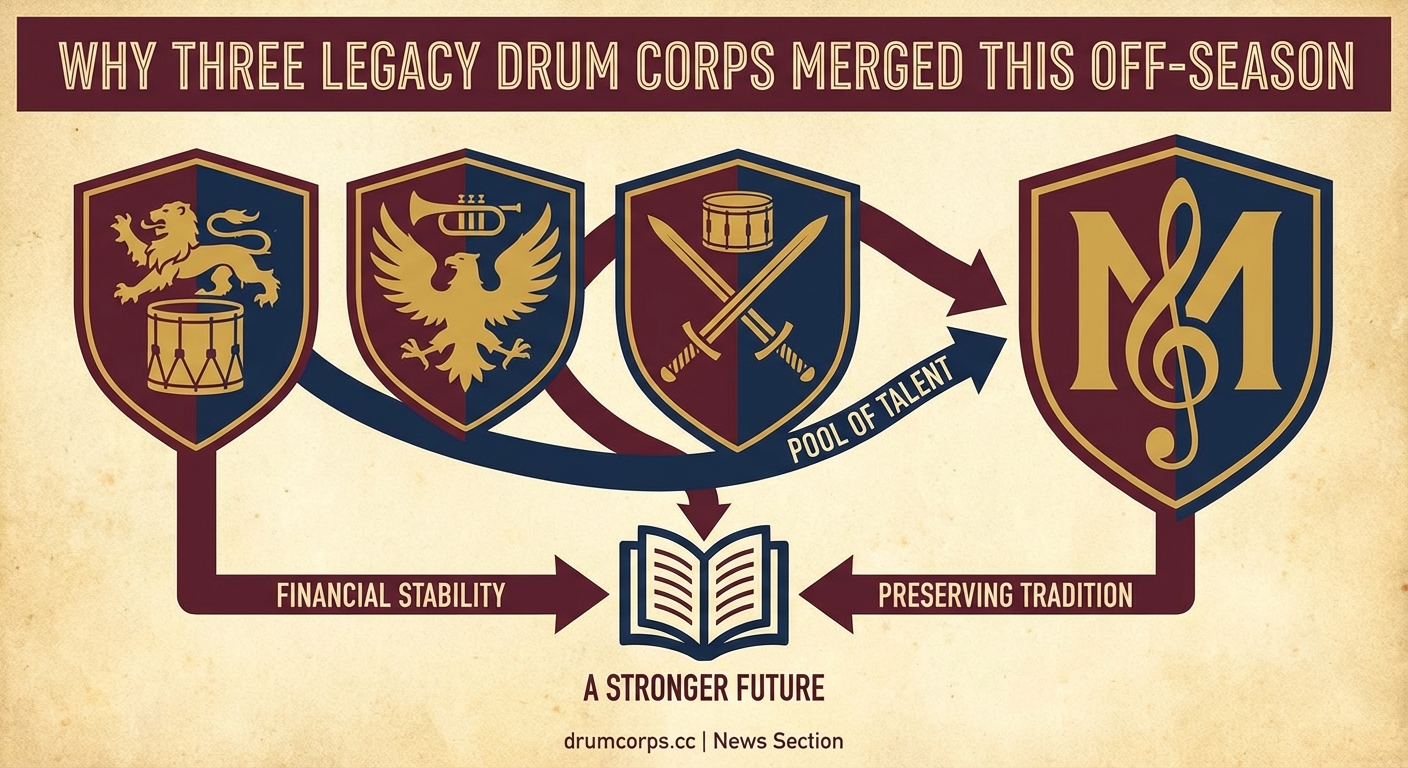
Three established drum corps merged during the 2024 off-season due to rising operational costs, declining membership numbers, and administrative challenges. The consolidation allows these organizations to pool resources, share expertise, and provide better opportunities for members while maintaining their legacy within the marching arts community. This merger reflects broader changes affecting many competitive drum corps nationwide.
Which corps merged and when did it happen
The merger involved three corps with deep roots in their respective regions. Each organization had competed at various levels of Drum Corps International for multiple seasons, building dedicated fan bases and alumni networks along the way.
The announcement came in late 2023, giving members and staff several months to process the change before the 2024 season began. This timeline allowed the newly formed organization to conduct auditions, hire instructional staff, and develop a unified creative vision.
The corps that merged were:
- A Midwest-based organization with 40 years of competitive history
- An East Coast corps known for innovative visual programs
- A Southern ensemble that had recently moved up competitive divisions
Each brought distinct strengths to the table. The Midwest corps had strong financial backing from a dedicated booster organization. The East Coast group featured an experienced design team with connections to top-tier instructors. The Southern corps had recently invested in new equipment and had access to excellent rehearsal facilities.
Why these organizations chose to consolidate
Financial pressures topped the list of reasons. Running a competitive drum corps costs significantly more now than it did even five years ago.
Transportation expenses have climbed dramatically. Fuel costs, vehicle maintenance, and insurance premiums all increased substantially. One corps director noted that their annual transportation budget had grown by 35% since 2019, even though they traveled roughly the same distances.
Equipment replacement represents another major expense. Brass instruments, marching percussion, sound systems, uniforms, and props all require regular updates. A single set of marching brass can cost over $100,000. Color guard equipment, flags, and tarps add tens of thousands more.
Staff compensation has rightfully increased as the activity has professionalized. Top instructors and designers command higher fees, and corps that want to remain competitive must pay market rates. Members also expect better amenities during tour, including quality food, comfortable transportation, and appropriate housing.
Recruitment challenges affected all three organizations. Fewer high school students participate in marching band programs compared to previous decades. Those who do march often face competing summer opportunities, from jobs to internships to family commitments. The pool of potential members has shrunk while the number of corps competing for those members has remained relatively stable.
The reality is that we were all chasing the same 50 kids in our region. By merging, we can offer something bigger and better than any of us could alone. We’re not giving up; we’re getting stronger.
Administrative burden also played a role. Each corps needed a board of directors, nonprofit compliance, insurance policies, and year-round operational staff. Consolidating these functions eliminated redundancy and freed up volunteer energy for member-focused activities.
How the merger process unfolded
The three organizations followed a structured approach to combining their operations. This careful planning helped ease the transition for everyone involved.
- Leadership from all three corps met privately for several months to assess compatibility and develop a framework for consolidation.
- Legal teams reviewed nonprofit status, assets, liabilities, and contractual obligations to ensure a clean merger.
- A joint announcement went out to members, alumni, and supporters explaining the decision and timeline.
- Town hall meetings gave stakeholders opportunities to ask questions and voice concerns about the change.
- A unified audition process launched, welcoming members from all three organizations plus new applicants.
- Design staff from each corps collaborated to create the first season’s program, blending their creative approaches.
- Financial systems, registration platforms, and communication channels were consolidated under one operational structure.
The merged organization kept elements from each predecessor. The new name incorporated references to all three corps. The uniform design featured color elements from each group. The show repertoire included musical selections that honored each corps’s history.
What members experienced during the transition
Current members faced the most immediate impact. Many had marched with their original corps for multiple seasons and felt strong loyalty to those organizations.
Some members embraced the change immediately. They recognized that a larger, better-funded organization could provide improved instruction, newer equipment, and more competitive opportunities. The prospect of marching with talented members from the other corps excited them.
Others struggled with the loss of their corps’s independent identity. They had joined specifically because of that organization’s culture, traditions, and community. Seeing those elements blend with two other groups felt like losing something important.
The instructional staff worked hard to honor all three legacies while building something new. They created rituals that acknowledged each corps’s history. They invited alumni from all three organizations to participate in events. They emphasized that the merger represented growth, not erasure.
| Challenge | Solution | Result |
|---|---|---|
| Members feeling disconnected from new identity | Created combined traditions honoring all three corps | Stronger sense of shared purpose |
| Uncertainty about staff roles and teaching styles | Held collaborative design meetings with input from all teams | Cohesive instructional approach |
| Financial concerns about increased fees | Leveraged combined resources to keep costs stable | More members could afford to participate |
| Questions about competitive placement and goals | Set clear performance benchmarks and communicated expectations | Unified focus on improvement |
Financial implications and sustainability
The merger created immediate cost savings. Instead of maintaining three sets of trucks, the combined organization needed fewer vehicles overall. Insurance policies covered one entity rather than three. Administrative software subscriptions dropped from three accounts to one.
Fundraising became more efficient. A larger organization with broader geographic reach attracted bigger sponsors. Corporate partners preferred working with one point of contact rather than coordinating with multiple small groups. Grant applications carried more weight when representing a larger membership base.
The combined alumni network proved valuable. Thousands of former members from all three corps now had a reason to stay engaged. Alumni donations increased because supporters felt they were investing in something with better long-term prospects.
However, the merger also created new expenses. Rebranding costs included new uniforms, updated equipment, and marketing materials. Legal fees for the consolidation process ran into five figures. Staff training to align teaching methods and administrative procedures required time and money.
The first season operated on a combined budget that exceeded what any single corps had spent previously but cost less than all three would have spent separately. This efficiency gain gave the organization breathing room to build reserves and plan for future growth.
Impact on the broader drum corps community
The merger sent a clear message to other struggling organizations. Consolidation represents a viable path forward when independent operation becomes unsustainable.
Several other corps reached out to learn about the process. Some were considering similar mergers in their regions. Others wanted to understand whether they faced the same pressures and how to address them proactively.
Drum Corps International acknowledged the trend. The organization has seen multiple mergers, dissolutions, and reorganizations in recent years. While DCI wants a healthy number of competitive corps, leadership recognizes that financial reality sometimes requires difficult decisions.
Fans had mixed reactions. Some mourned the loss of three distinct competitive voices. Others appreciated that the merger kept those programs alive in a new form rather than seeing them fold entirely.
The merged corps finished its first season with respectable scores and positive member feedback. The organization met its recruitment goals for the following year, suggesting that the consolidation achieved its intended effect.
Lessons for other organizations considering merger
Corps facing similar challenges can learn from this experience. Not every merger succeeds, but certain practices increase the likelihood of positive outcomes.
Start conversations early, before financial crisis forces hasty decisions. Organizations that merge from a position of relative strength have more negotiating flexibility and can plan more carefully.
Prioritize cultural compatibility. Financial alignment matters, but shared values and teaching philosophies matter more. Members will struggle if the merged organization feels like a forced combination of incompatible groups.
Communicate transparently with all stakeholders. Rumors and speculation create anxiety. Regular updates, honest assessments, and opportunities for input help people adjust to major changes.
Preserve what matters most from each organization. Names and logos may change, but core values, teaching approaches, and community connections can continue in new forms.
Honor the grief that comes with loss. Even positive changes involve letting go of something meaningful. Acknowledging that emotional reality helps people move forward.
These principles apply beyond drum corps. Any volunteer organization facing sustainability challenges can benefit from considering whether consolidation might strengthen rather than weaken their mission.
What this means for the future of drum corps
The 2024 merger represents part of a larger evolution in the marching arts. The activity looks different now than it did 20 or 30 years ago, and it will continue changing.
Fewer corps may compete at the highest levels, but those organizations will likely be stronger and more sustainable. Regional and lower-division corps will continue providing valuable experiences for members who want to participate without the intense commitment required by top groups.
Technology will play a growing role. Virtual auditions, online rehearsals during the off-season, and digital collaboration tools make it easier for geographically dispersed organizations to function effectively.
The member experience will remain central. Whatever structural changes occur, successful corps will focus on providing excellent instruction, meaningful performance opportunities, and supportive communities for young people.
Alumni engagement will become increasingly important. As operational costs rise, corps need strong fundraising networks. Former members who had positive experiences represent the most reliable donor base.
Moving forward together
The three corps that merged in 2024 made a bold choice. They could have continued operating independently, gradually declining until they could no longer field competitive ensembles. Instead, they chose to combine their strengths and build something new.
Their first season demonstrated that merger can work when organizations approach it thoughtfully. Members received quality instruction, performed well, and reported positive experiences. The organization finished the season financially stable and ready to grow.
Other corps watching this experiment now have a model to consider. Consolidation isn’t the right answer for every organization, but it deserves serious consideration when independence threatens long-term sustainability.
The marching arts community benefits when organizations make hard decisions that prioritize member experience over institutional ego. The drum corps merged 2024 story shows that change, while difficult, can lead to stronger outcomes for everyone involved.
For fans, members, and supporters of these three corps, the merger represents both an ending and a beginning. The organizations they knew have transformed into something different. That new entity carries forward the best elements of its predecessors while creating space for fresh traditions and achievements. Time will tell whether this consolidation becomes a template for others, but the early results suggest that thoughtful merger can preserve legacy while building a sustainable future.