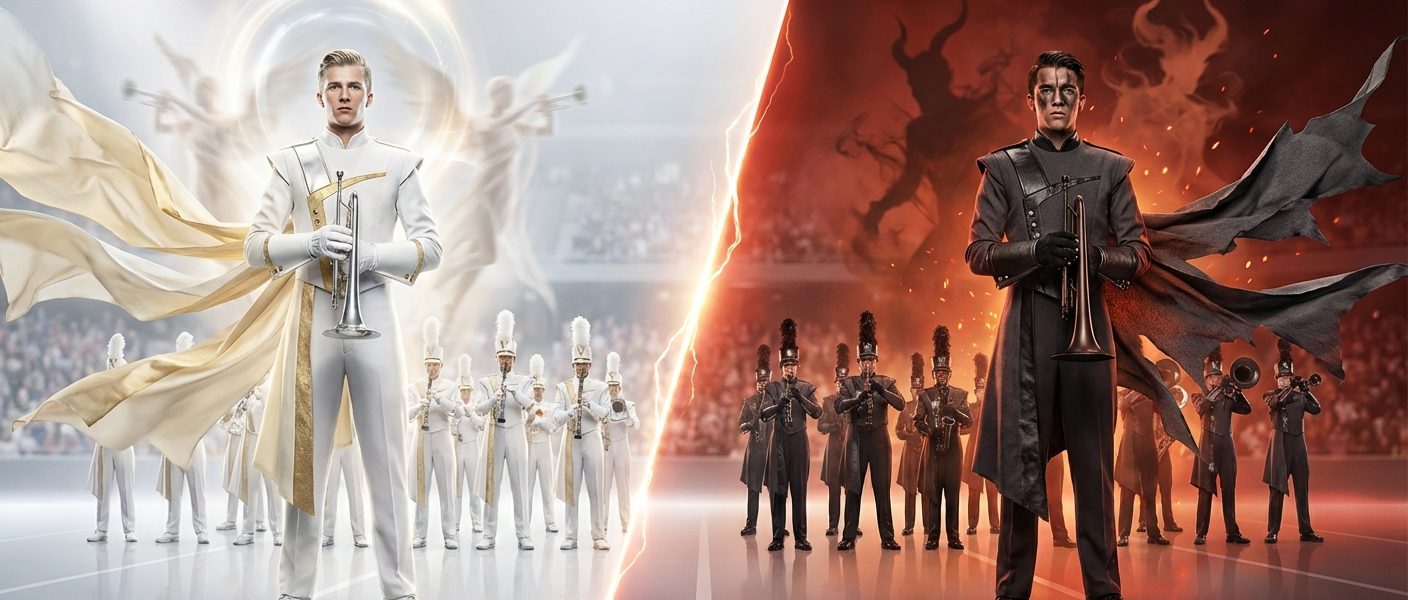
The Cadets walked onto the field in 2011 with a show that split the marching arts world in half. Between Angels and Demons wasn’t just a production about good versus evil. It was a visceral experience that forced audiences to choose sides, feel discomfort, and witness one of the most technically demanding programs ever staged on a football field.
The Cadets 2011 Between Angels and Demons remains a landmark drum corps production because it married extreme thematic contrast with groundbreaking visual design and relentless technical execution. The show divided the field into heaven and hell, featured asymmetrical drill that broke traditional staging rules, and pushed performers to embody two opposing emotional states within a single eleven-minute program. Its influence still echoes in modern competitive design.
What Made the Show’s Concept So Radical
Most drum corps shows build toward a single emotional climax. Between Angels and Demons threw that formula out entirely.
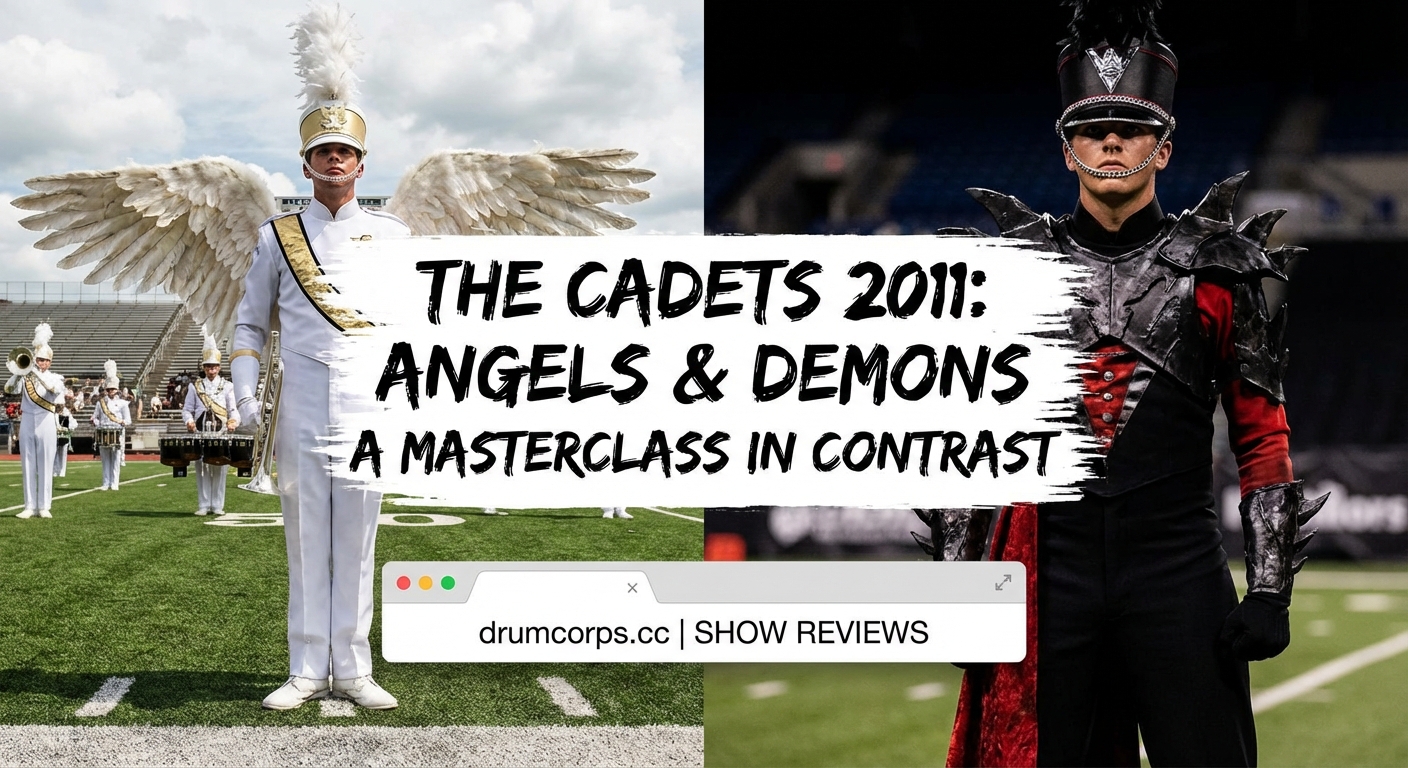
The Cadets created two distinct worlds on the same field. One side represented purity, light, and order. The other embodied chaos, darkness, and rebellion. The corps members wore split uniforms. Half the ensemble dressed in white with angelic imagery. The other half wore black with demonic accents.
This wasn’t subtle. The show forced you to see the division.
The musical selections reinforced the split. Angelic moments featured Mozart’s Requiem and Samuel Barber’s Agnus Dei. The demonic sections pulled from Mussorgsky’s Night on Bald Mountain and Stravinsky’s The Rite of Spring. The arrangers didn’t blend these pieces. They smashed them together.
The result was jarring. That was the point.
How the Visual Design Broke Convention
Traditional drum corps drill relies on symmetry. Formations mirror across the 50-yard line. Balance creates beauty.
George Hopkins and the design team rejected that completely.
Between Angels and Demons used asymmetrical staging throughout. The angelic side would form clean geometric shapes while the demonic side spiraled into chaos. Sometimes the two halves would march toward each other in aggressive confrontation. Other times they’d ignore each other entirely, creating uncomfortable negative space.
The drill also featured what became known as “the wall.” At multiple points in the show, one half of the corps would form a solid vertical line down the center of the field. This physical barrier separated the two factions. Members would reach across it, push against it, and eventually break through it.
This staging choice created genuine tension. You couldn’t watch both sides at once. Your eye had to choose.
The Technical Demands That Pushed Performers to Their Limits
Between Angels and Demons wasn’t just conceptually ambitious. It was brutally difficult to execute.
The brass book required players to shift between lyrical, sustained passages and aggressive, rhythmic attacks within seconds. The angelic sections demanded absolute control and blend. The demonic sections required raw power and precision at extreme tempos.
The battery faced similar challenges. The snare line had to maintain clean, traditional rudimental passages during angelic moments, then switch to guttural, driving rhythms for the demonic sections. The tempo changes were constant. The dynamic contrasts were extreme.
Here’s what made the show physically exhausting:
- Members had to maintain two distinct performance personas throughout the entire program
- The drill included extended backward marching sequences at high speeds
- Costume elements added weight and restricted movement compared to standard uniforms
- The emotional intensity required constant facial expression changes and body language shifts
- Several sections demanded full-volume playing while executing complex drill maneuvers
The color guard had to embody both characters as well. Some members portrayed angels with flowing, graceful movement. Others became demons with sharp, aggressive choreography. The contrast had to be visible from the press box.
Breaking Down the Show’s Three-Act Structure
Between Angels and Demons followed a clear narrative arc, even though it avoided traditional storytelling.
Act One: Separation
The show opened with the corps divided. Angels entered from one side, demons from the other. The opening statement established the musical and visual vocabulary for each faction. The two groups acknowledged each other but maintained distance.
Act Two: Confrontation
The middle section brought the two sides into direct conflict. The wall formations appeared here. Members from opposing sides would reach toward each other, creating moments of tension without resolution. The music became more dissonant. The drill patterns overlapped and intersected.
Act Three: Integration
The final movement didn’t resolve the conflict with a clear winner. Instead, the two sides began to blend. Angels and demons marched together in mixed formations. The music wove together previously separate themes. The ending left the audience with ambiguity rather than closure.
This structure worked because it respected the intelligence of the audience. It didn’t spell out a moral lesson.
The Competitive Impact and Scoring Breakdown
Between Angels and Demons placed second at the 2011 DCI World Championships with a score of 97.65. The Cadets lost to the Bluedevils by less than a point.
The judges’ sheets revealed interesting patterns. The show scored exceptionally high in visual proficiency and brass performance. The general effect captions showed more variation. Some judges loved the thematic risk. Others found the asymmetry unsettling.
| Caption | Strength | Challenge |
|---|---|---|
| Brass | Extreme dynamic range and tonal control | Maintaining blend during aggressive passages |
| Visual Performance | Commitment to dual character portrayal | Synchronization across divided formations |
| Color Guard | Distinct movement vocabularies for each faction | Visibility during asymmetrical staging |
| Percussion | Technical cleanliness at all tempos | Battery balance during tempo transitions |
| General Effect | Bold thematic concept | Polarizing audience reception |
The scoring controversy that year centered on whether innovation should outweigh execution. Some felt the Cadets took bigger risks and deserved higher effect scores. Others argued the Bluedevils’ cleaner execution and more cohesive design earned the win.
Both perspectives had merit.
Why the Show Still Influences Modern Design
You can trace a direct line from Between Angels and Demons to shows that followed. The willingness to abandon symmetry opened doors for future designers.
How Bluecoats 2014 ‘Tilt’ Redefined Modern Drum Corps Design built on the asymmetrical staging concepts the Cadets pioneered. The idea that a field doesn’t need to balance visually became acceptable.
The show also proved that audiences could handle discomfort. Modern drum corps productions regularly feature disturbing imagery, unresolved narratives, and challenging musical content. Between Angels and Demons demonstrated that the marching arts audience was ready for more sophisticated storytelling.
The technical standards set by the 2011 Cadets also raised the bar across the activity. Corps realized they needed to develop stronger performance training alongside musical and visual technique. The idea that members should be actors as well as musicians became standard.
Lessons for Today’s Performers and Designers
Between Angels and Demons offers specific takeaways for anyone involved in competitive marching arts.
For Performers:
- Develop a clear character before you step on the field
- Practice facial expressions and body language as much as your musical technique
- Commit fully to uncomfortable or unusual staging choices
- Maintain technical precision even when the drill feels chaotic
- Trust that the audience will follow bold creative choices
For Designers:
- Don’t be afraid to abandon traditional staging rules if the concept demands it
- Use negative space and asymmetry as deliberate design tools
- Give performers specific character motivations, not just drill coordinates
- Build musical arrangements that serve the visual concept
- Accept that polarizing some audience members means you’ve created something memorable
The best drum corps shows don’t try to please everyone. They commit to a specific vision and execute it with absolute conviction. Between Angels and Demons succeeded because every element reinforced the central concept, even when that concept made people uncomfortable.
The show also demonstrated the value of rehearsal focus. The Cadets didn’t achieve that level of character commitment by accident. They spent months developing the performance elements alongside the technical components. Members practiced transitioning between angelic and demonic personas until it became second nature.
This approach requires time and intentional coaching. But the results speak for themselves.
The Cultural Moment That Made the Show Possible
Between Angels and Demons appeared at a specific moment in drum corps history. The activity was transitioning from traditional military-style presentations toward theatrical production values.
Earlier shows had experimented with narrative elements, but most still maintained visual symmetry and clear musical themes. The 2011 Cadets pushed further into theatrical territory than any previous production.
The timing mattered. Audiences had grown accustomed to more complex staging through shows in the late 2000s. The technical abilities of performers had also increased dramatically. What would have been impossible to execute cleanly a decade earlier became achievable.
The show also benefited from the Cadets’ reputation. The corps had the credibility to take major risks. A less established organization might have faced more resistance from judges and audiences.
Technical Elements That Made the Concept Work
The show’s success depended on specific technical choices that supported the thematic concept.
The lighting design played a crucial role. The Cadets used handheld lights and strategic positioning to create stark contrasts. Angelic sections featured bright, even illumination. Demonic moments used shadowy, dramatic lighting that emphasized the aggressive staging.
The prop design remained minimal. The show didn’t rely on large set pieces. This kept the focus on the performers and their divided presentation. The few props that appeared reinforced the heaven and hell imagery without overwhelming the field.
The uniform design integrated seamlessly with the drill. The split costumes made the division visible from any angle. Even when formations mixed angels and demons, the audience could track which performers represented which faction.
The sound design also contributed. The brass arrangements used spatial positioning to create stereo effects. Angelic themes would emanate from one side of the field while demonic passages came from the other. This audio separation reinforced the visual split.
How to Study the Show Today
Between Angels and Demons remains accessible for anyone who wants to understand its impact.
Multiple video recordings exist online, including the DCI championship performance. Watching the show multiple times reveals details that aren’t obvious on first viewing. Pay attention to individual performers rather than just the overall formations. Notice how members maintain character even during drill transitions.
The brass and percussion arrangements are available through various educational resources. Studying the actual music reveals how the arrangers created the contrast between sections. The dynamic markings and articulation choices show the technical demands performers faced.
Some members from the 2011 Cadets have shared their experiences through interviews and social media posts. These firsthand accounts provide insight into the rehearsal process and the challenges of bringing the concept to life.
For current performers looking to improve their own skills, the show offers specific lessons. Working on character development and emotional commitment will benefit any marching arts participant. How to build a perfect 30-minute individual practice routine can help you develop the technical foundation needed for demanding shows.
What the Show Teaches About Creative Risk
Between Angels and Demons succeeded because the design team committed fully to their vision. They didn’t hedge their bets or soften the concept to make it more palatable.
This approach carries risk. The show could have failed spectacularly. The asymmetrical staging might have read as messy rather than intentional. The thematic split could have felt gimmicky instead of meaningful.
The difference between success and failure came down to execution. Every element of the production reinforced the central concept. The music, drill, uniforms, and performance all pointed in the same direction.
This level of cohesion requires clear communication from the design team and total buy-in from the performers. Everyone involved has to understand not just what they’re doing, but why they’re doing it.
Modern productions continue to grapple with this balance. DCI announces major rule changes for the 2025 competitive season shows how the activity keeps evolving, but the fundamental lesson remains the same. Bold concepts only work when every detail supports the vision.
Why This Show Still Matters
Between Angels and Demons proved that drum corps could be genuinely theatrical without sacrificing technical excellence. It showed that audiences would embrace challenging concepts if the execution justified the ambition.
The show’s influence extends beyond specific design choices. It changed how designers think about field coverage, character development, and thematic consistency. It raised the bar for what counts as a complete production.
For performers, the show demonstrated that emotional commitment matters as much as technical precision. The 2011 Cadets members didn’t just play their parts and march their drill. They inhabited two distinct characters and made the audience believe in both.
That level of performance doesn’t happen by accident. It requires dedicated training, clear artistic direction, and a willingness to push past comfortable boundaries. The technical demands alone would challenge any corps. Adding the performance element made it even harder.
But that’s what makes Between Angels and Demons worth studying more than a decade later. It represents what’s possible when a design team has a clear vision and the performers have the skill to bring it to life. The show didn’t win the championship, but it changed what people thought drum corps could be.
That legacy continues every time a corps takes a creative risk or stages asymmetrical drill or asks performers to embody a specific character. Between Angels and Demons opened those doors.